February 5, 2026
An Art Deco poster is so much more than a piece of paper. It’s a portal, a direct line to an era defined by glamour, speed, and an almost reckless sense of optimism. These are cultural artifacts born from the electric energy of the roaring 1920s and 30s, capturing the very spirit of modernity in their bold lines and elegant forms. Their appeal has lasted for a century because they manage to be both beautifully decorative and deeply historic, all at once.
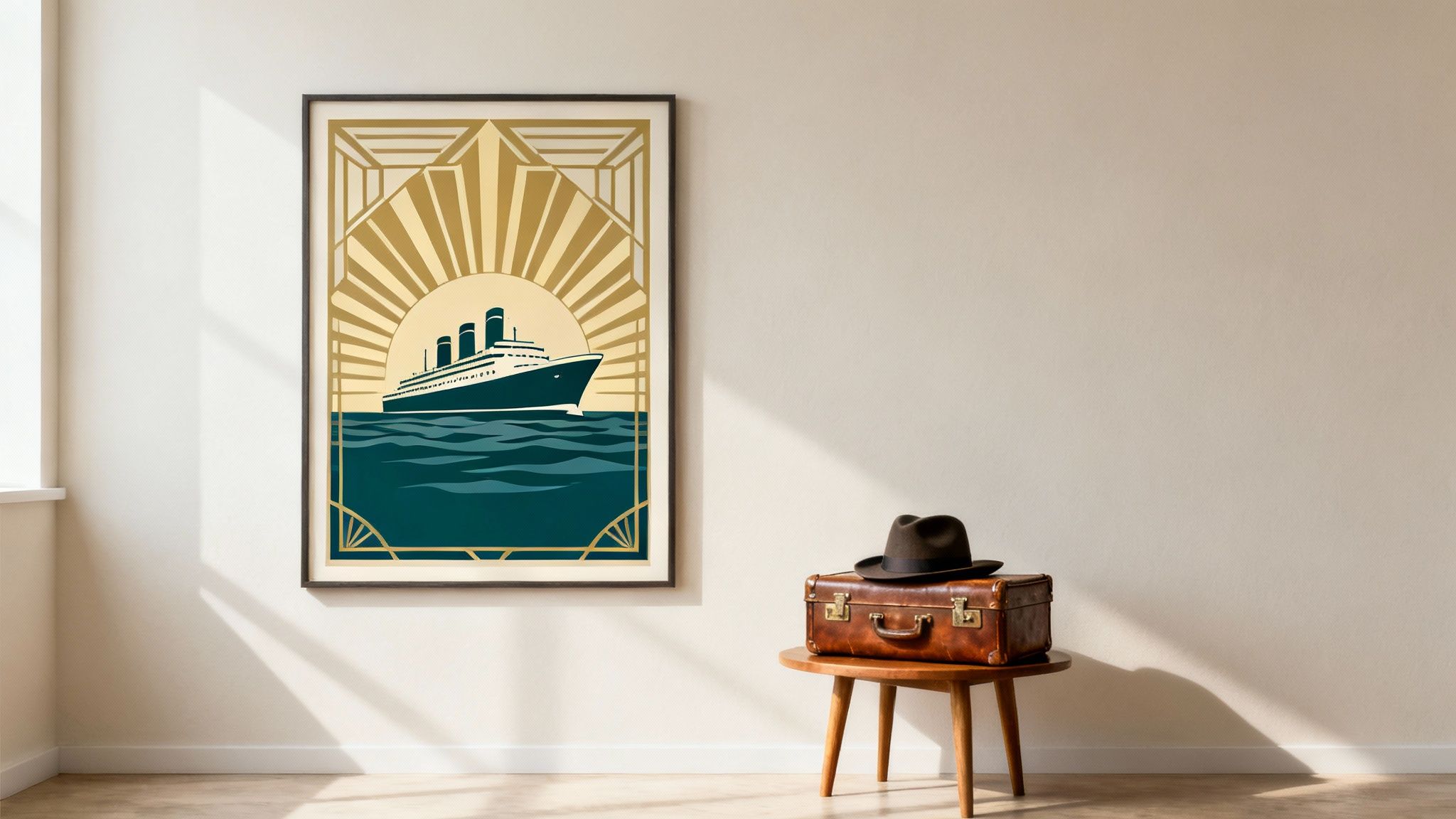
Picture a world just emerging from the shadows of a global war, absolutely ravenous for progress and sophistication. This was the stage where the Art Deco movement exploded. Posters from this period weren't just simple advertisements; they were bold declarations of a new, forward-thinking age. They celebrated the absolute marvels of the time: towering skyscrapers, luxurious ocean liners, powerful locomotives, and the undeniable thrill of the automobile.
Each Art Deco poster tells its own story of ambition and pure excitement. The sleek, streamlined forms and strong geometric shapes perfectly mirrored the industrial progress and architectural wonders sprouting up in cities like Paris, New York, and Miami. They captured a feeling of perpetual motion and limitless potential that truly defined the era.
The lasting fascination with the Art Deco poster comes down to its unique blend of high art and commercial purpose. Artists of the day took everyday advertising and elevated it, using sophisticated techniques to create images that were both visually stunning and emotionally powerful. The style is instantly recognisable, yet it offers endless variety.
This unique combination is exactly what makes them so sought-after today. Collectors, interior designers, and homeowners are all drawn to the elegance and energy these pieces bring to a space. They are so much more than decoration; they are conversation starters that connect us to a pivotal moment in design history. An Art Deco poster can:
For many, collecting an Art Deco poster is like owning a fragment of a more optimistic time. It’s a tangible link to an age that looked to the future with unapologetic confidence and style—a sentiment that feels just as relevant today.
By exploring these works, we do more than just appreciate beautiful art. We step into a world defined by innovation, luxury, and a deeply held belief in a brighter, more beautiful future. Their bold visual language continues to influence designers and captivate art lovers, proving that true style never really fades. This guide will help you understand their history and find the perfect piece for your own collection.
To really get a feel for an Art Deco poster, you have to picture the world that dreamed it up. The Art Deco style didn’t just pop up overnight; it was forged in the fire of the early 20th century, a direct answer to the massive social and technological shake-ups after World War I. This was a world desperate to leave the past behind and race into a future buzzing with speed, glamour, and progress.
The movement officially burst onto the scene at the 1925 Exposition Internationale des Arts Décoratifs et Industriels Modernes in Paris. This wasn't just any world's fair; it was a dazzling showcase of new thinking in design, making a clean break from the flowing, nature-heavy forms of Art Nouveau. Instead, it put luxury, expert craftsmanship, and a bold, modern look on a pedestal. The name "Art Deco" is just a snappy shorthand for the exhibition's title, tying the style to that landmark event forever.
But the seeds for this new look were planted well before 1925, drawing from a surprisingly wide and eclectic mix of influences.
Art Deco is a true melting pot of ideas. Its designers were masters of looking both to the ancient past and the immediate future, blending things that shouldn't work together into a sleek, exciting new visual language. They had a knack for taking an idea, boiling it down to its geometric core, and giving it a modern spin.
This unique mix of sources is what gives Art Deco its sophisticated, worldly vibe. Some of the key ingredients were:
Art Deco was the visual soundtrack to the Machine Age. It was a celebration of human ingenuity, turning the functional shapes of new technology into symbols of beauty, power, and forward momentum.
Beyond art movements, Art Deco was shaped by the very air of the Roaring Twenties. After the trauma of the war, people were ready for a party. There was a collective hunger for luxury, celebration, and a break from stuffy old traditions. You can see this energy in the style's rich materials, bold colour palettes, and its focus on travel, entertainment, and high society.
This spirit of modern fun resonated with everyone. It was a style that felt optimistic and glamorous, yet somehow accessible. It looked just as good on the front of a grand cinema as it did on an art deco poster advertising a new brand of cigarettes. This ability to connect high art with everyday life was the secret to its wild success and why it still feels so fresh today. The style wasn't just for looking at; it was a statement about living in a new, faster, more exciting world—a message that still pulls us in.
Have you ever looked at a poster and just known it was Art Deco, even without being able to explain why? It’s a style with a powerful and distinct visual signature, one that’s instantly recognisable once you know what to look for. Think of it as a design language, where specific shapes, lines, and colours communicate a message of modernity, elegance, and speed.
Learning to read this language is like getting a backstage pass to the 1920s and 30s. It allows you to appreciate the artistry and cultural storytelling embedded in every art deco poster. Let’s break down the core elements that give these pieces their timeless appeal.
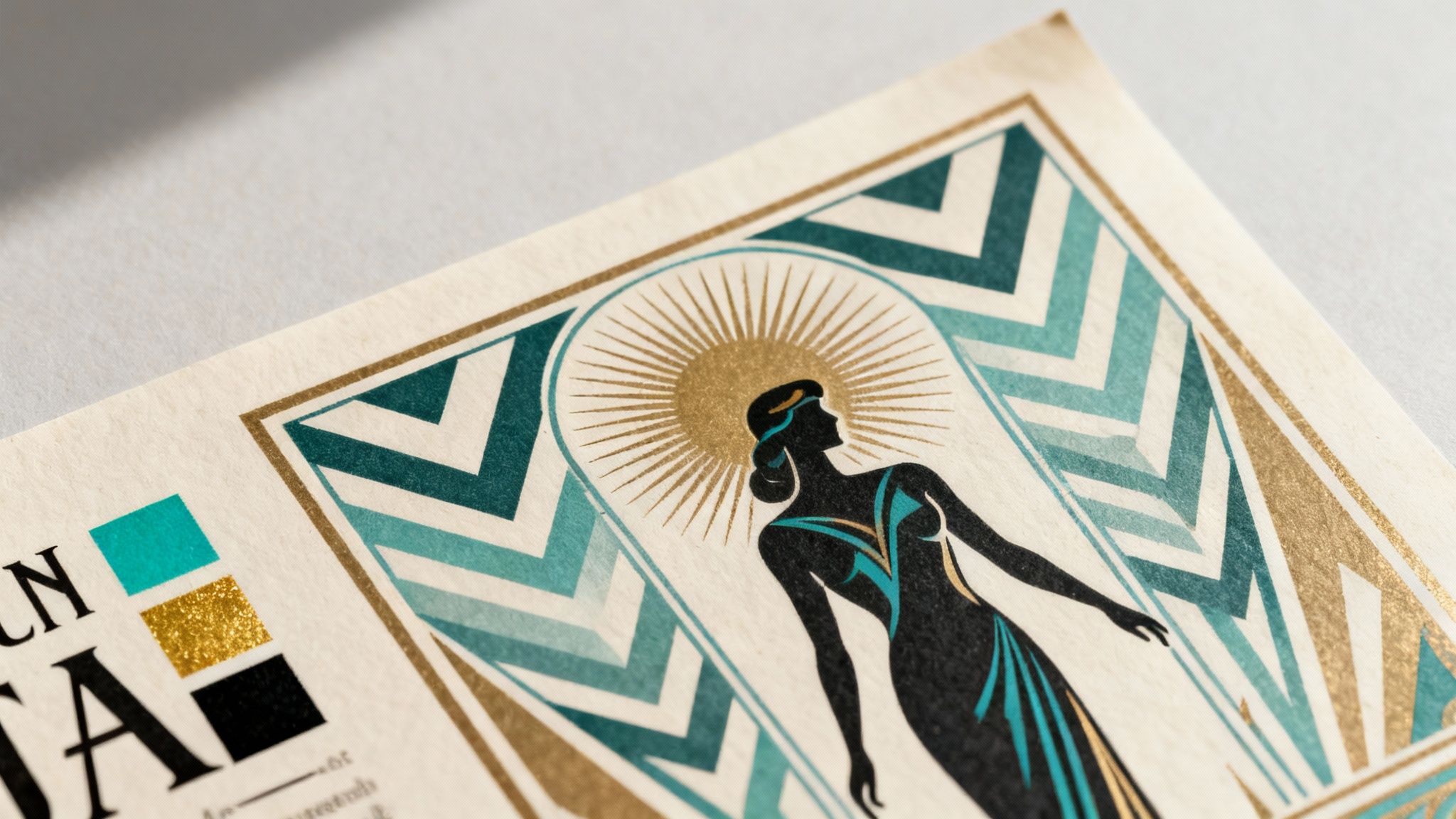
At its heart, Art Deco is a full-throated celebration of geometry. Artists were actively pushing back against the flowing, organic curves of the Art Nouveau movement that came before, choosing instead the clean, confident power of mathematics. This shift resulted in compositions built from precise, symmetrical, and often repeating patterns.
These geometric forms weren’t just for decoration; they were symbolic of the machine age and the era's architectural triumphs.
The geometry in an Art Deco poster is never accidental. It’s a deliberate choice to convey order, power, and a forward-looking perspective, turning simple shapes into a powerful statement about the future.
Another defining feature is streamlining, a design concept borrowed directly from the worlds of aviation and automotive engineering. Artists applied the principles of aerodynamics to their subjects, whether it was a train, a ship, or even the human form itself.
The result was smooth, elongated forms that appear to slice through space with minimal resistance. You'll often see powerful, simplified silhouettes of elegant women, stylised animals, and mighty machines, all rendered with a sleekness that suggests speed and efficiency. It’s a perfect visual representation of the era’s obsession with moving faster and breaking boundaries.
The lettering on an Art Deco poster is absolutely part of the artwork, not some afterthought. Artists created custom typefaces that were as geometric and stylised as the images themselves. These fonts were often tall, condensed, and rendered in all caps, which only added to the poster’s strong, assertive presence.
The colour palette further reinforces this mood of modern luxury. Artists favoured strong, contrasting colours to make their designs pop right off the paper. Common combinations included deep blacks and brilliant golds, rich blues and striking silvers, and vibrant reds, greens, and oranges set against neutral backgrounds.
This use of bold typography and sophisticated colour wasn't limited to the West, either. The global reach of the style led to some fascinating regional adaptations. For example, in 1930s Batavia (now Jakarta), Dutch colonial firms produced around 800 posters a year, with a staggering 60% in the Deco style, blending Parisian flair with Javanese motifs. These posters often used chevron patterns drawn from Borobudur temple reliefs, creating a unique fusion that supported local printers and even subtly advanced nationalist sentiments before Indonesia's independence. You can discover more about this fascinating regional history on metmuseum.org.
By mastering these key elements—geometry, streamlining, typography, and colour—you can begin to decode any art deco poster. You’ll start to see not just a beautiful image, but a carefully constructed message celebrating a world that was utterly in love with its own modernity.
Every great art movement has its pioneers—the trailblazers who rip up the rulebook and create a whole new visual language. The Art Deco poster was no exception. It was shaped by a handful of masters who elevated commercial advertising into a breathtaking art form, creating pieces that now hang in museums worldwide. These weren't just designers; they were storytellers capturing the very soul of the Machine Age with ink and paper.
Getting to know these artists helps you appreciate the incredible skill and creative vision poured into every single piece. They were the rock stars of graphic design in their day, and you can still feel their influence in the design world today. Let's put the spotlight on a few legends whose names are synonymous with the golden age of Art Deco posters.
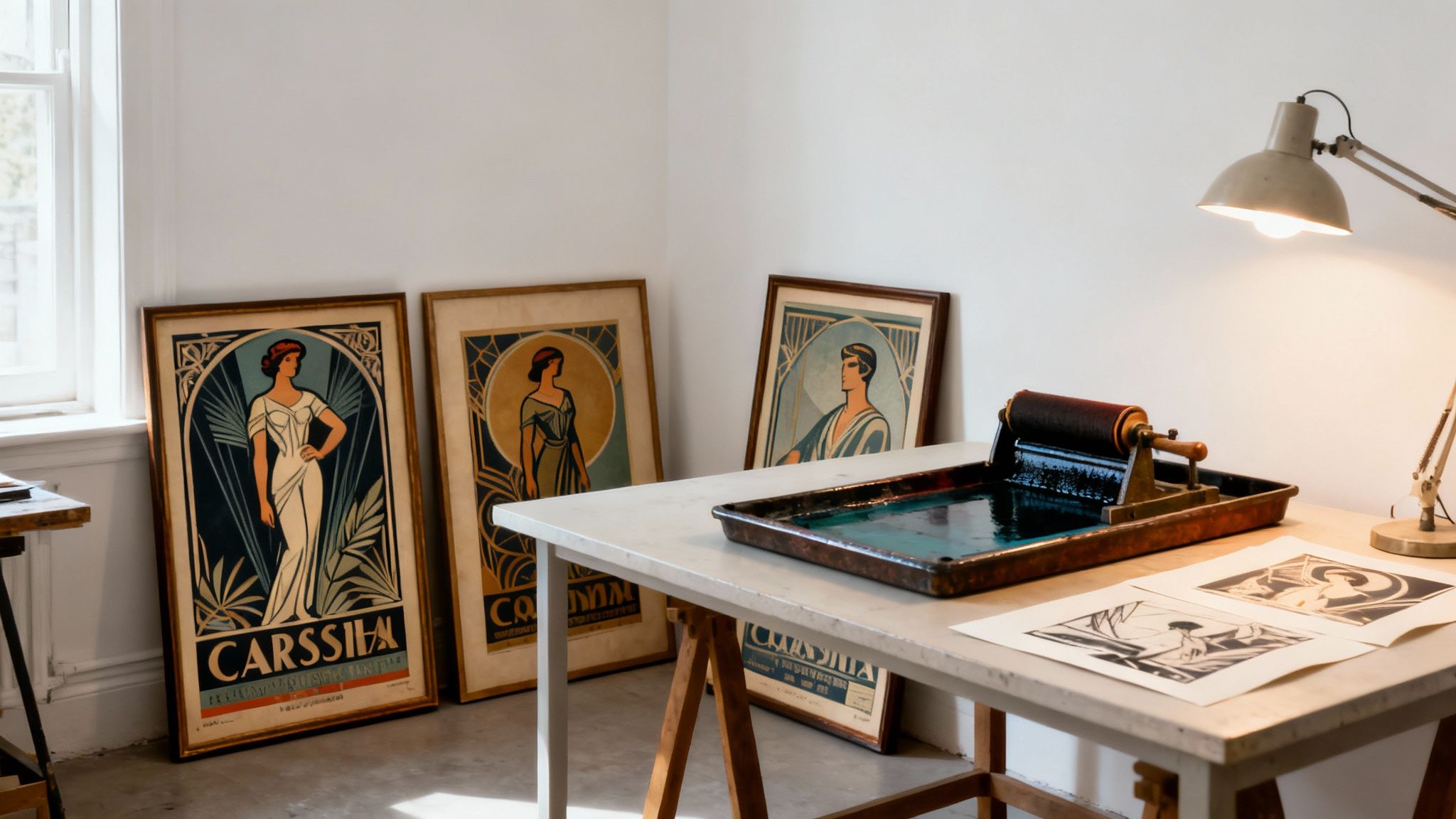
Adolphe Mouron Cassandre, known simply as A.M. Cassandre, is perhaps the most celebrated of them all. A Ukrainian-French painter and designer, Cassandre approached his work like an architect, building powerful compositions from stark geometric forms, dramatic perspectives, and bold, simplified shapes. He believed a poster should be a "telegram" to the viewer, delivering its message with immediate force.
His most famous works often celebrate the titans of modern transport. Who could forget his iconic 1935 poster for the ocean liner Normandie? It depicts the ship's colossal bow from an impossibly low angle, making it feel like a floating skyscraper slicing through the waves. It’s a masterclass in conveying power and luxury with minimal detail. Another classic, Nord Express, uses converging railway lines to create a dizzying sense of speed and distance.
Cassandre’s genius was his ability to fuse Cubist and Futurist ideas with commercial needs. He didn't just sell a product or a service; he sold the very idea of modernity itself, wrapped in an unforgettable visual package.
If Cassandre captured the mechanical might of the era, Paul Colin captured its vibrant, pulsing soul. His career exploded in 1925 when he created a poster for the Revue Nègre, which introduced the electrifying American performer Josephine Baker to Parisian audiences. That single poster, with its dynamic, almost frantic energy, perfectly encapsulated the Jazz Age.
Colin’s style was more fluid and rhythmic than Cassandre’s. He had an incredible talent for capturing human movement and emotion, often using loose, expressive lines to create a sense of lively activity. Over his long career, he produced more than 1,900 posters, becoming one of the most prolific and beloved artists of his time.
Charles Loupot was another key figure who, alongside Cassandre, helped define the modern French poster. His style evolved throughout his career, but he’s best known for an elegant, almost poetic approach to advertising. Loupot excelled at reducing an idea to its purest visual essence, often using soft colour gradients and clean, symbolic imagery.
He was a master of conveying a brand's identity through subtle visual cues. His long-standing work with St. Raphaël aperitif, for example, resulted in a series of posters featuring two stylised waiters that became instantly recognisable symbols of the brand.
While these French masters often dominate the conversation, the Art Deco style was a truly global phenomenon. Singapore’s own golden age from 1927 to 1939 saw the creation of around 1,200 commercial posters. Shipping lines were major patrons, and designer L.N. Tallentire-Walker created stunning works using metallic gold inks to capture the glamour of travel, contributing to a 35% rise in tourist arrivals. Much like the folk art revival in Dalarna, this period saw a beautiful merger of global style with local soul.
This worldwide adoption of the style shows just how powerfully its message of modern elegance resonated. For those interested in the broader context of modernist design, you might enjoy our article on another influential figure, Josef Frank.
Bringing an Art Deco poster into your home isn’t just about filling an empty wall; it’s about inviting in the glamour and optimism of a bygone era. The real trick is to let the poster’s bold personality shine without completely taking over your existing decor. Think of it like inviting a fascinating guest to a dinner party—you want to set the stage for them to tell their story and, in doing so, elevate the whole room.
Whether you're going for a full-on period look or just a subtle nod to the past, styling these pieces is an art in itself. The right placement and framing can turn a simple print into a show-stopping centrepiece.
The frame you pick for your Art Deco poster is just as important as the artwork. It’s supposed to be a quiet supporting actor, making the poster's colours and lines sing without stealing the spotlight. A clumsy frame choice can easily drain the piece of its sophisticated energy.
When you're looking at frames, here are a few practical ideas:
Where you hang it is your next big decision. An Art Deco poster has a commanding presence, so it deserves a prime spot. Hang it above a key piece of furniture—like a sofa, a console table, or a headboard—to create a natural focal point. Always aim to hang it at eye level, which is typically around 145-150 cm from the floor to the centre of the artwork, for the best view.
One of the most exciting ways to style an Art Deco poster is to mix it with completely different design aesthetics. This is how you create a layered, personal space that feels like it has been collected over time, not pulled from a catalogue. The goal is to start a visual conversation between different pieces and eras.
For example, the sleek, industrial glamour of an Art Deco travel poster can create a stunning contrast with the rustic, handcrafted charm of Scandinavian folk art. Picture a poster of a streamlined ocean liner paired with a hand-painted Dala horse on the mantelpiece just below. The contrast works beautifully because both styles, while worlds apart visually, share a deep appreciation for craftsmanship and bold, stylised forms.
This approach to mixing styles isn't about creating a clash; it's about finding harmony through contrast. The clean geometry of Art Deco can anchor the organic softness of other decor, while the warmth of folk art can keep a modern space from feeling too cold or sterile.
The Art Deco movement’s global reach gives us a rich well of inspiration for these kinds of pairings. In 1920s Siam (now Thailand), for instance, local artists produced over 500 Art Deco-inspired posters, blending Parisian streamlining with motifs from Thai temple architecture. These vibrant pieces, often promoting tourism or new products, show just how beautifully modernism can fuse with tradition. A famous series for the Siam Commercial Bank in 1928 reached an estimated 40% of urban households, proving the style’s widespread appeal. Exploring this unique fusion offers fantastic ideas for mixing cultural styles in your own home.
If one poster makes a statement, a gallery wall tells a story. A curated collection of Art Deco posters can become a powerful, immersive feature in any room. The secret to a great gallery wall is finding a common thread that ties all the pieces together.
Here’s how to build a cohesive collection:
An art deco poster is a versatile piece of history that can energise any interior. For those who appreciate the beauty of handcrafted decor, exploring our guides on other forms of decorative art, such as our feature on striking wood wall art, can provide even more inspiration for creating a unique and artful home.
Starting an art deco poster collection is an absolute thrill, whether it’s your very first piece or just the latest addition to a growing gallery wall. The real trick is learning how to navigate the market to find those authentic gems and, just as importantly, how to care for them once they’re yours. This guide will walk you through the essentials, so you can buy with confidence and keep your art looking brilliant for decades.
The first hurdle every new collector faces is telling a genuine vintage lithograph apart from a modern reproduction. While there’s nothing wrong with a good reproduction, an original piece carries a history—and a monetary value—that you’ll want to protect. Training your eye to spot the real deal is a skill you’ll build over time, but there are a few tell-tale signs to look for right away.
Original posters from the Art Deco period were almost always made using stone lithography. This old-world printing technique creates wonderfully rich, deep colours and a texture you just don't see in modern prints. If you look very closely, maybe even with a magnifying glass, you should see a random, subtle dot pattern from the ink on the stone. It’s completely different from the perfect, mechanical grid of dots you'd find on a poster printed digitally today.
The paper itself has a story to tell, too. Vintage paper often has a certain character—a slight creaminess or off-white tint from age. It simply feels different from the crisp, uniform paper stock we use now. Also, be sure to look for any signatures or printer’s marks; these were often beautifully integrated into the original design and are a great clue.
An original vintage poster is more than just an image; it is a physical artefact of its time. The subtle imperfections—the texture of the ink, the feel of the aged paper—are not flaws but hallmarks of its authenticity and history.
To help you get started on choosing the right poster for your home, this decision tree can guide you through matching your piece to your décor and frame.
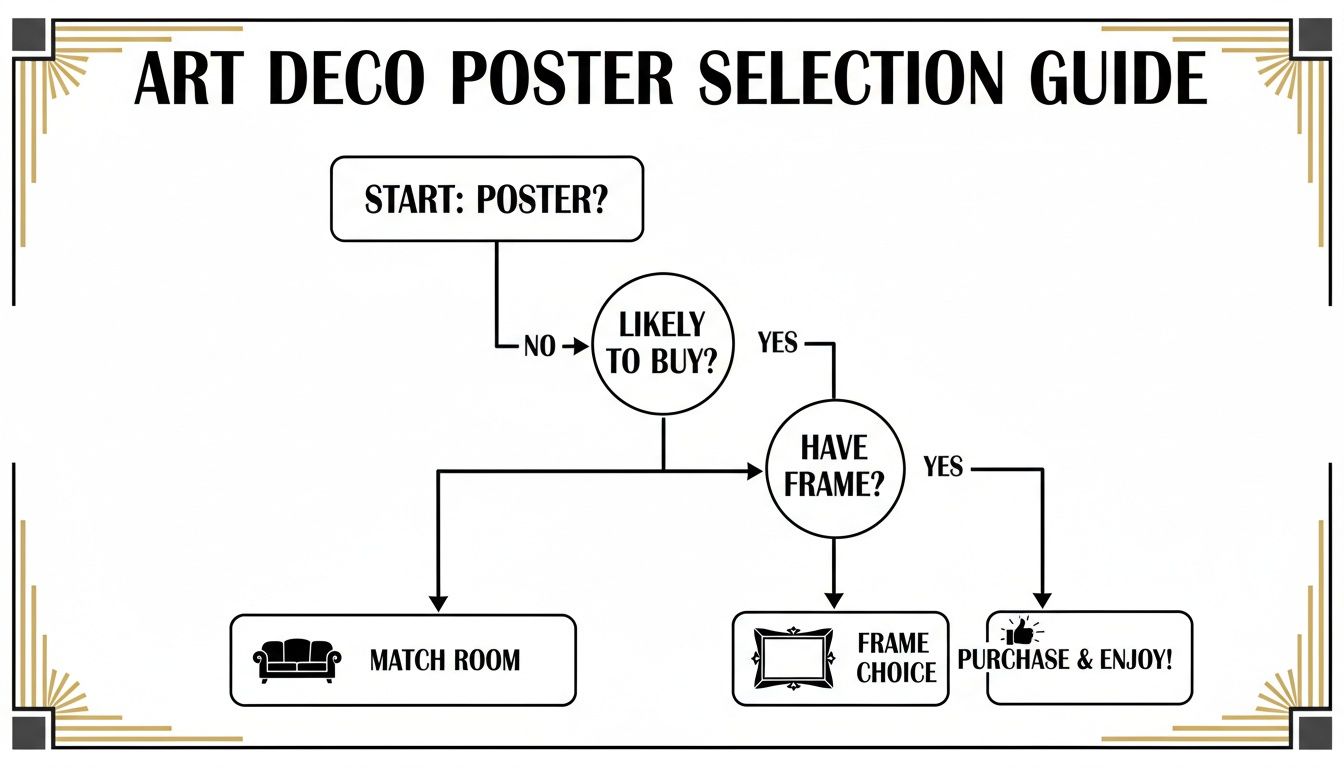
As the flowchart shows, the process can start with what you prioritise—the room's current style or the frame itself. Either way, it leads to a thoughtful choice that pulls the whole look together.
Once you feel comfortable spotting an original, your next step is finding a trustworthy place to buy from. This is crucial for making sure you're investing in a genuine piece of art history.
After bringing your art deco poster home, looking after it properly is key to protecting your investment. Light is the biggest enemy of vintage paper and ink, especially direct sunlight, which causes fading that can't be undone. You should always frame your poster using UV-protective glass or acrylic. It’s also a good idea to use acid-free matting and backing boards to stop the paper from yellowing over the years. And whenever you handle the poster, make sure your hands are clean, or better yet, wear gloves to avoid transferring any oils.
For anyone interested in exploring other kinds of historic prints, you can dive deeper into vintage posters from Sweden in our other article.
Jumping into the world of Art Deco posters can feel a little daunting. If you're new to collecting or just trying to figure out how to style these beautiful pieces, you probably have a few questions. Let's walk through some of the most common ones to get you started on the right foot.
So, what exactly separates an original Art Deco poster from a modern print? An original is almost always a stone lithograph from the 1920s or 1930s. A reproduction, on the other hand, is a contemporary copy, usually printed digitally. You can often spot the difference by looking closely at the printing itself—originals have a beautifully textured, almost random dot pattern from the lithographic process, while reproductions feature a much more uniform, mechanical grid of dots.
Several key ingredients determine a poster's worth. The artist is a huge factor; works by masters like A.M. Cassandre are always in high demand and command impressive prices. Beyond the artist's signature, its rarity, condition, and even the subject matter all play a massive part in its market value.
Posters that capture the glamour of the era—think sleek ocean liners, exotic travel destinations, or famous sporting events—are especially coveted. And, of course, the better the condition, the higher the value. That means minimal fading, no significant tears, and little to no restoration work.
Don't overlook a poster's provenance, which is its documented ownership history. A solid history linking a piece to a famous collection or a significant event can dramatically increase its desirability and price.
Looking after your poster properly is the key to preserving its beauty and value. The single most important rule? Keep it out of direct sunlight. UV rays are the enemy of old paper and ink, causing fading that you can never reverse.
When you frame your Art Deco poster, make sure to use UV-protective glass or acrylic. It's also vital to use acid-free matting and backing materials, which will stop the paper from yellowing over the years. Whenever you need to handle it, use clean, dry hands or wear cotton gloves to keep oils from damaging the delicate paper. A few simple precautions will ensure your piece stays as vibrant as the day it was printed.
At Dalaart, we believe in the magic that happens when timeless design meets handcrafted heritage. Take a look at our collection of authentic, artisan-made Swedish Dala horses and animals to find the perfect companion for your treasured art. Discover our collection at dalaart.com.


.svg)


.png)


