December 10, 2025
Step into the world of vintage Swedish posters, and you're not just looking at old paper; you're discovering pieces of history. These posters are celebrated for their clean, minimalist style, clever typography, and functional design. For collectors and designers, they're more than simple decoration—they are a genuine window into Sweden's artistic soul and social story.
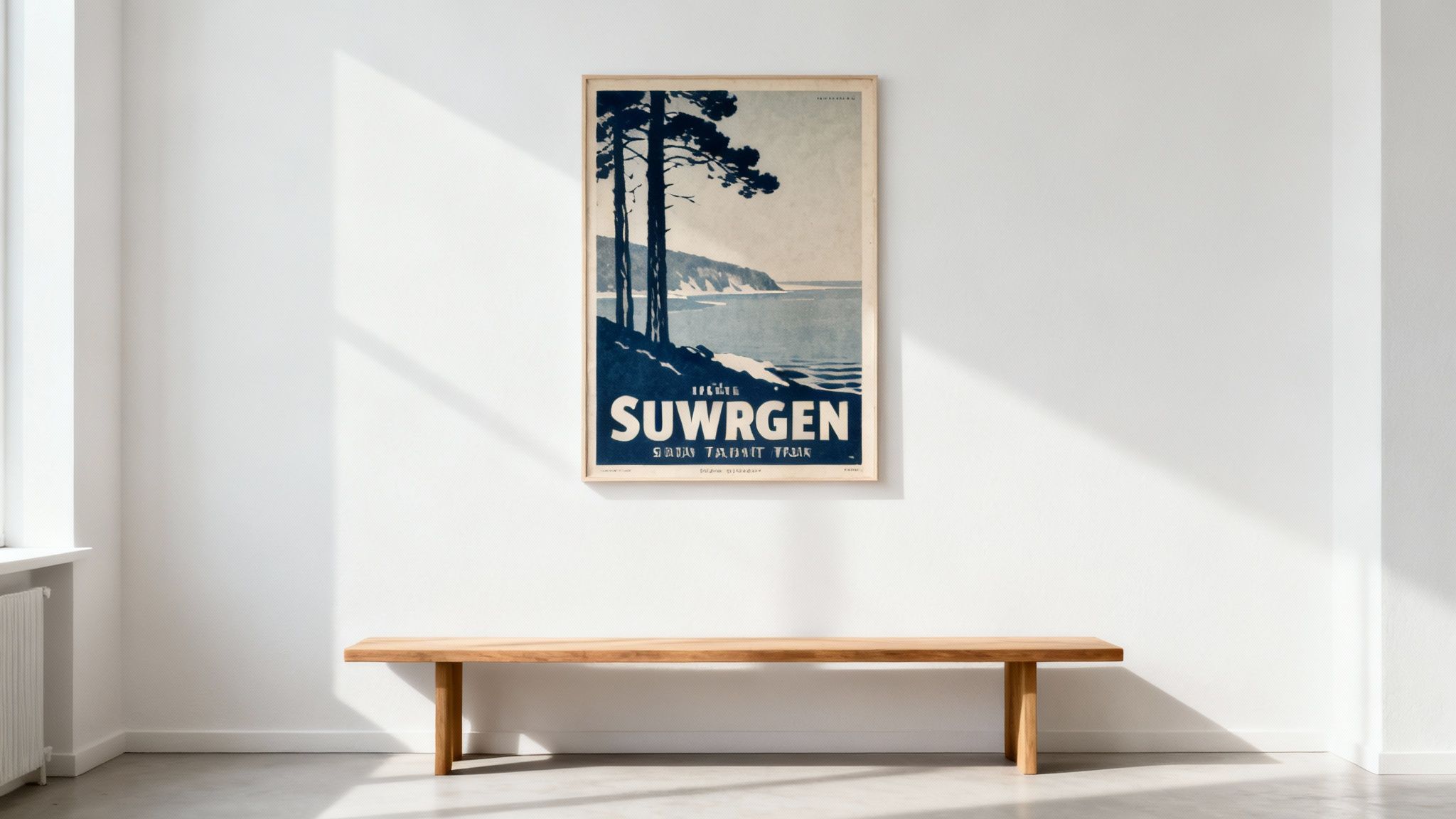
There’s a real pull to an authentic Swedish vintage poster. It's so much more than an old advertisement. It's a moment captured on paper, reflecting the very design principles that would eventually make Scandinavian style a global phenomenon. Don't think of them as mass-produced prints; see them as art, carefully created for the public eye.
These pieces speak a clear visual language. They mix bold graphics with crisp lines, and the typography is often as much a part of the artwork as the illustration itself. This whole approach was born from a need for practicality and clarity, creating a look that feels surprisingly fresh and modern, even decades later.
So, what really sets these posters apart? It’s their deep connection to core Swedish cultural values. The idea of functionalism—known locally as "funkis"—is everything. This movement, which really took off in the 1930s, believed that design should be useful, simple, and for everyone.
This thinking went straight into poster art. The result? Compositions that were both beautiful and incredibly effective. Artists stripped away all the fussy, unnecessary details to get a clear, powerful message across. Whether it was for a new product, a travel spot, or a public announcement, the goal was always direct communication through elegant design. If you're curious about this cultural mindset, you can learn more about the typical Swedish things that have shaped the nation's identity.
The lasting appeal of vintage Swedish posters comes down to their unique mix of artistry, history, and design. Each one tells a story about a specific point in time—a new railway opening, a hit film, or a social campaign.
These are not just decorative items; they are tangible links to the past. Collectors are drawn to them for their ability to evoke nostalgia while fitting perfectly within contemporary interior design, especially minimalist and Scandinavian-inspired spaces.
Here’s why people can't get enough of them:
Ultimately, collecting these posters is about appreciating a design legacy that put simplicity and function first, long before it became a worldwide trend.
The story of Swedish poster design isn't just about art; it's a journey through a nation's rapid transformation. This golden age, stretching from the late 1800s through the mid-20th century, saw artists take international trends and give them a distinctly Swedish twist, creating a visual language that still feels fresh and powerful today. These weren't just advertisements—they were cultural landmarks.
It all started as Sweden, like much of Europe, dove headfirst into industrialisation. Suddenly, there were new products to sell, railways crisscrossing the country, and a budding tourism industry. Posters became the public’s new canvas, shifting from simple, text-heavy notices to vibrant works of art that coloured the walls of every city.
The earliest Swedish posters were wrapped in the elegant embrace of Art Nouveau, or 'Jugendstil' as it was known locally. Around the turn of the 20th century, this style was everywhere, defined by its flowing, organic lines, intricate floral patterns, and graceful, stylised lettering. Picture graceful curves and nature-inspired designs, often used to advertise a touch of luxury or a special cultural event.
But as the 1920s and 30s rolled in, a quiet revolution was brewing. Designers started to shed the ornate European styles and forge a new path, one rooted in simplicity and purpose. This was the birth of Swedish Modernism and the functionalist movement, lovingly nicknamed 'funkis'. The focus swung sharply from decoration to communication, with clarity, bold graphics, and clean, geometric shapes taking centre stage. This shift perfectly captured the national mood of efficiency and progress.
The move from Jugendstil to Funkis wasn't just a style update; it was a change in philosophy. Designers wanted to create art that was not only beautiful but also accessible to everyone, convinced that good design could genuinely improve daily life. This very idea became the foundation of what the world now recognises as Scandinavian design.
During this period, posters became a vital part of Sweden's visual culture. The industry truly found its feet in the early 1900s, echoing a broader European movement where posters became the go-to medium for commerce and public information. By the 1920s, cities like Stockholm were alive with posters promoting everything from new films and holiday spots to municipal services. For a deeper dive into the continent's poster history, you can explore this comprehensive bibliography on the subject.
This explosion of creativity didn't happen in a vacuum. It was fuelled by the country's growth and changing needs, which is a big reason why looking at vintage posters sweden is like opening a time capsule.
You can trace the boom back to three main drivers:
While you can see flickers of influence from movements like the German Bauhaus or Russian Constructivism, Swedish artists were never mere copycats. They absorbed these ideas and filtered them through a uniquely Nordic lens, resulting in a style defined by its restraint, harmony, and deep connection to nature.
Swedish designers became masters of saying more with less. They used clever compositions, thoughtful use of negative space, and a restrained but impactful colour palette to create designs that were both elegant and incredibly effective. The typography was never just an afterthought; it was woven into the very fabric of the design, often hand-lettered to perfectly harmonise with the illustration. This seamless integration of text and image is a true hallmark of classic Swedish poster art, making every piece a beautifully balanced whole.
Stepping into the world of collecting vintage Swedish posters is a thrilling hunt for historical treasures. But how can you be sure you're buying a genuine piece of history and not a modern copy? The secret is learning to read the subtle clues that separate an original print from a reproduction.
Distinguishing an authentic vintage poster often begins with a simple touch. Originals were typically printed on specific types of paper that feel completely different from modern stock. Trust your senses—the paper itself is one of your most reliable guides.
The very first thing I always check is the paper's texture and feel. Original posters from the era were often printed on thin, matte lithographic paper that was never really designed to last forever. Over the decades, this paper develops a unique character, sometimes showing slight yellowing or tiny age spots known as foxing.
Reproductions, on the other hand, are frequently printed on heavier, glossy paper that feels unnaturally smooth and bright. An original might feel slightly dry or even a bit brittle at the edges, while a copy just feels slick and new.
Next, look closely at how the ink sits on the paper. The dominant printing method during the golden age of posters was stone lithography. This beautiful process involved layering colours one at a time, creating a rich, textured look that's hard to replicate.
Under a magnifying glass, a lithograph reveals a distinct, almost random dot pattern, like a fine-grained watercolour painting where colours blend softly. A modern digital print, however, will show a sharp, mechanical grid of pixels or a uniform inkjet spray pattern. Those slight imperfections of lithography are a hallmark of authenticity.
This artistic process is a running theme in how Swedish design evolved through different eras, influencing the posters of the time.
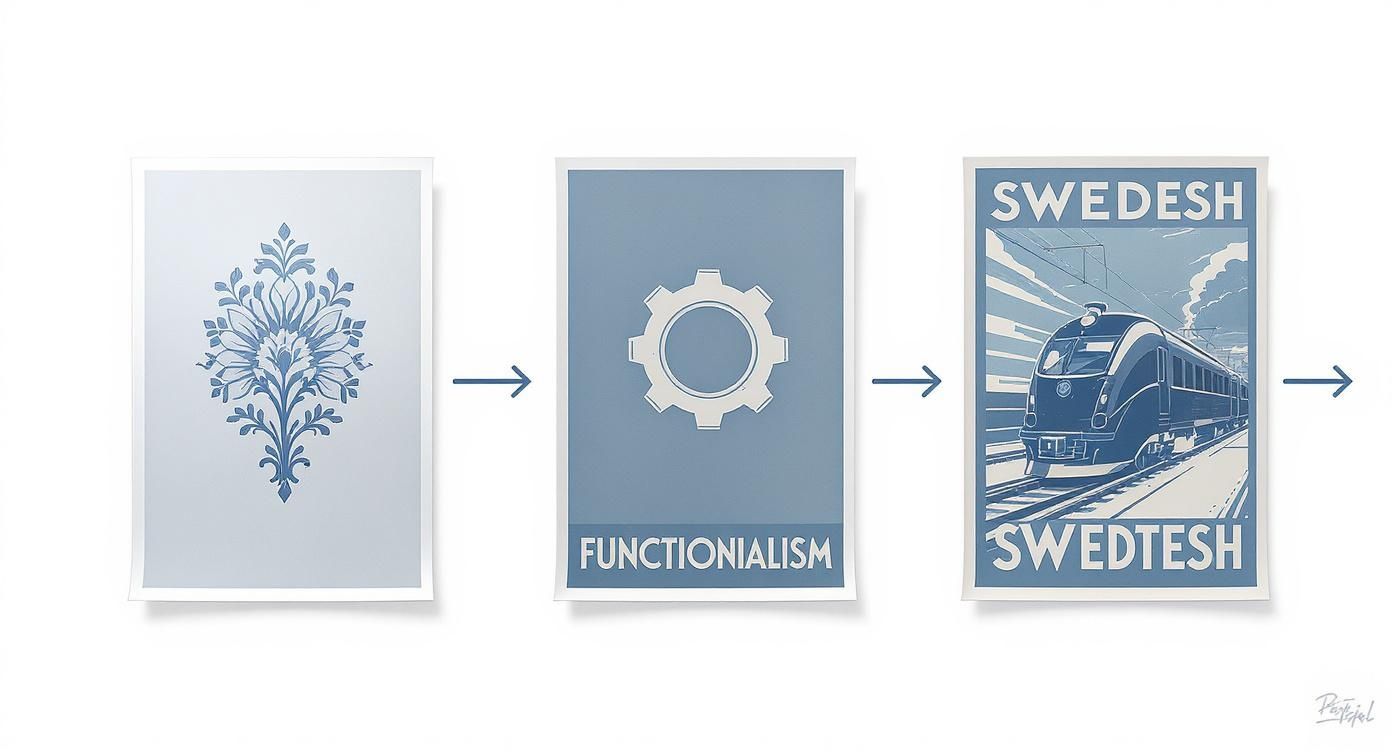
You can see the clear visual shift from the ornate Jugendstil to the clean lines of Functionalism and Mid-Century Modernism, each with its own printing and design characteristics.
Often, it’s the smallest details that provide the biggest clues. Scrutinising the edges, markings, and overall condition can reveal a poster's true story and help you make a confident purchase.
Here are a few key indicators I always look for:
A poster’s history, or provenance, adds another crucial layer of verification. While not every genuine poster comes with a detailed paper trail, documentation like an original sales receipt or a certificate of authenticity from a reputable dealer can provide valuable assurance.
Condition is also key. Don't be put off by minor imperfections like small edge tears, pinholes in the corners, or slight discolouration. These are often signs of a poster's authentic life and history. In fact, a piece that looks too perfect should be examined with extra care.
This focus on authenticity and history is a principle that applies across many areas of Swedish collectibles. For those interested in other traditional crafts, our guide on collecting Dala horses offers a beginner's guide with similar insights into identifying genuine artisan work. Ultimately, combining careful observation with dedicated research is the best way to build a collection of authentic vintage posters you can truly be proud of.
Dipping your toes into the world of vintage posters sweden feels a lot like exploring any other art market. Some pieces are beautiful decorations destined to brighten a room, while others are serious investments that gain value over the years. Figuring out what separates the two is the real secret to building a collection you’ll be proud of for a long time.
A poster’s value isn't just about how old it is. Not by a long shot. Instead, it’s a delicate blend of several key factors, and each one plays a part in its desirability and price tag. Once you learn to spot these elements, you can make confident choices, whether you’re buying your very first piece or hunting for that elusive rare gem.
Think of a poster's value like a recipe with four main ingredients. When you have all four in perfect measure, you get a masterpiece that everyone wants. If even one is lacking, it can throw the whole thing off and dramatically affect the price.
These are the core components that tell the story of a poster’s true worth:
A rare poster by a famous artist might seem like the ultimate prize, but if it's in rough shape, its value could plummet to a fraction of a well-preserved example. It’s this intricate balance of rarity, artistry, subject, and preservation that truly defines a poster's place in the market.
The market for vintage posters is always moving, with tastes and trends shifting over the years. That said, some types of vintage posters sweden have a timeless appeal. Mid-century modern designs from the 1950s and 60s, with their clean lines and cheerful vibe, remain a firm favourite among collectors and interior designers.
These pieces are actively traded by collectors in Sweden and across Europe, and prices can swing wildly. For instance, travel posters from this golden age can sell for anything from a few hundred to several thousand dollars at auction, all depending on those key value factors. This lasting interest really speaks to the deep appreciation for the stylish and powerful visual language of mid-century Nordic design. You can explore a more academic take on the vintage travel poster art market to see just how deep this world goes.
Once you know what makes a poster valuable, the next logical question is where to find one. Building a collection you can trust means buying from sources that care about authenticity and are transparent about what they're selling. It's about connecting with trusted people who share your passion for these little pieces of history.
Here are the main places to start your hunt for genuine vintage posters:
Walking into these places with confidence comes from knowing what you’re looking for and having a feel for the market. By sticking to these reliable sources, you can sidestep the reproductions and build a collection of authentic pieces that truly celebrate Sweden’s incredible design heritage.
While movements like Jugendstil and Funkis give us a great framework, the real story of vintage posters sweden is about the individual artists. These were the creative minds who took a commercial brief or a cultural idea and spun it into a piece of art that could stop you in your tracks. To really get into collecting, you have to get to know the names behind the masterpieces.
Many of these designers became household names, their work instantly recognisable on city walls. They weren't just illustrators; they were brilliant storytellers who knew exactly how to grab your attention and make an impression with a single, powerful image.
While countless talented people were part of this golden age, a few names just tower above the rest. Their work didn't just capture the look of their era; it defined it. Learning to spot their unique signatures is one of the most satisfying parts of building a collection.
Let’s meet a few of the heavy hitters you'll definitely come across:
Learning to recognise an artist’s touch is a bit like learning to identify a painter by their brushstrokes. Each one had their own visual language. Beckman’s friendly, hand-drawn feel is a world away from Eksell’s sharp, modern wit. Honestly, this variety is what makes collecting vintage posters sweden so endlessly interesting.
The real genius of these artists was their ability to walk the line between commercial work and fine art. They were making adverts, sure, but they were creating genuinely beautiful objects that elevated everyday products into something you’d actually desire, all through the power of design.
This artistic conversation wasn’t just happening within Sweden, either. Between 1876 and 1916, Sweden was actively sharing its culture with the world through official art exhibitions in America. These often featured art by Swedish immigrants that mixed modern styles with traditional Nordic themes. You can find more on this fascinating cultural exchange and its influence on the art world.
To bring this all to life, let's picture some of their work. Think of an Anders Beckman poster for Luma lightbulbs. You might see a whimsical, smiling character whose head is literally a glowing bulb—it’s a simple, funny, and brilliant way to communicate brightness and joy.
Now, imagine a travel poster by Adolf Probst for SJ. Picture a sleek, powerful train slicing through a stylised, snow-dusted forest. The colours are cool and crisp, the lines are clean and full of motion. It creates a sense of speed and efficiency that makes you want to pack a bag right away.
Finally, think of Olle Eksell. His poster for an exhibition might use just two or three colours and a simple, abstract shape to communicate a complex idea, trusting you to connect the dots. His work proves that you can often say much more by using much less. By studying these iconic designs, you start to build your own mental library of styles, making it that much easier to spot a true gem and appreciate the genius behind it.
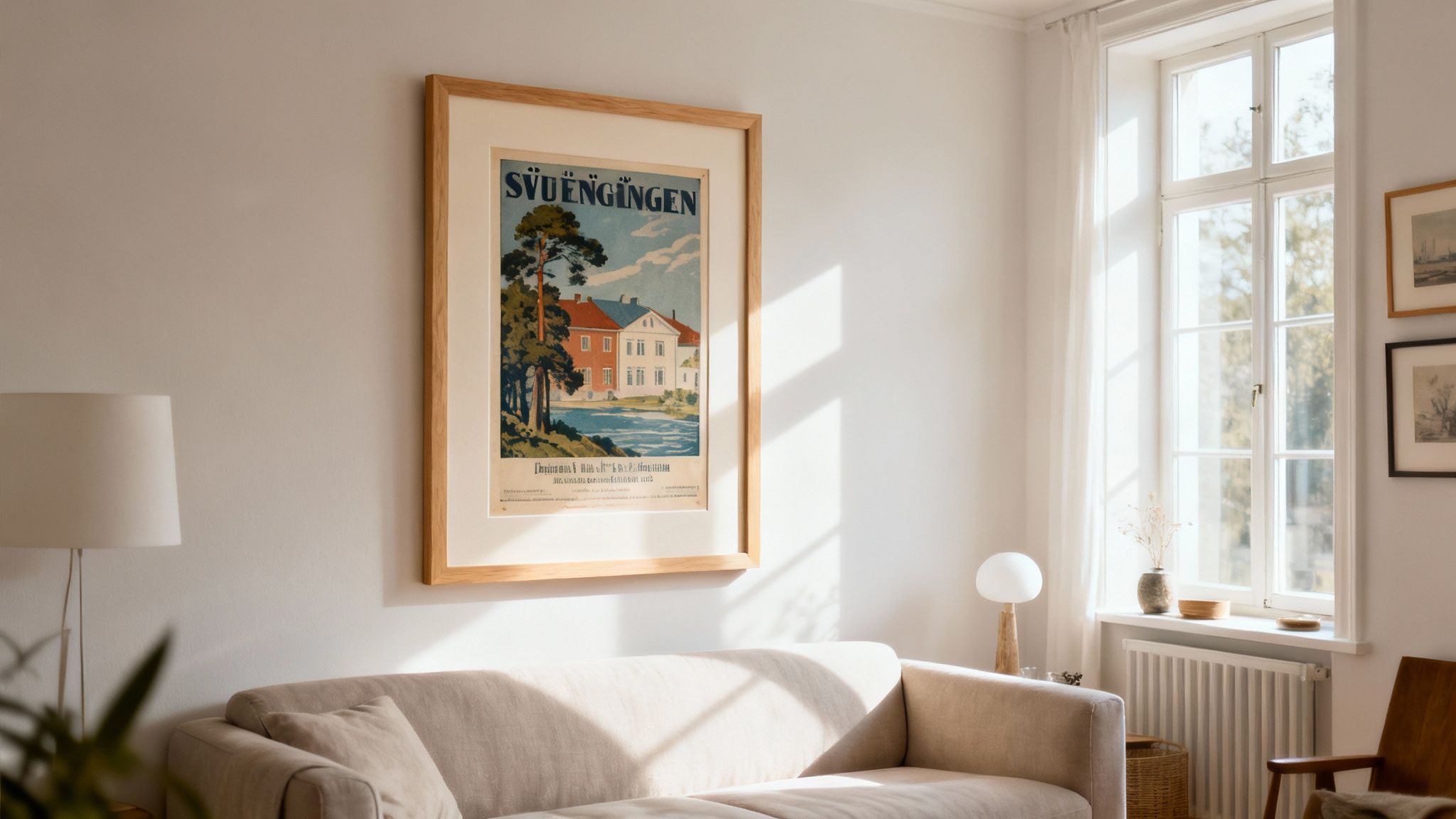
Bringing a beautiful piece of Swedish poster art into your home is just the start of its new life. Now, your focus shifts to protecting this delicate piece of history while showcasing its timeless style. Proper preservation isn't just about keeping it safe; it’s about making sure its story and vibrancy can be enjoyed for generations.
Think of a frame as more than just a decorative border—it's a protective shield for your investment. Standard framing materials often contain acids that will slowly yellow and break down the paper over time, causing damage that can't be undone. For any genuine vintage poster, choosing archival-quality materials is non-negotiable.
This means using acid-free mounts, mats, and backing boards. These materials create a safe, chemically stable home for your poster, preventing the paper from deteriorating. The glass you choose is just as important.
UV-protective glass or acrylic is your poster's best defence against the sun. It acts like a powerful sun cream, blocking up to 99% of harmful ultraviolet rays that cause colours to fade and paper to turn brittle. While it costs a bit more upfront, it's a critical investment in your poster’s future.
Once your poster is safely framed, the fun part begins: making it part of your home. The clean lines and bold graphics of vintage posters sweden make them incredibly versatile. They complement a huge range of interior styles, especially those with a Scandinavian feel.
Here are a few ideas to get you started:
The real magic happens when you create a dialogue between the past and the present. The warmth and history of a vintage piece can beautifully balance a modern interior, adding character and depth. This same principle of blending old and new can be seen in other decor, which you can read about in our article on the timeless appeal of the candles of Scandinavia.
Ultimately, styling your collection is about creating a space that feels personal and inspiring. Whether you choose one statement piece or an eclectic gallery, your vintage Swedish posters will bring a unique sense of history, artistry, and timeless design into your home.
Diving into the world of vintage posters sweden is exciting, but it naturally brings up a few questions. Let's tackle some of the most common ones to help you start your collection with a bit more clarity.
The price range for Swedish posters is incredibly wide. You might find a lovely, lesser-known design in good shape for a few hundred pounds, while a rare piece by an iconic artist like Anders Beckman could easily run into the thousands.
It all comes down to a blend of factors: how rare it is, the artist's reputation, the subject matter, and of course, its physical condition. Classic travel posters and ads for big brands from the mid-century are always in high demand, which tends to place them in a higher price bracket.
If you have to pick just one, rarity often has the greatest impact on a poster’s market value. Think about it – even a poster from a famous designer won't be worth a fortune if thousands of copies are still floating around.
On the flip side, a visually stunning poster by a relatively unknown artist can become incredibly valuable if only a handful of originals are known to still exist. When you get that magic combination of extreme rarity and excellent condition, you have the perfect recipe for a high-value piece.
Remember, age alone doesn't guarantee value. A rare and beautifully designed poster from the 1950s can easily be worth more than a more common but older print from the 1920s. It is the unique combination of factors that truly determines its worth.
Absolutely! You don’t need deep pockets to begin this journey. A fantastic way to start is by focusing on designs that are visually compelling but maybe not by the most famous names.
Keep an eye out for posters from smaller local events, regional product advertisements, or even old public service announcements. These pieces often have all the artistic quality and historical charm of their more expensive counterparts but are far more accessible. At the end of the day, building a collection you genuinely love is what matters most, especially when you're just starting out.
At Dalaart, we celebrate the artistry and heritage behind authentic Swedish craftsmanship. Explore our curated collection of hand-carved Dala horses and discover a piece of tradition to bring into your home. Visit us at https://dalaart.com to find your timeless treasure.


.svg)


.png)


