March 18, 2026
A fair isle sweater is so much more than a patterned jumper; it’s a living piece of history knitted into existence on the remote Scottish island of Fair Isle. Its hallmark is the intricate stranded colourwork, a special technique that paints complex geometric pictures using just two colours in any given row.
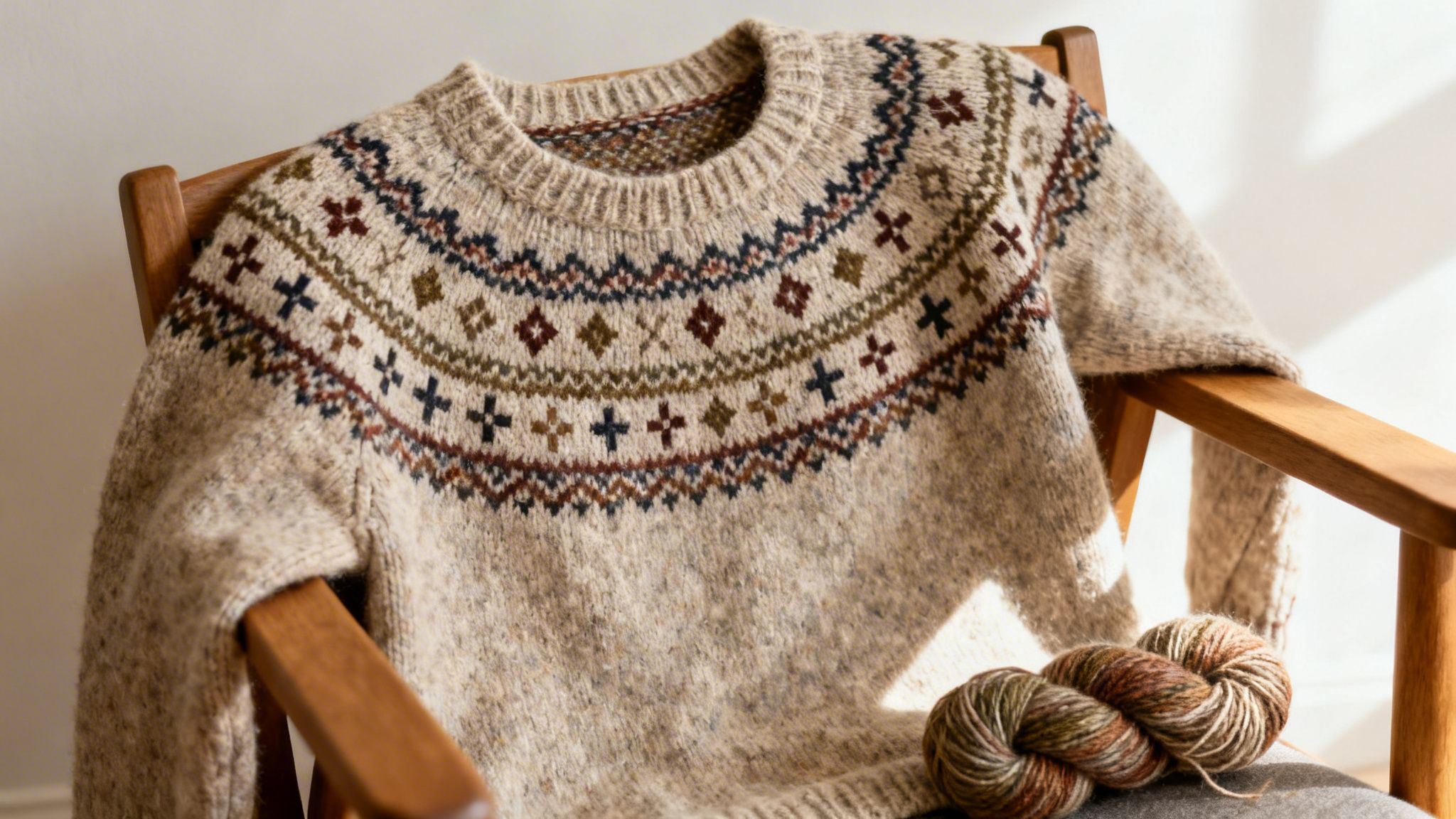
Imagine a sweater that tells the story of a remote, windswept island in its very threads. That’s the real essence of a Fair Isle sweater, a garment that’s both a piece of clothing and a canvas for cultural heritage, passed down through generations of knitters.
At its core, an authentic Fair Isle sweater is defined by its unique knitting method. Think of a mosaic artist working with a limited palette: the knitter juggles multiple strands of yarn but only ever uses two distinct colours in any single knitted row.
This method, known as stranded colourwork, creates the dense, wonderfully warm fabric and crisp patterns the style is famous for. The colour not in use is carried as a "float" along the back, which cleverly adds an extra layer of insulation.
The incredible visual charm of a Fair Isle sweater comes from its structured, repeating motifs, all carefully arranged in horizontal bands. These aren’t just random decorations but a recognised vocabulary of design.
The traditional patterns are often small and geometric, built on a grid-like structure. This systematic approach gives the finished garment a sense of order and rhythm, distinguishing it from more freeform Nordic designs.
While you'll find plenty of modern takes, the classic patterns are instantly recognisable. They draw their soul from the natural world and the daily life of the islanders.
Traditionally, the colours of a genuine Fair Isle sweater were pulled directly from the surrounding landscape. Dyers would use lichens, roots, and other plants to create a palette of soft, earthy tones.
Madder root produced rich reds, indigo gave deep blues, and a variety of lichens yielded stunning shades of yellow, brown, and even purple.
This reliance on natural dyes is what gives those early sweaters their famously harmonious, muted colour schemes. Today, while a much wider range of colours is available, the most iconic designs still echo this deep connection to nature, often pairing rich jewel tones with earthy neutrals. Understanding these core elements—the technique, the patterns, and the palette—is the first step in truly appreciating this wearable piece of art.
Every so often, a single piece of clothing captures the public’s imagination and rockets from local tradition to global phenomenon. For the Fair Isle sweater, that moment didn’t come from a clever marketing plan. It came from a prince, a game of golf, and one perfectly timed photograph.
Before the 1920s, the intricate knitwear from this tiny island was a beloved, but mostly regional, craft. It was a practical, beautiful tradition born from the hands of islanders. But a fashion-forward royal was about to change everything, forever cementing this humble sweater's place in fashion history.
The man of the hour? None other than HRH Edward, Prince of Wales, who was a true style icon of his time. In the early 1920s, he was snapped playing golf in a colourful, intricately patterned jumper. That single photo was all it took to light a fashion firestorm.
The image of the dashing prince in his unique sweater spread like wildfire, creating an unbelievable demand for what everyone was suddenly calling the "fair isle sweater." Almost overnight, this remote knitting technique was launched from the quiet Shetland Islands onto the world stage. It became an absolute must-have for the fashion-conscious across Europe and North America.
This royal seal of approval did for the Fair Isle sweater what today’s biggest influencers do for brands—it gave it instant visibility, credibility, and a cool factor that was simply impossible to resist. The demand exploded so quickly that knitters all over Shetland, not just on Fair Isle itself, had to start producing the jumpers to keep up.
The story gets even more interesting when you look closer. The sweater the prince wore was technically a Shetland creation, but its distinctive, colourful bands were pure Fair Isle style. He had it commissioned from a shop in Lerwick, which sourced the unique, traditional patterns directly from the island.
This moment perfectly captures how a hyperlocal craft can suddenly find itself in the global spotlight. The sweater became the very definition of sophisticated, relaxed country style—a reputation it proudly holds to this day.
The craze was incredible. Fair Isle knitting, with a history stretching back to the mid-1800s, was suddenly a worldwide sensation. The oldest surviving pieces, which you can see in the National Museum of Scotland, feature the same classic geometric motifs like crosses and diamonds that caught the Prince’s eye. Propelled by this newfound fame, the natural, earthy colours from Shetland sheep and early plant dyes became the signature look of the 1920s trend, defining the aesthetic we now think of as classic. You can explore the rich history of this knitting tradition to see its full evolution.
This amazing journey from a tiny community craft to a global style staple isn't entirely unique. It brings to mind the story of other beloved folk traditions, where the most valuable thing you have is authenticity and heritage. A fantastic parallel is Sweden's iconic Dala horse.
Much like the Fair Isle sweater, the Dala horse started out as a simple, handmade object in the villages of Dalarna, Sweden. Carved from leftover wood, these colourful little horses were toys for children and symbols of home. With time, they grew to become a powerful emblem of all Swedish craftsmanship.
Both of these traditions are built on the same core principles:
In Shetland today, handknitting skills are still taught to every primary school child, making sure the legacy is never lost. It's a beautiful echo of how carving skills are treasured and passed down within families in Dalarna. This shared spirit is a powerful reminder of how a community's creative heart can produce something so timeless it charms the entire world, from a prince's wardrobe to the high-fashion runways of designers like Ralph Lauren.
To the untrained eye, the cosy, patterned sweaters of Northern Europe can seem to blend together. They all share that intricate, rustic charm, but the world of Nordic knitting is actually full of distinct regional identities. A genuine Fair Isle sweater follows its own strict set of rules, giving it a unique visual language that sets it worlds apart from its Scandinavian cousins.
Learning to spot these differences is what elevates you from a casual admirer to a true connoisseur. Think of it like being able to tell regional accents apart; each knitting style has its own dialect, a story about its home woven right into the fibres, patterns, and colours. The trick is to train your eye on the details that define each tradition.
This visual map beautifully charts the journey of the Fair Isle sweater, from a remote island craft to an international fashion icon.
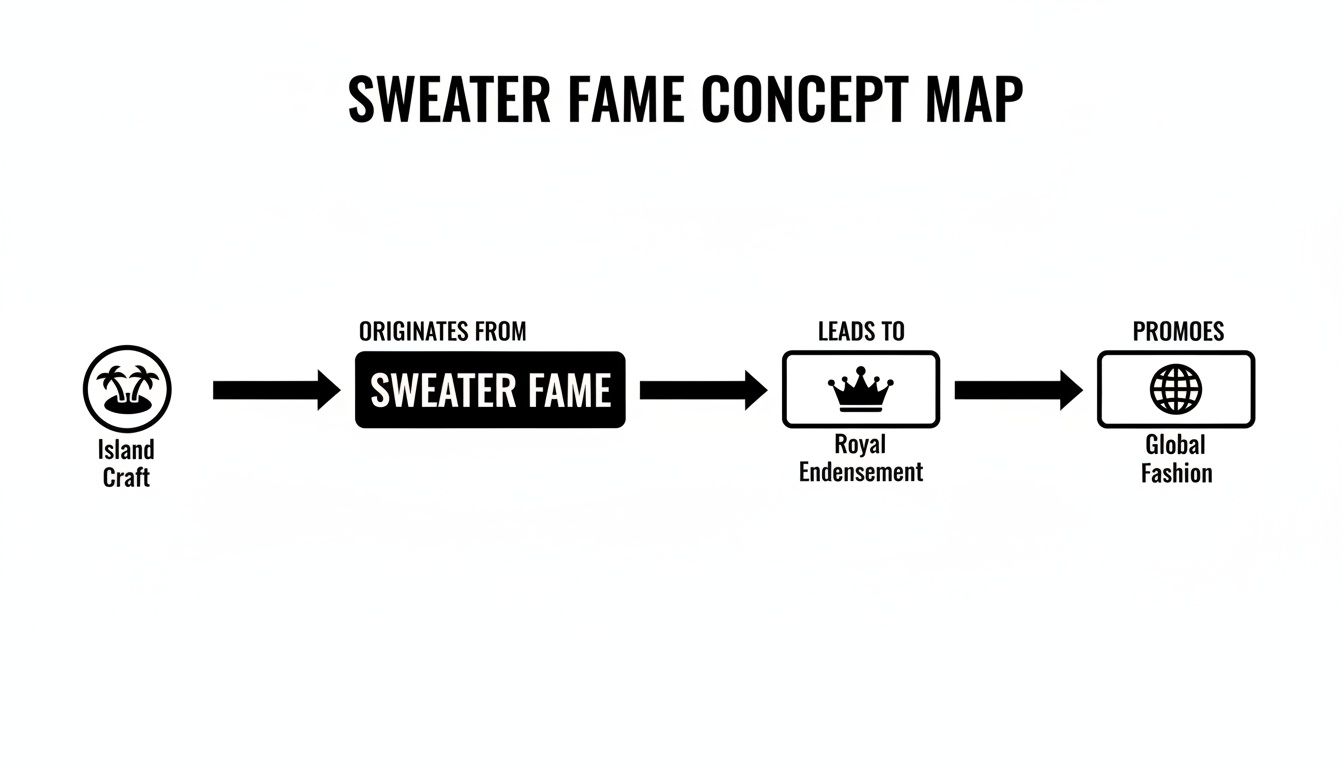
As you can see, the blend of hyperlocal authenticity with a powerful royal endorsement created the perfect conditions for global fame—a path many beloved folk arts have followed.
The single most important rule in traditional Fair Isle knitting is its disciplined approach to colour. While a finished jumper might boast five or more shades in its overall palette, any single knitted row will only ever use two colours. This is non-negotiable. This technique creates those crisp, well-defined patterns and a fabric with yarn "floats" on the reverse side, adding an extra layer of warmth.
Another key identifier is its structure. A true Fair Isle piece is built from horizontal bands of small, repeating geometric motifs that wrap around the entire garment, from hem to collar.
Think of it like patterned wallpaper, where small, self-contained designs are arranged in neat, orderly rows. This grid-like structure, often called an 'OXO' pattern, gives the sweater a balanced and rhythmic feel that is uniquely its own.
These two characteristics are the heart and soul of the style, making it impossible to mistake for other famous Nordic knitwear.
Now, let's take a trip over to Norway to meet the Lusekofte. The name might sound a bit odd, translating to "lice jacket," but it comes from its most recognisable feature: an all-over pattern of single stitches in a contrasting colour that look like tiny "lice."
Unlike the strict geometrics of Fair Isle, the Lusekofte often weaves in more figurative designs. It’s not uncommon to see stylised animals, people, or flowers worked into the pattern. And while it is a form of colourwork, it doesn’t follow Fair Isle's strict two-colours-per-row rule and often features bold, simple palettes like black and white or navy and cream.
Our final stop is Iceland, home of the iconic Lopapeysa. This sweater's most unmistakable feature is its construction. Instead of patterned bands covering the entire body, the Lopapeysa is defined by a single, wide, circular yoke of elaborate patterns that frames the neck and shoulders.
By keeping these key differences in mind—Fair Isle's two-colour rows and horizontal bands, Norway's "lice" stitches, and Iceland's decorative yoke—you'll be able to confidently identify an authentic fair isle sweater and fully appreciate the unique artistry that makes it so special.
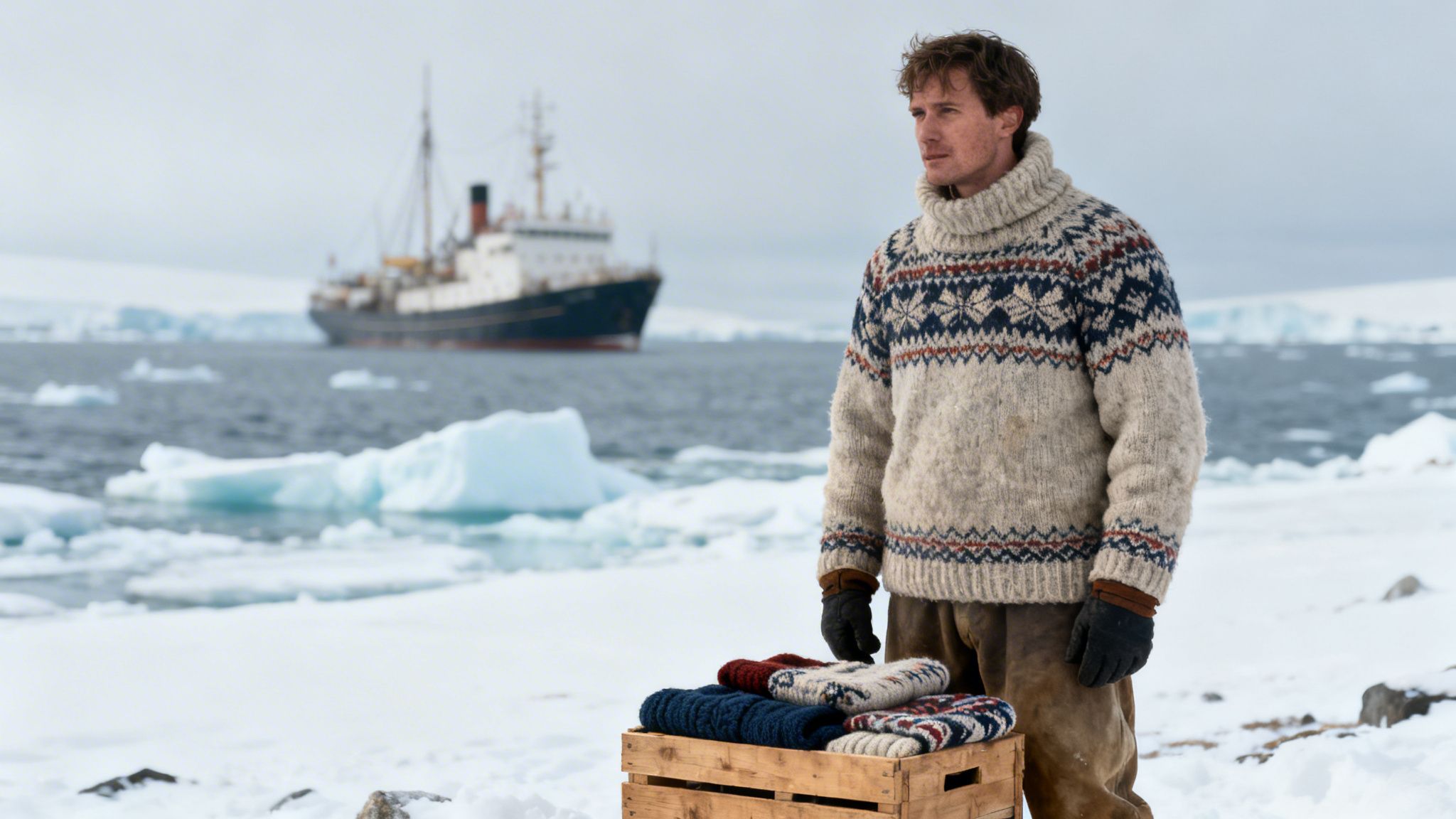
Long before it ever graced a royal portrait or a fashion magazine, the Fair Isle sweater had a much tougher job. It was a piece of high-performance gear, born from pure necessity and expertly engineered by islanders to survive the brutal North Atlantic. Its true spirit isn’t just in the patterns; it’s in its rugged, functional soul—a quality that was put to the ultimate test in the most unforgiving place on Earth.
This is the incredible story of how a tiny community’s craft was proven on the world’s harshest frontier. It shows us that the warmth and durability we cherish today aren't new features but the very heart of the Fair Isle sweater's legacy.
Back in 1902, the Scottish National Antarctic Expedition was preparing to venture into the brutal, uncharted wilderness of Antarctica. Led by William Speirs Bruce, the team needed clothing that could stand up to unimaginable cold, wind, and damp. They turned to the one place famous for producing knitwear that could handle the challenge: the tiny, remote island of Fair Isle.
The expedition placed a massive order with the island's small community of expert knitters. This wasn't just a request for a few jumpers; it was a commission for an entire arsenal of woollen armour, absolutely essential for survival.
The order put a huge demand on the island’s roughly 40 resident knitters, who got to work creating every single piece by hand. The final shipment to the expedition included an astonishing collection of handcrafted items, all designed for maximum warmth and resilience.
The list of gear included:
This enormous undertaking gave a significant economic boost to the island and cemented Fair Isle's reputation for producing exceptionally functional garments. You can learn more about the deep-rooted history of this craft on heritagecrafts.org.uk.
The triumph of these garments in the Antarctic really came down to one thing: the phenomenal quality of local Shetland wool. The stranded colourwork technique already creates a double-layered fabric that traps air for insulation. But when made with the unique fleece from Shetland sheep, the effect was amplified.
This expedition was the ultimate field test. The sweaters had to perform flawlessly, wicking moisture away during hard work while providing life-sustaining warmth in sub-zero temperatures. Their success was a powerful testament to a design perfected over generations.
Shetland wool is famous for its fine, crimped fibres that are both incredibly warm and surprisingly lightweight. It's also naturally water-resistant, making it the perfect material for sailors, fishermen, and, as it turned out, polar explorers. The Fair Isle sweater wasn't just chosen for its beauty; it was chosen because it worked.
This story perfectly frames the Fair Isle sweater not as a fashion statement, but as a masterpiece of practical design. It connects its historic utility to the quality you can still find today, reminding us that its intricate patterns are stitched around a core of pure, unyielding performance. Much like other regional crafts that blend artistry with function, such as the hardy socks of Sweden, its true value lies in its proven heritage.
A genuine Fair Isle sweater is far more than just a layer for warmth; it’s a story woven in wool, a versatile centrepiece for both your wardrobe and your home. Its intricate patterns and deep heritage bring a touch of timeless charm to any outfit or room. And while it has strong, outdoorsy roots, this iconic knit can be styled in wonderfully fresh and modern ways.
The secret is to let the sweater's detailed pattern do all the talking. Whether you're dressing down for a weekend walk or aiming for a more polished look, building your outfit around this single statement piece is the key to an effortlessly chic result.
Styling your Fair Isle sweater is all about creating balance. Because the knit is so busy and colourful, it pairs best with solid, neutral pieces that give its craftsmanship room to breathe.
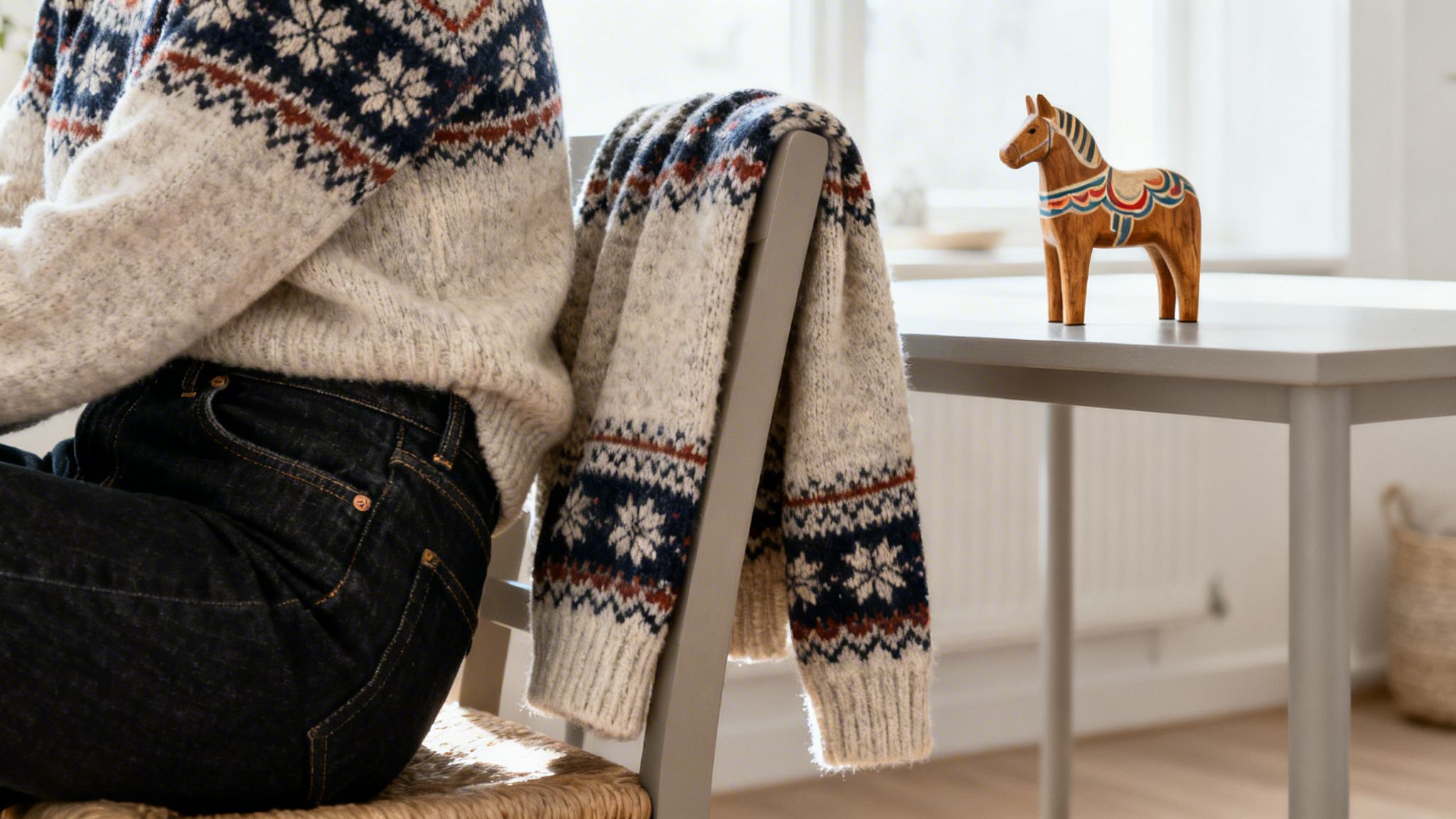
For a classic, can't-miss look, you simply can't go wrong with dark-wash denim. A great-fitting pair of jeans perfectly grounds the sweater's complex pattern, creating a relaxed yet put-together outfit that’s ideal for a weekend brunch or a crisp autumn day.
The goal is to build a modern look that honours the sweater's traditional feel. Think clean lines and simple silhouettes to complement the complex knitwork. This contrast is what makes the outfit feel current and intentional.
Ready to get started? Here are a few simple but effective pairings:
For more ideas on building a wardrobe with classic Nordic patterns, our guide to Scandinavian style clothing is full of inspiration.
The appeal of a Fair Isle knit extends far beyond your closet. Its rich texture and pattern are perfect for creating a warm, inviting atmosphere in your home, truly embodying the Danish concept of ‘hygge’—that feeling of cosy contentment.
Using a Fair Isle sweater in your décor is a simple way to add a layer of warmth and personality. Instead of tucking it away in a drawer, think of it as a functional piece of art that adds to a serene, Scandinavian-inspired interior.
Try draping a well-loved sweater over the back of a minimalist armchair or the corner of a sofa. This simple touch adds a pop of colour and intricate pattern, but it also invites you and your guests to wrap up and get comfortable.
To complete the picture, pair it with other elements of authentic Nordic folk art. Imagine it near a collection of hand-carved Dala horses on a mantelpiece or bookshelf. The sweater's geometric motifs and the smooth, hand-painted curves of the wooden figures create a beautiful, cohesive story—transforming a quiet corner into a charming celebration of artisanal heritage.
Bringing an authentic Fair Isle sweater into your life is like acquiring a piece of living history. It's more than just clothing; it's a connection to a remote island's legacy, a testament to generations of skill passed down through families. To find a piece you'll treasure for decades, it helps to understand what separates a true artisan garment from a simple imitation.
The real difference isn't just the price tag. It's in the hands that made it, the heritage behind the patterns, and the very soul of the wool itself. A genuine fair isle sweater is the product of extraordinary craftsmanship, and knowing what to look for is the first step on a delightful journey.
As you begin your search, you'll find a few different terms describing how these sweaters are made. Each method represents a different level of artistry and tradition, and knowing the difference is key to finding the perfect piece for your collection.
Truly Hand-Knitted: This is the absolute pinnacle of Fair Isle tradition. Made entirely by hand with knitting needles, these sweaters are crafted by a small, dedicated group of artisans, many still living on Fair Isle. The time, skill, and history poured into each one make them incredibly rare and sought-after treasures.
Hand-Framed: A wonderful blend of tradition and technology, these sweaters are made on a hand-operated knitting machine. While the machine helps create the fabric, a skilled artisan is still deeply involved, linking seams and finishing every detail by hand. This method allows for a faster creation time while keeping a remarkable amount of human touch and quality.
Machine-Made: These garments are mass-produced, often in large factories far from the Shetland Islands. While they might borrow Fair Isle-style patterns, they don't have the intricate complexity, premium materials, or unique character of an authentic piece.
The most exclusive and authentic sweaters come directly from the tiny population of Fair Isle, which has only around 55 residents. For a truly handmade piece from one of the island's master knitters, it's not unusual to join a waiting list that can be three years long.
Beyond newly crafted pieces, vintage Fair Isle sweaters have their own unique story to tell. Each one carries a rich history, connecting you to a specific moment in time. Collectors prize them for this sense of provenance, much like an art enthusiast appreciates the journey of a classic painting.
The knitting tradition has been a powerful cultural and economic force in Shetland since the 1700s, supporting the community and building its global reputation. This heritage is so vital that all primary school children in Shetland learn the art, ensuring the skills are never lost. To go deeper into this fascinating history, explore the full story of the Fair Isle sweater style on townandcountrymag.com.
Looking after your sweater properly is the key to preserving its beauty for a lifetime. Shetland wool is a wonderfully resilient natural fibre, but it loves a gentle touch.
Washing: Always hand-wash your sweater in cool or lukewarm water using a mild, wool-specific soap. Gently squeeze the suds through the fabric; never wring, twist, or scrub it, as this can damage the delicate fibres.
Rinsing: Rinse it carefully in water of the same temperature until the soap is completely gone. Be sure to support the sweater's full weight, as wet wool can easily stretch out of shape.
Drying: Gently squeeze out the extra water. Lay the sweater flat on a clean towel, roll them up together, and press firmly to absorb more moisture. Finally, unroll it and reshape the sweater on a fresh, dry towel or a mesh rack, keeping it away from direct heat or sunlight.
Storing: Never hang a wool sweater, as gravity will pull it out of shape. Instead, fold it neatly and keep it on a shelf or in a drawer. For long-term storage, a breathable garment bag with a few cedar blocks is perfect for keeping moths away.
Learning how to care for your garment ensures your investment will last for generations. If you're interested in exploring other iconic Scandinavian styles, you can check out our guide on prominent Swedish clothing brands.
As you’ve journeyed through the rich history and beautiful patterns of Fair Isle, a few practical questions might have popped into your head. It’s one thing to admire the craft, and another to live with it.
This final section is here to clear up some of the most common curiosities. Think of it as a friendly chat to round out your knowledge, helping you truly appreciate the unique place this knitwear holds in the world.
Yes, they certainly are—but these are some of the rarest garments in the world. The tiny island of Fair Isle is home to a permanent population of only about 55 people. Just a small handful of these residents are master knitters who produce pieces for sale.
These artisans create the true, hand-knitted sweaters that are considered the gold standard. As you can imagine, demand far outstrips supply, often leading to waiting lists that can stretch for years. While you'll find many "Fair Isle style" sweaters made elsewhere in Shetland and across the globe, an authentic, island-made piece remains a rare and deeply treasured find.
The price of a genuine fair isle sweater is a direct reflection of the incredible skill, time, and world-class materials poured into it. A single, hand-knitted garment can take hundreds of hours to bring to life, involving complex colourwork and painstaking hand-finishing.
On top of that, these sweaters are crafted from 100% Shetland wool, a fibre celebrated for its remarkable softness, warmth, and resilience. When you decide to invest in an authentic piece, you’re paying for:
In essence, you aren't just buying a sweater; you are supporting a fragile cultural heritage and acquiring an heirloom-quality garment that, with proper care, can last a lifetime.
It is strongly recommended that you never machine wash an authentic wool Fair Isle garment. The harsh agitation, temperature shocks, and spinning cycles of a washing machine can be disastrous. This process can cause the delicate wool fibres to felt, shrink, and completely lose their beautiful shape.
To preserve its integrity for decades, always choose to hand-wash your sweater gently in cool water. Use a soap designed specifically for wool, and your sweater will thank you for it.
At Dalaart, we celebrate the same spirit of authentic, sustainable craftsmanship found in every stitch of a Fair Isle sweater. Discover our collection of hand-carved and painted Dala horses, each a unique piece of Swedish folk art that brings timeless heritage into your home. Explore our curated selection at https://dalaart.com.


.svg)


.png)


