May 20, 2026
A framed Star Wars poster in a quiet Swedish flat can look either like a treasure or an afterthought. The difference usually isn't the film. It's whether the owner understands what kind of poster they've bought, why it matters, and how to let it sit comfortably inside a Scandinavian room.
The first thing many people notice about poster retro star wars art is its energy. Figures don't stand still. They surge forward. Lightsabers slice through dark space. Faces are larger than life, and the whole composition feels painted with urgency rather than assembled by software.
That feeling is part of why these posters still work decades later. They weren't made to be subtle. They were made to sell wonder.

Official Star Wars poster history includes multiple artist-approved variants, and that matters. StarWars.com's note on the original Star Wars poster states that the Style A poster was designed by Tom Jung in 1977, while another rare restored poster in its documented material was designed and autographed by Howard Chaykin. For collectors, artist attribution isn't trivia. It shapes provenance, historical importance, and value.
Tom Jung's work is a good example of why people respond so strongly to this period. The design language is cinematic but also illustrative. You can feel the hand behind it. Modern franchise prints often chase polish. Vintage poster art often chased drama.
A collector in Sweden might start with “I want an old Star Wars poster” and then discover that “old” isn't one thing. It could mean a theatrical release poster, a language variant, a later commemorative issue, or a retro-style decorative print. Once you notice the differences, the category becomes much richer.
Poster markets don't only respond to imagery. They respond to release moments. A useful example appears in this Galerie123 overview of Star Wars posters, which notes a clear historical anchor in the 1997 theatrical re-release, including The Empire Strikes Back “Special Edition” poster designed by Drew Struzan for the French theatrical re-release on 9 April 1997. The same source also points to official anniversary-poster campaigns documented by StarWars.com, including the 40th-anniversary celebration in 2017.
That helps explain why some posters sit in the collectible world and others stay in the décor world. A dated release, a specific edition, or an anniversary issue gives the object a place in the franchise timeline.
Original poster art should be read like printed film history, not just wall decoration.
If you're browsing Scandinavian listings, keep that historical lens in mind. The most useful starting point isn't “Which image do I like best?” It's “What was this poster made for?” Buyers who enjoy broader Nordic poster culture can also compare that thinking with vintage posters in Sweden, where edition history and print context often matter as much as the image itself.
A real collector often behaves like a detective. You don't begin with hope. You begin with clues.
When someone offers a “vintage” Star Wars poster, the safest first question isn't whether it looks old. It's whether the physical facts line up with a known theatrical object. Size, paper, print quality, folds, and restoration history tell you more than a romantic product description ever will.
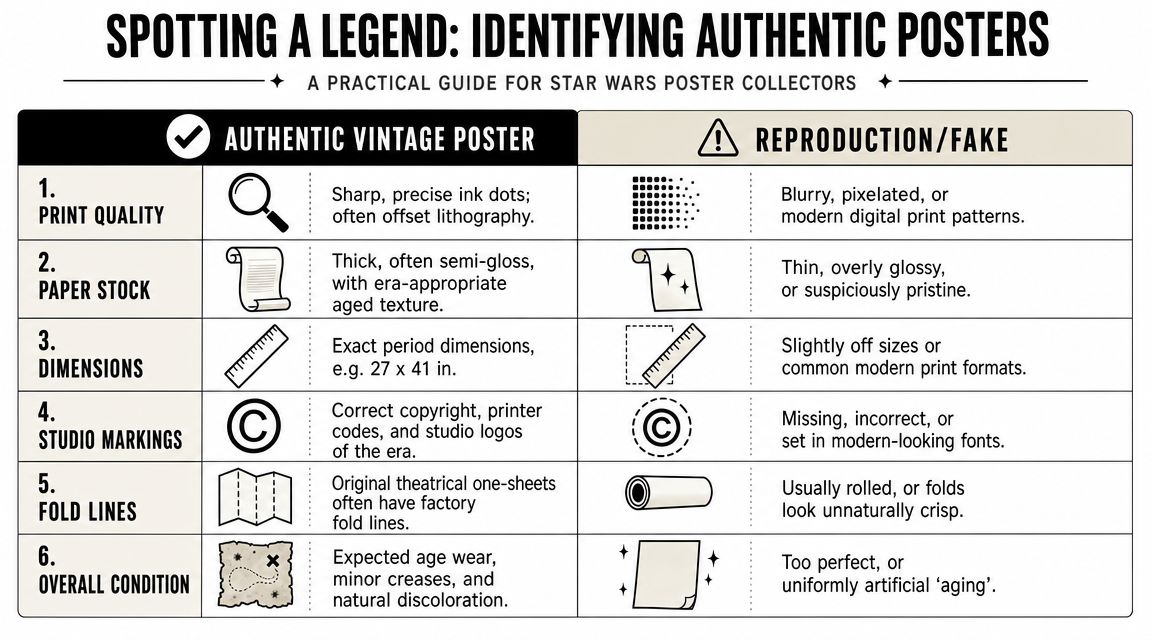
The strongest practical benchmark in this niche is the original 1977 U.S. one-sheet, printed in the standard 27 x 41 inch format. Posteritati's Star Wars listing notes that these originals are prized for their scarcity in near-mint condition, and it gives a concrete market example with an original 1977 U.S. one-sheet listed at USD 2,500.
That single fact teaches three useful lessons. First, exact dimensions matter. Second, originality matters. Third, condition can change the conversation dramatically.
Use this checklist before you buy:
Many newcomers get confused by restoration. They assume “restored” means fake, or they assume “linen-backed” means upgraded. Neither is always true. Restoration can stabilise fragile paper and help display it safely, but authenticity-sensitive buyers still want to know exactly what was done.
Practical rule: Buy the description as carefully as you buy the image.
The easiest mistakes usually come from listings that use collector language without collector detail. Terms like “vintage look”, “retro edition”, or “classic style” can describe a modern reproduction just as easily as an older object.
Watch for these red flags:
For Swedish buyers, there's also a practical issue beyond authenticity. Cross-border handling can be rough on paper. Even if the poster is legitimate, poor packaging can turn a good purchase into a compromised one before it arrives.
Not every Star Wars poster belongs in the same moral or commercial category. That's where many buyers get misled. Three objects can look similar on a screen and be completely different in legal standing, resale potential, and collecting purpose.
An original theatrical poster is part of the film's distribution history. It wasn't made to imitate the past. It is the past. That's why provenance matters so much in this tier.
An officially licensed reproduction serves a different role. It can be attractive, well-made, and worth owning, but it doesn't carry the same historic weight as a theatrical original. It's often the best choice for people who want the image without the pressure of preservation.
Then there's fan-made or inspired art. This can be the most personal category and sometimes the most visually fresh. It can also be the category where buyers need to pay the most attention to wording, permissions, and what's being sold.
Authentic Star Wars posters have shown a long-term upward value trend. Original Vintage Movie Posters' article on the Star Wars Triple Bill identifies a July 10, 2014 auction sale of the “Star Wars Triple Bill” poster as a notable milestone. The same source also points to an earlier Howard Chaykin original artwork sale at Bonham's in 2005 for $36,500.
Those details matter because they show this category isn't casual memorabilia. It's a mature collectible field where provenance, rarity, and condition drive serious interest.
Ethical collecting isn't complicated, but it does require discipline.
The common problem isn't that sellers offer different kinds of posters. The problem is that many listings blur those categories. A careful buyer keeps them separate and shops with the right expectations.
A Star Wars poster doesn't need to turn a room into a themed cinema corner. In a Scandinavian interior, it can work the same way a strong exhibition print works. As a focal point, a colour accent, and a piece of narrative.
The trick is restraint. Let the poster carry the drama so the room doesn't have to.

Retro Star Wars art often contains high contrast, deep blacks, warm reds, electric blues, and bright highlights. Scandinavian rooms usually lean on pale woods, soft whites, greys, wool textures, and disciplined spacing. Those two languages can complement each other beautifully.
A dramatic poster over a simple oak console works because the furniture stays quiet. A black frame can tie the poster to other dark accents in the room, such as a lamp base, chair legs, or a metal shelf.
If you add too many other pop-culture objects nearby, the poster loses dignity. If you give it breathing room, it starts to feel curated.
One practical issue gets ignored again and again. AllPosters' retro Star Wars poster category highlights common U.S. formats such as 22" x 34", and those sizes often don't fit standard local frames in Sweden. That usually means custom framing, careful matting, or the temptation to trim the print.
Don't trim if the piece has collector value. Build the frame around the poster, not the other way round.
For décor buyers, it helps to think through placement before ordering:
Matte finishes often sit more comfortably in bright Scandinavian daylight than shinier surfaces.
If you want the room to feel refined, repeat one visual idea from the poster somewhere else. A rust tone in a cushion. A black line echoed in a lamp. A muted blue picked up in a textile. You don't need literal Star Wars accessories.
People who enjoy pared-back wall styling often find useful visual principles in minimalist poster art. The same discipline applies here. One strong poster is usually more persuasive than several weaker ones competing for attention.
Framing is where many good intentions go wrong. Buyers spend time finding the right poster, then hand it over to cheap materials that slowly damage the paper.
For a collectible poster, the frame isn't decoration alone. It's part of the preservation system.
Paper reacts to light, handling, and acidic materials. A proper frame helps reduce those risks. If the poster matters to you, ask for archival, acid-free materials and discuss UV-protective glazing with the framer.
This is especially important for older posters or any piece with fragile edges, previous folds, or restoration. A frame should support the object without introducing pressure, staining, or unnecessary trimming.
A simple black frame often works best with retro Star Wars art because it respects the bold image without competing with it. Natural wood can also work in Scandinavian interiors, especially if the poster colours are warm and the room contains oak, ash, or birch.
What matters most is proportion. A poster with visual intensity usually benefits from a mount or enough breathing room to stop it feeling cramped. If the piece is valuable, ask the framer how they plan to secure it and whether the method is reversible.
The best frame protects quietly. You notice the poster first.
People sometimes treat framing choices the way they treat furniture trends. That's a mistake with paper collectibles. Fashion changes quickly. Conservation logic doesn't. If you'd like a useful reminder of how presentation can alter the mood of an artwork, even outside film posters, this piece on a Mark Rothko poster shows how framing and surrounding space shape what the viewer feels.
Not everyone needs an original. Sometimes the better path is to make a legal, personal tribute that captures the retro mood without pretending to be historic.
That approach is especially useful if you want a size that suits a Swedish flat, a matte finish for bright rooms, or a composition built around your own favourite character or trilogy era.

Start with artwork you're allowed to use. That might mean licensed material, your own illustration, or commissioned fan-inspired work with clear permission. Avoid anything that depends on misleading buyers later. If it's a modern creation, label it as one.
Then shape the look intentionally:
If you're ordering prints, paper stock, or framing supplies online, consumer information matters. The Swedish Consumer Agency, Konsumentverket, requires online shops to provide clear pre-purchase information on total price, delivery terms, and trader identity, which is especially relevant for cross-border art purchases and supplies ordered online, as noted in this Konsumentverket-related guidance reference.
That matters for DIY projects because the practical risks are familiar. Wrong paper. Delayed delivery. Prints arriving with colour shifts. A seller who looked polished until something went wrong.
Write down these decisions before you upload any file:
A well-made DIY poster doesn't compete with a theatrical original. It solves a different problem. It gives you the retro spirit, sized and styled for your home, without asking you to preserve a fragile artefact.
A good Star Wars poster can do two jobs at once. It can carry film history, and it can improve a room. The mistake is assuming every poster does both automatically.
If you're drawn to the collectible side, start slowly. Learn to recognise artist attribution, known formats, restoration history, and release context. Buy fewer pieces, but buy them with clearer eyes.
If you want the look more than the artefact, licensed prints and carefully made inspired work are often the more satisfying route. You'll get freedom with size, finish, and framing, and you won't feel anxious every time sunlight hits the wall.
If you're decorating a Scandinavian home, remember the simplest rule. Let the poster bring the drama, and let the room bring the calm. That contrast is what makes poster retro star wars styling feel grown-up rather than gimmicky.
Most collections begin with one honest decision. Do you want history, design, or a bit of both? Once you answer that, the rest becomes easier.
If you enjoy thoughtful collecting and Scandinavian craftsmanship, Dalaart is worth exploring. Its world is different from cinema posters, but the values are familiar: authenticity, provenance, hand-made character, and pieces chosen to live beautifully in real homes.


.svg)


.png)


