February 24, 2026
Kloster Keramik Ystad is a style of pottery that feels as if it were pulled directly from the soil and history of southern Sweden. It's a genuine piece of the Skåne region's soul, representing a beautiful bridge between medieval craftsmanship and the clean lines of modern Scandinavian design. For collectors who value authentic, handmade folk art, these pieces are a true find.
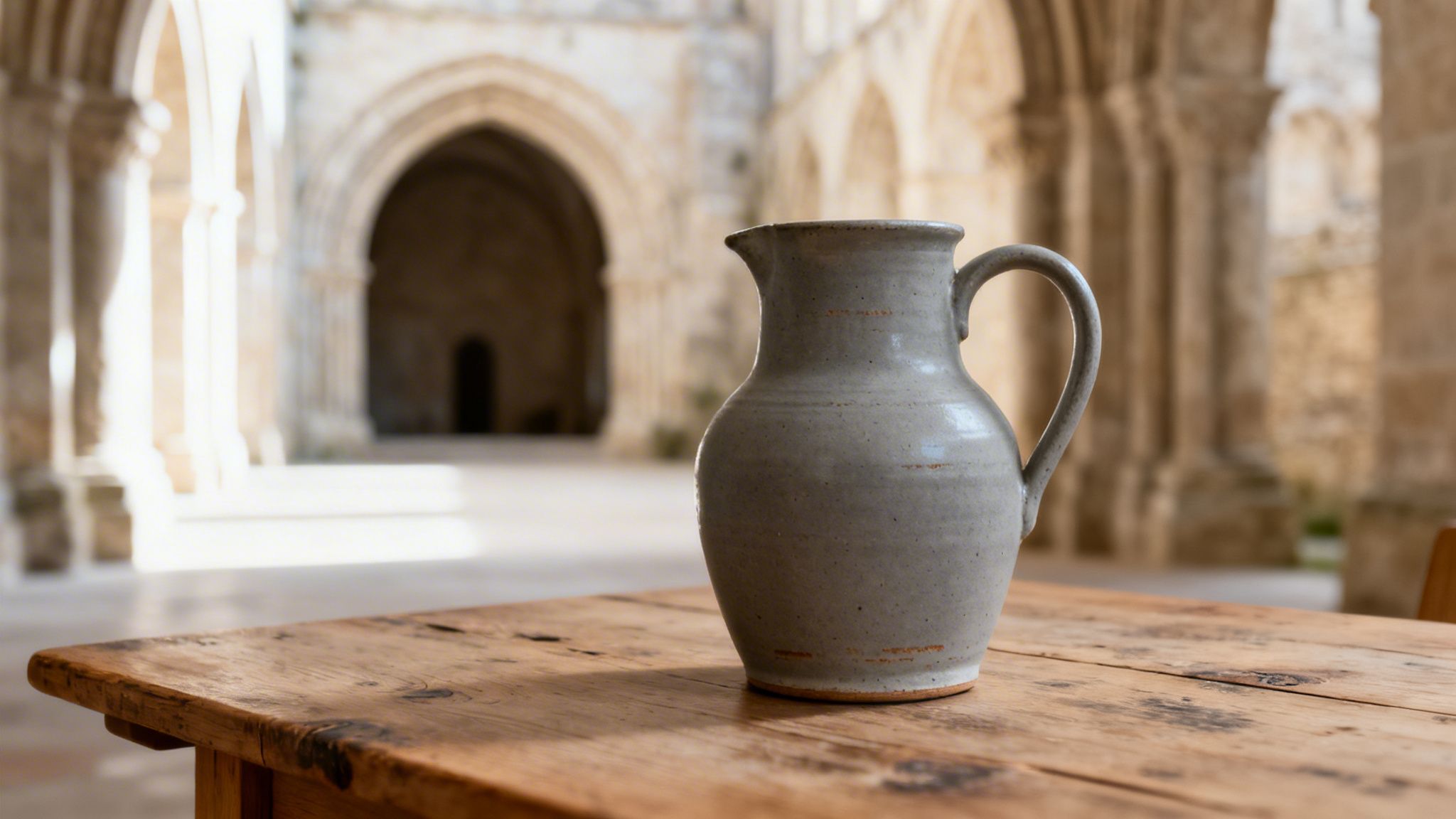
Discovering Kloster Keramik is like unearthing a story told in earth and fire. This isn't just about pottery; it's about connecting with centuries of Swedish tradition that began within the quiet walls of a medieval monastery. For collectors, each piece is more than a decorative object—it’s a fragment of history you can hold in your hands.
This ceramic tradition comes from Ystad, a picturesque coastal town in Skåne. Its heritage is directly tied to the Greyfriars Monastery (Gråbrödraklostret), where monks first developed the pottery techniques that would define the region's craft for generations. The unique, high-quality local clay gave them the perfect raw material, laying the foundation for a legacy of artisanship that has lasted for centuries.
The appeal of Kloster Keramik resonates deeply with anyone who loves Scandinavian design and folk art. In the same way a hand-carved Dala horse from Dalarna tells a story of its specific regional roots, a piece of Ystad pottery speaks of Skåne's coastal landscape and monastic past.
This powerful connection between place and craft is what draws so many collectors in. Owning a piece of Kloster Keramik Ystad is a chance to appreciate:
As you explore the world of Swedish folk art, you start to see a common thread. Whether it's the recycled wood of a Dalaart horse or the local clay of an Ystad pitcher, the materials themselves tell a story of sustainability and a deep respect for nature.
This guide will walk you through the fascinating history of this pottery, helping you understand its unique characteristics and what makes it such a treasured part of Sweden's artistic identity.

To really get a feel for Kloster Keramik Ystad, we need to wind the clock back—way back, long before these pieces became sought-after collector's items. The story here isn’t just about art. It’s a story shaped by geology, faith, and the simple, everyday needs of life in medieval Sweden. Its origins are literally baked into the soil of the Skåne region.
The heart of this tradition beats inside the ancient walls of the Grayfriars Monastery, or Gråbrödraklostret, which was founded in Ystad way back in the 13th century. The Franciscan friars who called this place home weren't just men of the cloth; they were innovators and artisans. They needed sturdy, reliable vessels for cooking, storing food, and eating, so they turned to the richest resource right under their feet: clay.
The land around Ystad is blessed with incredible post-glacial clay deposits, the perfect raw material for pottery. This wasn't just any old mud; its quality was fantastic, allowing the friars to create strong, functional stoneware that could stand up to the rigours of daily life. Their monastery workshops quickly became the first real centres of ceramic production, turning a gift of nature into essential goods.
The friars' expertise soon spread, influencing the entire region. This special local clay didn't just fuel their own workshops; it also supported major industries like brickmaking, which was vital for building. With timber not always easy to come by, clay became the go-to material. By the 19th century, it was used in over 60% of the area's buildings. You can dig deeper into Sweden's ancient ceramic arts over at Historiska.se.
This kind of regional craftsmanship has parallels all over Sweden, like the famous stoneware from Höganäs. If you're curious, you can learn more about this iconic pottery in our guide on Höganäs Keramik.
The pottery coming out of these cloister workshops, known as Younger Grey Ware, was so well-made and produced in such quantities that it became a medieval staple. In fact, historical finds show that by the 13th century, a whopping 70% of all grey ware pottery found in Skåne came from monastic kilns just like the ones in Ystad. This wasn't a small side hobby; it was a sophisticated and well-organised production system.
The connection between the land and the finished product is the essence of Swedish folk craft. Just as a Dala horse carries the spirit of the Dalarna forests, a piece of Ystad pottery holds the history of the Skåne soil and the hands that first shaped it.
This unbroken line of craftsmanship—stretching from a medieval friar shaping a simple bowl to a modern artist creating a beautiful vase—is what makes Kloster Keramik Ystad so special. Every piece is a direct descendant of this long and fascinating tradition. The simple, functional shapes and earthy glazes you see today are a clear nod to the practical needs and timeless style of those very first monastery potters.
For any aspiring collector, learning to tell the difference between a genuine piece and a simple lookalike is the most important skill you can develop. When it comes to Kloster Keramik Ystad, this knowledge turns a simple search into a rewarding treasure hunt. Think of it like learning to read the unique signature of an artist on a Dala horse; the potter's marks and stylistic details on a ceramic piece tell its entire life story.
Authenticating Ystad pottery doesn't require you to be a seasoned expert, but it does mean training your eye to spot a few key characteristics. The journey always begins at the bottom of the piece, where the maker often left their mark.
The most reliable sign of authenticity is the maker's mark or signature. Just like a painter signs their canvas, potters would inscribe or stamp the base of their work. For Kloster Keramik, these marks can vary quite a bit depending on the era and the specific artisan who made it.
Common marks to look for include:
An authentic mark is the pottery's certificate of origin. It connects the piece directly to a specific workshop and a moment in Ystad's long ceramic history, confirming its place within this cherished tradition.
Beyond the signature, the physical characteristics of the piece itself are crucial. Authentic Kloster Keramik has a distinct personality shaped by its form, weight, and glaze. Vintage pieces, for instance, often feel heavier and more robust than modern reproductions. They have a certain rustic sturdiness that speaks to their functional, everyday origins.
The glaze is another critical clue. Traditional Ystad glazes are known for their earthy, subtle tones—think deep browns, muted greens, and soft greys. Look for a richness and depth in the colour that’s hard to replicate. You might even spot minor imperfections, like tiny variations in the glaze thickness or slight crazing (a fine network of cracks on the glaze surface). These are often signs of age and authenticity, not flaws. Learning about different Swedish ceramic styles can give you helpful context; for example, you can explore the characteristics of another famous maker in our article on Gabriel Stengods.
Assessing the overall form is just as important. Kloster Keramik forms are typically simple, functional, and well-proportioned. They avoid overly ornate decoration, letting the quality of the clay and glaze speak for itself. By carefully examining these elements—mark, weight, glaze, and shape—you can build the confidence to identify true pieces of Kloster Keramik Ystad and add a genuine piece of Swedish heritage to your collection.
The story of Kloster Keramik Ystad isn’t just about artistry; it’s a fascinating tale of economic evolution. What began in the humble, secluded monastic kilns of the 13th century would grow into a commercial powerhouse, eventually shaping the entire Skåne region’s economy and turning local pottery into a major export.
This journey from a quiet monastery craft to a bustling marketplace was surprisingly organised from the start. Archaeological digs in Ystad have shown that even in medieval times, this was no simple cottage industry. The production of the now-famous Younger Grey Ware was highly standardised, a clear sign of a sophisticated system built for something much bigger than just local use.
The real game-changer came with the arrival of the railways in the 1860s. This new infrastructure was like a shot of adrenaline for Ystad’s potteries, connecting them to the rest of Sweden and far beyond. Local workshops quickly transformed into engines of export, and the impact was enormous. It firmly put Ystad on the map as a major centre for ceramic production.
This infographic breaks down the core elements to look for when identifying authentic pottery from this booming period.
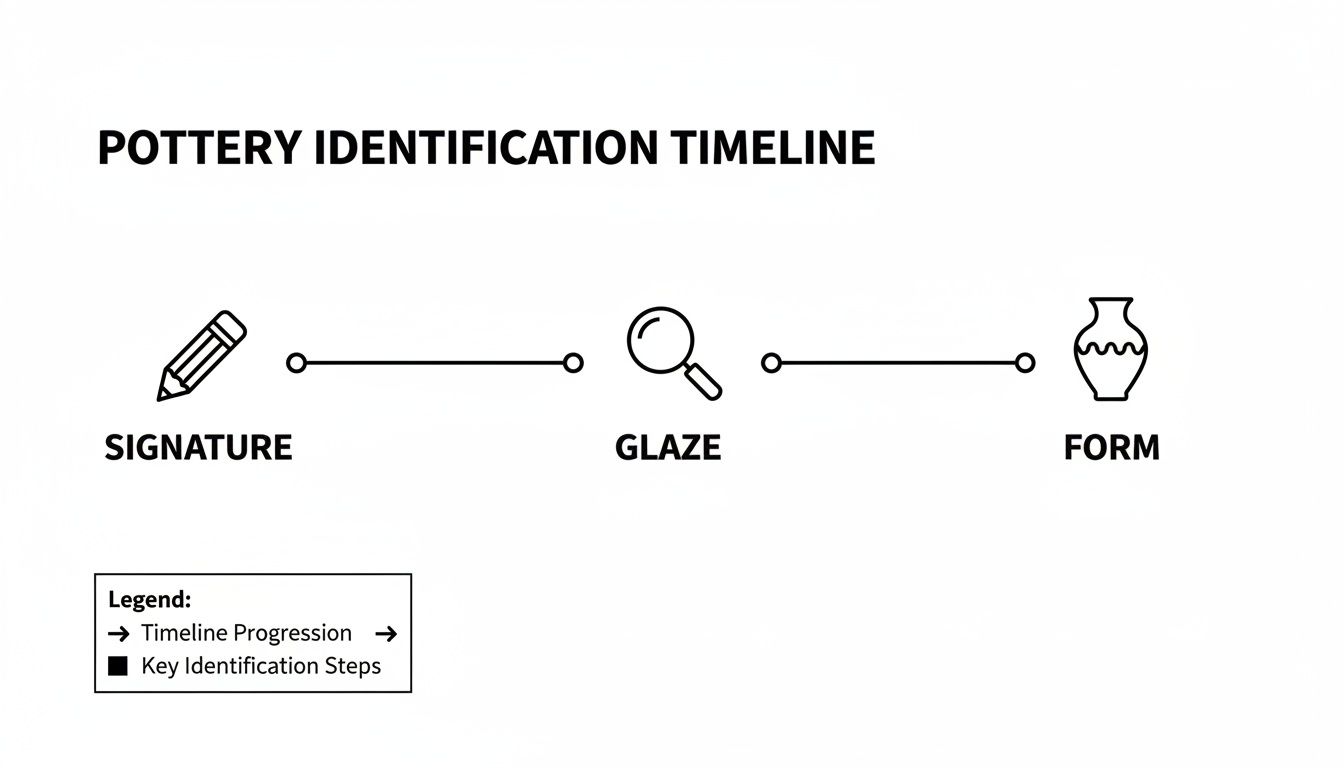
As the visual guide shows, it's about more than just one mark. You need to look at the combination of the signature, the glaze, and the form to be sure of what you have.
This industrial boom turned Skåne into a ceramics juggernaut. At its absolute peak, the region was responsible for a staggering 40% of all pre-industrial ceramics in Sweden. The railways turbocharged this growth, boosting exports by an incredible 300%.
You can see the sheer scale of this operation in the uniformity of the pieces they produced. In Ystad, those monastic kilns evolved into organised commercial ventures. Excavations at key sites like Kv. Myntet have unearthed large, almost identical collections of Younger Grey Ware. Vessel widths were consistently standardised to between 20-25 cm, and these standardised items made up a massive 90% of all medieval ceramic finds—clear evidence of mass production.
This industrial peak lasted right up until the 1930s. A decline eventually began as the economy shifted towards agricultural industrialisation, leading to the closure of the last major clay factory. You can dive deeper into this history in this detailed research from Chalmers University.
Understanding this economic journey adds a whole new layer of appreciation for each piece of Kloster Keramik. A simple bowl is not just a beautiful object; it’s a tangible piece of a regional industry that once powered southern Sweden's economy.
Although the era of mass production eventually faded, the story of Ystad pottery was far from over. Today, the tradition has been beautifully reborn, thanks to a modern love for artisanal craft and heritage. The legacy of those medieval kilns and old factories now lives on in the hands of contemporary potters.
This modern revival is part of a wider trend across the country. In 2025, Sweden's porcelain and ceramic manufacturing sector is projected to include around 800 businesses, a testament to the enduring appeal of handcrafted quality. For collectors, this means the pieces found today—whether vintage heirlooms or new creations—are all part of a rich, continuous story. Each one represents a chapter in Ystad's remarkable journey from monastic craft to modern artisanal treasure.
When you pair a wheel-thrown vessel from the clay beds of Skåne with a hand-painted figure from the forests of Dalarna, the result feels surprisingly seamless. Blending Kloster Keramik Ystad pieces into your Dalaart display isn’t just about filling shelves; it’s about telling a richer story of Swedish folk traditions. Although stoneware and painted wood start life in very different workshops, they carry the same spirit: a respect for natural materials and everyday beauty.
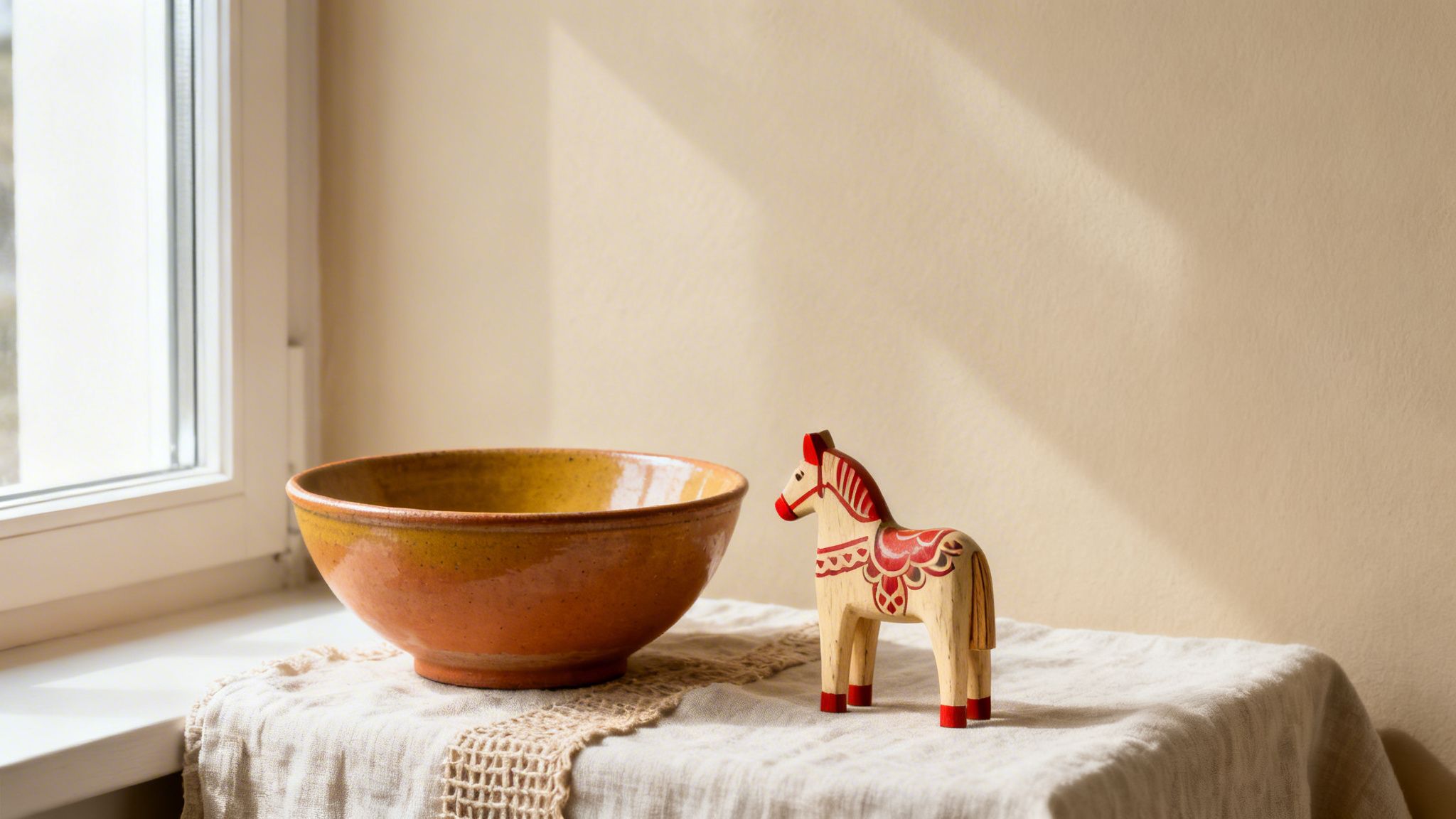
The real magic lies in contrast. The subdued, earthy glazes of Ystad—think deep browns, soft greys and mossy greens—set a calm stage. Against that, the lively curves and bright hues of a Dala horse leap forward, creating a dialogue between calm and colour. Imagine your pottery as the stage and your Dala horse as the star performer.
Styling these friends is all about sparking conversation between texture and tone. The slightly coarse finish of a Kloster Keramik vase finds its perfect counterpart in the glossy, hand-painted surface of a Dala rooster. Together, they add depth and authenticity to any space.
Here are a few practical ways to bring them together:
Combining these crafts turns decorating into curating. Each object enhances the next, weaving a single story of regional pride and artisanal skill.
Ultimately, merging these regional treasures celebrates the unity and variety of Swedish heritage. The honest character of Kloster Keramik Ystad and the cheerful energy of your Dalaart animals are two sides of the same coin—both telling a timeless tale of Sweden’s handmade artistry.
For anyone inspired to see where this incredible ceramic tradition comes to life, a trip to Ystad turns a simple shopping trip into a real cultural journey. The charming coastal town is more than just scenic; it’s a living museum where the legacy of Kloster Keramik Ystad waits to be discovered around every cobblestoned corner. If you plan your visit like an insider, you'll be able to connect directly with the region's rich history and its artisans.
Ystad is a wonderfully walkable town. At its heart lies the ancient Grayfriars Monastery (Gråbrödraklostret), the very birthplace of this ceramic art. I always recommend starting your exploration here, as it provides a powerful context for the pottery you’ll find later. Standing within its historic walls, you can almost feel the centuries of craftsmanship that originated on that exact spot.
Once you’ve soaked in the history, the hunt for pottery begins. Ystad and the surrounding Skåne countryside are dotted with places to find both vintage and contemporary pieces. The real trick is knowing where to look.
You'll find your best opportunities at:
Think of your search as a pilgrimage of sorts. Each shop you enter, from a dusty loppis to a bright, modern studio, is a stop along a path that connects you directly to Ystad's deep-rooted ceramic heritage.
The best time to visit is during the late spring and summer months, from about May to August. The weather is lovely, and all the local markets are in full swing. This is also when most artists' studios keep more regular opening hours.
A little planning goes a long way and will ensure your trip is a fruitful one. It allows you to not just buy a piece of Kloster Keramik Ystad, but to truly experience the culture that created it.
As you start exploring the beautiful world of Kloster Keramik, a few questions are bound to pop up. It's completely natural, especially when you're just getting your feet wet. Here are a few pointers to help guide you on your journey into this wonderful piece of Swedish heritage.
Distinguishing between vintage and contemporary Ystad pottery is one of the first things new collectors learn. You can often tell by feel and sight. Older Kloster Keramik from the 20th century usually has a bit more heft to it and might show subtle signs of a life well-lived, like fine crazing in the glaze. The maker's marks from potteries that have since closed are another key clue.
Newer pieces from today's Ystad potters, on the other hand, tend to have a more refined finish and brighter, more modern glazes. The artist's mark is typically very clear, and you'll often see a beautiful blend of traditional shapes with a fresh, modern twist.
Not at all! The cost of collecting Kloster Keramik Ystad can vary quite a bit, which is great because it makes the hobby accessible to almost everyone. You can find smaller, more common items from the mid-20th century for very reasonable prices, especially if you get the chance to browse a local Swedish flea market, or loppis.
Of course, like any collectible, prices can climb. Historically significant pieces or works by celebrated artists can fetch high prices at auction. But ultimately, you can build a wonderful collection that fits your budget, making it an incredibly welcoming field to get into.
For so many collectors, the real value isn't about the price tag. It’s about holding a piece of tangible history in your hands. Each ceramic tells the story of its home, from the clay of Skåne to the artisan who brought it to life.
A little bit of care goes a long way in making sure your pottery is enjoyed for generations to come. For most glazed stoneware, a gentle hand-wash with mild soap and warm water is perfect. Just be sure to avoid any abrasive sponges or scrubbers that could scratch that beautiful glaze.
If you have more fragile, older, or unglazed terracotta pieces, a simple dusting with a soft, dry cloth is your best bet. And a good rule of thumb is to always display your collection away from busy, high-traffic areas to prevent any heartbreaking accidents.
At Dalaart, we believe every piece of folk art has a story to tell. As you explore the rustic charm of Ystad's ceramics, take a moment to see how beautifully they pair with our collection of authentic, hand-carved Dala horses. Discover the Dalaart collection.


.svg)


.png)


