December 27, 2025
At its heart, a one line art drawing is exactly what it sounds like: a piece of art created with a single, unbroken line. The magic of this technique comes from its elegant simplicity. It’s all about capturing the true essence of a subject—whether that's a face, an animal, or a simple object—without ever lifting your pen from the paper. It’s a beautiful exercise in flow and expression.
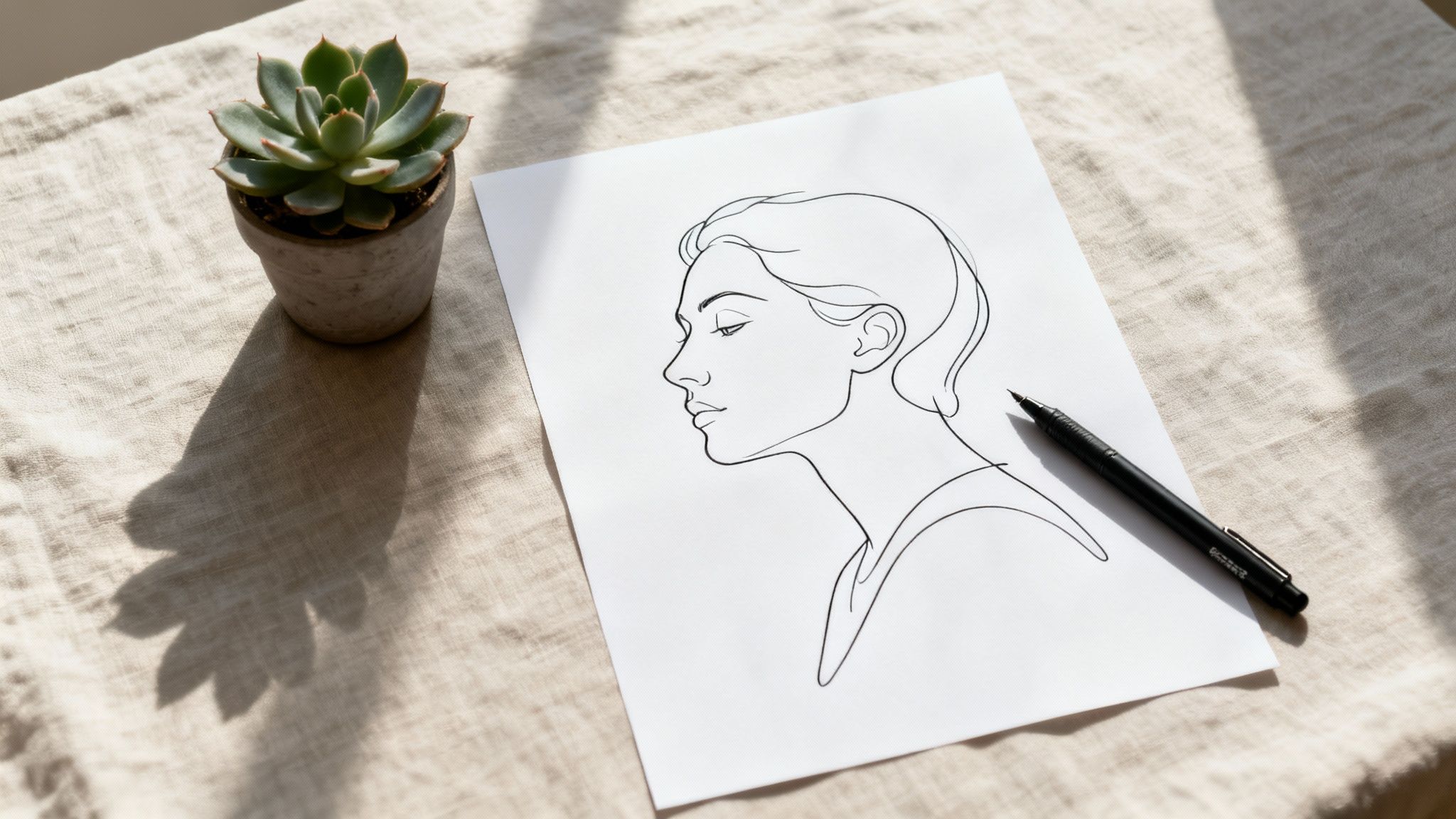
Welcome to the wonderfully meditative world of one line art. This isn't about chasing technical perfection; it's a celebration of continuous motion, intuition, and finding a profound beauty in minimalism. The single, flowing line forces you to really see the core form of your subject, stripping away all the unnecessary details to reveal its fundamental character.
This minimalist approach shares a deep kinship with Scandinavian design principles, which also champion clean lines, simple function, and a strong connection to nature. Think about it: just as a classic Nordic chair finds its elegance in its uncomplicated structure, a one line art drawing finds its power in a single, uninterrupted path.
So many of us feel intimidated by art, convinced we don't have the "skill" to create something beautiful. The continuous line method throws that pressure right out the window. Forget about being a "perfect" artist. This guide is your personal invitation to just pick up a pen and explore a relaxing, accessible, and deeply satisfying way to be creative.
This simple practice is so much more than just doodling. It’s about training your eyes to truly see the contours of the world around you and teaching your hand to follow, turning a simple line into a potent form of self-expression.
Ultimately, this guide will walk you through transforming a simple, continuous stroke into meaningful art. You’ll learn how to capture the spirit of everything from portraits to beloved Scandinavian icons like the Dala horse, creating pieces that feel both modern and timeless.
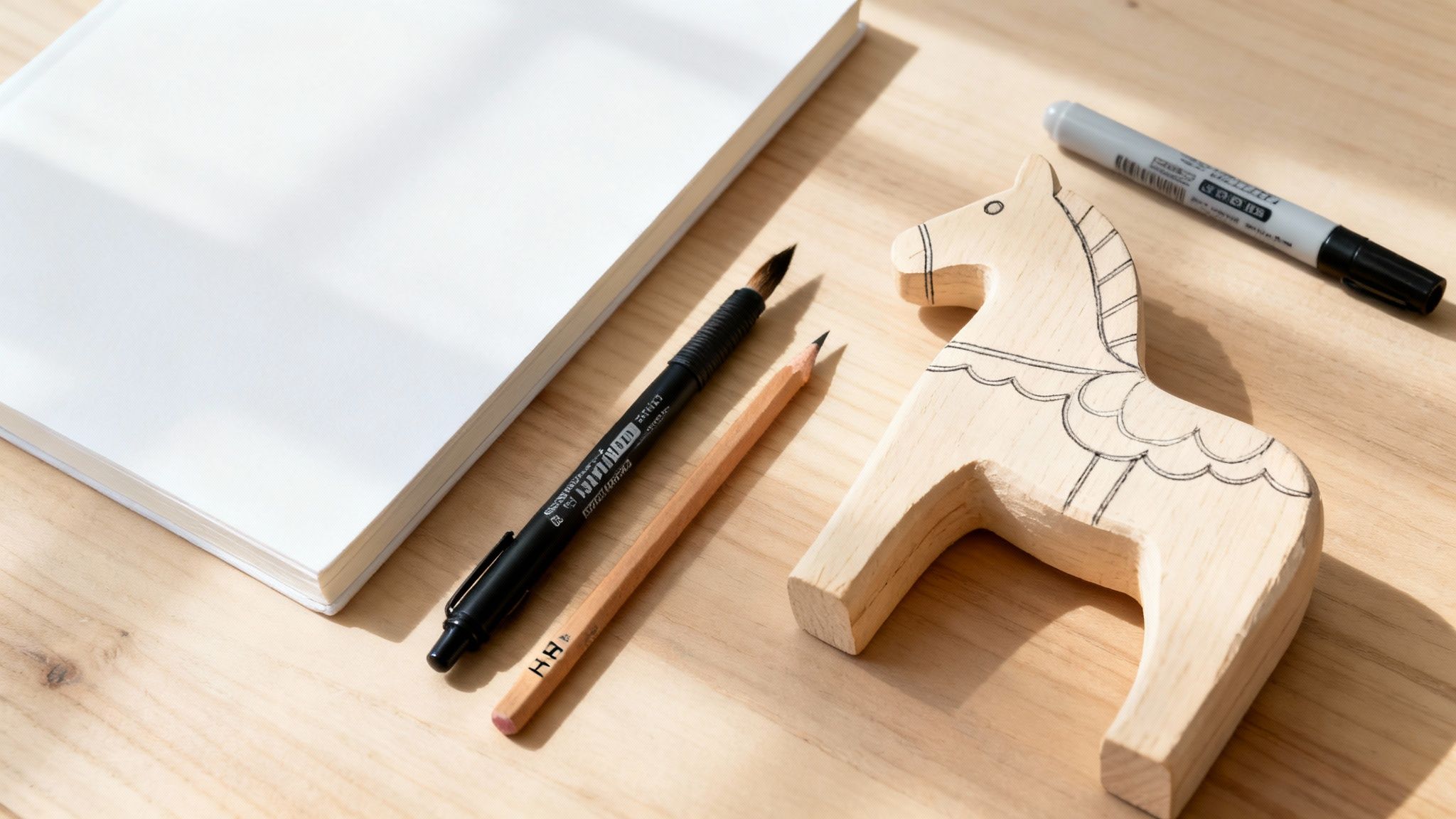
One of the most appealing things about diving into one line art drawing is how little you actually need to get started. There’s no need for an expensive, complicated setup. Chances are, you already have the perfect tools lying around the house. The real focus is on simple, accessible materials that let you start creating straight away.
The most important tool you'll pick up is your pen. Its unique character will directly shape the final look and feel of your artwork. Honestly, a simple ballpoint or gel pen is a fantastic starting point for building that crucial hand control.
Once you start getting the hang of it, playing around with different kinds of pens can totally transform your style.
Don't overlook your paper choice, either. A smooth, slightly thicker paper—something around 120 gsm or more—gives you a beautiful surface to work on and helps stop the ink from bleeding through. It just keeps your lines looking sharp and intentional. Regular printer paper is fine for practice runs, but a good quality sketchbook really elevates your finished pieces and makes them feel more special.
Remember, the main goal is to find tools that feel comfortable and natural in your hand. That connection between you, your pen, and the paper is what truly brings a one line art drawing to life. Don't ever be afraid to experiment with whatever you can find.
Taking your designs off the page and onto a 3D object is such a rewarding next step, and it’s a concept deeply rooted in Scandinavian craft traditions. Just imagine turning a simple, unpainted wooden Dala horse into a one-of-a-kind piece of decor for your home. For a project like this, you'll need a slightly different toolkit.
Paint markers with fine tips are fantastic for drawing directly onto wood. They give you brilliant control and beautifully opaque colour. If you prefer a more traditional feel, a fine-tipped paintbrush and some acrylic paint work just as well. You could lightly sketch out a design in pencil first, but I find the real magic happens when you commit and let that beautiful, continuous line flow directly from your brush or marker onto the surface.
Before you even think about tackling a complex subject, it’s a good idea to build up some foundational muscle memory. Think of these exercises less like boring practice and more like a meditative warm-up. It’s a chance to quiet that nagging inner critic and just get your hand comfortable with the continuous, flowing motion that defines one line art drawing.
The goal here isn't to create a masterpiece. It's about letting go of the fear of making a mistake. These drills are designed to forge a stronger connection between what your eyes see and what your hand does. You’re teaching your muscles to move smoothly and confidently across the page, embracing the wobbly, imperfect lines that give this art form so much of its character.
Grab a blank page and start filling it with simple, repetitive movements without ever lifting your pen. Don’t overthink it—just let your hand glide.
These aren't just mindless doodles; they are fundamental exercises in control and fluidity. Spending just five minutes on these warm-ups before you start a drawing can make a world of difference in your confidence and the final result.
The most powerful technique for building your observational skills has to be blind contour drawing. Place an object in front of you, put your pen to the paper, and draw its outline without ever looking down at your drawing. It feels incredibly strange at first, but it forces you to truly see every single curve and edge of your subject.
The simplicity and raw accessibility of this style have helped it explode in popularity around the world. In Southeast Asia, for instance, the one line art drawing trend has become a champion at major art fairs.
Singapore's Art SG recently drew over 40,000 visitors to see works from more than 100 galleries, where fluid, single-stroke masterpieces were a prominent feature. This reflects a much broader trend, with Christie’s noting that 26% of its 2024 global sales came from Asia-Pacific buyers—many of whom are millennials favouring accessible yet valuable styles. You can explore more on the online fine art market to see just how quickly this trend is growing.
With your hand nicely warmed up, you’re ready to create something recognisable. This is where the magic really starts, moving from abstract squiggles to defined subjects. The secret here is to mentally trace the entire journey of your line before the pen even touches the paper. Visualise it from start to finish.
Let's begin with a classic subject in one line art drawing: the human face profile. Picture your line starting at the forehead. Imagine it travelling down the gentle slope of the nose, dipping in at the lips, and then curving gracefully around the chin and jawline.
From there, the line can loop back to form the neck before sweeping upwards to create the flowing shape of the hair—all in a single, fluid motion. The trick is to let go of perfection and focus on the silhouette, allowing the continuous line to define the form.
This flowchart shows a simple warm-up sequence that gets you ready for more complex subjects, moving from basic spirals to observational contour drawing.
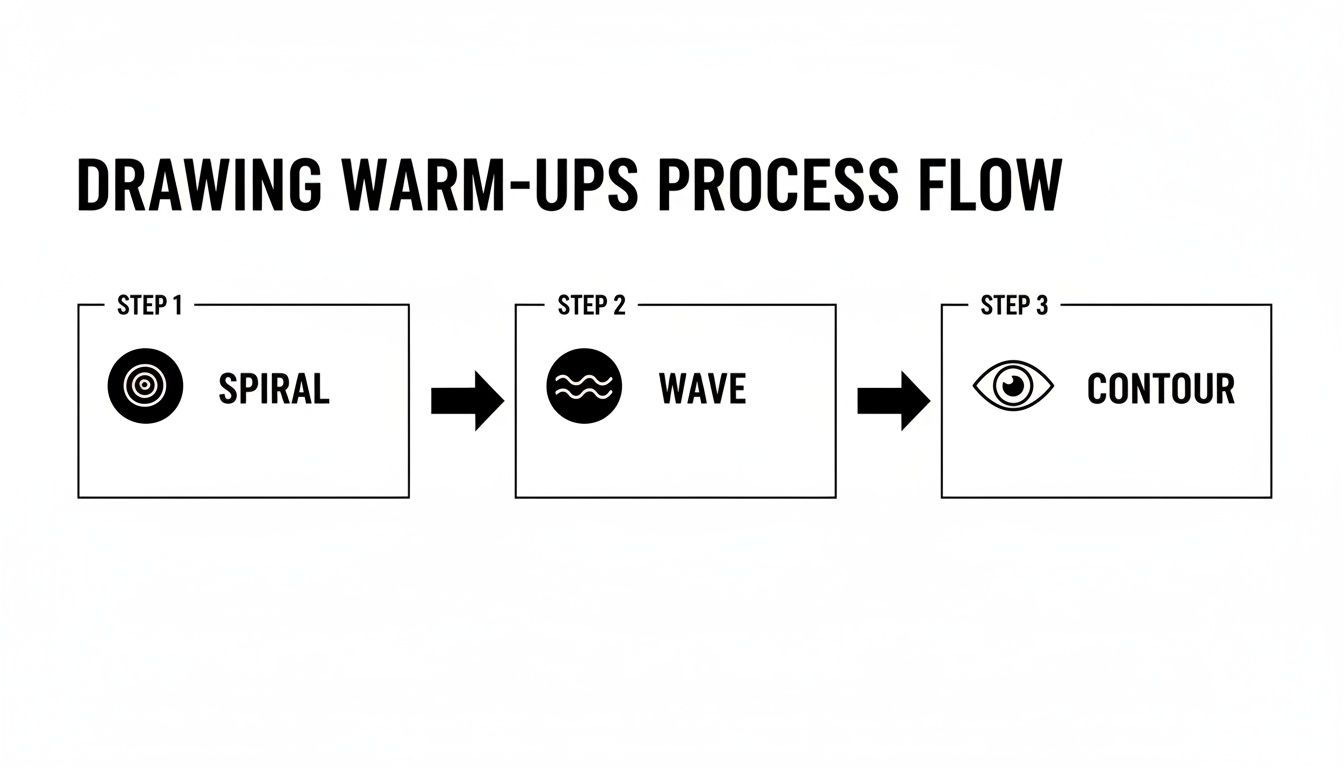
These foundational drills are what build the muscle memory needed for the more detailed work we're about to dive into.
Next, let's try an animal. A cat is always a great choice. The beauty of drawing animals is in capturing their natural movement and posture. You could start at the tip of an ear, letting your line trace the elegant curve of the cat’s back all the way to the flick of its tail.
Then, without lifting the pen, loop back underneath to form the belly and legs before finishing the head. Don't get bogged down in perfect anatomy. The goal is to capture the essence of the cat—its graceful curves and alert posture. Overlapping your line as you form the legs is a simple but really effective way to create a sense of depth.
An inanimate object, like a leafy plant, offers a different sort of challenge. This is great practice for capturing both organic shapes and a strong silhouette. Begin at the base of the pot and draw upwards, creating the stem.
From there, let your line branch out to form the individual leaves, looping back to the main stem after each one. The overlapping lines where the leaves meet the stem will naturally create a bit of dimension.
Planning your line's journey is half the battle. Before you start, try lightly tracing the intended path in the air just above your paper. This simple rehearsal builds confidence and helps you anticipate tricky turns and overlaps.
This minimalist art style has found a huge audience worldwide, especially in places where clean aesthetics are celebrated. In the vibrant art scene of Southeast Asia, one-line drawing has surged in popularity, embraced by contemporary galleries at major events like Art SG in Singapore.
The most recent fair hosted over 100 galleries from around 30 countries and drew more than 40,000 visitors, cementing the city's role as a major art hub. Simple, fluid line works gained serious traction, especially among younger collectors, who made up 44% of bidders at Christie's Asia auctions.
For more inspiration on how to get started, you can check out our full guide on one line art drawing for additional tips.
So, you've been practising and are starting to feel more confident with your continuous line work. That’s fantastic! Now for the really fun part: infusing your new skills with the cosy, minimalist charm of Scandinavian design.
It's a perfect pairing, really. Both one line art drawing and Nordic aesthetics are all about celebrating simplicity, nature, and things made with care. We’ll look at a few tangible projects that can turn your simple drawings into timeless pieces of decor for your home.
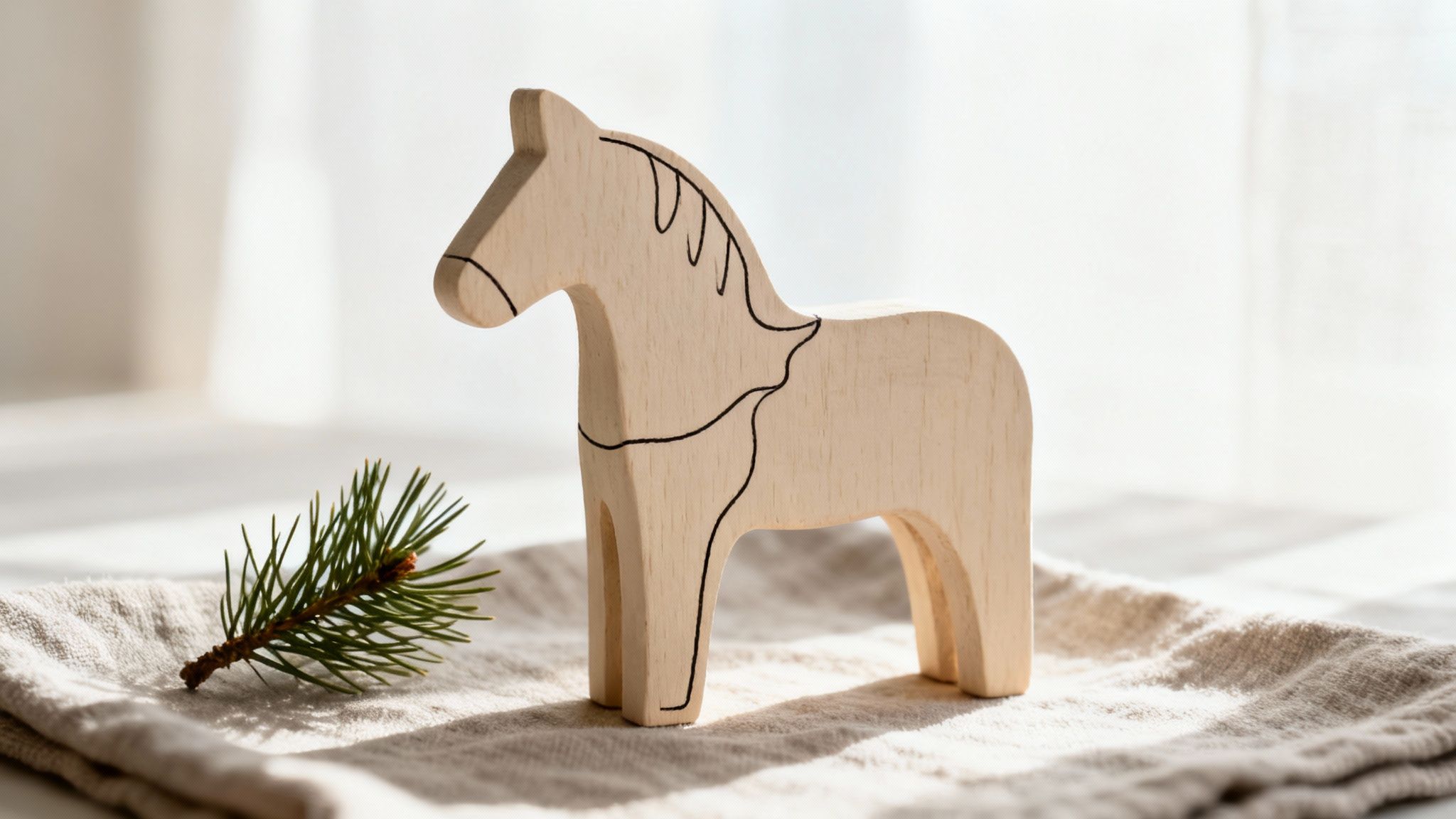
A brilliant place to start is with the iconic Dala horse. Its classic, rounded silhouette is just wonderfully suited for a continuous line interpretation. Before you even think about picking up a 3D object, spend some time getting a feel for its form on paper. Try to visualise the path your pen will take. Maybe start at the tip of the ear, flow down the neck and chest, curve gently under the belly, and then loop up to form those strong hind legs and tail, all in one elegant motion.
Once you’ve sketched a Dala horse design that you really love, you’re ready to bring it to life on a real object. Unpainted wooden figures are the perfect canvas for this kind of project. They give you a warm, natural backdrop that really lets your clean line work stand out and shine.
There are a couple of straightforward ways to transfer your drawing:
The whole point here is to create a faint but clear roadmap for your paint marker or fine-tipped brush. This little bit of prep work takes all the pressure off, letting you just focus on executing a smooth, continuous painted line.
This style of art, rooted in simplicity and sustainable materials, has been getting a lot of attention globally. For instance, Southeast Asia’s art scene has seen a huge surge in one-line works at major events like Singapore's Art SG. The 2025 fair pulled in over 40,000 visitors to galleries that were showcasing styles using minimal ink and paper. It really aligns with the eco-conscious trends among millennial buyers, who made up a surprising 44% of Christie’s Asia patrons. You can see how Asia's art market is taking centre stage and how much appreciation for minimalist art is growing.
The Dala horse is just the beginning, of course. The world of Scandinavian folklore and nature is absolutely brimming with inspiring subjects that are perfect for your one line art drawing practice. By exploring these themes, you can start to develop a whole cohesive collection of designs that feel both personal and stylishly timeless.
Think about other subjects that bring that Nordic charm to mind. You could try drawing a majestic moose, focusing on its distinctive antlers, or capture the simple, quiet elegance of a pine tree silhouette. Folk-art flowers, with their simple and symmetrical petals, are also a fantastic subject for this kind of continuous line work.
And if you're looking for more inspiration on creating that cosy, authentic atmosphere, you might enjoy our guide on the candles of Scandinavia. Every new subject you tackle helps you build a unique visual language that feels authentically yours.
Your beautiful one-line creations are far more than just sketches on a page; they’re the starting point for unique, handcrafted items. Taking your art from paper to product is an incredibly rewarding process, giving your creative vision a new life that’s both beautiful and functional.
This transition allows you to see your one line art drawing in a completely new light. Suddenly, a simple sketch becomes something you can hold, wear, or display in your home. It’s all about giving your art a purpose beyond the sketchbook.
One of the most direct ways to share your work is by creating professional-quality prints. A high-quality scan of your drawing opens up a world of possibilities, letting you easily turn your favourite designs into:
Plenty of online printing services make it incredibly simple to upload a design and have it printed on beautiful, high-quality cardstock. This is a fantastic way to produce multiple copies of your work, perfect for selling at a local market or giving as thoughtful gifts.
But why stop at paper? Your designs can bring a minimalist, artistic flair to all sorts of everyday items. Just imagine your continuous line art adding a touch of personality to home goods. Custom-printing services can place your art on tea towels, tote bags, or even throw pillow covers, creating truly unique pieces that blend art with daily life.
You can also circle back to the hands-on DIY painting we’ve been exploring. With the right paint markers, you can decorate items yourself and feel that connection to the craft.
This approach not only makes for wonderful, personalised gifts but also allows you to integrate your art directly into your living space. If you're looking for more ideas on incorporating handcrafted art into your home, you can find some great inspiration in our guide to wood wall art. It's really all about making art a part of your daily life.
As you dive into this wonderfully expressive art form, it’s completely natural for a few questions to pop up. Feeling a little uncertain is just part of learning something new. Let’s tackle some of the most common hurdles and practical questions artists face when starting a one line art drawing.
It happens to absolutely everyone, so please don't let it discourage you! The goal is to practise a continuous, flowing movement, but it’s not some unbreakable rule carved in stone. When it does happen, you have a couple of great options.
You can simply place your pen back down exactly where you left off and carry on. Or, you could choose to embrace the small break as part of your piece's unique story. Think of it as a hallmark of a handcrafted piece, not a mistake. What matters most is that you're enjoying the creative process.
This is where the real magic of one line art comes into play. Since you can’t lift your pen to fill in shadows, you have to get clever and use the line itself to build up texture and depth.
It's all about shifting your mindset to think about how line density and thickness can define form, rather than relying on traditional shading techniques.
The charming, slightly wobbly look is the whole point! The beauty of one line art is found in its organic, imperfect nature. Those unexpected proportions are what give the art its personality and vibrant energy. It's about capturing an essence, not a perfect replica.
Absolutely. In fact, this is a fantastic technique, especially when you're just starting out or tackling a particularly complex subject. Think of a very light, loose pencil sketch as a helpful roadmap for your final ink line.
It helps you visualise the entire path your pen will take before you commit to the permanent mark. Once you've confidently drawn over it with your continuous ink line, you can simply erase the pencil marks underneath. This leaves you with a clean, confident, and beautifully executed final piece of art.
At Dalaart, we believe in the beauty of handcrafted traditions. Explore our collection of authentic, unpainted Dala horses to use as the perfect canvas for your new one line art skills. Find your next creative project at https://dalaart.com.


.svg)


.png)


