January 8, 2026
Welcome to our definitive Swedish-English lexicon, a guide created especially for collectors, crafters, and anyone with a passion for traditional Swedish folk art. If you've ever felt a little lost in the vocabulary surrounding iconic pieces like the Dala horse, you're in the right place. This reference is designed to demystify the language used by artisans, helping you fully appreciate the rich heritage of Scandinavian craftsmanship.
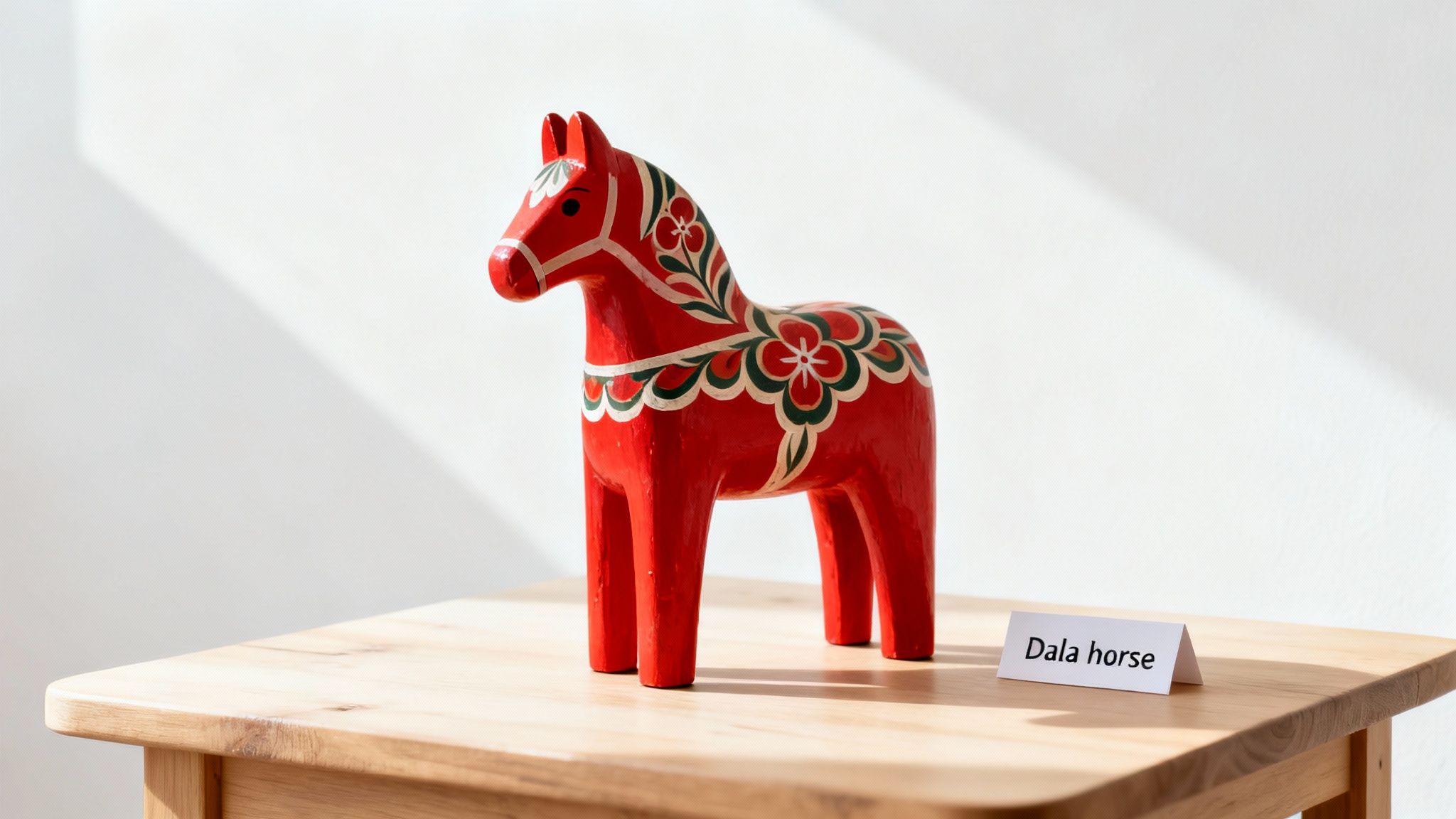
Getting to know the language behind Swedish folk art is the real key to a deeper appreciation for every hand-carved and hand-painted piece you encounter. This comprehensive Swedish-English lexicon is built for enthusiasts like you, whether you’re a seasoned collector or just starting your journey. Our goal is simple: to provide the clarity and context you need to turn unfamiliar terms into familiar tools.
This guide goes beyond simple translations. It's about giving you the practical knowledge that connects you to the heart of Swedish culture and the artisans who bring these treasured objects to life.
Think of this lexicon as your go-to resource for the terminology of Swedish artistry. Inside, you'll find detailed explanations that cover everything from the iconic objects themselves to the specific techniques used by master craftspeople. We’ve organised everything to make it easy to find what you're looking for.
Here’s a glimpse of what you'll learn:
By the end, you'll feel much more comfortable interpreting maker descriptions and discussing Swedish folk art with real confidence.
To make things easy for you, this Swedish-English lexicon is broken down into logical sections covering the objects, techniques, and materials you’ll come across most often. This way, you can jump straight to the term you’re curious about without wading through a sea of unrelated words. Think of it as your practical, go-to reference.
You’ll find that each term is presented with much more than just a simple translation. The goal is to give you the full picture, with all the essential details you need to truly understand the language of Swedish folk art.
Every term included has a few key parts to help build your knowledge from the ground up. You can expect each one to be explained with its Swedish name, a clear English equivalent, a simple pronunciation guide, and some notes on its cultural significance within folk art history and tradition.
This is designed so you can either get a quick definition or spend some time digging deeper. You’ll also find practical examples showing how a term might be used in a real-world item description or in a chat about a particular piece.
Whether you just need a quick answer or want a more thorough explanation, this layout makes it easy to find exactly what you’re looking for and become a more knowledgeable collector.
To help you connect the dots, there are also cross-references throughout. Follow these links to explore related concepts, which will help you build a more complete understanding of the craft and its unique vocabulary.
To really get to grips with Swedish folk art, you first have to know the cast of characters. The heart of any Swedish English lexicon for collectors are the iconic figures themselves. These hand-carved objects are much more than simple decorations; they’re deeply embedded in Swedish culture, tradition, and artistry. Learning their names and what they represent is the first real step toward appreciating your collection on a much deeper level.
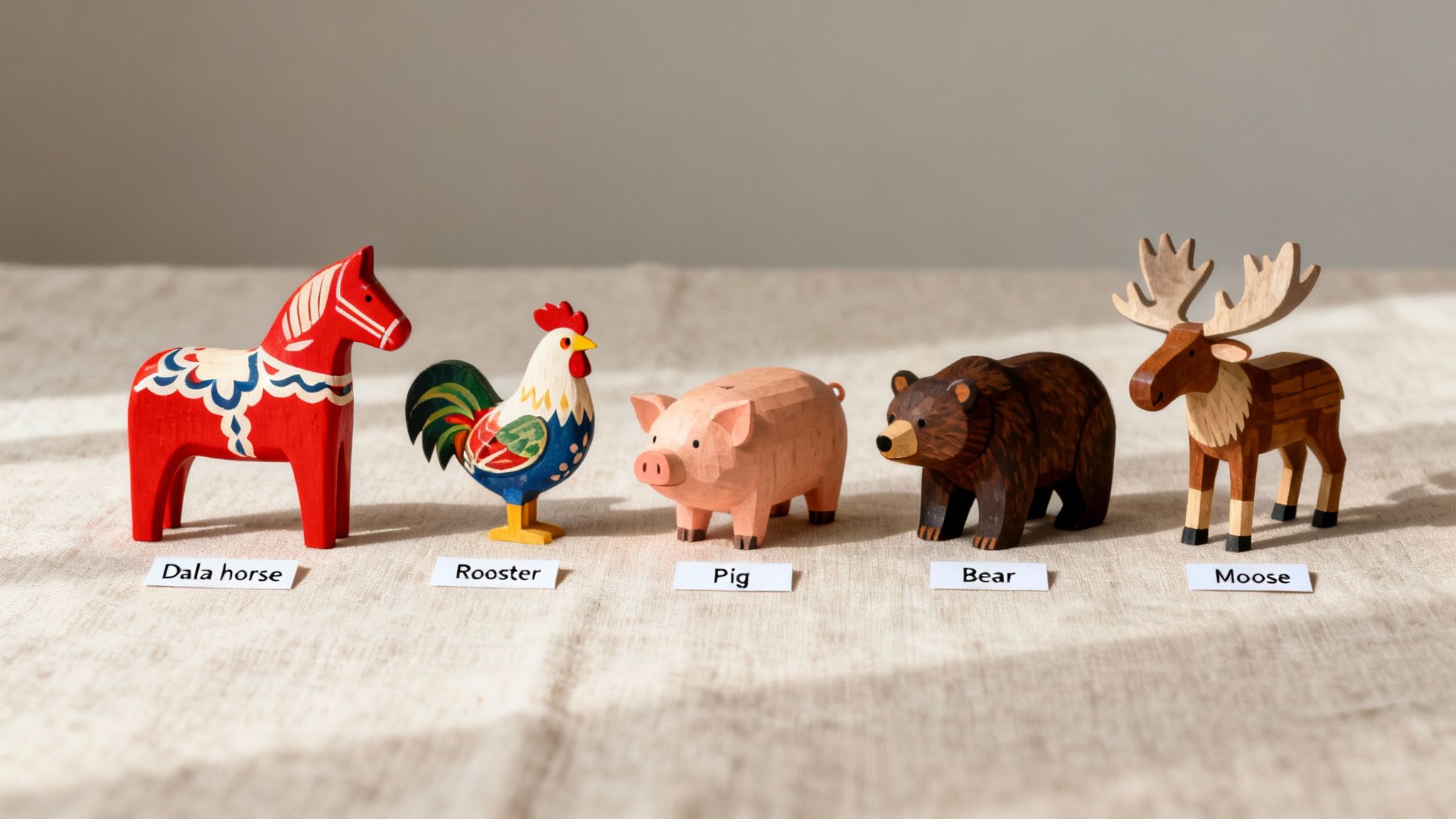
Of course, the most famous of all is the Dalahäst (Dala horse). It’s the quintessential symbol of Sweden, instantly recognisable across the globe. What started as a simple toy carved by woodsmen in the Dalarna region to pass the long winter nights has come to represent strength, courage, and good luck.
But the Dala horse doesn’t stand alone. Artisans have long carved a whole charming menagerie of other figures, and each has its own special place in Scandinavian tradition. Knowing this vocabulary is essential if you want to properly identify the different animals you come across.
To build out your lexicon, let’s look at the beloved companions often found alongside the Dalahäst. These figures also have deep roots in Sweden’s agrarian life and folklore, which is why woodcarvers have been shaping them for centuries.
The Tupp (Rooster) is often painted in bold, bright colours. He’s a symbol of watchfulness and the start of a new day, making him a very common motif in decorative arts.
In Swedish tradition, the Gris (Pig) represents good fortune and prosperity. Having a small carved pig in the house was—and still is—a cherished token of abundance.
As one of the most powerful animals in the Scandinavian wilderness, the Björn (Bear) naturally embodies strength and resilience. Carved bears are often depicted with a gentle, protective stance.
Affectionately known as the "king of the forest," the Älg (Moose/Elk) is a majestic symbol of the Swedish landscape and its untamed, natural beauty.
It's interesting to note that the specific vocabulary for these traditional folk art animals—like häst, tupp, gris, björn, and älg—remains overwhelmingly Germanic and native in origin. This is a sharp contrast to modern Swedish, which absorbed a significant number of English loanwords in the 19th and 20th centuries. You can explore more about this linguistic evolution in this study on the Swedish lexicon.
The artistry behind Swedish folk figures is built on a special set of skills, passed down from one generation to the next. To really appreciate what goes into each piece, it helps to know the language the artisans themselves use to talk about their work. This part of our Swedish-English lexicon breaks down the essential techniques that breathe life into these beloved objects.
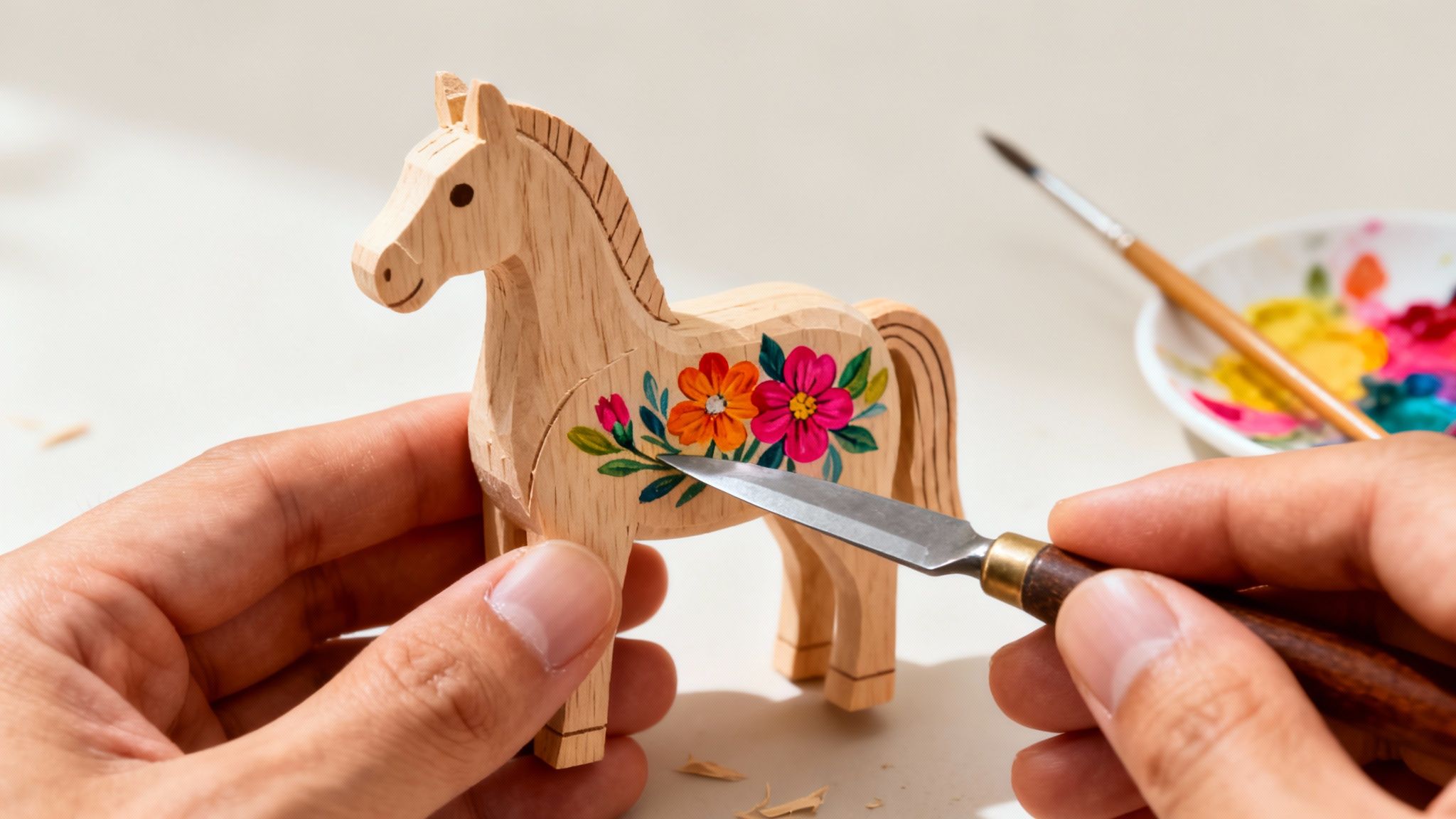
Everything starts with träslöjd, a term that literally means "woodcraft" or "wood sloyd." It's an all-encompassing word that covers the entire spectrum of woodworking, from picking out just the right piece of timber to giving it its final shape. This is the foundational skill that every single Dala figure comes from.
Another key term you’ll see pop up is snidad, which simply means "carved." Don't let its simplicity fool you; this one word is your guarantee that the figure was shaped entirely by hand with knives and traditional tools. It's a true hallmark of authentic craftsmanship. When you see this term, you know you're not looking at a mass-produced replica. You can get a better feel for the skill involved by reading our guide on the making of the Dala horse the traditional way.
Once the carving is done, the figure is ready for its vibrant coat of paint, a process that has its own unique vocabulary. These painting techniques are every bit as important as the carving when it comes to defining the object's character and authenticity.
The most famous painting style is without a doubt kurbits, an ornate, almost fantastical floral art that comes from Dalarna. You can spot it by its bold colours and imaginative, gourd-like flowers and leaves.
While kurbits is very specific, you might also come across the broader term rosmålning, or "rose painting." This refers to a more general Scandinavian tradition of decorative floral painting. When it comes to Dala horses, though, kurbits is the signature style you're looking for.
Finally, the term handmålad ("hand-painted") is a vital mark of quality. It tells you that every single brushstroke was laid down by an artisan, not a machine. It's this hands-on process that gives each Dala horse its own unique personality and charm, making sure no two are ever exactly alike. Understanding these words helps you see the immense skill and rich tradition packed into every single piece.
The soul of Swedish folk art isn't just in the carving and painting—it's also in the very materials that give each piece life. This part of our Swedish English lexicon dives into the terms for materials and finishes, helping you understand what makes an item both authentic and built to last. Knowing this vocabulary gives you a real appreciation for an artisan's choices and helps you care for your collection properly.

Many of today's artisans, including us here at Dalaart, put a strong focus on sustainability. A key term you’ll see is återvunnet trä, which simply means "recycled wood." This tells you the material has been sourced with care, often using high-quality offcuts from local workshops that might otherwise have gone to waste. It’s about giving beautiful timber a new purpose.
When you understand the materials, you get a feel for both the tradition and the modern spirit of Swedish craftsmanship. It’s the story of resourcefulness and a deep respect for nature, right there in your hands.
Of course, the wood is just the beginning. The final look and feel of a piece, and how well it stands the test of time, comes down to the finish.
The brilliant, lively surfaces of Dala horses and other figures are brought to life with specific coatings that both protect the wood and make the colours pop. Here are the essential terms you'll run into.
First, Färg (Paint/Colour) is the catch-all term for paint. When talking about authentic folk art, it usually means environmentally-friendly, high-pigment paints that deliver those deep, rich shades you see in the classic kurbits style.
Second, Lack (Lacquer/Varnish) is a clear coat almost always applied once the painting is done. This protective layer is what seals the paint, guards against scuffs and moisture, and gives the figure its signature subtle sheen.
Knowing these terms helps you spot quality from a mile away. For example, if a description mentions a durable lack finish, you know the piece was made to be a family heirloom, preserving its hand-painted details for generations. For any serious collector, that kind of insight is priceless.
If you’re going to navigate the collector’s market for Swedish folk art, you need to speak the language. Knowing the right vocabulary is what separates a casual browser from a confident buyer, helping you spot rare finds and make informed purchases. This part of our Swedish English lexicon is all about the words you’ll encounter when buying, selling, and collecting.
When you first start looking, you’ll probably see the word samlarobjekt, which translates to "collector's item." It's a simple term, but it’s a powerful signal that a piece is considered special—perhaps for its rarity, age, or unique artistry. It immediately tells you you're looking at something more than just a decoration.
Another foundational term is hantverk, meaning "handicraft" or "craftsmanship." Seeing an item described as genuine hantverk is your assurance that it was made by hand, with real skill and care. It’s what separates true Dala art from mass-produced souvenirs and gets to the very heart of what makes these pieces so special.
To really understand an item’s value and history, you need to know the words that speak to its authenticity and scarcity. For any serious buyer, these are probably the most important terms to learn.
Keep an eye out for the word äkta, which means "authentic" or "genuine." This is your guarantee that a piece is the real deal, not a knockoff or replica. For anyone looking to build a meaningful collection, making sure an item is äkta is always the first, most important step. For a deeper dive, you might find our post on collecting Dala horses, a beginner’s guide useful.
Spotting the phrase begränsad upplaga should always give you a little thrill. It means "limited edition," and it tells you that only a set number of these were ever made. That built-in scarcity makes an item instantly rarer and often much more valuable down the line.
Finally, you’ll often find items described as vintage. While it’s an English word, it's used frequently in Sweden to describe something with a bit of age and history that isn't quite old enough to be a true antique. A vintage Dala horse carries the charm of a past era, showing off a unique patina that new pieces simply haven't had the time to develop. Getting a handle on this vocabulary will completely change how you approach the marketplace.
To really get to the heart of Swedish folk art, you have to understand its language. The words themselves—dalahäst, kurbits, träslöjd—are more than just labels; they're echoes of a deep cultural and linguistic history. Appreciating these terms means looking at how the Swedish language was carefully documented and unified, a process that preserved the unique vocabulary of its traditional crafts.
Sweden's journey to a standardised language is a fascinating story. Over centuries, the country put a lot of effort into language-planning to build a cohesive national identity. This created a unique situation where old craft terms were protected and cherished, while new words for modern life were readily adopted from other languages. This balance is what makes the Swedish lexicon so rich.
A huge part of this effort involved creating official dictionaries. Sweden’s tradition of lexicography, especially the first Swedish-English dictionaries, was born from this national push for linguistic unity in the 18th and 19th centuries. The crowning achievement of this work is the Svenska Akademiens Ordbok (SAOB), a colossal historical dictionary that started publication way back in 1893.
The SAOB documents Swedish words used from 1521 onward, making it the ultimate authority for anyone studying the history of the language. It’s the backbone that helps us trace the origins of the Dala art terms we use today. You can get a sense of the immense effort that went into shaping the Swedish lexicon from this academic overview.
This incredible record-keeping is why we can understand the deep etymology behind the words describing our figures, materials, and painting techniques. These aren't just modern terms; they often have roots that stretch back centuries, all documented in works like the SAOB. It gives us a much clearer picture of the cultural heritage tucked into every hand-carved piece.
Knowing this history gives you a deeper appreciation for the language of folk art. You start to see how certain words were deliberately kept as authentic markers of cultural tradition, especially those tied to specific places.
This bond between language and location is especially powerful in Dalarna, the heartland of Dala art. If you're curious about the region itself, you can learn more by discovering the beauty and culture of Dalarna, Sweden in our detailed guide.
As you get deeper into the world of Swedish crafts, you'll run into a few specific terms that can be a bit confusing at first. Let's clear up some of the most common questions we hear from collectors and fellow enthusiasts.
This is a great question, and it gets to the heart of what makes Dalarna's art so special. While you might see the terms used near each other, they aren't interchangeable. Rosmålning (literally "rose painting") is the broader Scandinavian name for all kinds of decorative floral painting. You'll find variations of it across Norway and Sweden.
But kurbits? That’s pure Dalarna. It's a very specific, almost fantastical style of art featuring those signature, oversized gourd-like flowers and ornate, flowing leaves. This is the iconic style you'll see on any authentic Dala horse. Think of it this way: all kurbits is a type of rosmålning, but not all rosmålning is kurbits.
Knowing if a piece is äkta (authentic) is key for any serious collector. A genuine Dala horse will always be snidad (carved) from wood—usually from a single piece—and handmålad (hand-painted).
The real secret is to look for the tiny imperfections that prove it wasn't churned out by a machine. A slightly uneven brushstroke, a subtle asymmetry in the carving—these are the hallmarks of a true handcrafted item. Many authentic pieces will also have a sticker or a signature on the bottom from the workshop, especially if it comes from Nusnäs, the historical heart of Dala horse production.
While Dalarna is famous, don't forget other regions have their own incredible craft traditions. Down in Skåne, southern Sweden, they're known for stunningly vibrant textiles called flamskväv and unique painted furniture, all with a vocabulary of their own.
The pronunciation guides in our lexicon are a fantastic start, but nothing beats hearing the words spoken by a native Swede. Listening is absolutely crucial. A great trick is to search for online videos about Swedish crafts or travel documentaries on Dalarna.
Pay close attention to those three unique vowels: å, ä, and ö. Getting those sounds right is the biggest step you can take toward sounding natural when you're talking about your collection. It makes all the difference.
Ready to find your own piece of authentic Swedish tradition? We invite you to explore the beautiful, handcrafted collection at Dalaart, where every single item is a unique work of art brought straight from Dalarna. Find your perfect Dala horse today at https://dalaart.com.


.svg)


.png)


