March 17, 2026
Ever imagined being able to hold a digital design in your hands, turning an idea on a screen into a physical model you can place on your desk? This is the very essence of 3D printable miniatures, a fascinating space where modern technology and classic artistry come together.
At its core, 3D printing is a process that builds a physical object from a digital file, one microscopic layer at a time. It’s like having a digital sculptor’s chisel, allowing you to craft everything from detailed characters for tabletop games to unique collectibles that reflect your personal style.
This guide will walk you through this exciting world. We'll show you how this technology opens up incredible new avenues for creativity, putting immense artistic power right at your fingertips.
It's important to see this technology not as a replacement for traditional crafts, but as a powerful new tool in the artist's collection. It complements existing skills, offering a fresh medium for expression. For instance, an artist can design and print a blank miniature and then use time-honoured painting techniques to bring it to life.
This blend of old and new is something we cherish. We explore some of these very creative processes and share a look at how our own handcrafted pieces are made in our article about what goes on behind the scenes at Dalaart.
What was once a complex process confined to industrial workshops is now more accessible than ever, inviting more people to explore their creativity in three dimensions.
The real magic of 3D printable miniatures is in that journey from a simple digital file to a finished piece you can hold. It marries the satisfaction of modern making with the timeless pleasure of creating something beautiful with your own hands.
Whether you're a seasoned collector, a DIY painter, or just curious about new forms of artistry, 3D printing offers something for everyone. It bridges the gap between digital design and physical craftsmanship, allowing you to make your ideas real.
So, what exactly are 3D printable miniatures? At their heart, they are not physical objects to begin with. Instead, they start life as a digital blueprint—most often an STL file—that a 3D printer can read.
The printer then brings that blueprint to life, building the model one incredibly thin layer at a time. Think of it like constructing a detailed sculpture from thousands of paper-thin slices of plastic, each one stacked perfectly on top of the last. It’s this layer-by-layer process that allows for shapes and details that would be a nightmare to create using traditional methods.
This technology has opened up a world of creativity. It’s being used for everything from one-of-a-kind characters for tabletop games like Dungeons & Dragons, to intricate collectibles and even custom-designed pieces of home décor. The only real limit is your imagination and the digital designs you can find or create.
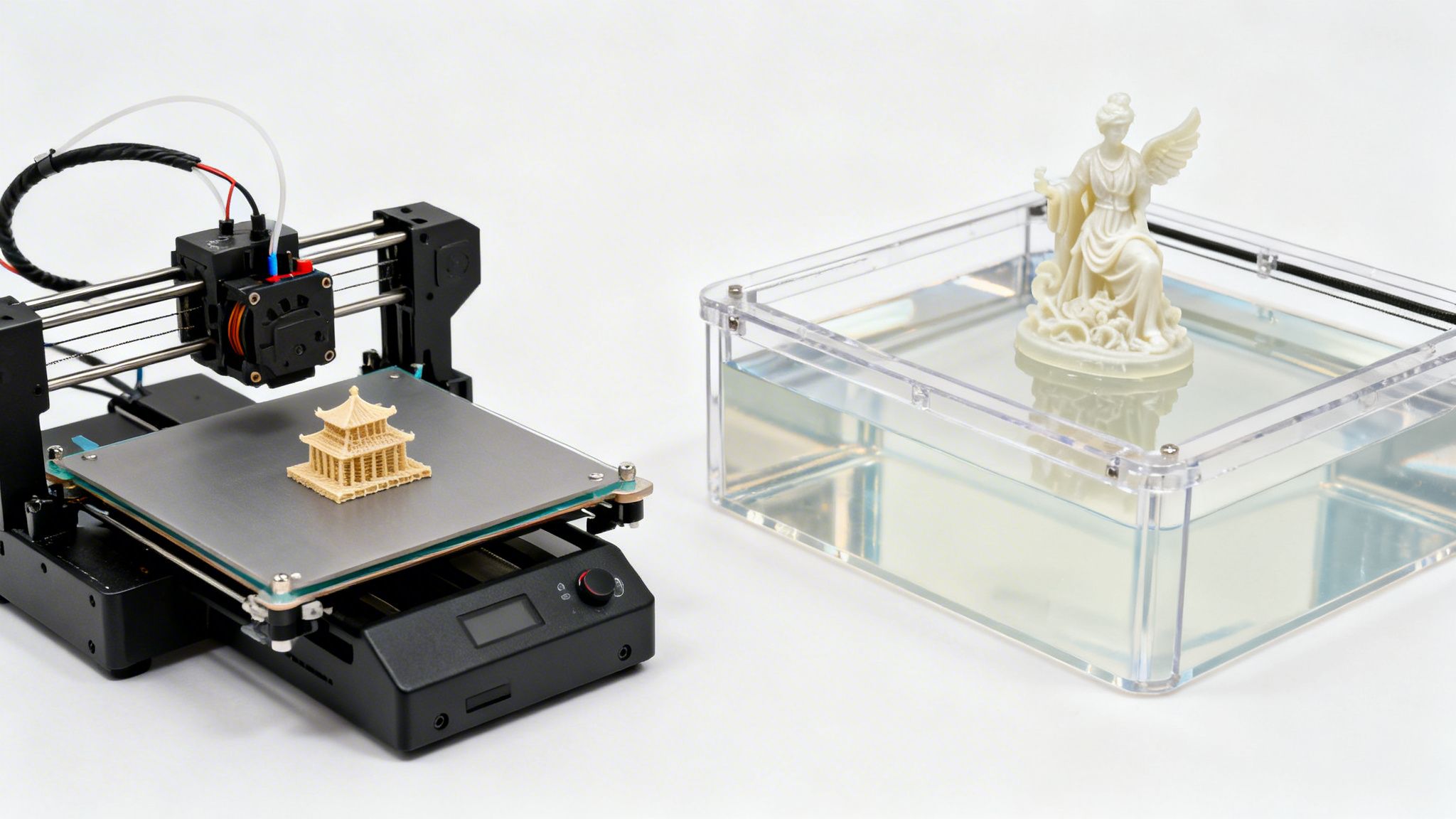
As you venture into the world of printing your own miniatures, you'll find two main types of printers available to hobbyists. Each has its own unique strengths and is better suited for certain kinds of projects.
The core difference comes down to how they build the model. One melts and squeezes out plastic like a precise glue gun, while the other uses light to harden liquid resin. This fundamental difference results in a huge gap in the level of detail and finish you can achieve.
This hobby is part of a much bigger movement. Here in Southeast Asia, the market for creating detailed miniatures has blossomed right alongside the 3D printing industry's massive expansion. Valued at USD 983.3 million in 2024, the entire South East Asia 3D printing market is set to climb to an incredible USD 5,291.9 million by 2033, with more and more enthusiasts picking up affordable desktop printers. You can see a full analysis on this growing industry from IMARC Group.
Getting to grips with the two main printer types is the first real step in choosing the right path for your own creative projects.
Fused Deposition Modeling (FDM) printers are the most widespread and often the most affordable entry point into 3D printing. The easiest way to picture an FDM printer is to imagine a very precise, computer-guided hot glue gun. It feeds a spool of solid plastic filament, melts it down, and draws out your model layer by layer from the bottom up.
Resin printers, which typically use a technology known as Stereolithography (SLA), work in a completely different way. These machines begin with a tank of liquid, light-sensitive photopolymer resin. A UV light source then carefully hardens the resin one layer at a time, pulling the now-solid object upwards out of the liquid.
So, you're ready to bring your first 3d printable miniatures to life? It might sound complex, but getting started is simpler than you think. You only really need three things to begin: a printer, the right material, and a digital file to act as your blueprint.
Think of it like a traditional craft. You need your tools (the printer), your raw materials like wood or clay (the printing material), and your design or pattern (the digital file). Each piece is essential for turning a simple idea into a detailed, physical object you can hold in your hand.
Your first big decision is what kind of printer to get, and there are two main types to consider. Fused Deposition Modeling (FDM) printers are known for being affordable and creating durable prints. They work by melting a spool of plastic filament, usually PLA (a versatile, plant-based plastic), and drawing your model one layer at a time. This makes them fantastic for larger pieces like scenery or sturdier figures that can handle a bit of wear and tear.
On the other hand, if incredible detail is what you’re after, resin printers are unmatched. These machines use a liquid photopolymer resin cured by UV light, producing an exceptionally smooth finish that’s perfect for capturing the finest details, like facial expressions or intricate armour on a knight. The materials can be a bit messier to work with, but for small, delicate miniatures, the stunning results are often well worth the effort.
This kind of accessibility is fuelling some exciting growth. As of 2023, the 3D printing scene in Southeast Asia is still in its ‘early stages of rapid growth’, showing a huge appetite for creative technologies like 3d printable miniatures. With the regional market projected to hit USD 29,335.90 million by 2032, it’s clear the interest is only just beginning. Right now, plastics make up 55% of the market, with photopolymers being the top choice for detailed minis—a perfect match for hobbyists and collectors. You can discover more insights on the future of 3D printing here.
Once you’ve settled on a printer and material, you’ll need the actual designs. This is where digital marketplaces come in, serving as vast libraries packed with countless files ready for you to download.
These online platforms are the modern-day equivalent of a crafter's pattern book, offering endless inspiration from a global community of artists and designers.
You can find everything from fantasy warriors and sci-fi soldiers to charming miniature animals and intricate decorative objects. Websites like MyMiniFactory and Thingiverse are brilliant places to start. They host thousands of 3d printable miniatures, and many are even free, letting you begin your printing adventure without spending anything on designs. Simply download a file, and you're all set for the next step.
Let's demystify the journey from a digital design to a physical model you can actually hold. Thinking of it less as a technical task and more as a creative project makes the whole process feel wonderfully approachable. It all begins with a design you love and finishes with a tangible piece of art in your hands.
The path from file to figurine is surprisingly direct. The core steps involve preparing your digital blueprint, sending it to the printer, and finally, giving your newly created model a few finishing touches.
This simple diagram shows the essential toolkit for any 3D printing project: the file, the printer, and the material.
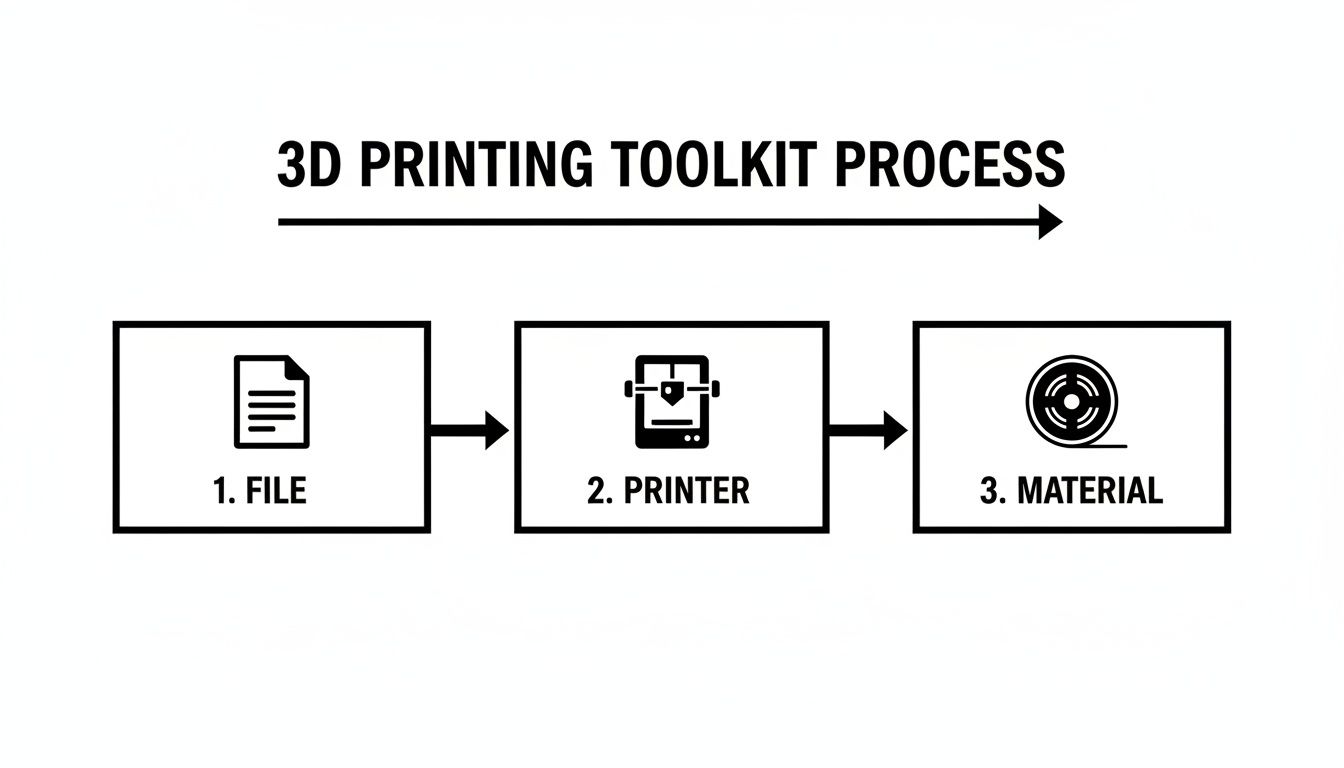
As you can see, every print starts with that digital design. The printer then reads this design and uses a specific material to build the final object, layer by precise layer.
Your first step is to open your chosen digital file in a special piece of software called a "slicer." You can think of a slicer as the master translator that gives your 3D printer its instructions. It cleverly translates the 3D model into hundreds, or even thousands, of incredibly thin horizontal layers that the printer will build upon.
Excellent slicer programs like Lychee Slicer or Chitubox are often free and are designed to be quite intuitive. They let you position your models on the build plate, choose your printer and material settings, and add supports. These are just tiny, removable stilts that hold up any overhanging parts of the model while it prints. For many 3d printable miniatures, these supports are often pre-generated and included with the file.
Once you’ve "sliced" the file, you simply save it, pop it onto your printer (usually with a USB stick), and press "print." This is where the real magic happens, as you get to watch your creation emerge from seemingly nowhere, layer by mesmerising layer.
The workflow is beautifully straightforward: find a design you adore, let the slicer software prepare it, and then allow the printer to do its remarkable work. It puts the power of creation in your hands, turning digital ideas into real-world art with just a few clicks.
After the printer has finished its job, your miniature isn’t quite ready for the display shelf. It requires a little post-processing to bring out its best. This is the final, hands-on stage that truly makes the model your own.
The steps differ slightly depending on your printer type:
With these steps complete, your miniature is officially finished and ready for priming and painting. This entire process, from file to finished figurine, is an artistic journey in itself, making the creation of 3d printable miniatures a deeply rewarding experience.
A freshly printed miniature is more than just a model; it's a blank canvas, patiently waiting for your artistic touch. This is where the real magic happens, transforming a single-colour figure into a character with personality and a story to tell. With just a few simple tips, anyone—even a complete beginner—can achieve truly wonderful results.
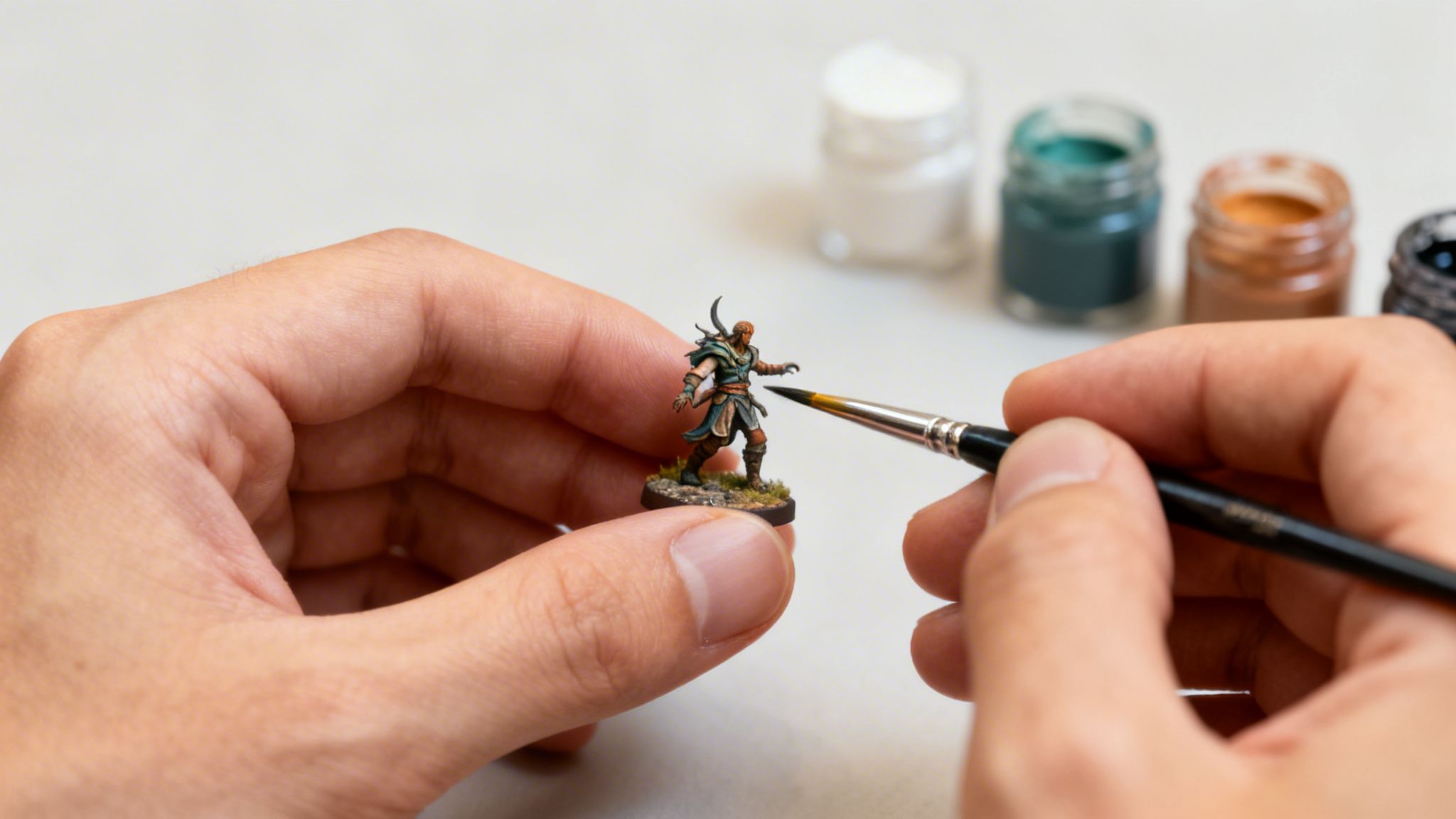
The journey begins with one crucial step: priming your model. Think of primer as the bridge between your model and your paint. It’s an essential first coat that gives the paint something to grip onto, whether your miniature is made from plastic filament or cured resin. Without it, your colours can look patchy, bead up, or rub off with handling.
Before you even dream of specific colours, applying a thin, even coat of spray primer is absolutely key. This creates a consistent surface that not only holds paint beautifully but also makes all those tiny, sculpted details much easier to see. A neutral grey is a popular choice, but a black primer can create instant, natural shadows, while a white one will make your colours appear especially bright and bold.
Once the primer is fully dry, you're ready for the fun part. You don’t need a huge collection of expensive paints to get started. Standard acrylic paints, the kind you can find in any craft shop, are perfect for your first 3d printable miniatures. If you need a little help combining shades, our guide to creating a basic colour mixing chart can help you build your palette with confidence.
The real joy of painting a miniature is in making it your own. It's the same feeling as personalising any craft, allowing you to breathe a unique character and soul into your creation. This is how you transform a printed model into a true masterpiece.
With your paints at the ready, you can start exploring some simple but highly effective techniques. These methods are designed to add depth and realism, making the details on your miniature pop right off the surface.
Two of the most popular techniques for beginners are wonderfully straightforward:
By combining just these two techniques, you can add incredible contrast and dimension to your 3d printable miniatures with very little effort. It’s a fantastic way to bring them to life and create something that is uniquely yours.
How does a 3D printed model stand up against a traditionally handcrafted object? It’s a question we hear a lot, and it’s tempting to think of it as a competition. But really, it’s more like a conversation between two wonderful and valid forms of art. Each one offers a different kind of beauty and satisfaction for collectors and creators alike.
3D printing brings a level of precision and the ability to reproduce complex designs that’s simply breathtaking. It opens up a world of intricate art to almost everyone. On the other side of the coin, a hand-carved piece holds the unique story of its creator, with a warmth and organic feel that a machine can't quite replicate.
The incredible appeal of 3D printable miniatures often comes down to their technical perfection. A modern resin printer can capture details so fine they’re barely visible to the naked eye, bringing a digital artist’s vision to life without any compromise. This allows for flawlessly symmetrical patterns and intricate shapes that would be nearly impossible to carve by hand.
A handcrafted object, like a traditional Dala horse, tells a completely different story. Its real value is found in its subtle, charming imperfections—the faint mark of a knife, a unique brushstroke, the slight asymmetry that proves it was shaped by human hands. It carries a sense of heritage and a direct connection to the artisan who made it.
The beauty of collecting is that you don't have to choose. Many find that both forms have a place in their collection—the 3D printed miniature for its flawless detail and the handcrafted item for its unique soul.
This beautiful blend of digital and heritage crafts is really starting to take hold. In parts of Southeast Asia, workshops that combine 3D printing with traditional techniques have managed to cut material waste by an impressive 50%. At the same time, 60% of new printers in Vietnam are using recycled PLA filaments, echoing a shared passion for sustainability. You can learn more about Southeast Asia's 3D printing market and its creative boom.
Ultimately, whether you lean towards digital craft or traditional artistry is a personal choice, and there’s truly no right or wrong answer. Many hobbyists find joy in both worlds, perhaps using 3D printing to create a base model and then applying their traditional painting skills to make it uniquely their own. It’s a fantastic example of how new technology can work in harmony with time-honoured skills.
Whether you're drawn to the technical marvel of a perfectly printed figurine or the rustic charm of a hand-carved treasure, both offer a unique way to celebrate art. You might even find inspiration for your own creative projects, like building the tiny, imaginative worlds found in custom displays. For a few ideas on building these miniature worlds, you might enjoy our guide on crafting a book nook inspired by Harry Potter.
Getting set up is more affordable than you might think. An entry-level resin or FDM printer can now be found for roughly the same price as a large tabletop gaming starter set, typically between £200 and £400.
Your materials won't break the bank, either. A one-kilogram spool of PLA filament or a one-litre bottle of resin usually costs between £20 and £40. That single purchase is often enough to print dozens, if not hundreds, of standard-sized miniatures.
Thankfully, no. The software you'll use most, known as a "slicer," is designed with newcomers in mind. Programs like Lychee or Chitubox feature intuitive interfaces and often include pre-set profiles for popular printers, which takes a lot of the guesswork out of it.
You can think of a slicer as a helpful guide. It takes your 3D model and translates it into simple, step-by-step instructions that your printer can understand. All the complex work is handled behind the scenes.
Finding high-quality, legal designs is incredibly easy. The community is built around online marketplaces where talented independent artists sell their digital files, offering a vast, ever-growing library of 3d printable miniatures.
These platforms are a wonderful way to support artists directly while ensuring you have a limitless supply of creative projects to bring to life.
At Dalaart, we celebrate artistry in all its forms, from digital creations to handcrafted traditions. Explore our collection of authentic, hand-painted Swedish Dala horses and find a unique piece of folk art to inspire your next project. Discover our collection at Dalaart.com.


.svg)


.png)


