June 1, 2026
You're probably doing what many people do before choosing a Norse mythology tattoo. You've saved a folder full of images. A hammer with knotwork. A pair of ravens over a shoulder blade. A stark black symbol on a forearm that looks ancient and fierce. Something about it feels personal, even if you can't yet explain why.
That pull makes sense. Norse imagery carries the weight of story. It speaks of protection, memory, fate, courage, ancestry, wilderness, and the bond between human life and a larger cosmos. But the internet rarely helps you sort the meaningful from the merely fashionable. Designs are often bundled together under the label “Viking” even when they come from very different times, texts, and traditions.
A good tattoo deserves better than a mood board.
The most rewarding path is to choose a design you can live with intellectually as well as visually. That means asking sharper questions. Is this symbol rooted in Old Norse myth? Is it a later Icelandic magical sign? Is it modern tattoo shorthand dressed in ancient language? And if the design is an interpretation, what kind of interpretation is it?
A visitor once told me, in almost these exact words, “I know I want something Norse, but I don't want to get it wrong.” That's the right instinct. Not because there is one perfect answer, but because Norse mythology rewards curiosity.
Many people begin with feeling. They're drawn to wolves, ravens, runes, trees, ships, serpents, or hammers long before they know the names attached to them. A person who values resilience may be pulled towards Thor's hammer. Someone who thinks constantly about ancestry, memory, and wisdom may stop at Odin's ravens. Another may see Yggdrasil and recognise a symbol of interconnected life without having read a single saga.
The confusion usually appears in three places:
A thoughtful tattoo isn't only about what looks powerful. It's about knowing what kind of power the symbol was meant to express.
That's where a more careful approach changes everything. Instead of copying a dramatic image, you start reading the design the way you'd read an object in a museum case. What tradition shaped it? What story does it carry? What has modern culture added to it?
A Norse mythology tattoo can still be bold and contemporary. It doesn't need to be an archaeological reconstruction. But it should be a conscious choice. Once you understand the difference between historically grounded symbols and later inventions or revivals, your options become clearer, not narrower.
The popular image of the tattooed Viking is vivid. It appears in films, games, television, and endless social posts. The trouble is that the historical record is much thinner than commonly believed.
The strongest early written evidence for tattoos in the Viking world comes from the 10th-century traveller Ahmad ibn Fadlan, who described the Rus with markings from “fingertips to the neck”, as discussed in this account of Viking tattoo history. That matters because Swedish Viking Age activity stretched eastward through Baltic trade and raiding networks into the Rus sphere, so this description is relevant to the wider Scandinavian world.
But there is a limit, and it's an important one. No preserved Viking Age Scandinavian body with tattoos has ever been found archaeologically. Modern Norse tattoo designs are therefore interpretations of period art rather than copies of surviving ancient skin.
That single fact changes the conversation. When people say they want an “authentic Viking tattoo,” they usually mean one of two things. Either they want a tattoo based on imagery known from the Viking Age, or they want a tattoo that feels faithful to Old Norse myth and visual culture. Those are sensible goals. Exact replication isn't possible.
Some readers hear this and feel disappointed. I think the opposite response is more useful. Uncertainty makes the subject more interesting.
You aren't choosing from a frozen catalogue of original Viking flash sheets. You're working from surviving clues. Those clues include carved stone, metalwork, woodwork, narrative sources, and the visual habits of the period. Animals that twist into knotwork, compact symbolic forms, and motifs tied to gods, warfare, travel, death, and protection all emerge from that world.
If you want to deepen that background before speaking to an artist, a good starting point is a guide to books on Norse mythology that helps separate saga material from modern retellings.
For tattoo purposes, “historically grounded” usually means this:
Practical rule: choose a design that can answer two questions clearly. “What does this symbol mean?” and “What tradition does it come from?”
That second question is the one people skip. It's also the one that keeps a tattoo from becoming a vague costume version of the past.
Some symbols belong squarely to the Norse mythic world. Others are often bundled into it later. If you're choosing a Norse mythology tattoo with historical care, this distinction matters.
A visual overview can help before we examine the details.

If you want a symbol with strong historical footing and immediate recognisability, Mjölnir, Thor's hammer, is one of the clearest choices. In mythology, Thor protects gods and humans against destructive forces. That makes the hammer an enduring sign of protection, strength, and consecration.
For tattoo design, Mjölnir works across many styles. In a historically minded piece, it often appears with compact proportions and ornament inspired by carved and cast objects rather than oversized fantasy weapon design. A small blackwork hammer can feel intimate and steady. A larger one framed by knotwork can feel ceremonial.
Mjölnir suits people who want a tattoo that says, in plain terms, “stand firm.”
The Valknut is visually simple and emotionally charged. It is commonly linked with Odin, slain warriors, and the passage between life and death. Because it appears in contexts associated with warfare and the dead, many people choose it to honour courage, sacrifice, or remembrance.
Its appeal lies in restraint. Three interlocking triangles can carry a great deal without becoming decorative clutter. That also makes it easy to misuse. A Valknut with no understanding behind it risks becoming a generic badge of hardness. A thoughtful use treats it as a serious symbol tied to mortality, destiny, and Odinic themes.
Odin's ravens, Huginn and Muninn, bring a different emotional register. They are often understood as thought and memory. For many wearers, that makes them one of the richest subjects in Norse tattooing.
Ravens can be literal or symbolic. Some people choose two birds in flight, placed in conversation with each other across the chest or shoulder blades. Others prefer a more abstract treatment, letting wing shapes merge into knotwork or runic rhythm. The strongest versions avoid turning them into generic gothic crows. Their meaning comes from connection to Odin, perception, recollection, and the gathering of knowledge.
Later in your research, you may find modern discussion around protective motifs such as the Helm of Awe in Norse symbolism. That can be useful, but it's important to distinguish those later symbols from the older mythic forms discussed here.
Yggdrasil, the world tree, often attracts people who want a larger and more layered piece. It symbolises the structure of the cosmos, the linking of realms, and the deep rootedness of life, death, and fate.
Tattoo symbolism can become too loose if an artist isn't careful. Many online versions turn Yggdrasil into a generic fantasy tree. A stronger approach recognizes that this is not merely “nature” imagery. It is a cosmic tree, a living axis. Roots, branches, animals, and surrounding knotwork can all be arranged to stress interconnection rather than botanical realism alone.
For someone who wants their tattoo to express belonging within a larger order, Yggdrasil carries unusual depth.
Here is a useful visual introduction to common Norse symbols in modern tattoo culture:
A major problem in popular tattoo content is that it collapses different traditions into one “Viking” basket. As noted in this discussion of popular Norse tattoo ideas and their historical gaps, motifs such as Aegishjalmur and Vegvísir are often presented beside Mjölnir or the Valknut even though they originate much later.
That doesn't make them meaningless. It does make them different.
Keep this distinction in mind when choosing a design:
A design can be beautiful without being Viking Age. The key is naming it honestly.
If your priority is heritage accuracy, choose from the first group or work with an artist to build from period ornament. If your priority is spiritual or modern symbolic meaning, the later staves may still matter to you. Just don't let anyone tell you they come from the same historical layer as Thor's hammer.
Once you know which symbol you want, a new question appears. What should it look like on skin? The same symbol can feel solemn, raw, elegant, or contemporary depending on the style.
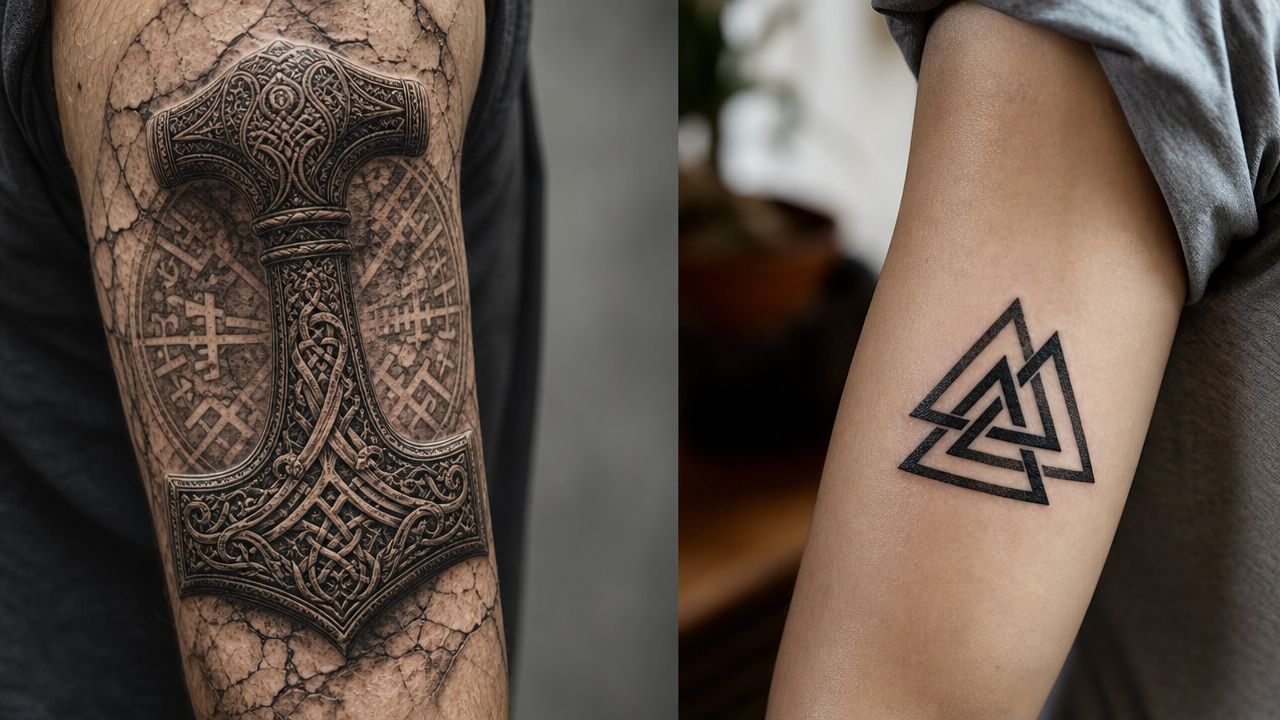
This is the style many people imagine when they want something “authentically Norse” in spirit. Interlaced animals, ribbon forms, serpentine bodies, and dense ornamental flow can turn a hammer, raven, or beast head into something that feels close to carved wood, runestone design, or metalwork.
It suits forearms, sleeves, backs, and chest pieces because the lines can travel with the body. It's especially effective if your tattoo artist understands historical pattern language rather than copying generic Celtic knotwork and calling it Viking.
The mood is rooted, ornamental, and old-world.
Realism is often chosen for portraits of Odin, Thor, or a raven with dramatic texture and shadow. It can be striking, but it changes the relationship between myth and image. Instead of wearing a symbol, you wear an interpretation of a divine figure or scene.
That can work beautifully if you want narrative drama. Odin with one eye, a weathered face, and ravens nearby has strong emotional force. So does a scene of Fenrir, a ship in rough water, or a world tree rising through mist. But realism also dates more quickly if it follows current fantasy aesthetics too closely.
Some of the best Norse mythology tattoos are spare. A clean Mjölnir. A small Valknut. Two ravens reduced to sharp silhouettes. A restrained branch and root form suggesting Yggdrasil without illustrating every detail.
Minimal work succeeds when the symbol itself is strong enough to carry the meaning. It's ideal if you want something discreet, modern, and easy to place. It also ages well when the artist leaves enough breathing room in the lines.
This style takes old symbolic material and reorders it through symmetry, repetition, and bold contrast. It is not historically literal, but it can be respectful if the underlying symbol remains clear and if the artist doesn't pile unrelated signs into one dramatic collage.
A geometric Yggdrasil can emphasise cosmic order. A raven composition built from black shapes can suggest thought and memory without illustration. This approach suits wearers who want a Norse mythology tattoo that feels current without becoming generic fantasy.
Ask yourself these questions:
A strong tattoo style doesn't compete with the symbol. It reveals the symbol's character.
Placement changes meaning. The same design can feel like private devotion on the ribs, public declaration on the forearm, or ceremonial armour on the chest.
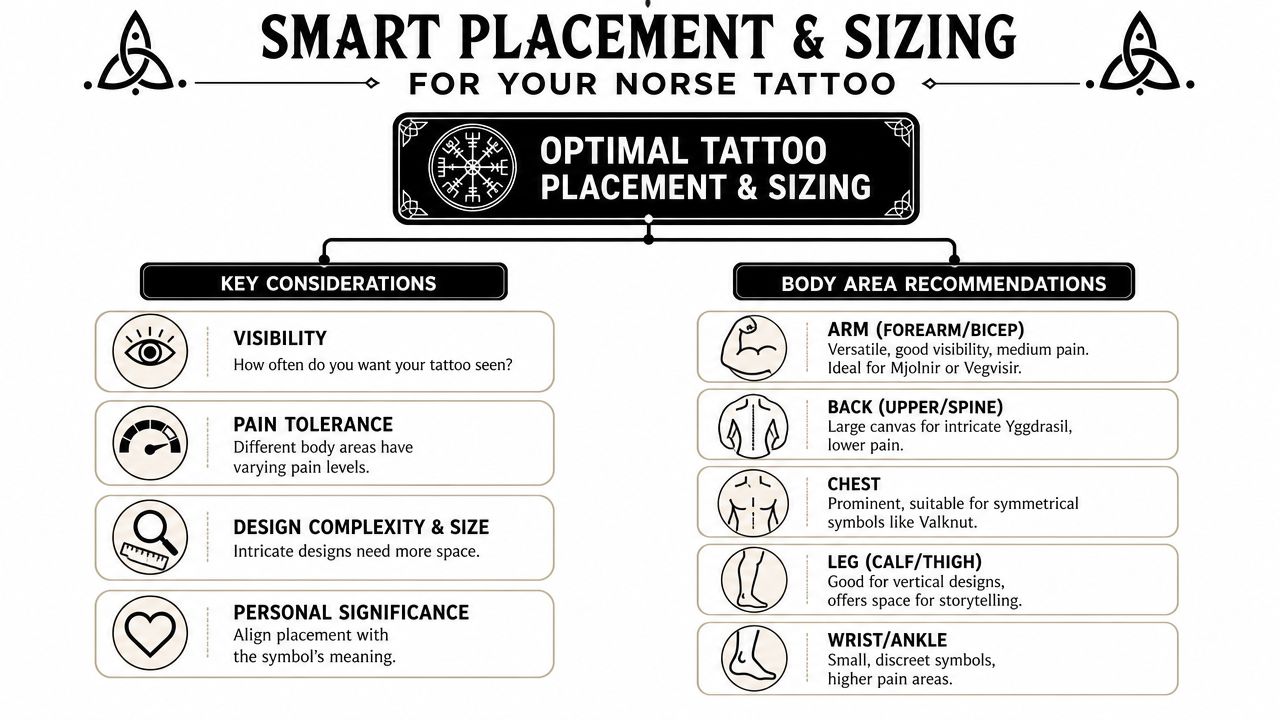
Large mythic subjects need room. Yggdrasil, a wolf-binding scene, a long serpent, or a full knotwork composition usually belongs on the back, thigh, chest, or full outer arm. These areas let the design breathe and preserve the storytelling.
Medium-scale symbols such as Mjölnir, ravens, or a dense ornamental animal form often work well on the forearm, calf, upper arm, or shoulder blade. These placements give enough space for structure without requiring a full-body commitment.
Small symbols can be effective too. A simple Valknut, a compact hammer, or a single carefully chosen rune can sit on the wrist, inner forearm, ankle, or behind the ear. The danger is shrinking a detailed design too far. Fine knotwork packed into a tiny area tends to lose clarity.
Norse designs often involve movement. Interlacing lines wrap. Ravens arc. Serpents coil. Trees rise. Good placement respects that movement.
Before deciding, weigh these factors carefully:
Visibility in daily life
If you want the design as a personal reminder, a less visible placement may feel more intimate. If you want open conversation about it, the forearm remains one of the clearest choices.
Complexity and future ageing
Designs with fine detail need enough scale. This is one of the simplest rules in tattooing, and one of the most ignored.
Your long-term plan
A single symbol can later become part of a larger sleeve or chest panel. Leave room if you think your interest in Norse material will grow.
Choose a placement that serves the design first. Convenience comes second.
A strong Norse mythology tattoo usually comes from collaboration, not from handing over a random screenshot. Your artist needs to understand both the visual language and the symbolic stakes.
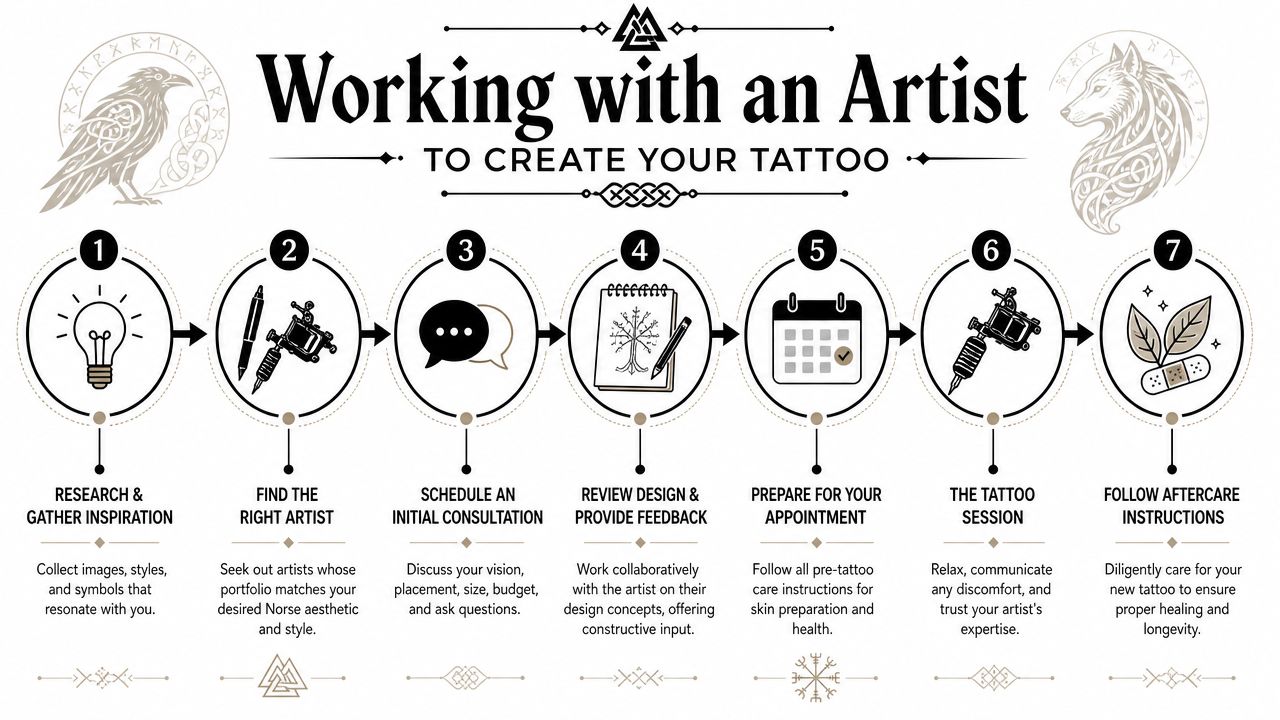
Don't arrive with only “I want something Viking.” Bring references with intention.
This helps the artist design from a brief rather than guess your priorities.
Look beyond whether they've done “Viking tattoos” before. Study how they handle line discipline, symmetry, ornament, scale, and body flow. A person who excels at fine blackwork may be better for a compact Mjölnir than someone known for cinematic portraits. An artist with experience in large ornamental pieces may be the right choice for Yggdrasil or a knotwork sleeve.
The best sign is thoughtful adaptation. You want someone who can translate references into a tattoo that works on skin, not someone who traces a popular image.
When the sketch arrives, respond in ways the artist can use.
Say things like:
Avoid vague comments such as “make it more epic.” Those usually push a design towards cliché.
Healing is part of the artwork. Follow the artist's aftercare instructions closely. Keep the area clean, avoid friction, and don't improvise with internet folklore. Fine lines, solid black, and intricate spacing all depend on calm healing.
A carefully researched symbol deserves careful treatment after the session too.
A Norse mythology tattoo is never only decoration. Even the simplest design carries layers of story, revival, interpretation, and modern identity. When you wear one with understanding, you're not pretending to be ancient. You're entering a conversation with the past.
Respect starts with accuracy, but it doesn't end there. It also means resisting the urge to flatten Scandinavian culture into a single fantasy of warriors, rage, and battle. Norse myth includes wisdom, grief, fertility, law, craft, travel, prophecy, kinship, and cosmic order. A tattoo that recognises that range feels more human and more grounded.
It also helps to know that some Norse symbols have been misused in modern extremist contexts. That misuse doesn't erase their older meanings, but it does make awareness important. If you choose one of these symbols, be prepared to explain why you wear it and what it means to you. Informed wearers help return these images to richer, more honest contexts.
When someone asks about your tattoo, your answer matters. You don't need to become a lecturer, but a few clear words can make a difference. “This is Mjölnir, Thor's hammer. I chose it as a symbol of protection.” Or, “These are Odin's ravens, thought and memory.” Or, “This design is inspired by Viking Age ornament, but it's a modern interpretation.”
That kind of clarity honours the source material.
If your design connects specifically to Swedish heritage or a Scandinavian family story, those personal ties can deepen the tattoo further. For readers exploring how Norse identity is discussed in a Swedish context, this reflection on the Sons of Odin in Sweden adds another layer to the cultural conversation.
The finest heritage tattoos don't close the subject. They keep opening it. You may begin with a hammer and later read more about Thor. You may choose ravens and then become fascinated by Odin's relationship to wisdom and sacrifice. You may start with Yggdrasil and find yourself thinking differently about fate, ancestry, and interconnection.
That's one of the pleasures of this tradition. The symbol on the skin is fixed. Your relationship to it keeps growing.
A Norse mythology tattoo chosen with care can be beautiful on first sight. Chosen with knowledge, it becomes something more enduring. It becomes a work of modern storytelling, carried on the body with intention.
If Norse mythology, Swedish heritage, and living craft traditions speak to you, Dalaart is worth exploring. Their collection of authentic Swedish folk art offers another way to bring Scandinavian symbolism and artistry into daily life, with the same respect for tradition that makes any meaningful tattoo choice worthwhile.


.svg)


.png)


