May 30, 2026
A cashier hands you a five, and you tuck it away without a glance. Later, under a lamp at home, that same note can turn into a small history lesson, a design puzzle, and sometimes a collecting clue.
Many recognise the 5 dollar bill by habit, not by observation. They know Lincoln is on the front, they know it's common, and they assume that's the end of the story. It isn't.
A U.S. five is one of those objects that becomes more interesting the longer you look at it. It's a piece of national design. It's also a practical anti-counterfeit tool, built so ordinary people can check it with their hands and with light. And for collectors, it can be something else again: a note that looks ordinary until the serial number, a star symbol, or a printing mistake gives it a different kind of appeal.
That last point trips people up. Many assume a bill has to be obviously old to matter. They picture large antique notes, yellowed paper, and museum-style rarity. But a modern 5 dollar bill can still catch a collector's eye for reasons that have nothing to do with age alone.
Practical rule: Don't judge a note only by how old it looks. Start with what type of note it is, then check its serial number, symbols, condition, and printing details.
Another source of confusion is that people mix together three separate questions. Is the note real? Is it spendable? Is it collectible? Those aren't the same thing. A note can be genuine and legal tender yet still be interesting to collectors for a serial-number pattern. It can also be genuine and ordinary, with no premium at all beyond face value.
That's what makes the five so rewarding to study. It sits at the intersection of history, portraiture, engraving, security printing, and everyday life. The bill in your wallet isn't just a payment instrument. It's a small curated object, handled constantly and rarely examined.
The story of the 5 dollar bill begins in wartime and settles into standardisation. The first U.S. $5 note of the Civil War era appeared in 1861 as a Demand Note, and the modern U.S. $5 bill was formally reissued as a Federal Reserve note in 1914. Its standard size was later reduced to 6.14 x 2.61 inches in 1929, a key shift in the move toward the familiar modern format, as described by the U.S. Currency Education Program's historical summary of the $5 note.
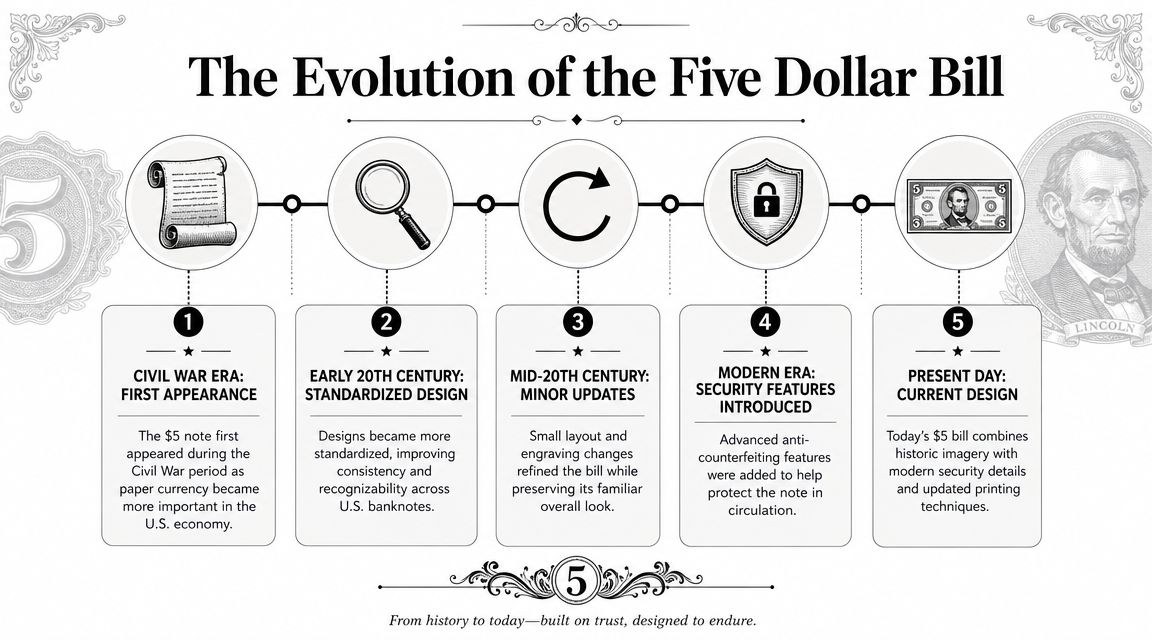
The earliest five-dollar issues belonged to a very different America. In the Civil War period, paper money answered urgent needs. These notes didn't yet have the calm, standardised identity that modern users expect from U.S. currency.
That's why the 1914 reissue matters so much. Once the denomination entered the Federal Reserve Note era, the five became part of a more stable, recognisable national system. Over time, the design language tightened. The note became less like an emergency instrument and more like a durable part of everyday commerce.
Abraham Lincoln's place on the front also became permanent in the Federal Reserve era. That continuity gave the denomination a fixed public face. When people say “the Lincoln five”, they're responding to a design choice that became embedded in daily life over decades.
The 1929 size reduction sounds technical, but it changed how the note felt, stored, counted, and printed. Standardised dimensions made U.S. notes easier to handle across banks, tills, wallets, and machinery. The five stopped being one variation among many and became part of a tightly organised family of notes.
For collectors, this is one of the most useful dividing lines. Large-size notes belong to an earlier visual world. Small-size notes belong to the modern one. If you're sorting inherited currency or a mixed group of old U.S. bills, noticing the format can immediately tell you which broad era you're looking at.
A quick way to think about the note's evolution is this:
The five-dollar bill didn't become familiar all at once. It became familiar by being redesigned, resized, and standardised until the public could recognise it instantly.
When people look at a modern five, they often assume it has always looked roughly like this. History says otherwise. The current note is the result of repeated decisions about portraiture, portability, trust, and printing.
That matters because collecting starts with noticing change. A collector doesn't just ask whether a note is old. They ask which version it is, what era it belongs to, and what clues its format carries. The 5 dollar bill rewards that kind of attention because its development is easy to trace once you know the major milestones.
A five-dollar bill isn't decorated at random. Every major image has a job. On the front, Abraham Lincoln gives the note a human centre. On the back, the Lincoln Memorial turns the bill into a small statement about memory, nationhood, and public architecture.
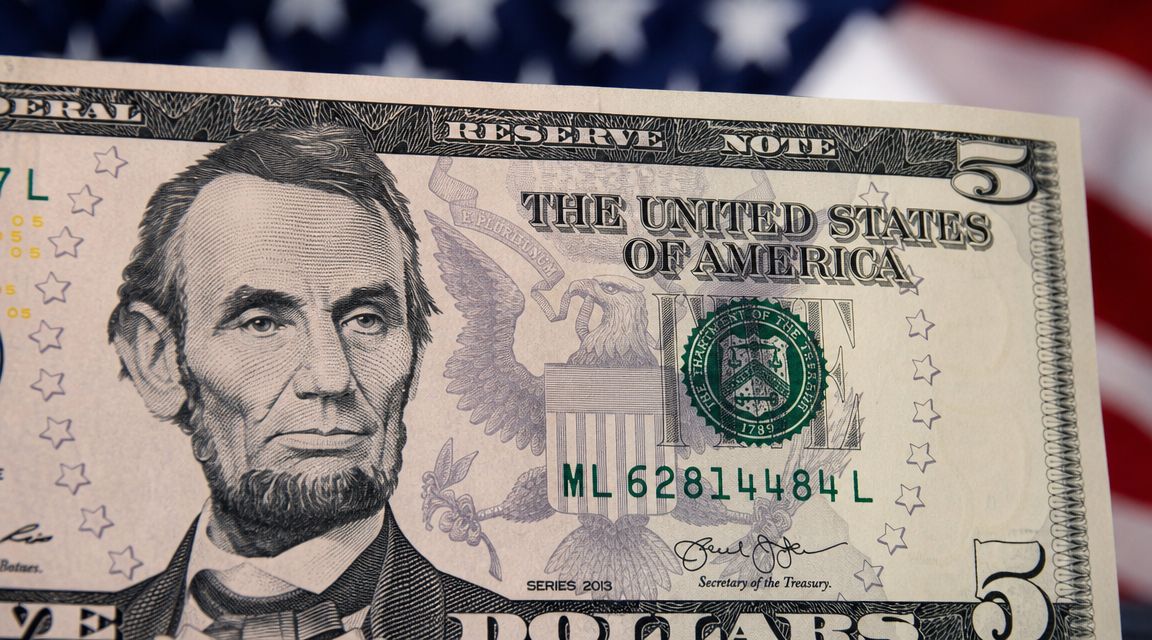
Lincoln's presence makes symbolic sense. He's associated with union, constitutional strain, sacrifice, and the preservation of the United States during its greatest internal rupture. On a circulating note, that symbolism is powerful. Currency is one of the few national objects that passes through nearly every hand. Putting Lincoln there turns memory into routine contact.
Collectors often focus first on rarity, but iconography matters too. A note becomes more than paper when the portrait carries public meaning. Lincoln's image gives the denomination moral weight and familiarity at the same time.
There's also a practical side to his enduring portrait. Stable iconography helps people recognise a note quickly. Currency design always balances symbolism with instant usability.
The back of the note features the Lincoln Memorial, which deepens the connection between person and monument. Instead of showing a generic patriotic scene, the bill links the portrait to a place dedicated to remembrance. The design tells a simple visual story: the statesman on one side, the national memorial on the other.
That choice gives the bill a ceremonial quality without making it hard to read. The five remains functional, but it also carries a civic narrative. You don't need to know architectural history to feel that the reverse is formal and commemorative.
A careful observer can read the note in layers:
A well-designed banknote has to do two things at once. It must be easy to use at a glance, and rich enough to hold up under close study.
People don't usually think of a banknote as a curated visual object, but it is. The arrangement of portrait, lettering, framing, and monument is deliberate. The engraving style creates depth, contrast, and seriousness that a flatter design wouldn't convey.
That's one reason the five attracts both casual curiosity and sustained collecting. Even before rarity enters the picture, the note offers portrait art, memorial architecture, and state symbolism in a format small enough to vanish into a pocket. Familiarity makes it easy to overlook. Looking closely brings it back to life.
Authenticating a modern 5 dollar bill is easier when you stop searching for one magic sign. The note's current security system was designed as a set of cues that work together. You check it by touch, by sight, and by holding it to light.
The current U.S. $5 note is an intaglio-printed Federal Reserve Note with a redesigned security architecture introduced in 2008. The Bureau of Engraving and Printing states that all U.S. currency remains legal tender regardless of issue date, and the note's anti-counterfeit design centres on a high-contrast purple numeral, a watermark, and a security thread meant to be checked by transmission light, as explained in the official features guide for the 2008-present $5 note.
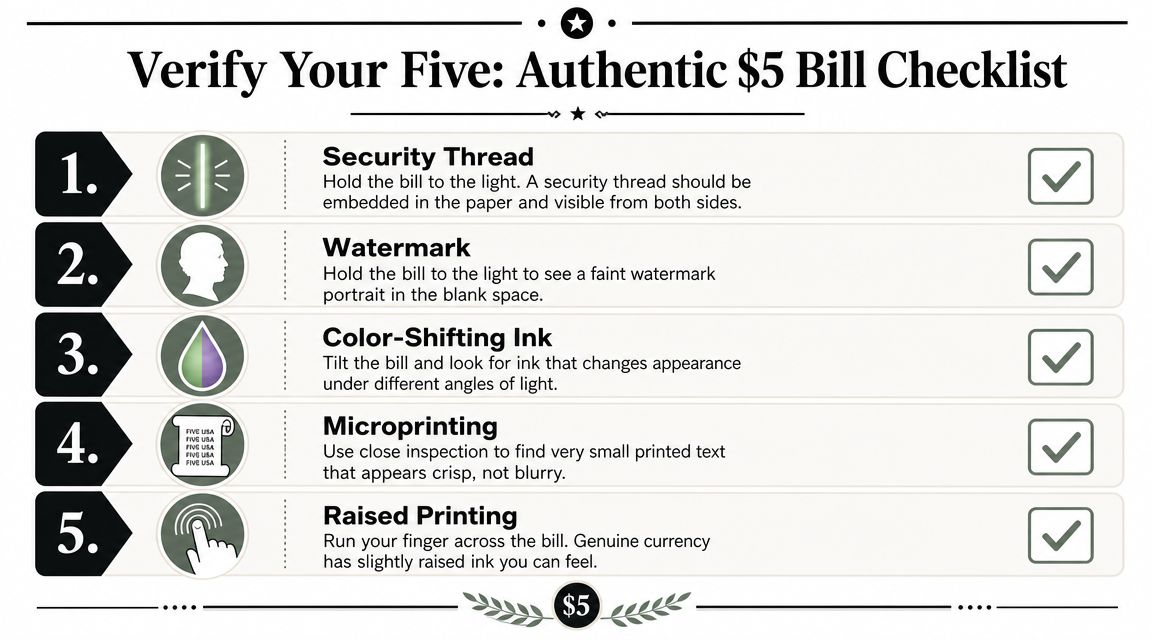
A genuine note should feel crisp and purposeful, not limp or waxy. The modern five is intaglio-printed, which means parts of the design have raised ink. You're not trying to detect dramatic texture. You're looking for a subtle tactile quality that copied paper often lacks.
Next, look at the overall design. The modern note includes a high-contrast purple numeral. That doesn't mean colour alone proves authenticity. It means the note was redesigned to work as a whole visual system, not as a single-colour portrait piece.
If you enjoy studying printed art and reproduction details in other media, the same habit of close looking applies to posters and paper collectibles as well, including Andy Warhol posters and print-era design cues.
Many people make mistakes: They stare at Lincoln's face and try to decide whether it “looks right”. The better method is simpler. Hold the bill up to transmitted light.
Check for these features:
Don't rely on the portrait alone. The modern five was intentionally designed so its strongest authentication clues appear when light passes through the note.
That design choice matters in real life. Shops, cash handlers, and ordinary users can verify the note without specialist equipment if they know where to look. Light reveals what colour imitation can't easily fake.
A short official demonstration helps if you want to see the features in action:
When someone hands you a five and you want to verify it quickly, use a repeatable order instead of random inspection.
That last step matters because counterfeit notes often fail in combination. A fake may copy one visual cue while missing the structure of the genuine note. The modern 5 dollar bill was built to be checked as a system.
The most useful collecting lesson is also the one many guides skip. A 5 dollar bill doesn't have to be antique to be interesting. Some modern notes attract attention because of serial-number patterns, star notes, or printing errors.
A practical collecting angle is to look for modern notes with low serials, palindromes, repeated digits, or star serials rather than assuming age alone determines interest. One consumer guide explicitly notes that “very low serial numbers can help make even modern bills more valuable” and explains that star notes are replacement notes, while also pointing to modern-note error demand in a 2017A $5 example, as discussed in this guide to rare 5 dollar bills and what to look for.
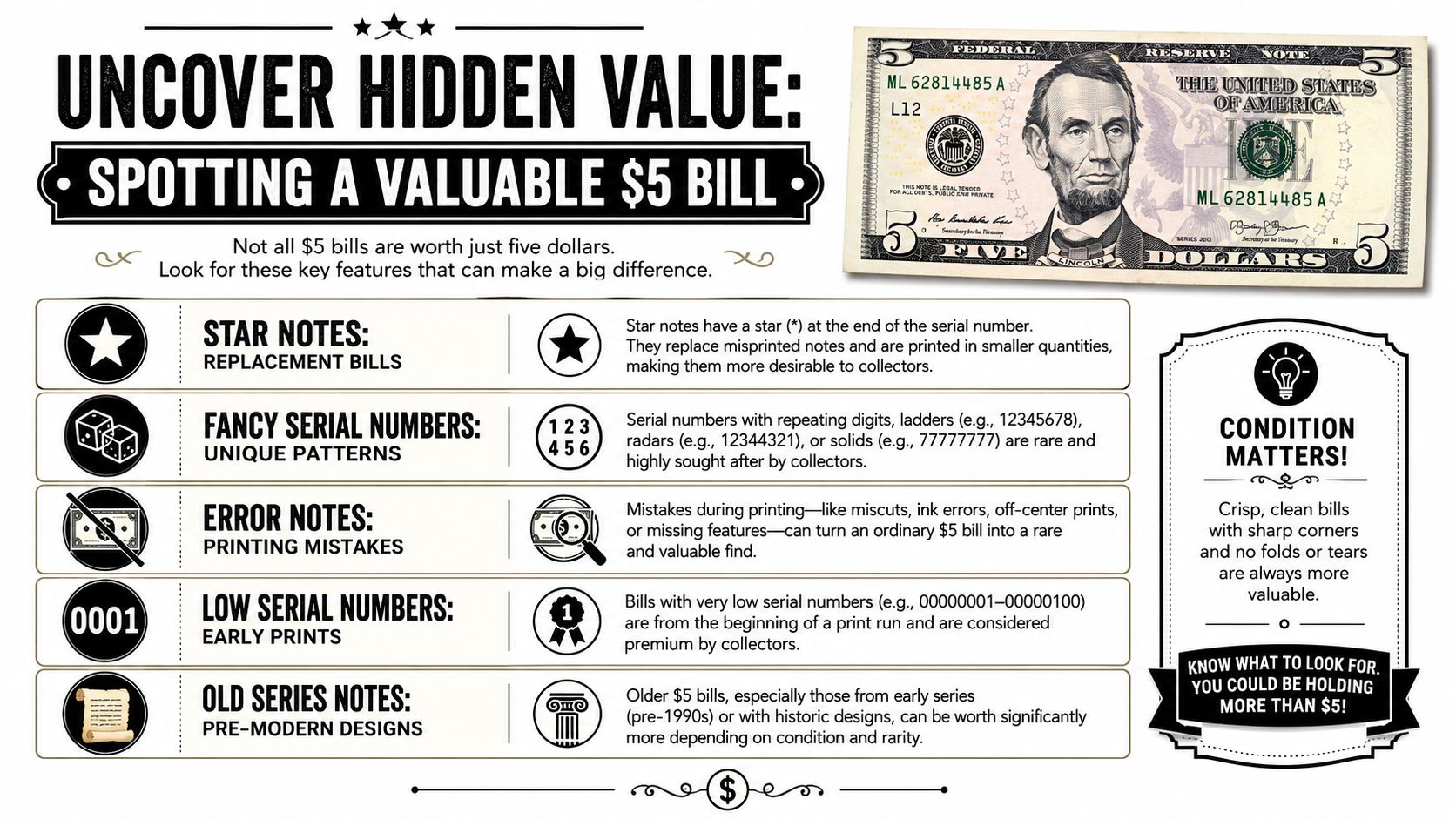
If you only glance at denomination and date, you'll miss most of the interesting material. The serial number is often the real story. Collectors pay attention to patterns because patterns are easy to recognise and difficult to manufacture by chance in an appealing form.
Look for serials with visual order. A very low serial number stands out because it suggests an early position in a print run. A palindrome reads the same forwards and backwards. A string of repeated digits can be attractive because it looks deliberate even though it isn't.
Examples of what catches the eye include:
Not every patterned serial is valuable, and condition still matters. But these are the notes worth setting aside for a closer look instead of spending immediately.
A star note is a replacement note. In plain terms, the star tells you the note was issued to take the place of another note in the production process. That doesn't automatically make it rare in the everyday sense, but it does make it collectable to many people because it marks the note as a specific production type.
The easiest way to approach star notes is not to overcomplicate them. If you see the star in the serial, pause. Then assess the note like a collector would:
A star note isn't valuable just because it has a star. It becomes more interesting when the star appears together with strong condition or a memorable serial pattern.
If you collect other old paper objects, stamps, or printed ephemera, this logic will feel familiar. Type matters. Condition matters. Visual distinctiveness matters. That's also the mindset behind evaluating old bookmarks and what gives them collector interest.
Beginners often misidentify certain features. A torn corner, scribble, stain, or crease is usually damage, not a printing error. A genuine error note comes from production. It might show misalignment, unusual placement, or another feature that happened during printing rather than after circulation.
When checking a possible error, ask one basic question: does this look like something the printing process caused, or something a person caused later?
Useful habits include these:
Inspecting every note received isn't a universal practice, nor is it necessary. But if you're curious, a quick routine can help.
First, check whether the note is ordinary modern circulation or something that stands out at once. Then read the serial number slowly. Finally, look for the star and any obvious production oddities.
That routine is especially useful outside the United States, where U.S. cash may show up in a drawer, travel wallet, inherited envelope, or souvenir bundle rather than in daily spending. In those situations, modern notes often get ignored because they don't look “old enough”. Sometimes that's a mistake.
In the United States, the 5 dollar bill is an ordinary working note. People spend it, receive it in change, and rarely think twice about it. Yet the official status of U.S. currency is broader than many people assume. Earlier issues remain legal tender, even when their designs differ from current notes, as noted earlier in the authentication discussion.
Outside the United States, the note changes role. It stops being ordinary domestic cash and becomes something else: foreign currency, a travel leftover, a collectible, or part of an inherited group of papers.
For readers in Sweden, the key practical point is simple. Sweden doesn't use the U.S. $5 bill as legal tender. The Swedish cash system is based on SEK, and banknotes are denominated in kronor, not dollars, so a U.S. five is treated as a foreign-currency asset rather than spendable local cash, as described on the U.S. Currency Education Program page for the $5 denomination.
That changes the questions you ask. You're no longer asking, “Can I spend this at a local shop?” You're asking whether the note should be exchanged, kept with travel money, or evaluated as a collectible. For businesses, it should be handled as inbound foreign currency or as inventory if it belongs in a collecting context.
People in Sweden also encounter U.S. notes in a different rhythm. They may find them in old travel envelopes, desk drawers, albums, estate clearances, or mixed souvenir boxes. Selling such items online adds another layer of judgement about listing, category, and buyer expectations, which is why guides to using eBay in Sweden can be helpful for practical resale decisions.
The five-dollar bill is easy to underestimate because it's familiar. But familiarity hides complexity. A single note can carry historical milestones, portrait symbolism, modern anti-counterfeit design, and collector interest tied to serial numbers or replacement status.
That's why the best habit is a calm, observant one. Don't assume every modern five is special. But don't assume it's automatically ordinary either. A quick look at the paper, the light-readable features, the serial number, and the note's context will usually tell you which kind of object you're holding.
If you enjoy looking closely at everyday objects that carry history, craft, and collecting potential, explore Dalaart for authentic Swedish folk art with the same sense of character and provenance.


.svg)


.png)


