February 1, 2026
Andy Warhol's posters are so much more than just decoration for your walls. They are tangible pieces of cultural history that blew the doors off the exclusive art world. By taking everyday objects and celebrity faces and turning them into iconic symbols, Warhol made art something everyone could want and own, cementing his legacy for generations.
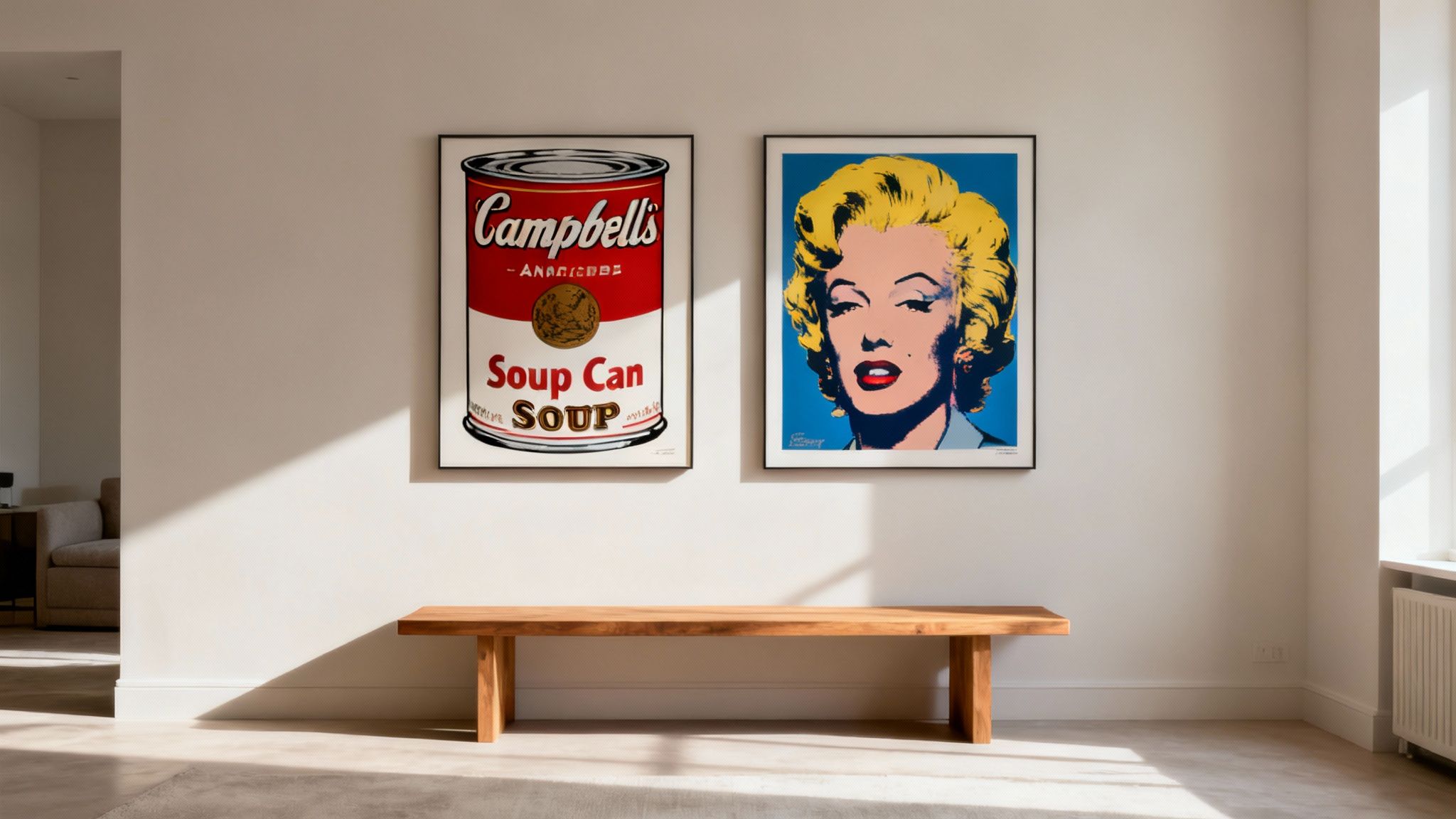
So, why does a simple picture of a soup can or a vividly coloured portrait of Marilyn Monroe still grab our attention all these years later? It all comes down to Andy Warhol's genius for erasing the line between stuffy "high art" and the messy, brilliant world of pop culture. He saw the beauty and power in the things people were buying, watching, and obsessing over every single day.
Before Warhol came along, the art scene often felt like an exclusive club, reserved for a select few. He turned that idea on its head. He'd take something totally familiar—like a Campbell's Soup can or a Coca-Cola bottle—and give it the same status as a classical painting. This was a radical move; he was showing us that art isn't just hiding in museums, but it’s all around us if we just look.
His choice of medium was just as rebellious as his subjects. Warhol embraced commercial methods like screenprinting, which allowed him to churn out images in huge numbers. This directly challenged the age-old idea that an artwork had to be a unique, one-of-a-kind masterpiece.
You could almost think of it as an assembly line for art. This approach made owning a piece of his vision possible for far more people, making the whole idea of collecting art less intimidating and way more inclusive. His posters, especially, became one of the main ways the public could get their hands on his work.
"Posters are typically intended to convey messages to the wider public rather than serve as works of art for collectors. In this sense, they are an inherently democratic medium."
This democratic spirit is at the very heart of why we're still fascinated with Andy Warhol posters. They represent a massive shift in how we think about and live with art. Owning one isn't just about filling a space on your wall; it's about holding a fragment of a movement that changed our culture forever.
These posters are like artefacts from a pivotal moment in art history. Each one tells a story about 20th-century consumerism, our obsession with celebrity, and the incredible power of mass media.
Ultimately, the magnetic pull of these works is in their blend of simplicity and depth. Warhol took the ordinary and made it extraordinary, inviting every single one of us into the conversation. This guide will walk you through the entire world of Andy Warhol posters, from how they were made to how you can start collecting them yourself.
To really get what makes an Andy Warhol poster special, you have to picture where—and how—it was made. Our journey takes us to his legendary New York studio, "The Factory." It was exactly what it sounds like: a sprawling, silver-foil-covered space that was part art studio, part non-stop party, and a hub of pure creative chaos. It was in this whirlwind that Warhol perfected the production methods that would change art forever.
The Factory wasn't your typical quiet artist's loft. It was a buzzing epicentre where artists, musicians, filmmakers, and socialites collided, and all that raw energy was channelled directly into the art. Warhol himself famously called it a factory because he approached art like a commercial product, using mechanical processes to churn it out on a massive scale.
At the very heart of this operation was a technique called serigraphy, which you probably know as screenprinting. Now, this wasn't some new invention—it was a workhorse of commercial advertising and printing t-shirts. But Warhol's genius was in taking this industrial process and elevating it to a fine art form. It was the perfect tool for his obsession with mass culture and consumerism, allowing him to reproduce the same image over and over again.
Think of it like using a really sophisticated stencil. An image is transferred onto a fine mesh screen, with certain areas blocked out to stop ink from passing through. Ink is then pushed across the screen, seeping through the open mesh onto the paper below. By using a different screen for each colour, he could layer vibrant, often deliberately clashing, hues to create his signature pop aesthetic.
This process also had a fascinating side effect. Even though it was mechanical, it wasn't perfect. Tiny misalignments between the colour screens, slight variations in the pressure used to push the ink, or the occasional smudge meant that no two prints were ever exactly identical. Each print, even from the same series, carries its own unique character and subtle flaws. It's the human touch sneaking into the machine.
When you start looking for Andy Warhol posters, you'll quickly realise they fall into several distinct categories. Knowing the difference is absolutely fundamental to understanding their authenticity, rarity, and, of course, their value. You can think of them as different tiers, each with its own purpose and place in the collecting world.
Here are the main types you need to know:
Exhibition posters are a fantastic entry point for new collectors. They are official, historical documents tied directly to Warhol's career, offering an affordable way to bring his iconic style into your home. Think of them as a time capsule—a souvenir from a landmark event in art history.
Being able to tell these types apart is the first critical step for any aspiring collector. A signed and numbered Marilyn is a completely different class of object from a poster advertising a show at a Paris gallery, even if they both feature the same striking image. This knowledge is your power; it allows you to navigate the market, understand pricing, and make smart decisions about which Andy Warhol posters are right for you.
When it comes to collecting Andy Warhol posters, the single most important question you'll face is, "Is it real?"
Navigating the art market can feel daunting, especially with an artist as iconic—and as copied—as Warhol. But learning to distinguish an authentic print from a clever fake is a skill you can absolutely develop. Think of it like being a detective; you just need to know what clues to look for and where to find them.
This guide will walk you through the essential checks for inspecting a potential purchase. We'll break down the specific details that separate a genuine Warhol from a reproduction, from the very paper it’s printed on to the subtle marks left by the original printmaker. Getting these fundamentals right is crucial for protecting your investment and buying with total confidence.
The flowchart below is a great starting point, offering a simple decision tree to help you classify the different types of Andy Warhol prints you might come across.
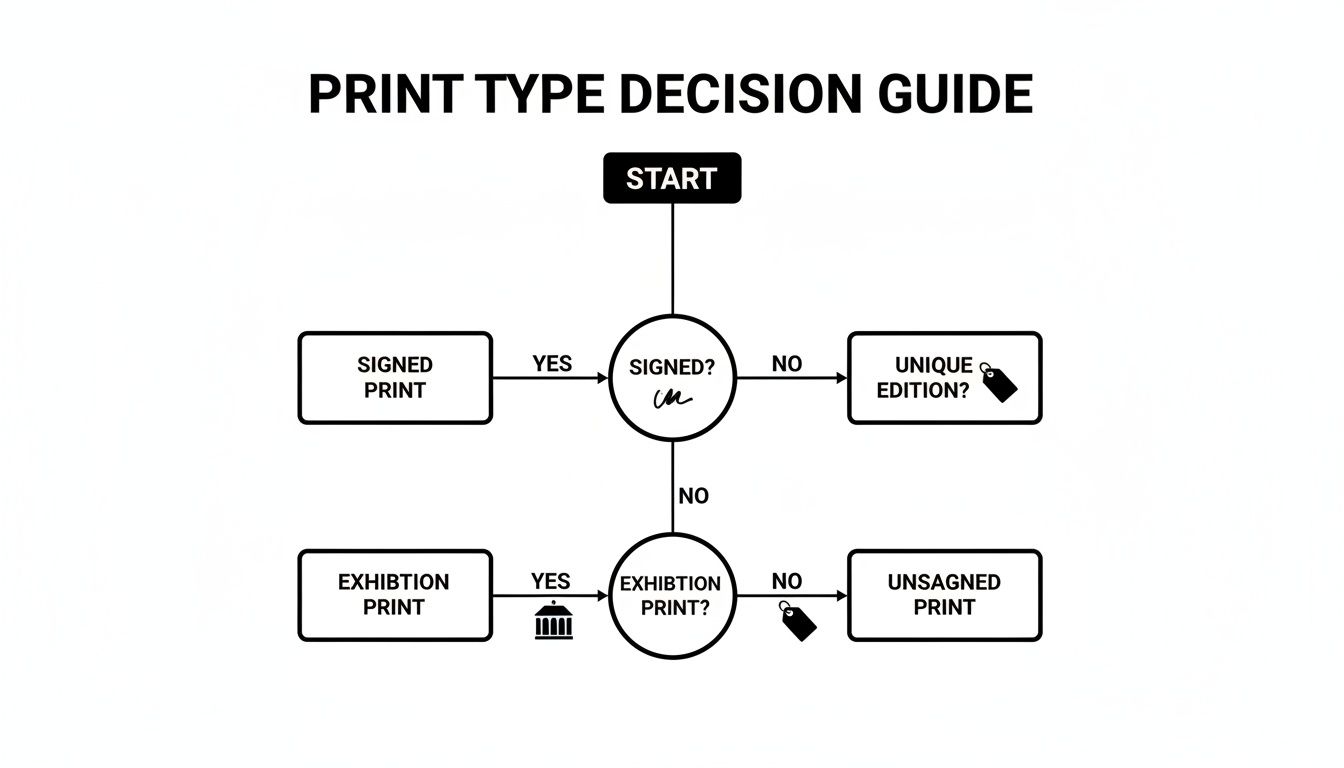
This visual guide is your first step in assessing a poster's origin and potential value, helping you quickly figure out if you're looking at a signed, unsigned, or exhibition piece.
First things first: get up close and personal with the artwork. The physical qualities of an authentic print are often the hardest things for a forger to replicate perfectly. Your inspection should start with the paper.
Warhol and his printers favoured specific types of high-quality, often heavy paper that feels substantial in your hands. A cheap, glossy poster paper is an immediate red flag. You're looking for something with a matte finish and a certain texture; it should feel like proper art paper, not a commercial flyer.
Next, look for a printer's mark, often called a chop mark. This is a small, embossed, or stamped symbol from the print workshop that produced the piece. While not all Warhol prints have them, their presence is a very strong indicator of authenticity. It’s worth researching the known chop marks for the specific print series you are considering.
A genuine Andy Warhol signature is a huge validation, but it’s also one of the most frequently faked elements. It's important to know that Warhol's signature style evolved significantly over his career. Early on, he signed with a clear, almost delicate cursive script. Later in life, it became a much more abbreviated, block-like scrawl.
Here’s what to check:
Verifying a signature really does require a trained eye. If you have even the slightest doubt, consulting with a reputable art dealer or appraiser is always the wisest move. Their expertise can save you from a very expensive mistake.
Beyond the physical print, the most powerful tool you have for authentication is its history. Provenance is simply the documented ownership trail of an artwork. A solid provenance traces the piece from the artist's studio or publisher all the way to the current owner, with a clear paper trail of gallery receipts, auction records, and exhibition history.
The absolute gold standard for this is the official catalogue raisonné: Andy Warhol Prints: A Catalogue Raisonné 1962–1987, meticulously compiled by Frayda Feldman and Jörg Schellmann. This multi-volume book is the scholarly bible for Warhol prints, documenting every known edition he ever produced.
If a print is listed in this catalogue, it provides the strongest possible evidence of its legitimacy. The catalogue details everything: edition sizes, printers, dimensions, and paper types. Always ask a seller if the print is documented in Feldman & Schellmann and request the specific catalogue number (e.g., F.S. II.22) as proof.
For those interested in Pop Art contemporaries, you can explore similar authentication principles in our guide on collecting Keith Haring posters. Mastering these steps will give you the confidence you need to spot red flags and build a genuine, valuable collection.
Andy Warhol’s influence wasn't just confined to the galleries of New York or London. It rippled across the globe, sparking entirely new markets for Andy Warhol posters in places you might not expect. The story of how Pop Art exploded in Southeast Asia is the perfect real-world example of this, showing just how one single event can ignite a collecting firestorm.
This case study takes the abstract idea of "market dynamics" and makes it tangible. It shows how a major exhibition did more than just hang art on walls—it actively created a new generation of collectors, sent prices soaring, and cemented Warhol's status as a truly global icon. His work proved it could connect with audiences anywhere, crossing cultural and geographic lines with incredible ease.
So, what was the catalyst? A landmark exhibition that didn't just showcase art, but fundamentally reshaped the region's relationship with Pop Art.
In 2012, the ArtScience Museum at Marina Bay Sands in Singapore became the epicentre of the Warhol phenomenon in Asia. The museum hosted 'Andy Warhol: 15 Minutes Eternal,' a massive exhibition that kicked off an ambitious 27-month tour across the continent. It was a sensation, featuring over 300 of his most famous works, from the Marilyn Monroe portraits to the iconic Campbell's Soup Cans. Tens of thousands of visitors flocked to the show, sparking a regional obsession.
But this event was more than just a retrospective; it was a clever cultural conversation. A dedicated gallery, 'Warhol in Southeast Asia,' featured works by local artists from Singapore, Malaysia, and Thailand who put their own regional spin on Warhol's style. One Singaporean artist brilliantly depicted a local Ma Ling luncheon meat can in the style of the soup series, directly connecting Warhol's critique of consumerism to everyday life in Southeast Asia. This creative exchange made Warhol's ideas more relatable and, in turn, inspired a new wave of local Pop artists.
The exhibition's effect on the market was immediate and clear. Galleries across Singapore reported a huge jump in sales, with private transactions for pop art prints rising by 25% in the months right after the show. It was a textbook case of how a well-timed cultural event can create real commercial demand.
The impact didn't stop there. Data from regional art fairs after 2012 showed that inquiries for Warhol prints in Southeast Asian markets shot up by 40%. Singapore quickly became the main hub, accounting for an incredible 55% of all Warhol poster sales in Asia that year. The exhibition had fundamentally changed the collecting landscape. You can learn more about this exhibition’s profound regional influence and see the specific artworks that started it all.
This boom wasn't just for high-end collectors. A huge part of Warhol's growing appeal came from the accessibility of Andy Warhol posters. The exhibition made his work visible to a massive new audience, and many people were inspired to bring that bold, graphic energy into their own homes. The posters offered a powerful entry point for new buyers who loved the pop aesthetic but perhaps weren't ready to invest in a signed print.
This whole phenomenon highlights a key part of Warhol's legacy: he made art feel democratic. His work effortlessly bridges the gap between the museum and the home. For collectors of Scandinavian heritage items, like the hand-painted Dala horses from Dalaart, this intersection is especially interesting.
It shows how global pop culture can live happily alongside cherished folk traditions. A vibrant, mass-produced Warhol poster can hang near a unique, handcrafted Dala rooster, each representing a different but equally valid form of collectible art. One speaks to global iconography, the other to deep-rooted artisanship, yet both bring colour, history, and personality to a living space. The Singapore event proved that Warhol's appeal truly has no borders, inspiring a new passion for collecting that continues to thrive today.
So, what makes one Andy Warhol poster command a price tag in the thousands while another, seemingly similar one, is far more affordable? The answer isn't a single thing but a mix of factors that build its market value. Getting a handle on these drivers is the key to understanding the worth of any Pop Art piece you’re looking at.
Think of it like sizing up a vintage car. Two models from the same year might look alike, but the one with its original engine, low mileage, and a famous first owner will always be in another league. It’s the same with Andy Warhol posters—the value is built on its subject, condition, rarity, and whether the artist’s own hand is present.
First things first, not all Warhol subjects are created equal. His most iconic and instantly recognisable images are the ones that consistently fetch the highest prices. The celebrity portraits and famous product series are basically the blue-chip stocks of his poster market.
A poster of Marilyn Monroe is simply in a different collecting universe than one from a less famous series. The subject’s fame acts as a powerful multiplier on its base value.
Beyond the image itself, rarity plays a massive part. This is where understanding the different print types becomes so important. A signed and numbered print from a small edition of 250 is naturally scarcer—and therefore more valuable—than an unsigned exhibition poster printed in the thousands.
The core principle is simple supply and demand. The fewer copies of a specific print that exist, the more people will compete for them, driving up the price. An unsigned print from that same edition of 250 is still rare, but the signature adds another layer of desirability and value.
The market for Warhol's work has also shown incredible global strength, with demand popping up in new regions over time. Southeast Asia, for example, became a hotspot after a few key exhibitions, with data showing a market frenzy similar to what was seen in Europe. While Warhol's prints globally make up 72% of his auction sales, Southeast Asian markets were right there with them, with posters accounting for 68% of regional transactions. The growth was explosive; Warhol poster sales in the region surged 126% year-over-year by 2022, proving a robust and expanding collector base.
The physical state of a poster is a non-negotiable factor. A print in pristine, or "mint," condition will always be worth significantly more than one with obvious damage. Collectors are looking for sharp colours, clean paper, and no signs of being mishandled.
Common condition issues that can seriously tank the value include:
Even tiny flaws can have a big impact, so a careful inspection is essential. This is one of the main reasons professional framing and conservation, which we’ll get into later, are so vital for protecting your investment. For those interested in preserving other types of art, check out our guide on caring for vintage posters from Sweden.
While signed prints are the top of the pyramid, don't sleep on the value and appeal of unsigned exhibition posters. These pieces were created to promote Warhol's shows at galleries and museums around the world, making them authentic historical artefacts in their own right.
Because they were usually made in larger numbers and are unsigned, they are much more affordable. This makes them the perfect starting point for anyone looking to dip their toes into art collecting without a huge upfront cost. An exhibition poster lets you own a genuine piece of the Warhol story, a real link to a specific moment in his career, and a bold piece of Pop Art for your home.
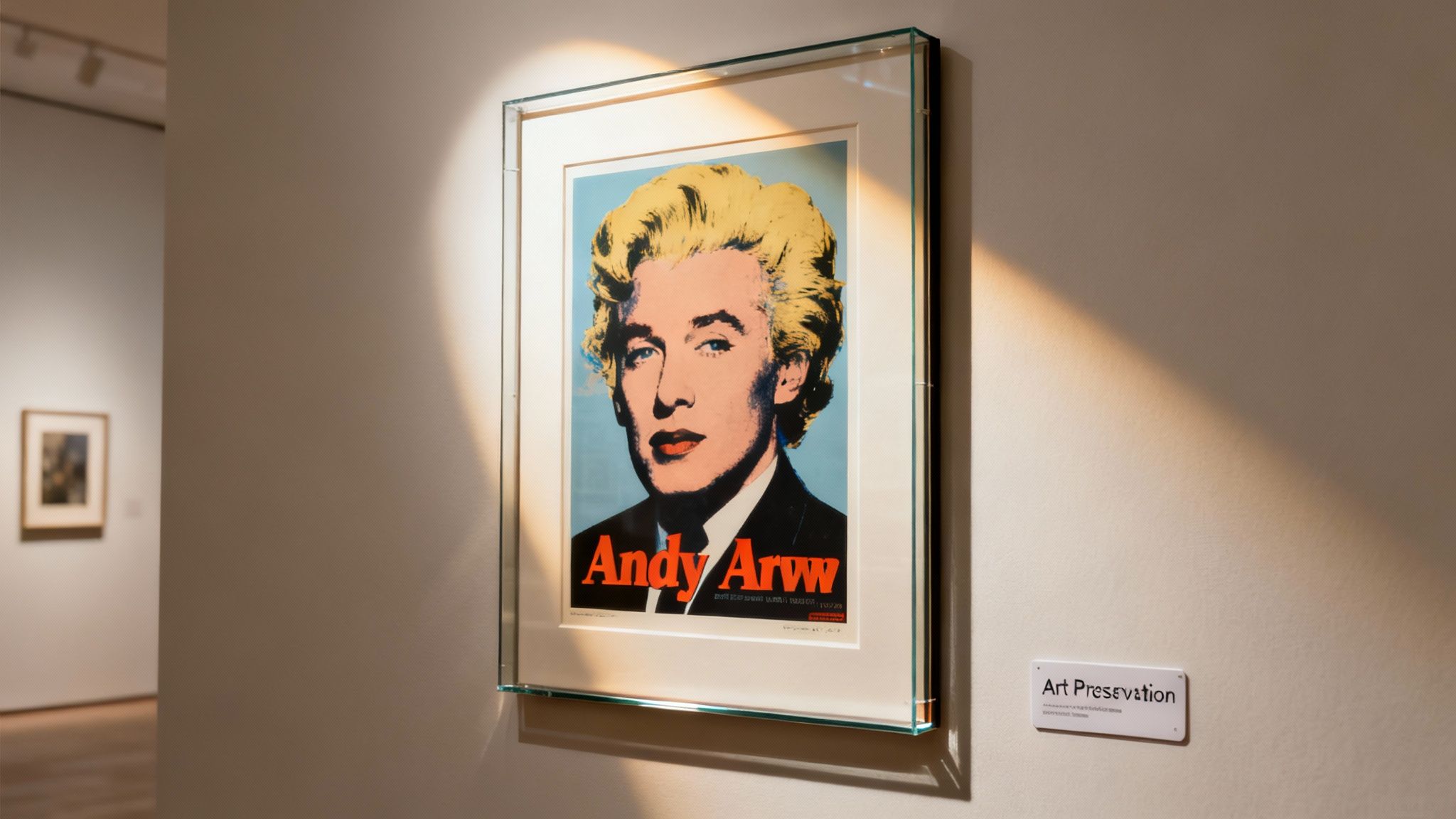
Getting your hands on an Andy Warhol poster is just the beginning of the journey. Now, it's about protecting that investment so you can enjoy it for years to come. Proper care and display aren’t just about making it look good on the wall—they’re essential for preserving the artwork's condition, vibrant colours, and long-term value.
Believe it or not, simple things like sunlight and humidity are the biggest enemies of any work on paper. Direct UV light is notorious for bleaching the brilliant, saturated colours that make Warhol’s art so iconic, leaving them looking dull and faded. On the other hand, high humidity can cause mould growth (known as foxing) or make the paper itself warp and ripple.
To keep your poster safe, always hang it away from direct sunlight. A wall that doesn't get blasted by the harsh afternoon sun is a perfect spot. It’s also wise to avoid hanging valuable art in rooms with a lot of moisture, like bathrooms or kitchens. The goal is a consistent, moderate environment.
Don’t think of framing as just an expense; it’s a crucial layer of protection for your poster. Opting for a professional framing job is one of the best moves you can make. It’s not a luxury—it’s a necessity for any piece you want to keep in mint condition.
Here are the key things to insist on for a conservation-quality frame:
Professional framing is your first line of defence against the elements. It seals the artwork in a stable microenvironment, shielding it from dust, humidity fluctuations, and the fading effects of UV light, ensuring its bold colours remain true for decades.
A bold Warhol poster doesn’t have to dominate a room—it can elevate it. The secret is to create a visual conversation between the art and its surroundings. For a deeper look at this, our guide to the world of Pop Art posters offers plenty more inspiration.
In a clean, minimalist space, a single, large-scale Warhol can be a stunning focal point against a neutral wall. Just let the artwork’s electric colours provide the main pop of energy.
If your style is more eclectic or maximalist, don't be afraid to mix things up. A Warhol hangs beautifully as part of a larger gallery wall, placed right alongside photographs, abstract pieces, or even traditional paintings. This approach makes the poster feel more integrated and personal, adding its unique character to a rich, layered display.
Jumping into the world of Andy Warhol posters can bring up a few questions, especially when you’re just starting out. Let's tackle some of the most common ones to help you begin your collecting journey with confidence.
The simplest way to think about it is originality and purpose. A fine art print (like a signed, numbered screenprint) is considered an original work of art. Warhol himself was directly involved in its creation, and it was made in a deliberately limited quantity.
An exhibition poster, on the other hand, was usually a promotional piece for a gallery show. They were produced in much larger numbers and are often unsigned. This makes them a fantastic and much more affordable entry point for new collectors.
While any art investment comes with its own set of risks, Warhol’s work has shown incredible staying power. His most famous images, especially signed prints kept in excellent condition, have a solid history of appreciating in value. For many, though, the biggest reward is simply owning a genuine piece of art history.
Warhol’s global appeal just keeps growing, creating strong demand in markets far beyond Europe and America. A 2012 exhibition in Singapore, for example, pulled in an estimated 150,000 visitors. This buzz led to a 35% increase in regional gallery sales, proving the worldwide investment potential of Andy Warhol posters. You can read more about the statistical impact of this art market boom here.
To make sure you’re getting the real deal, always buy from reputable sources. This means sticking to major auction houses like Christie's or Sotheby's, well-regarded art galleries that specialise in Pop Art, and properly vetted online art marketplaces.
Always, always ask for the paperwork. This should include its provenance (the history of ownership) and, if possible, a certificate of authenticity.
Prices for Andy Warhol posters can vary wildly. You might find an unsigned exhibition poster for a few hundred pounds, which is a great starting point.
At the other end of the scale, a signed and numbered print of a superstar subject like Marilyn Monroe can easily fetch tens, or even hundreds, of thousands. It really all comes down to your budget and which part of the market feels right for you.
At Dalaart, we celebrate the intersection of iconic art and timeless craftsmanship. While you explore the vibrant world of Pop Art, discover our collection of authentic, hand-painted Swedish Dala horses that bring a touch of Scandinavian heritage to any home. Explore our unique pieces at https://dalaart.com.


.svg)


.png)


