December 23, 2025
More than just paper for your walls, Keith Haring posters are a direct line to the electric energy of 1980s New York. They're tangible pieces of cultural history, capturing Haring's core belief that art belongs to everyone, bringing his bold lines and dancing figures from the subway tunnels right into our living rooms. To this day, they remain powerful statements of joy, activism, and community.
Step into the world of Keith Haring, an artist who truly believed that art was for everybody. His iconic posters, instantly recognisable by their confident lines and energetic figures, aren't simply decorations. They are slices of history that continue to captivate new admirers and seasoned collectors alike. Haring’s whole philosophy was about making art accessible, turning public spaces like subway stations and city walls into his personal canvases.
This democratic approach is exactly what makes his work so powerful and timeless. Haring developed a visual language that was immediate, easy to understand, and completely universal. His posters were a natural extension of this mission, a way for people to bring a piece of his vibrant world into their own homes. The themes he tackled are still incredibly relevant today:
“Art should be something that liberates your soul, provokes the imagination and encourages people to go further.” - Keith Haring
Think of this guide as your roadmap to the world of Keith Haring posters. While his work has a global footprint, with major pieces everywhere from New York to Berlin, its appeal is truly universal. We'll walk through the different types of posters out there, from rare originals to modern reprints, and give you the knowledge you need to confidently identify, purchase, and display these iconic works in your own space. If you're curious, you can learn more about Keith Haring’s original vintage posters and their history.
Navigating the world of Keith Haring posters can feel a bit like learning a new language. To buy with confidence, it’s crucial to understand that not all posters are created equal. They fall into a few distinct categories, each with its own story, purpose, and value—from genuine historical artefacts to beautiful pieces for your wall.
Think of it like collecting books. Some are rare, signed first editions, while others are modern paperbacks. Both let you enjoy the story, but their significance and market value are worlds apart. The same idea applies here.
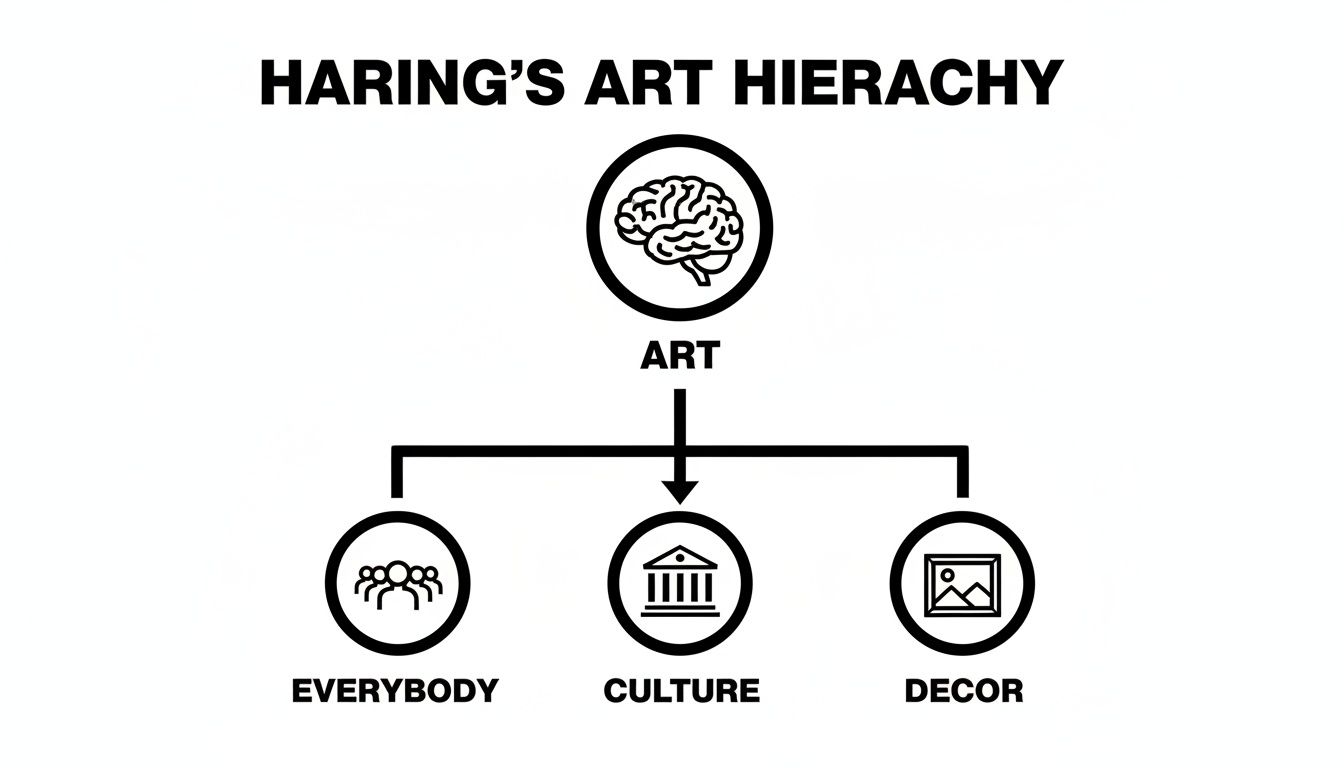
Haring's vision was always to bridge the gap between high art and everyday life. The diagram above captures this perfectly, showing how his art was meant to connect with everyone, whether through a museum exhibition or as a poster in someone's home. This tiered structure is the key to understanding why certain pieces command higher prices and hold more historical weight.
At the very top of the pyramid are the original posters created during Haring's lifetime, mostly throughout the 1980s. These aren't just pictures; they're historical documents. Often printed as offset lithographs, they were made to announce a specific gallery show, a community event, or a social cause he cared deeply about, capturing a moment when Haring was right there, part of the action.
Within this top tier, you’ll also find limited-edition prints, like screenprints, which Haring created as fine art in their own right. These were produced in a fixed, small number and, most excitingly, often signed and numbered by the artist himself.
The next category includes official posters produced after Haring's death in 1990. It’s important to know these are not fakes. They are legitimate, high-quality reproductions sanctioned by the Keith Haring Foundation or museums that hold his work, all done to continue his mission of making art accessible.
These posthumous editions are a fantastic starting point for new collectors. You get to own an iconic image without the hefty price tag of a vintage original. While they don't have the same historical value as a poster from the 80s, they are beautifully made items that honour his legacy.
Owning an authorised reprint is a brilliant way to support the artist's foundation, which continues the charitable work Haring was so passionate about. It’s a purchase that really aligns with the spirit of his art.
Finally, we have decorative reproductions. These are the mass-produced posters you might find in large home decor shops or online marketplaces, created purely for interior styling. They feature Haring’s famous imagery, but they lack the collector value of vintage originals or the official stamp of approval from estate-authorised editions.
Still, these posters make Haring’s vibrant, energetic style available to just about anyone, which fits perfectly with his whole philosophy. The bold, simple nature of his work is so powerful, much like other art forms that convey deep meaning with just a few strokes. In fact, you can explore the captivating history of one-line drawing to see how other artists have achieved similar impact.
Understanding these distinctions is the first real step. It's how you find the perfect Keith Haring poster for your home, your collection, and your budget.
Jumping into the market for Keith Haring posters without knowing how to spot a fake is like trying to find your way through a new city without a map. It's easy to get lost. So, let's go over a practical checklist you can use when looking at a potential purchase, helping you sidestep those costly mistakes and buy with real confidence.
The very first thing to check, and arguably the most important, is the print quality. A genuine vintage poster, which is usually an offset lithograph, will have lines that are incredibly crisp, clean, and confident. Haring's whole style was built on these bold, unbroken strokes, and the original printing methods really show that clarity.
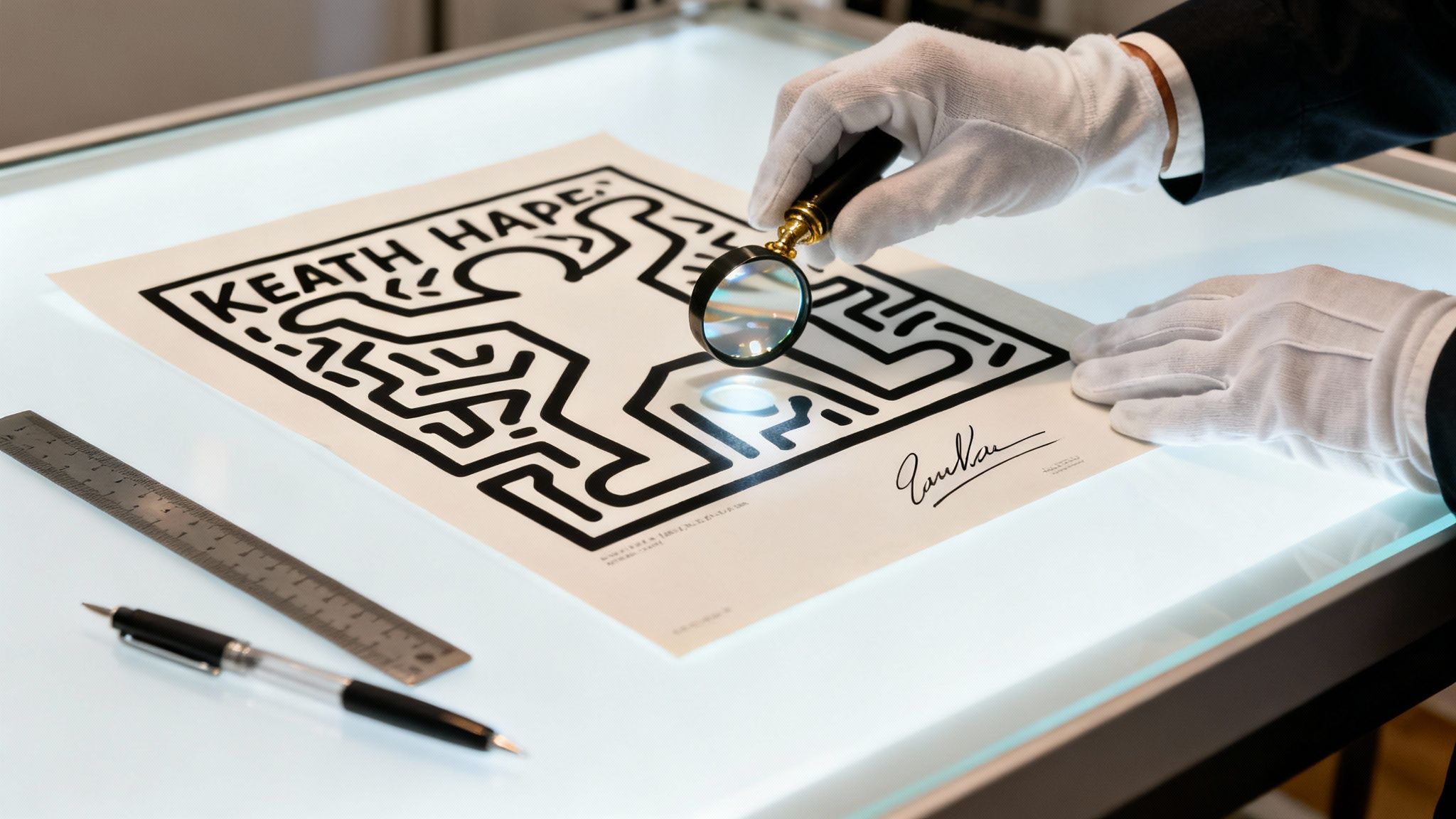
A forgery, on the other hand, is often just a digital copy of a real poster. That process almost always leads to a loss of detail. You'll need to look closely—maybe even with a magnifying glass—for any hint of pixelation, fuzziness, or blurred edges. If the lines aren't sharp and definite, that’s a huge red flag.
Beyond the image itself, the physical poster has its own story to tell. The paper's type and condition are big clues that can help you separate a genuine piece from a modern knock-off.
An original poster from the 1980s is going to show its age. The paper might have a slight, even patina or a gentle off-white tone, unlike the bright, stark white of new paper. It should also have a feel that's right for its time—not super glossy or thin like a cheap, mass-produced print you’d buy today. While his murals were massive, like the famous 300-metre-long piece on the Berlin Wall, his posters had a more intimate, tangible quality you can really feel when you get up close. You can read more about his career and famous works on his Wikipedia page.
Keep an eye out for these key details:
If you're looking at a signed piece, checking the signature is everything. Haring had a very distinctive, fluid signature that's incredibly hard to fake perfectly. You need to compare it meticulously against verified examples from reputable sources like major auction houses.
A suspiciously low price is almost always a warning sign. If a deal for an 'original' Keith Haring poster seems too good to be true, it almost certainly is. Authentic vintage art holds its value for a reason.
Finally, always, always vet the seller. A reputable dealer or gallery will have a track record you can check, clear return policies, and a deep well of knowledge they should be happy to share. Be very cautious of sellers with no history or anyone who can't provide clear provenance—the poster's ownership history. This due diligence is just as crucial as inspecting the artwork itself.
The world of vintage posters is fascinating, and these same principles of authentication apply to all sorts of styles and artists. If this has piqued your interest, you might enjoy our guide on collecting vintage posters from Sweden, which explores similar themes.
Ever wondered why one Keith Haring poster might sell for a few hundred pounds while another fetches thousands? The art market can feel like a bit of a mystery, but the value of a Keith Haring poster isn't random at all. It’s actually driven by a pretty clear set of factors. Getting your head around these is the key to knowing what you're looking at and making a smart purchase.
Think of it a bit like valuing a classic car. It’s not just about the make and model; it’s about how many were ever made, what shape it’s in today, and the story behind it. The exact same logic applies to these iconic posters.
First and foremost, the biggest driver of a poster's price is how rare it is. An original poster from a small, limited print run will always be more valuable than one churned out in the thousands. This is particularly true for signed and numbered prints, where a low edition number—say, 5/100—is far more coveted than one higher up the run.
Posters created for smaller, one-off events or niche gallery shows tend to be much rarer than those printed for major museum exhibitions. It’s a simple case of supply and demand. Scarcity creates desire, and in the art world, that translates directly into higher value. A poster that’s genuinely hard to find will always command a higher price among serious collectors.
The physical condition of a poster is absolutely crucial. A piece that looks like it just came off the printing press will always be valued higher than one that’s seen better days. Collectors have a whole grading system for this, and even seemingly minor flaws can knock the price down significantly.
Here's what to look for with a critical eye:
A poster in what's known as "mint" or "near-mint" condition is the gold standard. This means it looks almost as fresh and crisp as the day it was printed, and that pristine state can make it worth exponentially more than a damaged version of the exact same print.
Not all of Haring's images are created equal in the market. Posters featuring his most famous motifs, like the 'Radiant Baby' or the 'Barking Dog', are often in higher demand simply because they are so instantly recognisable. These symbols are the heart of his visual language and have a much broader appeal.
Finally, a poster's history—what the art world calls provenance—adds another important layer of value. This is the documented trail of ownership. A poster with a clear history, maybe one that was bought directly from Haring's legendary Pop Shop back in 1986 or was part of a well-known collection, is more valuable than one with a mysterious past. Good provenance gives you confidence and a tangible link back to the artwork's origin.
So, you've brought a Keith Haring poster home. That's fantastic. But finding the right spot on the wall is only half the story; now it's about making sure that incredible energy lasts for decades to come. Think of proper framing as the first line of defence for your investment.
Without a good frame, the enemies of art—sunlight, humidity, even the air itself—will slowly but surely take their toll. Colours fade, paper turns yellow and brittle. That's why archival framing isn't just a nice-to-have, it's absolutely essential for any piece you care about.
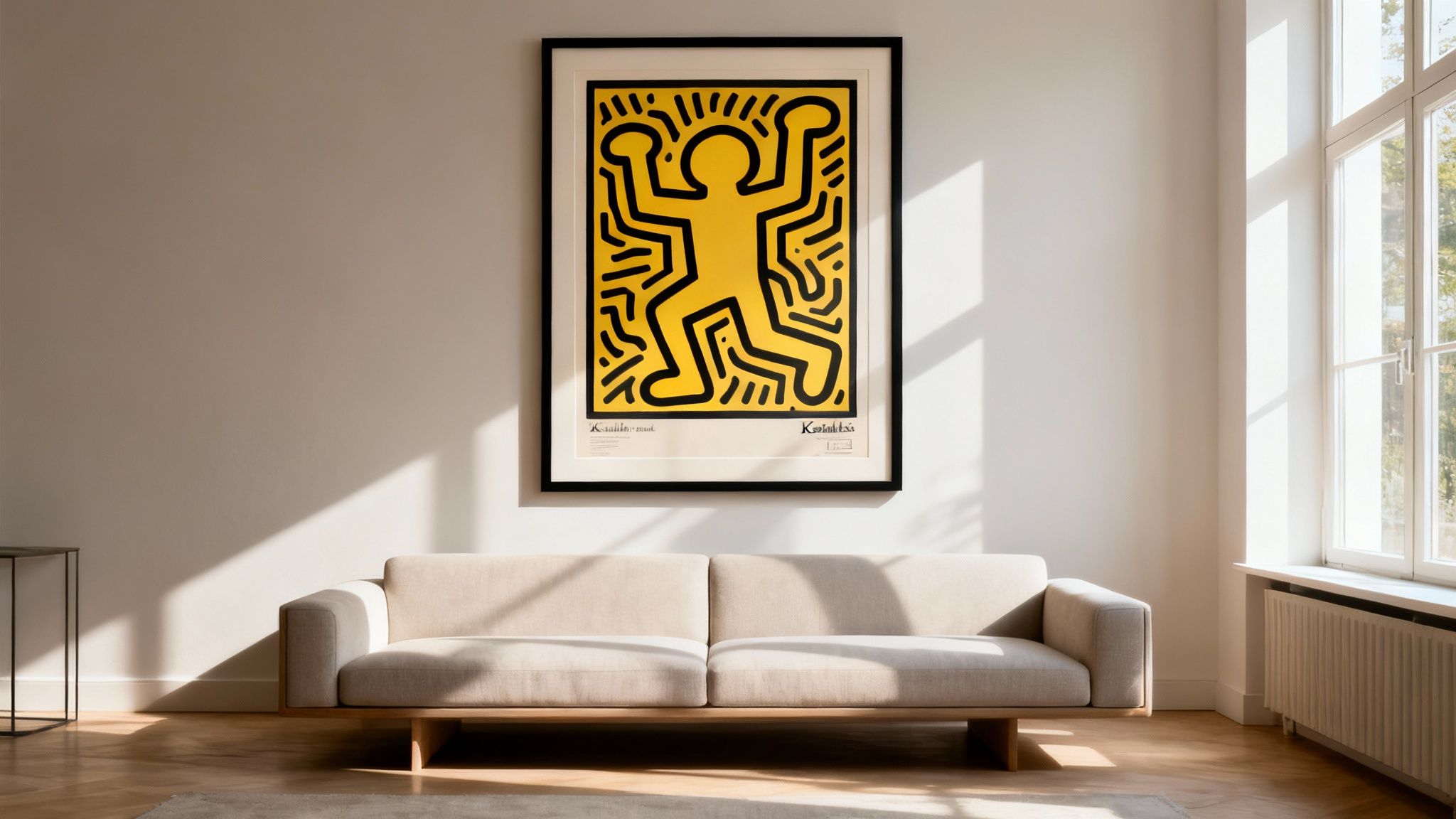
Archival framing is all about creating a safe little micro-environment for your poster, shielding it from everything that wants to cause it harm. When you walk into a professional framer's shop, these are the non-negotiables you'll want to talk about.
A professional framer can be your greatest ally. Their expertise ensures that every component used is of archival quality, safeguarding your Keith Haring posters against the slow march of time and preserving their value and visual punch.
Once your poster is safely framed, the real fun begins. Haring’s bold, graphic style has the power to electrify any room, but the way you display it makes all the difference. His work is surprisingly versatile and plays incredibly well with a whole range of interior designs.
A single, large-scale Haring can be a commanding focal point in a minimalist or modern room, injecting an immediate hit of colour and movement. But don't be afraid to mix it up. The clean, simple lines of Scandinavian decor, for instance, create a perfect neutral canvas that makes a Haring piece pop. Likewise, placing his work alongside the organic textures of folk art can create a fascinating, layered conversation between different styles. For more ideas on blending artistic elements, check out our guide on styling with wood wall art.
Haring's art was made for the people and seen everywhere, from subway stations to city walls across the globe. This universal accessibility is part of what makes it so adaptable to almost any home. To get a sense of just how far his art travelled, you can read more about Keith Haring's public artworks around the world.
Diving into the world of art collecting can feel like learning a new language, and it’s natural to have questions. To wrap up our guide, let’s tackle some of the most common queries that come up when people start looking for Keith Haring posters. Think of this as your quick-reference cheat sheet to help you feel more confident in your search.
We'll cover the essentials, from the nitty-gritty of prints versus posters to what really makes a piece valuable. Having these answers handy will give you a clearer perspective as you navigate the market.
This is a big one, and while people often use the terms interchangeably, there’s a crucial distinction that really affects the value of a piece.
In the art world, a "print" usually means a fine art work, like a screenprint or lithograph, created in a specific, limited run. Haring would often sign and number these himself, and they were intended from the get-go to be collectible works of art.
A "poster," on the other hand, was typically an offset lithograph made in large numbers to advertise something—a gallery show, a social cause, or an event. While the original vintage posters from the 1980s are absolutely collectible pieces of history, many posters you see today are modern, decorative reproductions. The real difference comes down to the artist's original intent, how it was made, and how many were produced.
Yes, absolutely. Any poster you buy directly from the official Keith Haring Foundation is an authentic, licensed reproduction. It's important to know that these aren't the original vintage posters from his lifetime, but they are fantastic, high-quality items that faithfully represent his work and honour his legacy.
Buying from the foundation is a brilliant and affordable way to bring his art into your home. Better yet, the money from these sales goes on to support the charitable organisations that Haring was so passionate about, making it a purchase you can feel great about.
A Certificate of Authenticity (COA) is only as credible as its source. For signed or high-value works, a COA from a major auction house or a reputable gallery specialising in Pop Art is a significant asset.
Be very wary, however, of generic COAs from unknown online sellers. Frankly, they often hold little to no real weight in the art market. For an unsigned exhibition poster, solid provenance—like an original receipt from the gallery it was sold at—is often far more valuable than a random third-party certificate.
The price range for Keith Haring posters is incredibly wide, and it all comes down to what you're buying. The cost can swing dramatically based on rarity, condition, and whether it’s signed.
Here’s a rough idea of what you can expect:
Without a doubt, the single biggest factor driving the price is whether the piece is a vintage original created during Haring's lifetime or a modern, posthumous reproduction.
At Dalaart, we celebrate art that tells a story and brings unique character into your home. While you explore the vibrant world of pop art, discover our collection of authentic, hand-carved Swedish Dala horses that honour a rich folk art tradition. Find your piece of Scandinavian heritage at Dalaart.


.svg)


.png)


