May 31, 2026
You're probably staring at a plain jumper right now, or scrolling through loud holiday knits that feel funny for five minutes and forgettable by Boxing Day. You want something playful, but not flimsy. Something that makes people laugh, yet still looks like it was made by a person with taste and a steady hand.
That's where handmade funny Christmas sweaters shine. They can be silly without being throwaway. They can carry a joke, a memory, even a bit of family heritage. And when you build one with Scandinavian inspiration, especially Dala-style motifs, the result feels less like a gag costume and more like a festive object you'll want to wear again.
Shop shelves are full of ready-made novelty knits, and the category is big enough to measure at global scale. The global ugly Christmas sweater market was estimated at $1.12 billion in 2024 according to this ugly Christmas sweater market report. That tells us one thing clearly. Funny Christmas sweaters are no small seasonal oddity.
But popularity doesn't automatically create meaning.
A bought sweater can be amusing for a party. A handmade sweater can become part of your holiday routine. You remember where each trim came from, why you chose that tiny bell, why the reindeer looks smug instead of sweet. The humour lands better when the piece has personality.
When you make your own, you control the balance between chaos and charm. You can keep the joke broad, like a giant felt gingerbread man skiing downhill, or make it sly, like a traditional-looking folk border that hides dancing sausages, crooked stars, or a Dala horse pulling a Christmas pudding.
That's especially lovely if you already enjoy Scandinavian festive styling. If your home leans towards candles, natural textures, painted wood, and carefully chosen decorations, a mass-produced synthetic jumper can feel oddly out of tune. A crafted sweater sits more naturally beside your wreaths, ornaments, and Swedish Christmas decorations.
A good holiday sweater doesn't just get a laugh across the room. It rewards a closer look.
The trick is to stop thinking of the sweater as a one-night joke and start treating it like a small textile project. That shift changes everything. You choose a better base. You place the design with care. You make decisions that help it last through parties, family photos, washing, storage, and another December after that.
That's how funny Christmas sweaters become more than novelty. They become wearable storytelling.
The best funny Christmas sweaters aren't random. They have a point of view. Even the most over-the-top design feels stronger when the joke is clear within a few seconds.
That idea fits the history of the trend. The roots of ugly sweater culture are tied to irony-led holiday parties, and the first recorded ugly sweater party dates to 2002 in this background piece on the quirky charm of ugly Christmas sweaters. From the beginning, the sweater's job was to become a visual centrepiece that people noticed and talked about.
Most readers get stuck because they try to put every joke on one jumper. Don't. Pick one humour lane first, then build around it.
A few dependable lanes work well:
If you're unsure which to choose, start with what makes you laugh when explaining it aloud. If you need a long explanation, the design may be too complicated.
A sweater isn't a flat poster. It wraps around the body, folds at the underarms, stretches at the chest, and moves when you walk. Use that to your advantage.
Break the garment into zones:
One easy mistake is putting important details too low. Once the sweater tucks, bunches, or sits at a dining table, that joke disappears. Keep the core idea high enough to be seen in conversation and photographs.
Try this quick planning method on paper first:
Practical rule: If every detail supports the same joke, the sweater looks intentional. If each detail tries to start a new joke, the sweater looks messy.
Ambition is lovely. Wearability matters more.
A giant sculptural chimney with stuffed felt smoke may sound funny, but if you can't sit down in it, you won't wear it twice. Choose an idea that survives hugging, eating, sitting, and carrying a plate of mince pies. The most successful handmade sweaters are often the ones with one strong focal image and a handful of supporting details.
Materials decide whether your sweater looks crafted or cobbled together. You don't need a huge toolkit, but you do need the right one.
A DIY sweater can also be a more sustainable choice. That matters if you'd rather make something with rewear value than buy a novelty item for one evening, as discussed in this piece on DIY ugly Christmas sweaters and rewear value.
Pick the base before you buy a single pom-pom. The jumper should suit both your design and your patience level.
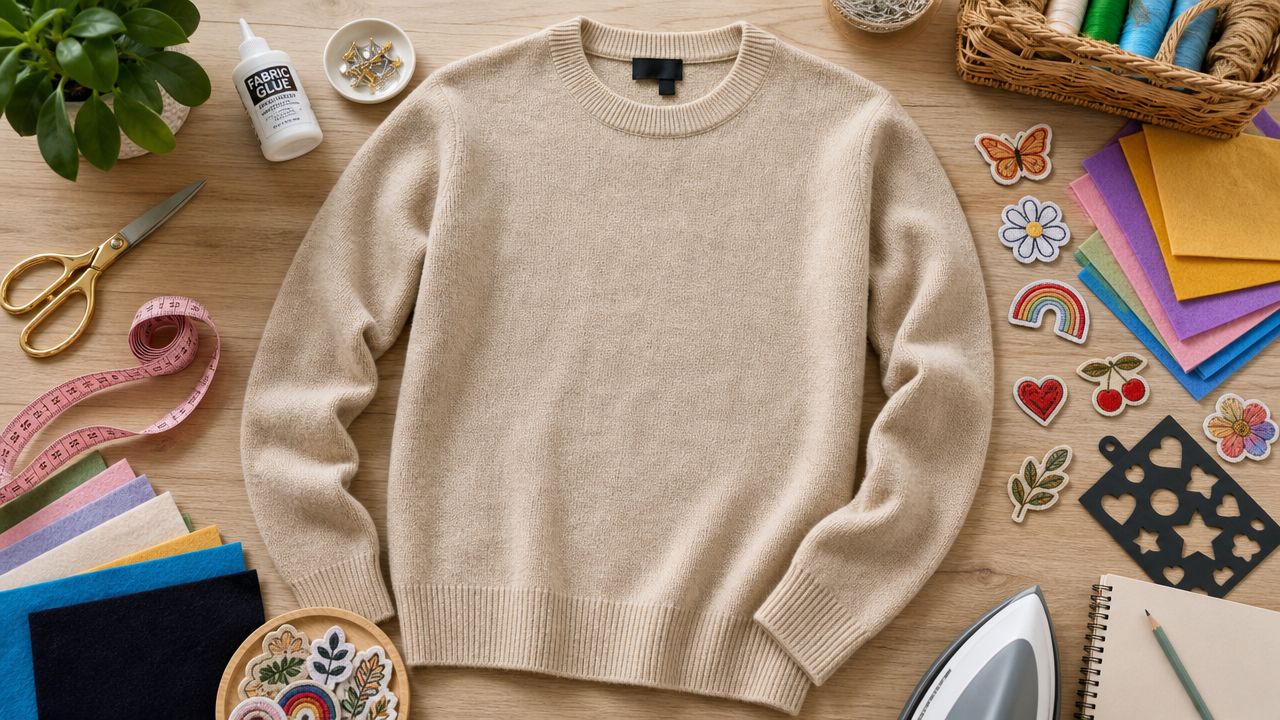
Here's what to look for:
Choose a sweater with enough body to support embellishments. Very thin knits sag. Very chunky knits can swallow fine details.
Many readers buy one adhesive and hope for the best. Different parts need different methods.
Keep these on hand:
If an item swings, dangles, or has any weight, sew it. Glue alone is best for lighter decorative work.
A good project distinguishes itself from a last-minute costume.
Useful materials include:
Try to repeat at least one material in several places. Repetition makes even a ridiculous design look organised.
A tiny handmade extra can lift the whole project. A painted charm, a stitched tag, or a miniature hanging detail gives the sweater more character than a pile of shop-bought trim. If you enjoy small decorative projects, these key ring DIY ideas can spark useful miniature techniques that adapt well to sweater embellishments.
Cheap trim often looks fine at first and tired by the second wear. Better felt, better ribbon, and stronger stitching make a visible difference.
Funny Christmas sweaters look effortless when they're built in the right order. Most construction problems happen because people attach things too soon. Plan first, secure second, decorate third.
Begin by seeing the process at a glance.
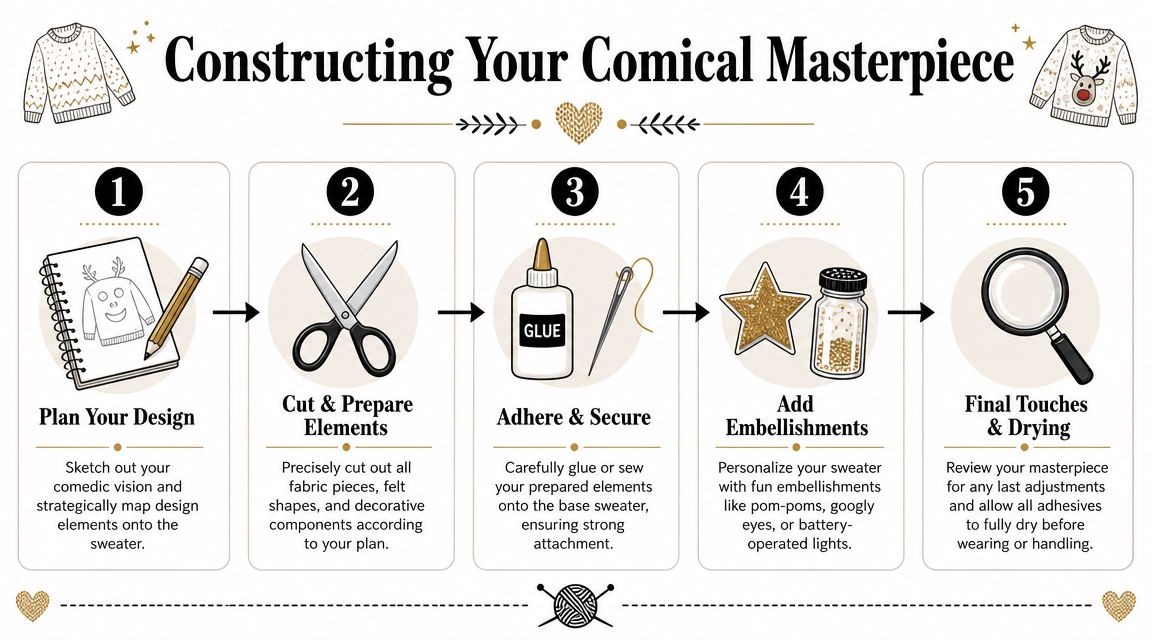
Lay the sweater flat on a table. Smooth it gently, but don't stretch it. Mark the centre line with a few tiny chalk dots, then place your main pieces without attaching anything.
Stand back and check three things:
Take a phone photo. It's easier to spot imbalance in a photograph than when you're hovering over the table.
For scenes, figures, or lettering, start with the largest shapes in felt. These create a clean visual foundation and stop the design from feeling scattered.
For example, if you're making a comic winter scene, attach the broad snowbank first. Then add the house, horse, tree, or moon. Only then should you sew on details such as eyes, reins, gifts, or tiny stars.
A neat trick is to back delicate felt pieces with a slightly stiffer scrap layer. That helps corners stay sharp and keeps letters from curling after wear.
Not every element needs the same treatment.
Use this rule set:
If your motif includes a heavier focal piece, attach it to an underlying felt patch first, then sew that patch to the sweater. The patch spreads the strain and protects the knit.
Lights can be charming. They can also become uncomfortable if placed badly.
Keep any battery pack low on the inside hem or near a side seam where it won't press into the chest. Stitch a small felt pocket to hold it in place. Thread the light wire along seams or under appliqué so it disappears into the design.
Before closing anything up, wear the sweater for a minute and move around. Sit down. Raise your arms. Twist. If you feel poked, scratched, or pulled, fix it now.
A good visual guide can help if you prefer watching hands at work.
This is the part many people rush. Don't.
Check the reverse side of the sweater and trim loose threads. Add a backing patch behind scratchy stitch areas if needed. Press felt pieces lightly with your hand so they lie smoothly, but avoid flattening anything meant to be dimensional.
If you'd like extra decorative structure, small stitched borders can tie the whole composition together. Traditional counted motifs can inspire neat edging ideas, and cross stitch patterns are useful for planning repeated geometric flourishes around cuffs, hem bands, or shoulder lines.
The funniest sweater in the room often has the cleanest construction. People may laugh at the joke first, but they notice craftsmanship immediately after.
Wear the finished sweater at home for a short spell. That test often reveals problems you won't see on the table.
Look for:
If something feels off, remove one thing before adding another. Funny Christmas sweaters need boldness, not overcrowding.
A humorous sweater becomes more memorable when it carries a design language older than the trend itself. That's what Dala-inspired decoration offers. It adds shape, rhythm, and heritage.
The holiday search boom around funny Christmas sweaters was dramatic. Google searches for the phrase saw a 400% increase between 2012 and 2015 according to this holiday sweater trend summary. Trends rise fast. That's exactly why it's smart to anchor your design in a craft tradition that won't feel tired once the party photos are over.
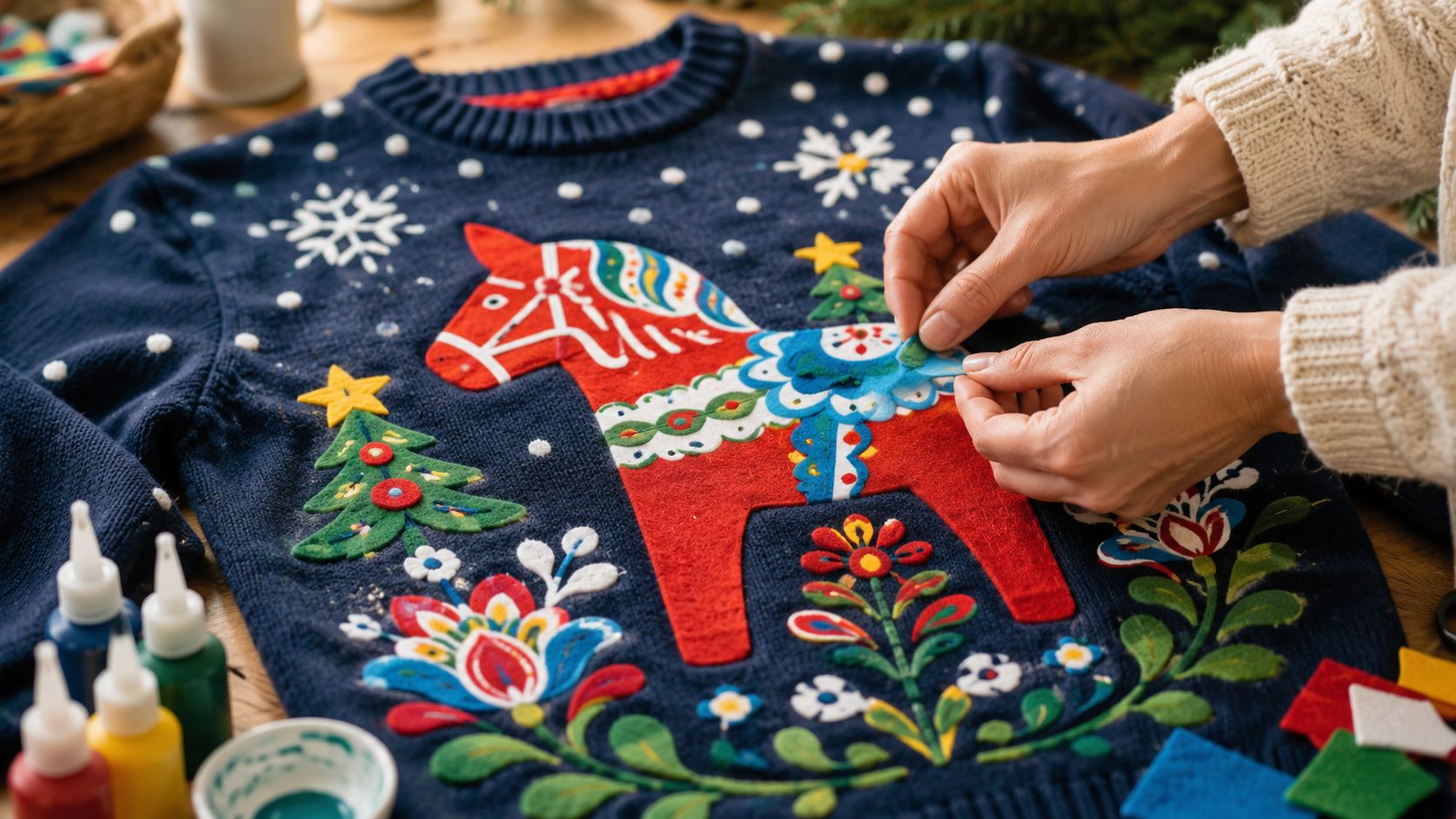
Dala forms are naturally sweater-friendly. Their silhouettes are readable from a distance, which matters for humorous clothing. Their painted details also adapt beautifully into appliqué, embroidery, ribbon work, or painted fabric accents.
A Dala-inspired motif does something else too. It changes the tone of the joke. Instead of a sweater that says, “I grabbed the loudest thing in the shop,” you get one that says, “I know exactly what I'm doing, and I'm having fun with tradition.”
That combination is rare. It's witty without becoming careless.
You don't need to make the whole sweater serious. In fact, the contrast is where the charm lives.
Try one of these approaches:
The formal border with a comic centre
Frame the chest with kurbits-style swirls or folk-art flowers, then place one absurd festive scene inside the frame.
The heroic Dala horse
Turn the horse into the star. Give it antlers, skates, a scarf, or a sleigh full of cinnamon buns.
Tiny repeated motifs
Use miniature horses, roosters, or floral marks along the cuffs and shoulders, then keep the front panel simpler.
One sculptural focal point
Attach a small lightweight miniature as a centrepiece and support it with stitched or felt ornament around it.
A common mistake is mixing Scandinavian folk shapes with unrelated visual clutter. Neon tinsel, cartoon fonts, plastic candy canes, and rustic painted motifs can fight each other.
If you want the Dala element to feel intentional, repeat its colours or curves elsewhere on the sweater. Pull one painted flower shape into the sleeve border. Echo the horse's contour in stitched lines near the hem. Add leaf scrolls around a comic figure so the joke sits inside a visual tradition rather than on top of it.
Heritage details don't make a sweater less funny. They make the joke more distinctive.
Different makers prefer different levels of involvement.
If you enjoy painting, sketch a Dala-style silhouette onto felt or fabric and add decorative pattern by hand. If you prefer sewing, build the horse from layered felt and define the details with embroidery thread. If you love dimensional work, a tiny miniature can become a focal accent, provided it's attached with care and balanced by the fabric beneath it.
The key is restraint. One beautifully handled folk-art element usually has more impact than five rushed ones.
A handmade holiday sweater deserves a proper life after the final stitch. Wear it well, gift it thoughtfully, and store it with the same care you used to make it.
That matters even more if you're giving it to someone outside your immediate circle. Appreciation for ugly Christmas sweaters isn't equal across Europe. A Statista country comparison on ugly Christmas sweater appreciation reported that Finland sat at about one-third of adults who liked ugly Christmas sweaters, while Ireland ranked highest. In a Nordic context, that makes a Dala-themed handmade sweater feel less like a generic novelty and more like an interesting cultural bridge.
A detailed jumper doesn't need much competition. Let it lead the outfit.
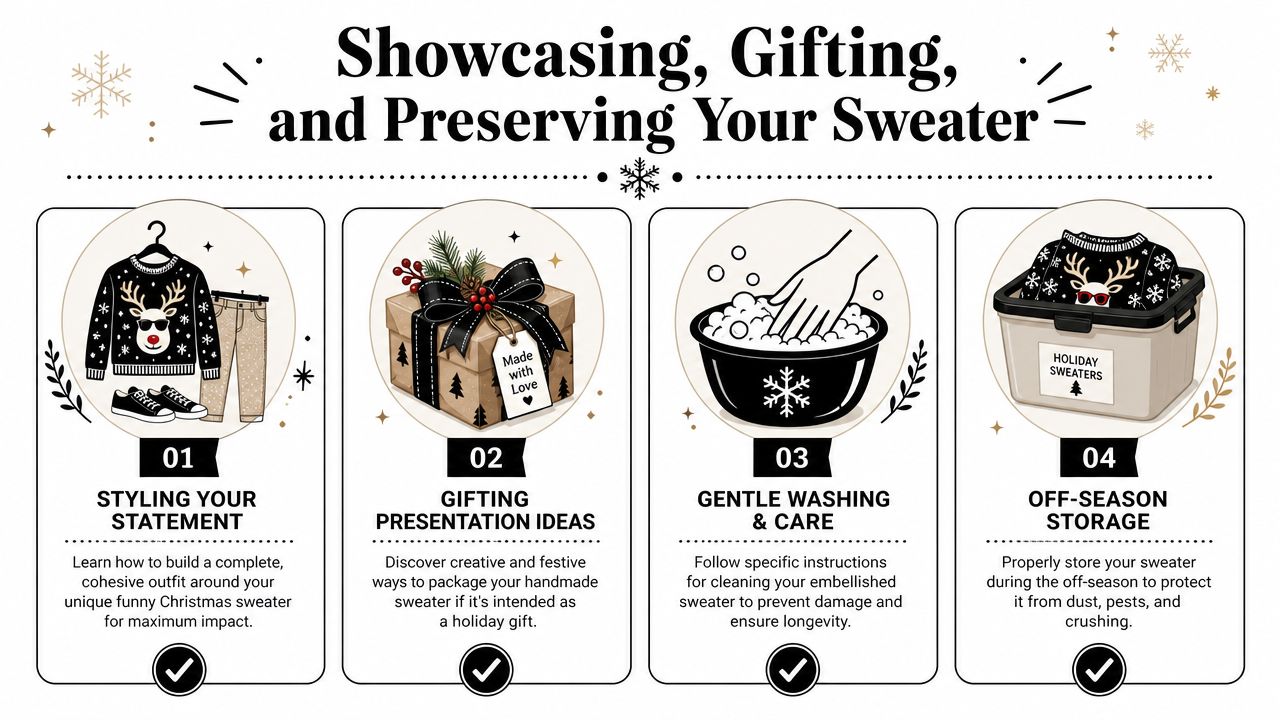
The easiest combinations are:
If the design is playful and dimensional, keep everything else calm. That contrast makes the workmanship easier to see.
Don't fold a detailed sweater hard into a tiny gift box. Dimensional trims can flatten, bend, or catch.
A better approach is to lay tissue between decorative areas, fold the sleeves inward gently, and place the sweater in a box with enough room around raised elements. If you've added bells, lights, or miniatures, include a small handwritten care note so the recipient knows how to handle it.
If you're posting it, wrap the embellishment area with soft tissue first, then add outer padding. Make sure no heavier feature can knock against another during travel.
Most embellished sweaters do best with spot cleaning rather than regular machine washing. If the base knit needs freshening, hand washing in cool water is safer, provided the decorations are secure and the materials allow it.
For off-season storage:
A sweater with stitched felt, painted details, or small sculptural elements can last for many holidays if it isn't squashed under winter blankets in January.
The moment you store a handmade sweater properly, you stop treating it like a novelty and start treating it like part of your holiday collection.
One lovely habit is to tuck a note into the box. Write the year you made it, the joke behind the design, and any special materials or memories attached to it. That tiny record turns a handmade jumper into something closer to a family decoration.
Funny Christmas sweaters can be loud, cheeky, and wonderfully unserious. They can also be beautifully made. That mix is what makes people remember them.
If you'd like to create a sweater with authentic Scandinavian character, explore Dalaart for hand-crafted Swedish Dala horses, companion animals, and DIY pieces that can inspire or enrich your next festive project. Their collection makes it easier to bring genuine folk-art detail into holiday crafting without sacrificing humour, quality, or heritage.


.svg)


.png)


