April 10, 2026
A small painted horse sat on a windowsill beside a basket of thread. Its curves, flowers, and strong little stance felt so alive that I wanted to keep looking at it, then realised I wanted to make it too.
Cross stitch often begins that way. You fall in love with an object, a memory, or a tradition, and then you look for a way to hold it in your hands.
Collectors of folk art know this feeling well. You bring home a carved horse, a rooster, or a painted wooden moose, and after the first delight of display comes a quieter wish. How could this colour and character live elsewhere in the home, stitched into cloth, tucked into a frame, or passed to a child?
That is a point where cross stitch patterns become something more than charts on paper. They become a bridge between admiration and making.
In Scandinavia, that bridge has deep roots. Interest in Dala horse imagery continues to grow, yet a gap remains for stitchers who want that visual language translated into embroidery. In the Scandinavian region, interest in "Dala horse" searches has been on the rise, yet top cross stitch pattern results still show a noticeable lack of Dala-specific designs, leaving heritage enthusiasts underserved (123stitch.com pattern category page).
That gap has significance because people do not only want to buy heritage objects. They want to participate in the tradition.
A stitched piece does that beautifully. A small horse on linen can mark a first home. A rooster can become a cushion for a kitchen bench. Initials worked into a border can turn a decorative project into a family record.
Tip: The most meaningful first project is rarely the most complex one. It is the one that connects to your own story.
When I teach beginners, I often suggest they start with a motif they already love. If Scandinavian folk art speaks to you, your first stitched piece does not need to be generic. It can carry the same joy as a painted wooden figure, while adding something only thread can give. Patience, texture, and the unmistakable warmth of a handmade heirloom.
A cross stitch pattern is best understood as a map for thread. It tells you where each stitch goes, what colour to use, and how all the tiny marks combine into one image.
That sounds simple until you open your first chart and see a page full of squares, symbols, and numbers. Many beginners think they are looking at something technical. In truth, they are looking at a very old visual language.
In 16th and 17th-century Scandinavia, cross stitch patterns developed into regional folk styles, and samplers worked as both learning tools and personal records. Those designs often used symmetrical motifs drawn from nature and folklore, and they became part of household textiles in ways that still shape modern pattern design (historical overview of cross stitch traditions).
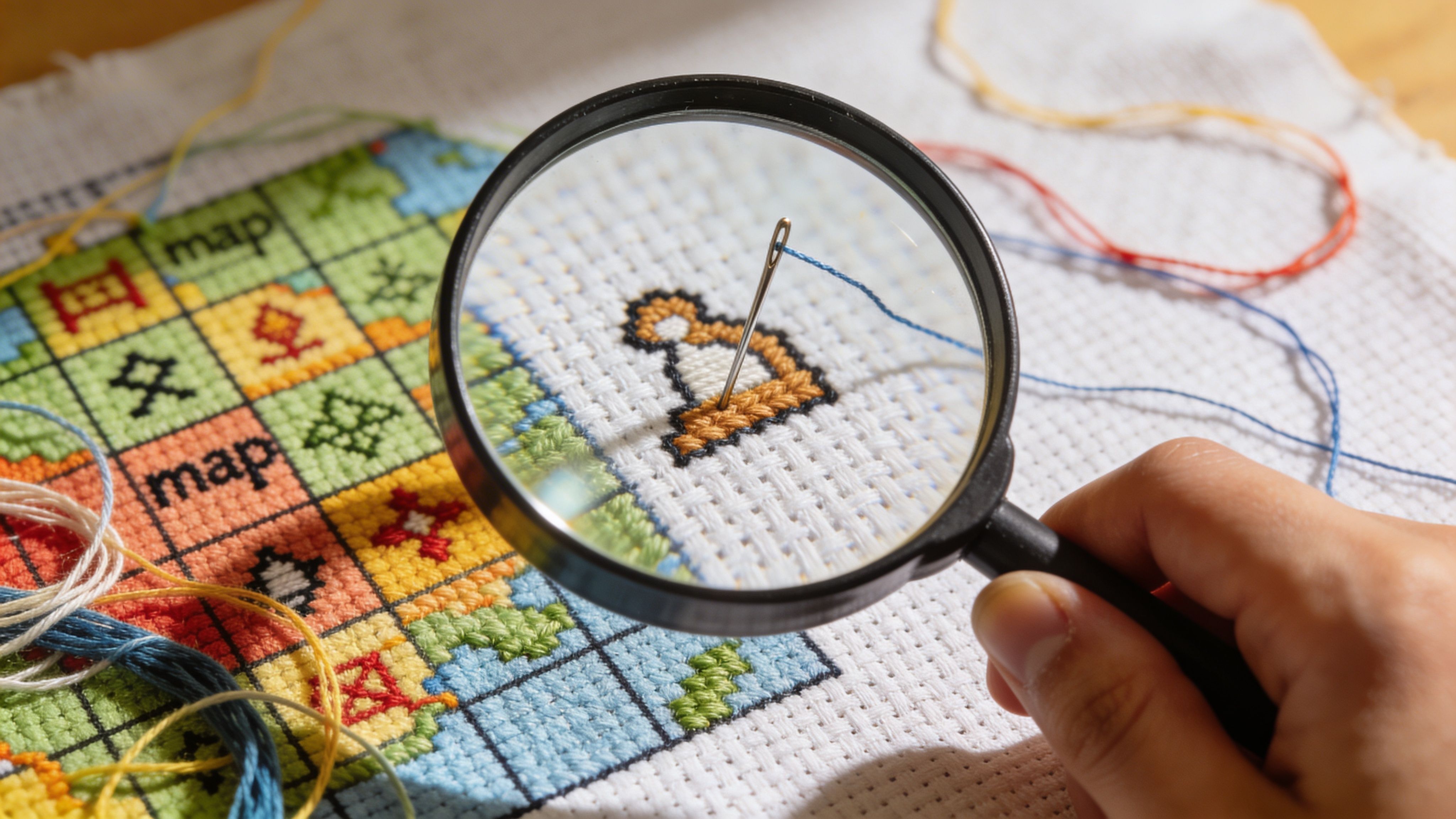
Each square on a chart usually equals one cross stitch.
If your fabric has an even, visible structure, such as Aida, each square on the pattern matches one stitch space on the fabric. You are not drawing freely with a needle. You are building an image one counted square at a time.
This is why beginners often do well with motifs that have clear shapes. A heart, star, border, or stylised horse teaches your eye how pattern and fabric relate.
Most charts use symbols inside the grid. A black triangle might mean one red floss. A circle might mean cream. A plus sign might mean dark blue.
Patterns use symbols because many shades can look similar when printed or viewed on a screen. Symbols keep the chart clear, even in detailed areas.
If you have never read one before, pause and look for repeated symbols forming blocks or outlines. You will start to see the image emerge.
The pattern key, sometimes called the legend, lists the threads and symbols used in the design. It may include floss brand numbers, colour names, and stitch notes.
A beginner should always check the key before making the first stitch. That one habit prevents a great deal of confusion.
Useful things to look for:
Key takeaway: If the grid is the map, the legend is the compass.
For readers who want to personalise text-based designs, this guide to cross stitch letters is helpful for seeing how alphabets fit into a charted style.
The common sticking point is not stitching. It is orientation.
People lose confidence when they cannot tell where to begin or how the paper relates to the cloth. The fix is straightforward. Find the centre of the pattern, find the centre of your fabric, and match them.
Then work in small sections. Do not try to “read” the whole pattern at once. Read it the way you would read a road sign. One clear instruction at a time.
Some stitchers love an empty fabric and a separate chart. Others prefer the design printed directly on the cloth. Both approaches are valid. They suit different temperaments, projects, and goals.
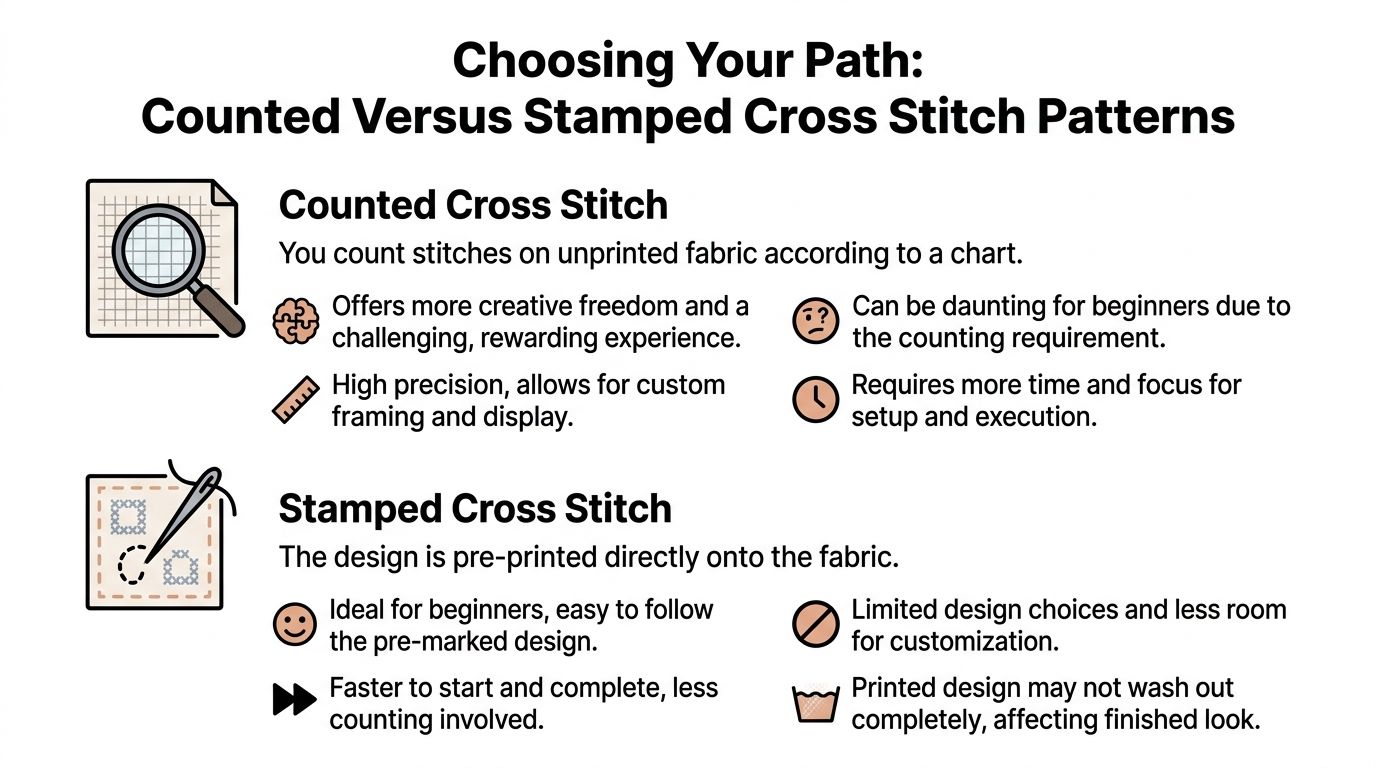
With counted cross stitch, you work from a chart and count stitches on blank fabric. Nothing is printed where the stitches go.
This method asks more of your attention, but it gives more freedom in return. You can change fabric colour, reuse a chart, resize your margins, and make matching pieces from one design.
Counted work is especially lovely for folk-art inspired projects because the finished piece feels clean and deliberate. It also works well if you want a set, such as a horse, rooster, and moose stitched in the same style for a hallway or kitchen.
With stamped cross stitch, the design is printed on the fabric itself. You stitch directly over the marked areas.
That printed guidance can remove much of the anxiety a beginner feels. According to the guide on counted and stamped cross stitch at Caterpillar Cross Stitch, stamped patterns can reduce the learning curve by as much as 50% because the water-soluble printed design dictates exact stitch placement.
For someone making a first gift, or testing whether they enjoy the craft, that ease can be a gift in itself.
Counted stitching feels a bit like reading music. You interpret a chart, translate it through your hands, and slowly build order from symbols.
Stamped stitching feels more like painting by guide marks. The route is visible from the start.
Here is the practical difference many people notice first:
Tip: If you love the idea of building a family of related folk motifs, counted patterns often serve you better over time.
Choose counted if you enjoy detail, want to alter colours, or hope to build a small collection of coordinated pieces.
Choose stamped if you want a gentle first experience, a lower barrier to entry, or a project you can begin almost immediately.
Neither option is more “authentic” than the other. Authenticity comes from care, thought, and the meaning you bring to the motif.
In many Scandinavian homes, the pieces that stay with a family are rarely the grandest ones. They are the small horse above the kitchen shelf, the stitched bird tucked into a linen cupboard, the winter flower framed beside a doorway. A first cross stitch project can begin in that same humble way. Choose something you can finish with pleasure, and it already has the makings of an heirloom.
That choice starts with honesty. How much time can you give it each week. Do you enjoy careful counting, or would you rather settle into a calm, repetitive rhythm. Are you stitching for a season, a gift, or a corner of your own home that needs a touch of folk warmth?
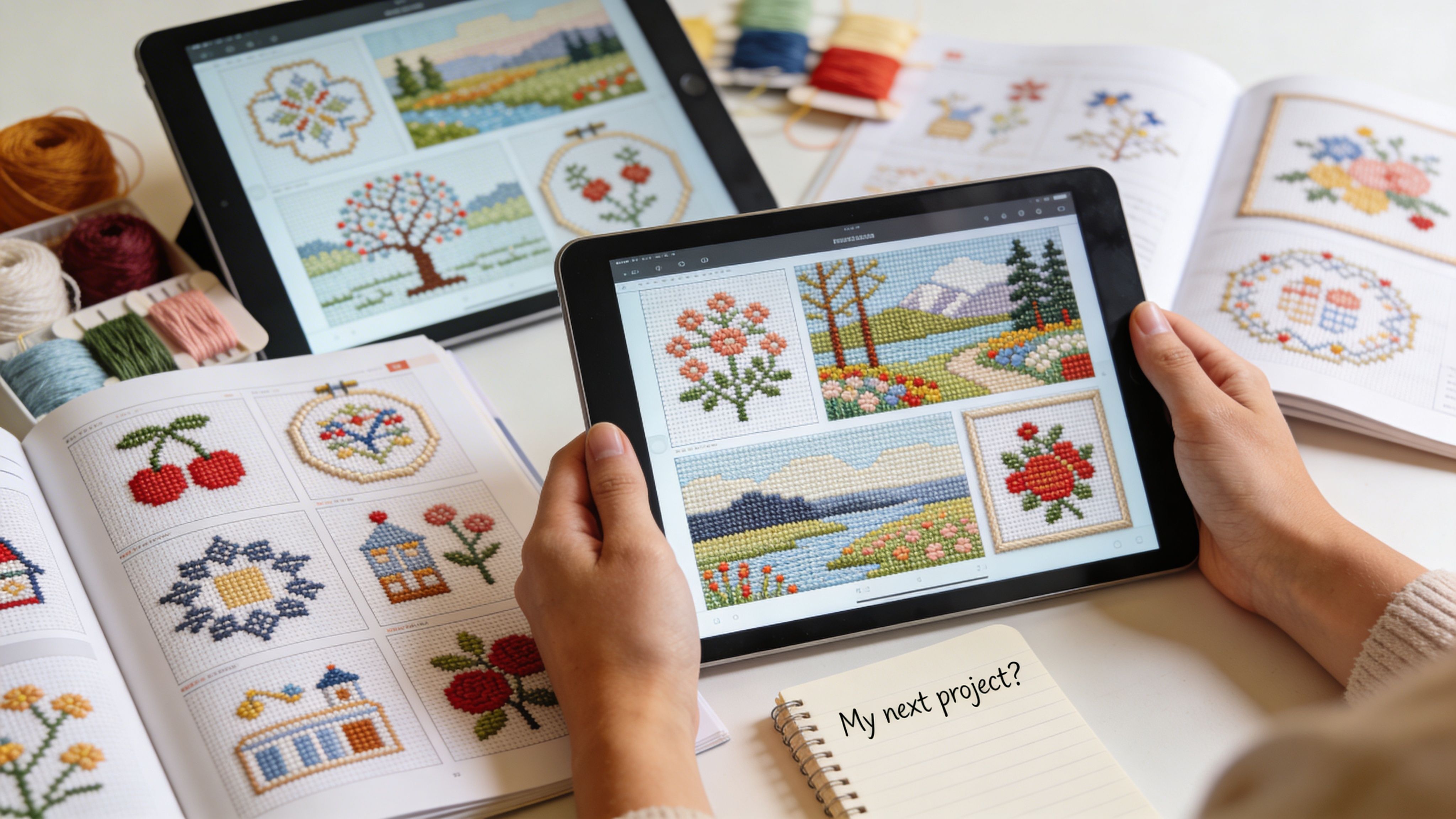
Strong shapes make kind first projects.
That is one reason Scandinavian folk art adapts so well to cross stitch. A Dala horse, a rooster, a tulip, or a simple border has a clear outline that still looks good on a grid. You can recognise the motif early, which keeps motivation high. With more painterly designs, the image often looks awkward until late in the process, and that can make beginners feel they are doing something wrong when they are not.
If a pattern is crowded with shading, isolated confetti stitches, or constant colour changes, save it for later. Beauty matters, but clarity matters too.
Fabric count changes two things at once. It changes how easy the stitching feels in your hands, and it changes the finished size on the wall, cushion, or pouch.
A simple way to remember it is this:
Many beginners feel at home on 14-count Aida because the grid is easy to read. If you already enjoy fine handwork, you may later prefer evenweave for a smoother look. For a first project, comfort is usually the wiser guide than delicacy.
Before you buy, pause and study the pattern notes. Good planning saves frustration and wasted materials, which matters even more if you are trying to stitch sustainably and buy only what you will use.
Look for these details:
If the description leaves you guessing, choose another pattern. A clear chart usually comes from a designer who wants you to succeed.
Cross stitch becomes more meaningful when you know where it will live. A narrow repeat border may suit a tray cloth or basket liner. A single Dala horse with room around it can become framed wall art. A small heart or flower works well on a lavender sachet, holiday ornament, or mending patch for a well-loved textile.
This is also an area where folk art lovers can borrow ideas across crafts. Repeated motifs from knitwear, painted wood, and woven bands often translate beautifully into cross stitch. If Nordic pattern rhythm speaks to you, this article on the Fair Isle sweater offers a useful companion for spotting borders and repeats you may want to adapt later.
Key takeaway: Choose a motif you love, then scale it to your time, skill, and daily life.
Small projects teach proportion, colour handling, and patience. They also leave room for joy, which is what brings people back to the hoop and, over time, helps them create the pieces a family keeps.
The first time I watched a painter in Dalarna draw a horse with a few steady strokes, the magic was not in tiny detail. It was in recognition. Before the flowers were added, before the saddle was dressed with curls and leaves, the horse already carried its character. That is the lesson to keep close when turning folk art into cross stitch patterns. You are not copying paint stroke by stroke. You are translating a motif from one language of making into another.
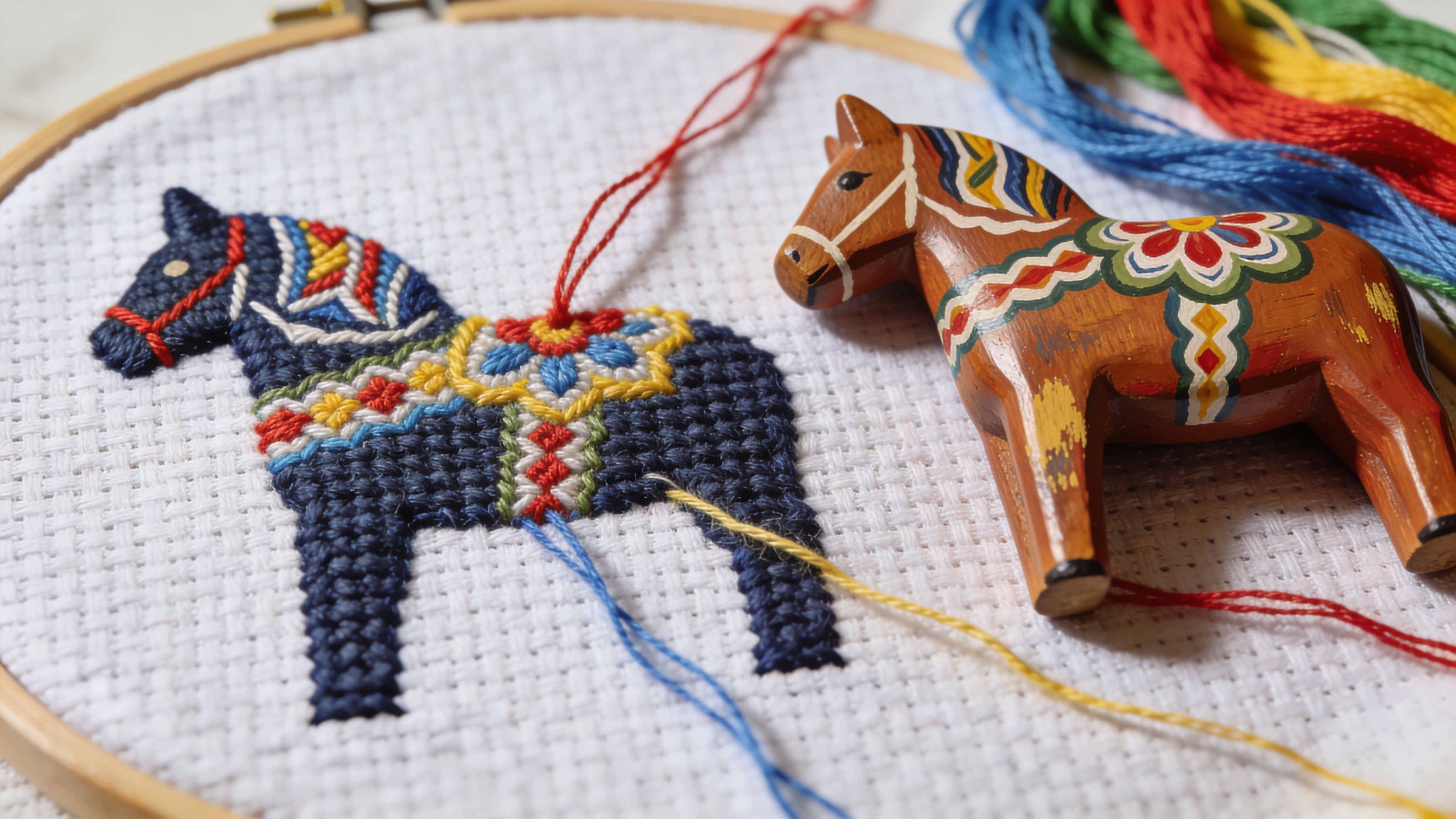
A painted Dala horse can curve and taper in ways a square grid cannot. That limitation is part of the beauty. Cross stitch asks you to choose what matters most, much like a woodcarver chooses the cleanest cuts to reveal a form.
Start by studying only the outline. Set aside the flowers, dots, and little trailing leaves for a moment and ask a simpler question. If you drew the horse, rooster, pig, or moose as a plain block shape on graph paper, would it still feel alive and familiar?
If the answer is yes, the pattern has a strong foundation. That foundation is important because Scandinavian folk art depends on memorable silhouettes. The proud neck of a horse, the upright chest of a rooster, the rounded strength of a pig. Decorative painting gives joy and local character, but the outer form is what makes the motif readable from across a room.
Many beginners worry that reducing colours will flatten the design. In practice, the opposite often happens. A limited palette gives folk motifs clarity, and clarity suits cross stitch.
Group your threads by purpose:
A hand-painted original may contain subtle shifts from brush pressure and layering. Thread behaves differently. On fabric, too many similar shades can make a small motif look busy instead of joyful. Start simple, then add one or two extra colours only if the design still feels calm.
Dala painting has a pulse to it. Flowers repeat. Curves answer one another. Small details sit in balance, even when the motif feels playful. Your stitched version should preserve that rhythm.
Beginners often get stuck at this point. They try to recreate every painted flourish and end up with a chart that feels crowded. Folk art usually works better when you edit with a firm hand. Keep the elements that give the motif its identity, then simplify the rest into shapes the eye can read quickly.
A useful way to judge this is to step back from your sketch. If the design still feels balanced and recognisable from a short distance, you are on the right path.
Both methods can produce beautiful results, and each teaches a different skill.
Digital charting helps when you have a clear photo or scanned motif. Software can place the image onto a grid and suggest colour areas. The first draft almost always needs editing. Clean outlines, merged colours, and removed speckles make a chart feel handmade rather than mechanically converted.
Manual charting is slower, but it trains the eye beautifully. Draw the outer shape on graph paper, fill the largest colour areas first, and add ornament only after the form feels stable. Many stitchers discover that hand-charting teaches proportion faster than any software because every square requires a decision.
If you enjoy studying how handcrafted objects keep their personality through each stage of making, this look at the behind the scenes of traditional craftsmanship offers helpful perspective.
Here is a visual example of the kind of motif thinking that helps during adaptation:
Sustainable stitching begins long before finishing. It begins at the chart.
A well-planned folk motif can live many lives. The same horse can become a framed piece, a lavender sachet, a holiday ornament, or a border repeated across household linen. That reuse is very much in the Scandinavian spirit. Make something once. Use it well. Let beauty belong in daily life.
You can support that approach by charting motifs that work at more than one scale, choosing thread colours you are likely to use again, and building small coordinating designs from leftover floss. A flower taken from the horse's saddle can become its own ornament. A border from one piece can edge a napkin or basket liner later.
Tip: Stitch a small test of your main colours together before finalising decorative details. Colours that sing on painted wood can feel crowded when worked in thread on a tight grid.
The strongest folk-inspired patterns do not try to hold every painted line. They hold the spirit of the motif with confidence, then let the stitches speak in their own clear, settled voice.
Good stitching habits make more difference than fancy tools. A modest project worked with care will always outshine a complicated one rushed to completion.
One habit I recommend to nearly everyone is starting from the centre. It helps the design sit evenly on the fabric and reduces the risk of discovering, too late, that your horse has wandered too close to one edge.
Cross stitch looks best when the top arms of the stitches all lie in the same direction. That consistency gives the surface a settled, polished look.
Try these habits early:
Scandinavian craft traditions have long valued usefulness, repair, and beauty in ordinary objects. That spirit pairs naturally with sustainable finishing.
Choose natural fabrics when you can. Linen has a particularly lovely relationship with folk motifs, and cotton Aida remains practical and approachable. Reused frames, recycled boards, and repurposed wooden boxes can all make thoughtful homes for finished stitching.
Finishing ideas that suit folk-inspired work include:
The history of pattern distribution also reminds us that embroidery has long lived in ordinary homes, not only in museums. In the 19th century, Berlin Woolwork introduced an estimated 14,000 new coloured patterns across Europe, heavily influencing Swedish folk embroidery; these loose-sheet patterns often depicted local wildlife such as horses and moose and helped make the craft a significant part of household production in regions like Dalarna (history of cross stitch and Berlin Woolwork).
That household spirit is worth keeping. Your finished piece does not need grand presentation. It needs a place where it can be used, seen, and loved.
Key takeaway: A sustainable finish is one that honours the work, suits the object, and encourages you to keep making.
A pattern begins as a grid of symbols. In your hands, it becomes colour, texture, memory, and meaning.
That transformation is why cross stitch lasts. You learn to read the chart, choose the right format, select a manageable project, and adapt a beloved folk motif until it feels like your own. Somewhere in that process, the craft stops being abstract. It becomes personal.
A stitched horse on linen is not only decoration. It can mark a family story, a heritage connection, a housewarming, or a quiet season of making. The same is true of roosters, moose, initials, borders, and floral details. Each choice says something about what you noticed and wanted to preserve.
If you are standing at the beginning, start with one small design that makes you smile. Use colours you enjoy. Let the first piece teach you what the second one wants to be.
That is how heirlooms often begin. Not with perfection, but with affection, patience, and a desire to turn what you love into something lasting.
Yes. Many stitchers use photo-to-pattern software or graph paper to convert a motif into stitches.
For folk-art inspired work, simplify before you begin. Strong shape matters more than tiny detail. If the image has decorative painting, reduce it to the most recognisable forms and a manageable palette.
Not at all. It asks for concentration, but it is learnable.
Beginners usually struggle more with choosing a project that is too detailed than with the method itself. A simple chart on easy-to-see fabric is often enough to make counted work feel calm rather than difficult.
Many beginners prefer Aida because the holes are clear and evenly visible.
Linen can be beautiful, especially for traditional-looking finishes, but it often feels easier after you understand how counted stitching sits on the fabric. If you love the look of linen, save it for your next project rather than your first.
Work from the centre, mark off completed areas, and count twice before starting a new section.
Some stitchers also find it helpful to complete one colour in a small area before moving on. Others prefer crossing all stitches in rows. The best method is the one that keeps you accurate and relaxed.
Yes, especially in counted designs.
This is one of the pleasures of folk-inspired stitching. You can shift a horse from red to blue, soften a border, or echo colours already present in your home. Change with intention. Keep enough contrast between outline and body so the motif stays readable.
Use a gentle approach. Cool or lukewarm water and careful handling are usually safest.
If your project includes printed markings from a stamped kit, follow that kit’s own directions closely. Before framing or sewing, let the piece dry flat so the fabric settles evenly.
A neat back is helpful, but it is not the whole measure of good stitching.
Focus first on a smooth front, secure thread ends, and even tension. Tidiness improves with practice. Many beautiful heirlooms were made by hands that were still learning.
Think beyond frames.
Small motifs can become sachets, pincushions, or box inserts. Medium pieces work well as cushion panels or hanging ornaments. A useful finish often makes a piece feel more at home in everyday life.
If Scandinavian folk art inspires your stitching, Dalaart is a wonderful place to explore authentic Swedish Dala horses and companion animals made by artisans in Dalarna. Their collection offers rich colour, traditional forms, and handmade details that can spark your next cross stitch pattern, whether you are planning a small keepsake or a future family heirloom.


.svg)


.png)


