April 16, 2026
You’re probably standing in the bathroom doorway, looking at tile samples, paint swatches, or a half-finished renovation, and thinking about the big pieces first. Vanity. Mirror. Tapware. Lighting. Then your eye lands on the wall beside the toilet, and you realise one of the smallest fixtures can either complete the room or detract from it.
That’s the toilet paper holder’s strange power. It’s ordinary until it’s wrong. Too shiny for a soft Scandinavian scheme. Too bulky for a compact loo. Too flimsy for daily use. Or placed in the wrong spot, so every reach feels awkward.
A well-chosen toilet paper holder does more than hold a roll. It helps the room feel considered. In a calm Nordic interior, that matters. Scandinavian design has always treated utility with respect. A spoon, a stool, a hook, a shelf. Each object earns its place through usefulness and beauty. A bathroom fixture deserves the same care.
There’s also a charming bit of history behind it. The toilet paper holder was patented in 1891 by Seth Wheeler, and his design included illustrations showing the paper hanging over the roll, not under, according to this history of toilet paper and its holder. That patent arrived roughly 12 years after the Scott brothers commercialised rolled toilet paper in 1879, which makes the holder a later invention that helped complete the modern bathroom experience.
That tiny detail changes how you see it. The toilet paper holder wasn’t an afterthought. It was part of a new way of organising everyday life. More than a century later, the same choice still says something about how you live: practical, careful, and attentive to the feeling of home.
A bathroom often comes together in layers. First the essentials go in. Then the finishes. Then the room starts asking for small decisions that turn it from functional into personal.
The toilet paper holder sits right in that final layer.
You notice it most in two situations. One is a newly finished bathroom that still feels oddly incomplete. The other is an older bathroom where everything works, but the details don’t speak the same visual language. A sleek basin with a clumsy holder beside it creates a small but constant tension.
This fixture lives at hand level. People see it, touch it, and use it every day. That makes it part hardware, part ritual object.
In Scandinavian interiors, that everyday contact matters. The room should feel easy to use. It should also feel calm. A holder with clean lines, honest materials, and a sensible position supports both aims.
A bathroom feels luxurious when the practical choices disappear into ease.
There’s also a scale issue. In a compact cloakroom, an oversized holder can make the space feel cramped. In a larger bathroom, a tiny basic model can look accidental. Proportion is one of the quiet rules that separates a polished room from a merely fitted one.
The history of the toilet paper holder helps explain why it still deserves attention. Once rolled paper became common, people needed a dedicated way to store and dispense it neatly. That’s where design stepped in.
Wheeler’s 1891 patent solved a practical problem with a form that still feels familiar now. The basic idea has endured because it works. Good design often does that. It doesn’t chase novelty. It settles into daily life so comfortably that people stop noticing how clever it is.
If readers get confused here, it’s usually because “holder” and “dispenser” sound interchangeable. In home bathrooms, people often use both terms casually. In practice, a toilet paper holder usually means the visible fixture that supports one roll. A larger enclosed unit, more common in public settings, is often called a dispenser.
That distinction helps when you start shopping. It keeps you focused on the right kind of object, especially if you want something decorative rather than institutional.
It's not poor taste that leads to choosing the wrong toilet paper holder. It's the failure to pause and match the type to the room.
That’s the first decision to make. Not colour. Not finish. Type.
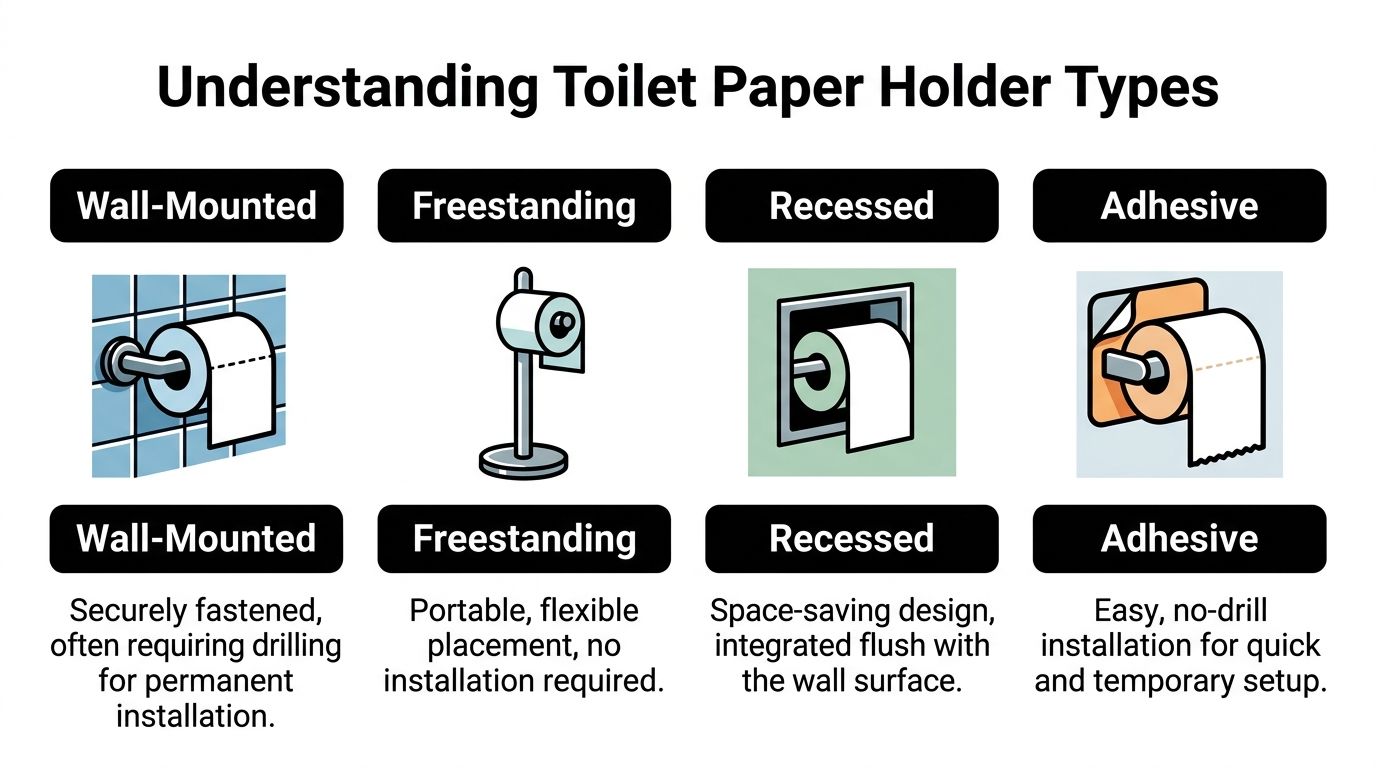
This is the classic choice. It fixes directly to the wall and keeps the roll in a stable, expected place.
Think of it as the bathroom equivalent of a built-in coat hook. It’s dependable, tidy, and easy to integrate into almost any style.
Wall-mounted holders tend to suit:
Some wall-mounted designs have an open arm, which makes roll changes quick. Others use a bar with a spring-loaded spindle. The open style often feels more modern and less fussy.
A freestanding toilet paper holder is like a floor lamp. It gives you flexibility, but it needs room around it.
It doesn’t require drilling, which makes it appealing for renters or anyone avoiding wall work. It can also hold spare rolls, which is useful in bathrooms with little storage.
Still, it’s not ideal everywhere. In a tight bathroom, a freestanding piece can feel like one object too many. If the room already has a bin, brush, stool, or plant on the floor, adding another vertical item can make the space feel busy.
Practical rule: If you’d be annoyed to move it while cleaning the floor, it may not be the right type for your bathroom.
A recessed model sits partly inside the wall. It’s the built-in bookcase of toilet paper holders. Elegant, efficient, and best chosen when you’re ready for commitment.
This type works beautifully in narrow bathrooms because it reduces projection into the room. That can make circulation feel easier, especially beside a toilet in a tighter alcove.
The trade-off is installation. Recessed holders usually involve more planning and may not suit every wall. They’re easiest to install during renovation rather than as a quick weekend update.
Adhesive models are the low-commitment option. They attach with peel-and-stick backing rather than screws.
They can be handy in temporary spaces, guest loos, or tiled bathrooms where you’d rather not drill. But they depend heavily on surface quality and correct installation. If the wall is uneven, dusty, or textured, they may not perform as well as a mechanically fixed holder.
Readers often confuse adhesive and wall-mounted types because both sit on the wall. The difference is how they attach. One is fixed with hardware. The other relies on adhesive.
A quick way to decide is to ask these questions:
If your bathroom aims for Scandinavian calm, the best choice is often the type that adds the least visual fuss while still feeling secure.
A toilet paper holder can look lovely on day one and disappointing a year later if the material isn’t right for the room. Bathrooms ask a lot of their fixtures. Steam, splashes, cleaning products, and constant handling all leave a mark.
That’s why material deserves more attention than people usually give it.

Stainless steel is the dependable workhorse. It suits modern bathrooms, cleans up well, and handles moisture sensibly when the grade is good.
In Sweden, quality sanitary fixtures must meet standards requiring a minimum load-bearing capacity of 200 N (approx. 20.4 kg), and AISI 304 stainless steel is recommended for corrosion resistance in humid bathroom conditions where average humidity can reach 70 to 80%, according to this reference on sanitary fixture standards and material guidance. If you want a practical benchmark, that’s a strong one.
Brass has warmth and presence. It can suit traditional, vintage, or softly luxurious interiors. Some people love the way it develops character over time. Others want a more polished, consistent appearance and may prefer a coated finish.
Zinc alloy often appears in budget-friendly fittings. It can work well visually, but it’s worth checking the build quality, especially around the mounting points and moving parts.
Wood brings something metal often can’t. Warmth. Texture. A sense of craft. In a Scandinavian bathroom, a wooden toilet paper holder can soften tile, chrome, and porcelain beautifully. It works best when the wood is properly sealed and thoughtfully paired with the room’s other materials.
If you enjoy this dialogue between cool and warm finishes, the mix of reflective and natural surfaces in this chrome plant pot styling article offers a helpful parallel.
Finish affects mood more than people expect. The same holder shape can feel crisp, rustic, refined, or graphic depending on surface treatment.
A few simple cues help:
Don’t stop at appearance. Examine how the fixture is made.
Look for:
In a humid room, durability starts with the base material, not the colour on top.
For Scandinavian decor, the strongest combinations are usually simple. Black and oak. Brushed steel and white tile. Soft wood tones with off-white walls. The holder shouldn’t fight the room. It should complete it.
The best toilet paper holder in the world will still feel wrong if you place it badly. Most installation mistakes aren’t dramatic. They’re just annoying. Too far back, so you twist. Too high, so you reach. Too close, so it feels cramped.
Good placement solves that before the first screw goes in.

Swedish residential benchmarks suggest an optimal toilet paper holder height of 66 cm from the finished floor, positioned 20 to 30 cm in front of the toilet bowl’s edge, based on ergonomic guidance intended to minimise reach and twisting, as outlined in this installation guide and best-practice reference.
Those numbers matter because they describe comfort, not just convention.
If readers get muddled here, it’s usually over what “in front of the toilet bowl’s edge” means. It refers to the front edge of the bowl when viewed from the side. The holder should sit slightly forward of where your body lands, not behind your hip.
Before drilling, try this:
That quick test helps tailor the standard position to the actual room and user.
If you’re refreshing a tiled wall and want the area around the holder to feel more intentional, decorative tile decals can help tie the fixture into the broader design without major renovation.
For a standard wall-mounted holder, installation typically requires only a few tools: a tape measure, pencil, level, drill, suitable bit, wall fixings if needed, and a screwdriver.
The process is usually straightforward:
A short visual guide can make the sequence easier to follow:
If the holder shifts even slightly when you pull paper, the problem usually starts at installation, not design.
For adhesive models, surface preparation matters most. The wall must be clean, dry, and smooth. For freestanding pieces, placement is more about traffic flow. Make sure it doesn’t interfere with the door swing or cleaning routine.
A well-placed holder should feel so natural that nobody thinks about it. That’s the goal.
A toilet paper holder can disappear into the bathroom, and sometimes that’s right. But in a Scandinavian or folk-inspired interior, it can also become one of those delightful details that gives the room soul.
That doesn’t mean making it loud. It means making it intentional.

Google Trends data from 2025 showed a 45% surge in searches for “toilet paper holder Scandinavian design” in several European markets, yet few options blend authentic folk art with function, according to the cited trend note in this reference. That gap makes sense. Many holders are designed as hardware first and décor second.
The easiest way to style this fixture well is to think in the core language of Nordic interiors:
A wooden bar with black mounts, for example, can echo a timber vanity stool, a framed print, or a simple shelf. The holder becomes part of a material conversation happening across the room.
Folk art works best in bathrooms when it arrives as a note, not a shout. A full theme can feel heavy-handed. A considered accent feels charming.
That might mean:
The point isn’t to turn the holder itself into a novelty item. It’s to let it participate in a room that honours heritage.
Folk-inspired design feels most sophisticated when function stays clear and decoration stays disciplined.
If you enjoy DIY, a plain wooden toilet paper holder can be a wonderful blank canvas. A soft painted border, a simple floral rhythm, or a restrained colour accent can nod to Swedish folk traditions without becoming fussy.
One good rule is to keep the structure plain and let the surface carry the personality. That mirrors a lot of Scandinavian design thinking. Form stays calm. Detail adds warmth.
For visual inspiration rooted in Swedish colour and shape traditions, this reflection on Färg & Form in Sweden is a lovely companion.
Some pairings are especially effective:
The toilet paper holder won’t carry the whole room. But it can confirm the room’s point of view. That’s what thoughtful styling does. It takes even the humblest fixture seriously enough to let it belong.
The last step isn’t finding the prettiest holder. It’s finding the one that fits your bathroom, your habits, and your style all at once.
Start with the room itself. Measure the wall space beside the toilet. Notice the door swing. Check whether the holder needs to clear a vanity side panel, radiator, or bin. If the bathroom is compact, a slim wall-mounted or recessed option often feels calmer than anything freestanding.
Then think about how you live. Renters usually benefit from low-commitment solutions. Households with children may prefer a sturdy mounted holder that won’t tip or shift. If you dislike visual clutter, avoid styles with unnecessary bulk.
Stand back and ask one more thing. Does this toilet paper holder look like it belongs in your home, or does it merely solve a problem?
That question matters. The best fixtures do both. They work easily, age well, and add to the room’s character without asking for attention every second. In a thoughtful bathroom, even a small practical object can carry a sense of care.
If your choice feels calm, useful, and beautiful, you’re probably choosing well.
Use the gentlest method that suits the material. A soft cloth and mild cleaner are usually enough for metal finishes. Dry the holder afterwards so water marks don’t linger.
For wood, avoid soaking the surface. Wipe with a barely damp cloth, then dry it promptly. If the piece is sealed, that protective layer does much of the work. If it’s hand-painted or decorative, treat it more like a small furniture detail than a utility fitting.
Not always. This catches people out more often than it should.
Check the holder’s clear width and projection before buying. Open-arm designs often cope better with bulkier rolls than tightly enclosed spindle styles. If you regularly buy larger rolls, choose a holder with a little breathing room rather than the most compact model on the shelf.
Sometimes yes, sometimes no. It depends on whether the new holder matches the existing opening.
If the replacement is close in size and shape, the update may be fairly simple. If not, you may need patching, tile work, or a cover plate solution. Many homeowners switch from recessed to surface-mounted when they want a cleaner, less complicated refresh.
It can be, but only in the right conditions. Smooth, clean, dry surfaces give adhesive products the best chance. Uneven walls, dusty tile, or damp installation conditions can reduce reliability.
For long-term use, fixed hardware usually feels more secure.
If you enjoy a historical ruling, the early patent illustration settled on over. It’s also the orientation many people find easier to grab neatly. In most homes, though, the answer is simple. Choose the direction that works best for the people using the bathroom.
If you’d like to bring authentic Swedish craftsmanship into the smallest details of home, explore Dalaart. Their collection of hand-carved, hand-painted Dala horses and companion animals offers a beautiful way to add Scandinavian heritage, colour, and warmth to bathrooms, guest spaces, and the shelves and corners that make a room feel personal.


.svg)


.png)


