February 9, 2026
When you search for "vintage posters Sverige," you're not just looking for decorations. You're opening a door to Sweden's rich visual history. These posters are genuine historical artefacts, each one a window into the nation's artistic soul. From eye-catching film adverts to charming travel promotions, every piece tells a story.
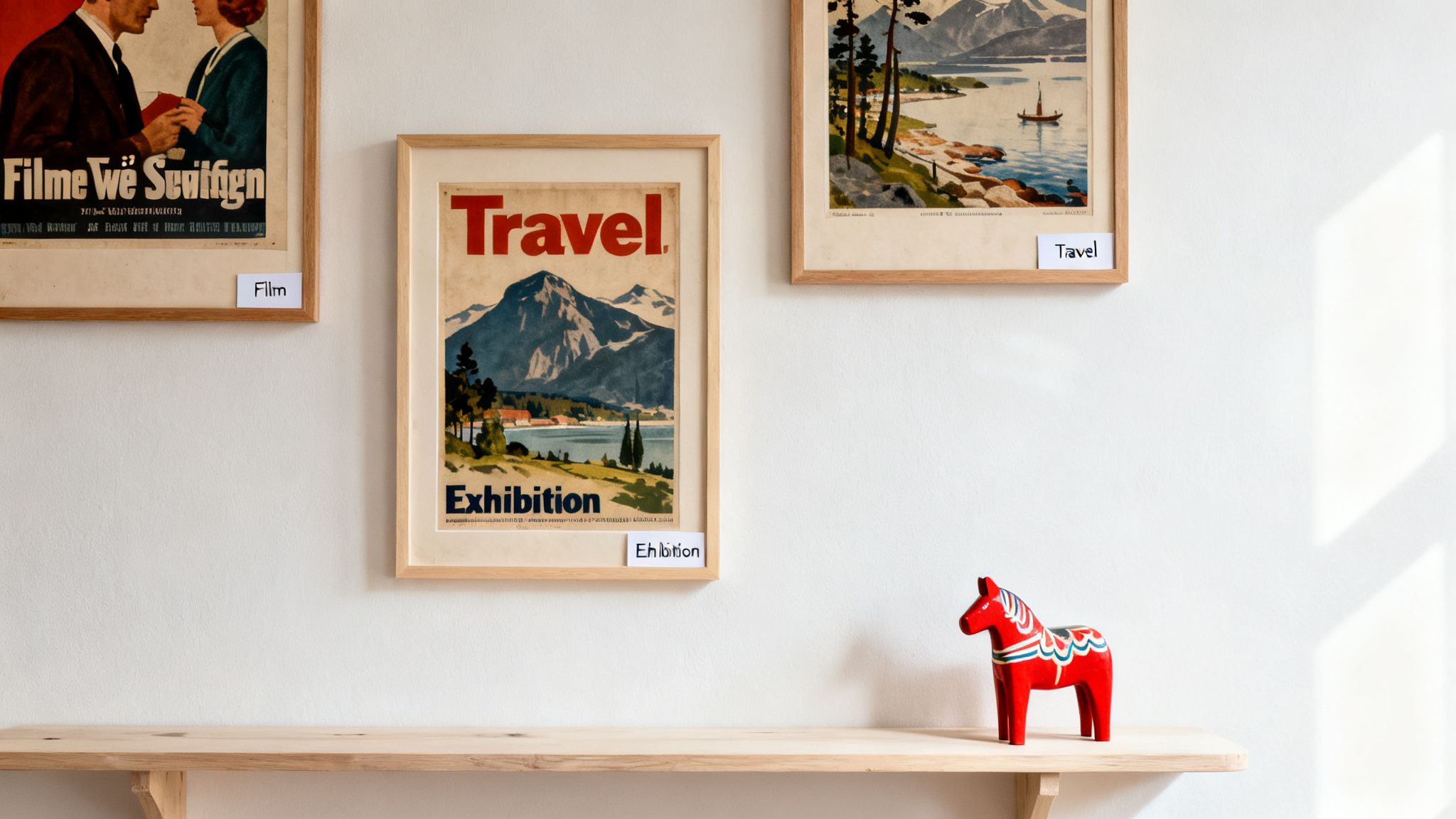
Diving into the world of vintage Swedish posters is a bit like opening a time capsule. Each design freezes a moment in the country's cultural and creative evolution, making them incredibly compelling for seasoned collectors and modern interior designers alike.
Think of these posters as storytellers printed on paper. A piece promoting a Stockholm exhibition from 1912 or a film advert from the 1950s does more than just sell something; it reflects the aesthetics, social values, and graphic design trends of its day. This depth is precisely what sets an authentic vintage piece apart from a simple reproduction.
The unique magic of vintage Swedish posters comes from a special blend of artistic vision and historical context. Unlike the mass-produced global marketing we see today, these posters were often crafted by local artists who poured a specific Scandinavian flair into their work. That local touch makes them highly sought-after.
A few key things contribute to their charm:
Much like a hand-carved Dala horse represents a tangible piece of folk tradition, a vintage poster offers a glimpse into Sweden's graphic arts heritage. It connects us to the past through powerful visual language.
This guide is here to walk you through every step of collecting vintage posters from Sverige. We'll explore the golden age of Swedish poster design, shining a light on the key artists and movements that shaped this unique art form.
We’ll also get practical, sharing advice on how to spot authentic pieces, navigate the market to find them, and ultimately, how to display them beautifully in your home. By understanding their history and character, you can appreciate these works not just for their beauty, but for the rich stories held within their fragile paper fibres.

To really get the appeal of vintage posters Sverige, you need to step back in time. Imagine an era when graphic design in Sweden was hitting its creative stride. The years between the early 1930s and the late 1970s are what many of us consider the golden age of Swedish poster art.
Back then, posters weren’t just simple adverts; they were a form of public art. Artists were hired to dream up stunning designs for everything from films and art exhibitions to travel promotions. This created a distinct visual style that, amazingly, still feels incredibly fresh and modern today. It was a time defined by a deep respect for local talent, which left us with a rich legacy of graphic treasures.
One of the most captivating parts of this story is how Sweden put its own spin on international culture, especially movies. When a big Hollywood film landed on Swedish shores, they didn't just slap some new text on the original marketing materials. Oh no.
Instead, local distributors commissioned Swedish artists to create entirely new posters from scratch. This gave artists the creative freedom to pour their own style and cultural perspective into the work. The result? A whole collection of film posters that offer a uniquely Scandinavian lens on global classics, often featuring bold colours and dynamic designs that make them leap off the wall.
This local redesign process is why Swedish versions of famous film posters are so coveted by collectors worldwide. They are not mere copies but original artistic creations, capturing a unique intersection of global entertainment and Swedish design.
Think about it: an American film noir might get a Swedish poster that feels more minimalist, digging into the psychological tension with clean lines and a sense of emotional depth that we associate with Scandinavian aesthetics. These pieces don't just advertise; they offer a completely different mood, making them fascinating objects of art and history.
This creative explosion wasn’t an accident. It was driven by brilliant artists whose names are now legendary among collectors. Figures like Eric Rohman (1891–1949) are absolutely central to the story of Swedish poster design. His work is still celebrated for its masterful compositions and incredible visual storytelling.
Rohman and his peers weren't just illustrators. They were communicators who knew exactly how to capture the heart of a film or product in a single, powerful image, elevating the humble poster into a respected art form. Finding one of their original works today is incredibly difficult, as they are both scarce and immensely valuable.
If you’re thinking about starting a collection, getting to grips with the physical details of these posters is a must. The standard sizes changed over the years, and knowing this can help you identify and date a piece you've found.
During the peak of Swedish cinema, from the 1930s to the late 1970s, posters were printed in very specific formats. The iconic one-sheet, measuring 70x100 cm (about 27.5x39.4 inches), became the industry standard. At the same time, a smaller format known as the 'stolpe' (pole poster) popped up. These measured 30x70 cm (11.8x27.6 inches) and were designed to be plastered on telephone poles across Swedish cities.
Artists like Eric Rohman created works in these sizes that are now so sought-after that only a handful of originals from before 1965 are even known to exist.
Of course, the legacy of this era wasn't just about film. Other influential artists like Josef Frank brought a similar vision to textile and print design, further shaping the Swedish aesthetic we love. To see how these design ideas crossed into other mediums, check out our guide on the timeless appeal of a Josef Frank poster. This golden age truly laid the groundwork for what we recognise today as classic Swedish design.
To really get a feel for the clean lines and bold visuals of so many vintage posters sverige, it helps to look at the design ideas that brought them to life. The unique Swedish look didn’t just pop up out of nowhere; it was part of a bigger creative conversation happening all over Europe. Major artistic movements gave Swedish designers the concepts and tools they would later shape into their own distinct style.
Think of it like this: a master woodworker suddenly gets a set of new, more precise tools. Their fundamental skill is still there, but their work becomes sharper, more modern, and more efficient. That's a great way to understand how Swedish printers and artists in the early 20th century took on new design principles, changing the face of their graphic art forever.
This wasn't about blindly following trends. Instead, Swedish artists drew inspiration from these bigger movements and passed them through a local filter of functionalism and simplicity—ideas you can see just as clearly in classic Scandinavian furniture as in a vintage travel poster.
One of the biggest game-changers was the New Typography movement, which made its way from Germany to Scandinavia in the 1920s and 1930s. This wasn't some stuffy, academic theory; it was a hands-on revolution in how to communicate visually. It was all about clarity, order, and getting rid of the fussy, overly decorative styles of the past.
At its heart, New Typography pushed for:
This whole approach was a perfect fit for the Swedish design mindset, which has always prized function and directness. By adopting these ideas, Swedish poster designers created pieces that were not only beautiful but also incredibly good at getting a message across quickly and with real punch.
In Sweden, embracing New Typography was less about being an avant-garde rebel and more about a practical need for clarity. It was a craftsman's decision—a way to make printed materials simply work better for the modern world.
The concepts of New Typography didn't arrive in Sweden through art galleries; they came through trade. Master printers and typesetters in Sweden learned about these German innovations from industry journals and hands-on typesetting examples. They immediately saw how these new techniques could create cleaner, more powerful advertisements and public notices.
This practical, grassroots adoption was incredibly effective. Journals like Typografisk Årbok 1935 featured cutting-edge work from designers like Viktor Peterson, and Viggo Hasnæs’s layouts in Selmars Typografi (1938) became hugely influential. This quiet revolution, led by craftsmen rather than theorists, sparked a massive shift in Swedish graphic design. Some estimates suggest these new principles influenced 30-40% of all printed materials by the late 1930s. You can even explore a deep dive into how Jan Tschichold's typographic manifesto spread through over 50 Scandinavian publications to find a home in Sweden. Read the full research on the New Typography movement in Scandinavia.
While New Typography gave them the structure, the soul of these posters remained completely Swedish. The movement’s principles were blended seamlessly with the wider philosophy of Functionalism (or 'Funkis,' as it was affectionately known in Sweden). This homegrown movement was built on the idea that objects should be designed first and foremost for their purpose, with beauty flowing naturally from that function.
This meant that every single element in a Swedish poster had a job to do. There was no room for decoration just for the sake of it. The bold colours, clean lines, and simple illustrations were all carefully chosen to serve the main message. It's this blend of international modernism and local functionalist values that created the timeless look that makes these vintage posters so captivating today. It's a style that feels both historically important and perfectly at home in a contemporary space, much like the broader influences seen in the graphic arts of that era. For more on related styles, you might enjoy our guide to Art Deco posters and their impact.
Telling a genuine piece of Swedish history apart from a modern reproduction can feel like a real challenge. But with a trained eye, you'll start to see the clues. Think of yourself as an art detective, looking for the tell-tale signs in the paper, ink, and fine print that reveal a poster’s true story.
Learning to spot these details is what separates a casual admirer from a confident collector. It's less about memorising dates and more about getting a feel for the materials and methods of the time. With a little practice, you can navigate the market for vintage posters Sverige with the assurance of a seasoned expert.
The first and most immediate clue is the paper itself. Imagine the feel of an old book page—it has a certain texture and weight that new paper just can't replicate. Authentic vintage posters, especially those made before the 1970s, feel much the same.
They were usually printed on a matte, non-laminated paper that feels a bit rough to the touch. This stock was practical and cheap, made for widespread distribution, not for lasting centuries. Because of this, it’s often more delicate and might show its age with a slight yellowing or brittleness at the edges.
Modern reproductions, on the other hand, are almost always printed on bright white, glossy, or semi-glossy paper. If a poster supposedly from the 1940s feels slick and smooth like a modern cinema poster, that’s a huge red flag. The paper should absolutely feel its age.
Next, take a closer look at how the image was printed. Many early Swedish posters were made using stone lithography, a process that creates beautifully rich, deep colours with a unique texture. If you look closely with a magnifying glass, you'll see a random, dot-like pattern instead of the perfect, grid-like dots you find in modern printing.
Later on, offset printing became the norm. While this also uses dots, vintage offset prints tend to have a softer look compared to the razor-sharp precision of today's digital reproductions. Look for subtle flaws or slight overlaps between colour layers—these are the hallmarks of older, mechanical printing methods.
Here are a few things to check for:
This decision tree gives you a great visual for how to think about the design principles—like asymmetry and typography—that were common in functionalist vintage posters.
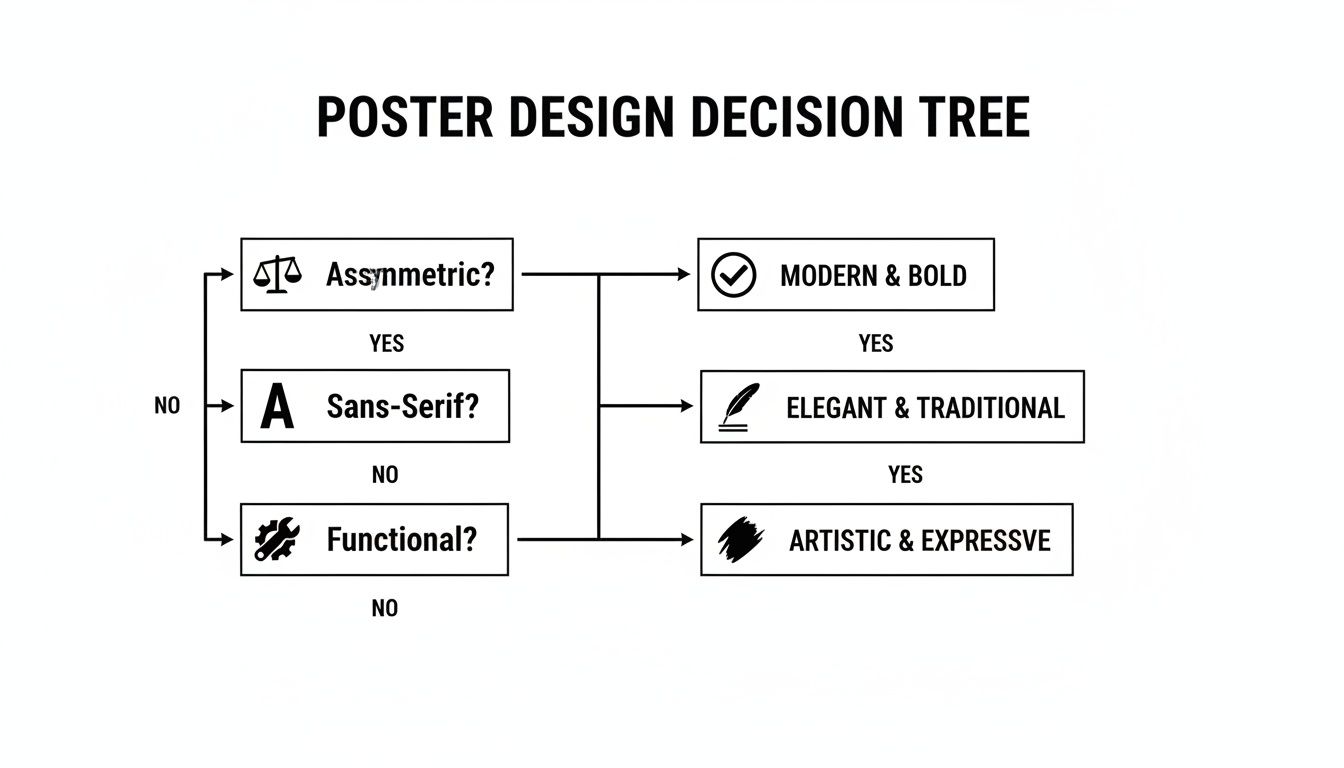
The flowchart shows how these specific design choices came together to create the clean, functional look that defines so many authentic Swedish posters from that era.
Swedish posters from their golden age were printed in specific, standard sizes. The classic one-sheet, measuring 70x100 cm, was the go-to format for film and advertising posters. Knowing these standard dimensions can help you spot a fake from a mile away.
If a seller is offering a "vintage" poster in a modern size like A3 or A4, it's almost certainly a reproduction. Originals were rarely trimmed down; they were made to fit the standard display cases of the day.
Finally, always check for small text along the bottom edge of the poster. Genuine pieces will often include the printer's name and city, something like "AB Kopia, Stockholm." The complete absence of a printer's mark is a major cause for concern. These little details are like an artist's signature, anchoring the poster to its specific time and place.
So, you're ready to start the hunt for an authentic vintage poster from Sverige? Fantastic. Knowing where to look is the first step in turning that spark of interest into a real, tangible collection. The market is wonderfully varied, with avenues for everyone from the curious newcomer to the seasoned collector looking for that next great piece of Swedish graphic art history.
Your search can take you down several paths, from the digital aisles of online specialists to the quiet corners of a local antique shop. Each source has its own unique feel and requires a slightly different approach. The key is to navigate these spaces with a clear idea of what you’re after and an even clearer idea of what red flags to watch out for.
In our connected world, many of the finest Swedish posters are just a click away. Specialised dealers who focus on Scandinavian or European graphic art are often your best bet. These experts usually provide detailed histories, condition reports, and guarantees of authenticity, which makes them a wonderfully safe starting point for your first significant purchase.
When browsing, look for dealers with established reputations, crystal-clear return policies, and high-quality photographs that show every detail—flaws and all. Their expertise is a resource you should absolutely use; they can help guide you toward pieces that fit your taste and budget. Big online marketplaces can also be goldmines, but you'll need to vet individual sellers carefully. For a few pointers on that, our guide on using eBay for Swedish treasures has some helpful tips.
If you're chasing rarer or higher-value posters, auction houses are where the real action is. Major international auctioneers and smaller, local Swedish houses often feature graphic art in their sales. It’s well worth getting on their mailing lists or following their auction calendars to get a heads-up on upcoming opportunities to bid on some truly exceptional items.
Taking part in an auction is a thrill, but it pays to do your homework. Always go through the auction catalogue, paying close attention to the estimated price and the condition report. Most importantly, set a firm budget for yourself before the bidding even starts. A disciplined approach like this ensures you’re making a considered investment, not just getting swept up in the moment.
Should you find yourself wandering through Sweden, popping into local antique shops (antikvariat) and flea markets (loppis) can be an incredibly rewarding adventure. These places are genuine treasure troves where you might just stumble upon a hidden gem tucked away in a dusty corner. While the thrill of the hunt is a huge part of the fun, this is also where your knowledge of authenticity becomes absolutely crucial.
When buying from these kinds of sources, you’ll be relying on your own eyes to inspect the paper, printing techniques, and dimensions. It also never hurts to build a friendly rapport with the shop owners; they often have incredible local knowledge and might just share the story behind a piece you've fallen for.
One of the most critical factors in a poster's value is its provenance—the documented history of its ownership. A clear paper trail can significantly boost a poster's desirability and worth, transforming it from a beautiful object into a verifiable piece of history.
For those of us buying from outside of Sweden, figuring out the logistics of shipping is vital. Any reputable dealer will be well-versed in international postage, but it’s always smart to confirm the details before you pay.
Here are a few essential points to ensure a smooth international purchase:
By keeping these steps in mind, you can make sure your chosen vintage poster arrives safely at your door, ready to be admired for many years to come.

Bringing a piece of Swedish graphic history into your home is an incredible moment. A vintage poster is so much more than just something to hang on the wall; it’s a conversation starter, a bold focal point, and a genuine connection to a bygone era of art. Integrating these pieces into your space is an art in itself, a chance to blend historical charm with your own personal style.
The real beauty of vintage posters sverige is just how versatile they are. Their clean lines and thoughtful use of colour harmonise perfectly with the core principles of Scandinavian design—minimalism, light, and natural materials. Whether you have one powerful statement piece or a thoughtfully curated collection, these posters can transform a room from ordinary to exceptional.
A single, dynamic poster, like a classic 70x100 cm film advert, has more than enough presence to command an entire room. Try placing one striking piece above a sofa, bed, or console table to immediately create a magnetic centre of attention. This approach works especially well in minimalist interiors where the poster's artistry can truly shine without competing for the spotlight.
Think of the poster as the anchor for the room's colour palette. You can pull accent colours directly from its design and weave them into cushions, throws, or other decorative items. For example, the deep blues in a travel poster for the Swedish archipelago could be echoed in a nearby vase or rug, creating a look that feels cohesive and intentional.
For smaller posters or a growing collection, a gallery wall is a fantastic way to showcase your finds. This method allows you to tell a bigger story by grouping pieces that share a common theme, colour scheme, or artist. A series of smaller travel posters lining a hallway, for instance, can create a captivating journey for the eyes.
To get a balanced, professional look, keep these tips in mind:
The goal is to create a visual dialogue between the pieces. A gallery wall shouldn't feel cluttered, but rather like a curated exhibition that reflects your passion for Swedish design history.
Once you've found the perfect spot, preserving your poster for future generations is the final, crucial step. Vintage paper is delicate and highly susceptible to damage from light and acidic materials. Proper framing isn't just about display; it's about protection.
Always insist on archival-quality materials when you get your poster framed. This means using acid-free mat boards, backing, and mounting tapes. These materials are essential to prevent the yellowing and deterioration that happens when old paper comes into contact with acidic substances over time.
Most importantly, invest in UV-protective glass or acrylic. Sunlight, and even some indoor lighting, can cause the vibrant inks of your poster to fade dramatically. UV-filtering glazing blocks up to 99% of harmful ultraviolet rays, acting as a vital shield that preserves the poster's original colour and vitality. This one choice is the single best investment you can make to protect your piece of Swedish art history.
As you step into the captivating world of vintage posters Sverige, it's natural to have a few questions. Whether you're just starting your collection or have been an enthusiast for years, getting clear answers helps you buy with confidence. Let's walk through some of the most common queries we hear.
While any poster over 25 years old could technically be called vintage, for serious collectors, the term means something more specific. It typically points to original prints from the golden age of Swedish design, a period stretching roughly from the 1920s to the late 1970s.
The real magic is in their originality and age, not just a retro look. These posters are treasured because they capture a uniquely Swedish artistic voice from a time before marketing became a global, cookie-cutter affair. They aren't just decorations; they're genuine artefacts of history.
An authentic vintage poster's value comes from its rarity, historical context, and original printing process. While a reproduction can look beautiful, it lacks the cultural and financial significance of an original print from that specific era.
Reproductions definitely have their place! They're a fantastic and affordable way to bring a vintage aesthetic into your home. You can capture the beautiful style and colour of classic Swedish design without the significant investment of an original.
From a collector's perspective, however, they hold very little, if any, monetary value. An original's worth is tied directly to its scarcity and its story—it's a true survivor from a bygone era, and that's something a modern copy can't replicate.
Proper storage is absolutely essential for protecting your collection's beauty and value. If you have unframed posters, the best method is to store them completely flat inside archival-quality, acid-free folders. This prevents creases, tears, and other damage.
If you have to roll them, always do it with the image facing outwards, wrapped around a wide-diameter archival tube. This simple trick minimises stress on the delicate paper fibres. Above all, find a cool, dark, and dry spot with stable humidity to keep them safe from fading, mould, and brittleness.
At Dalaart, we celebrate the artistry and heritage behind every piece of Scandinavian culture. Explore our collection of authentic, hand-crafted Swedish treasures and bring a piece of tradition into your home. Visit Dalaart to find your next masterpiece.


.svg)


.png)


