April 8, 2026
I once lit a tealight inside a Kosta Boda Polar piece just as winter dusk settled over the gallery. The flame did not merely glow. It fractured, softened, and seemed to hover inside the glass like light trapped in thawing ice.
To understand kosta boda polar, start with place. Småland is not just a map location in southern Sweden. It is a working area of forest, water, furnaces, and craft memory.
Kosta Boda’s history gives Polar much of its weight as a collectible object. The company states that its furnaces have been continuously operating since 26 July 1742, making it the oldest active glassworks in Sweden. It also notes that during its first 150 years of operation, the glassworks focused on fine glassware such as window panes and crystal chandeliers for royalty, nobility, and wealthy merchants, and that today it is recognised as the number one glassworks in Northern Europe (Kosta Boda history).
That matters for collectors because Polar did not appear from nowhere. It belongs to a deep workshop tradition that had already survived changing tastes, industrial pressure, and shifting ideas about what glass should be.
The setting helped shape the craft. Kosta Boda was established in the forests of Småland, a region that became known as the Kingdom of Crystal. Forest resources supported the heat needed for furnaces, and running water helped power machinery.
A collector often sees only the finished object. The fuller story is industrial, geographic, and cultural.
For much of its early life, Kosta made refined objects for elite interiors. Later, the company changed direction. In the 1930s, Kosta Boda shifted towards artist glassworks, and that transition helped define the modern brand identity described in its official material.
That change is the backdrop for Göran Wärff. He was not merely designing a product line. He was working inside a house that had already decided glass could carry artistic meaning as well as practical use.
Collectors who also appreciate other Swedish objects of character, such as figurative folk art and studio pieces, often respond to this mix of continuity and reinvention. A useful companion read is this look at Kosta Boda All About You, which shows how the glassworks continued to pair design identity with collectibility in a much later era.
Wärff’s name matters because Polar depends on a particular artistic intelligence. He worked with light, transparency, and natural forms in a way that feels unmistakably Nordic. Ice, water, reflection, and atmosphere were not decorative themes for him. They were structural ideas.
Curator’s view: The strongest Scandinavian objects often do two things at once. They feel local in spirit, yet they remain modern in any setting. Polar achieves that balance.
When a collector buys Polar, they are not buying “a nice candle holder”. They are buying a chapter in the long evolution of Swedish glass, shaped by one of the designers who helped turn that tradition into something sculptural and enduring.
Polar arrived in the early 1970s with unusual clarity of purpose. It was not designed to imitate ice in a literal way. It was designed to make light behave as if it had entered ice.
Kosta Boda describes the series as designed by Göran Wärff and launched in 1973 to 1974, consisting of glass sculptures that resemble rippling water frozen in time. The company also notes that the collection marked its 50-year anniversary in 2023 and that it was selected as a gift from Sweden to the Sydney Opera House (Kosta Boda Polar collection).
That official description explains why Polar has lasted. The concept is simple enough to recognise immediately, yet rich enough to reward long attention.
Many first-time buyers misread Polar because they encounter it in a retail category. It may be listed as a votive or candle holder, so they assume function comes first.
With Polar, function is only one layer.
The object behaves like a small sculpture even when unlit. Once a candle is placed inside, it becomes an instrument for light. That shift is central to understanding its appeal. Scandinavian design often blurs the line between use and atmosphere, and Polar is one of the clearest examples of that tradition.
A short film helps show the series in motion and in light:
Polar remains current because it avoids trend language. It does not depend on a period pattern, a fashionable colour, or a novelty silhouette. Instead, it translates a recurring Nordic experience into glass: the unstable edge between water, ice, and winter light.
That is why these pieces work in very different interiors. They can sit comfortably among rustic painted wood, strict modern furniture, or a more collected room with ceramics, textiles, and books.
Three qualities give the series its staying power:
Collectors often ask whether the Sydney Opera House story is just a sales anecdote. Kosta Boda presents it as part of the official history of the line. That matters because it places Polar within a diplomatic and cultural context, not just a commercial one.
A useful rule for collectors: when a design moves from shop object to symbolic gift, its cultural standing changes. People begin to read it as representative.
That is exactly what happened with Polar. It came to stand for a recognisable idea of Swedish design. Not ornate. Not cold in the emotional sense. Restrained, luminous, and strongly connected to its natural setting.
The first feature noticed by many is the outline. Polar does not sit like a neat cylinder or a balanced bowl. Its body swells, folds, and turns in ways that feel slightly irregular, almost geological.
That asymmetry is not a flaw to be corrected. It is the reason the object comes alive.
According to the referenced product information, the thick-walled, asymmetrical form of Polar sculptures causes candlelight to refract through the lead-free crystal, producing an ice-like scintillation. The same material notes that the glass is annealed at 520°C for 30 to 60 minutes to prevent thermal stress cracks, and that pieces can weigh up to 6 kg (Nordic Urban product details).
Those details help explain what your eye is experiencing.
A thin glass wall gives a clearer, flatter transmission of light. Polar does something else. Its mass bends and scatters the flame. The heavy crystal slows the eye down. You look into it, around it, and through it.
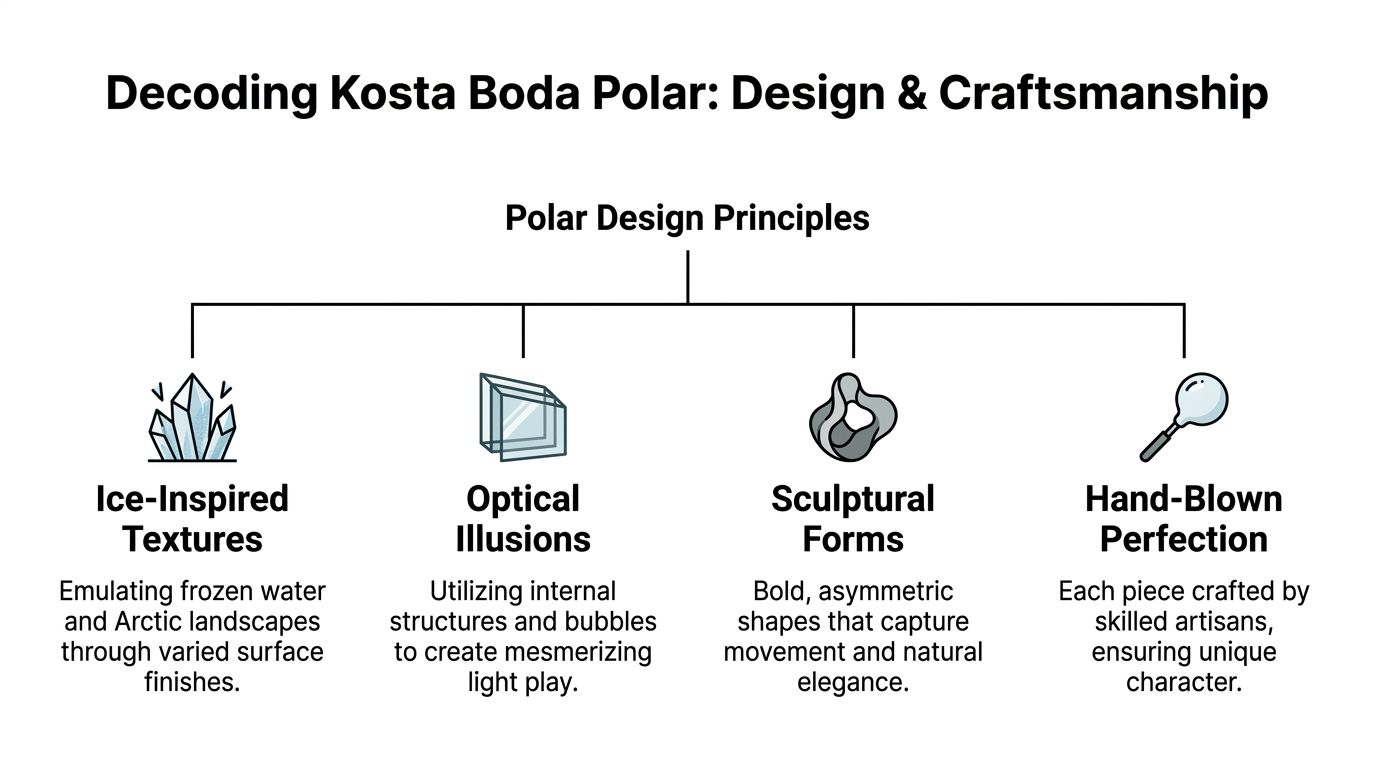
When teaching visitors how to identify a Polar piece across a room, I ask them to look for four features before they look for any mark.
These design traits produce a useful collector insight. Polar is strongest when seen from several angles. A photograph taken straight on often flattens it. In person, the object changes as you move.
Much of Polar’s power comes from what handcrafted glass preserves. Slight variation, small differences in contour, and subtle changes in how the surface catches light are not defects. They are evidence of making.
If you lift one carefully, you notice another essential quality. It has gravity. The weight anchors the object physically and visually.
That is one reason collectors often become attached to Polar quickly. The piece resists the disposable feeling that affects so much decorative glass. It announces itself as something made to endure.
Handling tip: Hold a Polar piece with both hands when examining it, especially a larger example. The shape can be less intuitive to grip than a conventional vase or bowl.
A final point often gets overlooked. Polar succeeds because technical control never overwhelms poetic effect. The annealing, the wall thickness, and the optical behaviour all serve a single artistic goal. The glass should feel like frozen movement.
That is difficult to achieve. In lesser designs, “ice-inspired” becomes merely jagged or theatrical. In Polar, the form remains calm. The drama arrives through light.
Collectors usually begin with excitement and end with doubt. The listing looks right. The shape feels close. Then the questions arrive. Is it genuine? Is it later production? Has it been altered, polished, or damaged?
A methodical inspection solves most of that anxiety.
The first checks are the obvious ones. Look for an etched or engraved marking associated with Kosta Boda, Göran Wärff, or a model reference. Some vintage pieces may also retain original paper or foil labels.
Marks help, but they are only one part of authentication. Labels fall off. Bases get worn. Older owners sometimes clean too aggressively.
That is why experienced collectors combine inscription checks with object-level observation.
A practical sequence works well:
A copy often imitates the outline and misses the optical character. This error often trips up beginners.
Real Polar tends to present a convincing internal life. The glass has depth. Light does not merely pass through. It shifts, refracts, and gathers.
Watch for these warning signs:
For collectors learning to train the eye, this article on SEA Glasbruk and Kosta Sweden offers helpful context for distinguishing Swedish glass traditions and workshop identities.
Damage can make a genuine piece look suspicious. Small chips on an edge, scratches from poor cleaning, or wear to the underside may distract from otherwise correct features.
Patience becomes important here. Separate the question of authenticity from the question of condition.
Museum habit: I always inspect the rim, the highest points of the form, and the underside first. These are the areas where use, storage, and cleaning leave the clearest evidence.
If buying online, ask for photographs in natural light, a view of the base, and close images of any area that catches glare. Glare can hide chips. Soft daylight usually tells the truth.
The best collectors do not rely on one “magic sign”. They build confidence through accumulation. Markings, weight, finish, optical quality, and design coherence should all point in the same direction.
The market for kosta boda polar is easy to enter and hard to read. Pieces appear regularly, yet reliable valuation remains surprisingly thin.
One verified point is especially important. Public listings make current retail and resale pricing for common pieces visible, but there is a documented information gap around long-term appreciation, discontinued colourways, production runs, and rarity tiers. That gap matters for anyone treating Polar as a long-term piece of Swedish design heritage (Etsy listing context).
In plain language, you can usually find Polar. What is harder is understanding where a specific piece sits within the broader collecting context.
The source shapes the risk.
Dealer stock tends to offer better vetting and clearer condition descriptions. Auction houses may provide stronger provenance when they catalogue carefully. Online marketplaces give wider choice but demand sharper judgement from the buyer.
Each route has advantages:
A collector who also follows other Swedish art glass makers may find useful parallels in this piece on Mats Jonasson Målerås, especially when thinking about workshop identity, collectibility, and secondary-market caution.
Without a reliable public rarity map, the sensible approach is comparative rather than absolute. Study several listings over time. Note the recurring factors that appear to matter.
Condition is usually the first filter. Chips, scratches, clouding, and base wear all affect desirability. Scale can matter too, because larger objects often command stronger visual presence and greater display impact.
Beyond that, collectors usually pay close attention to:
Treat valuation as a triangle, not a single number. One side is authenticity. Another is condition. The third is desirability.
If one side weakens, the others must compensate. A scarce-looking colour with edge damage may still attract interest, but not in the same way as a pristine example with clear markings. A common piece in beautiful condition may be more satisfying than a supposedly rare one with compromised presence.
Collector’s rule: Buy the best example you can understand, not the most dramatic listing description you can find.
That rule protects both beginners and experienced buyers. Since the public data on rarity tiers remains incomplete, your own eye, patience, and record-keeping become part of the collection itself.
Polar asks for stewardship, not fussiness. It is sturdy enough to be used, yet refined enough to suffer from careless handling.
One verified issue stands out. Product listings often say only that Polar is hand wash only, while detailed preservation guidance is limited. The same reference highlights the importance of pH-neutral detergents and proper display conditions to protect pieces from micro-abrasions or etching over time (Neiman Marcus product context).
That is the right starting point.
The goal is simple. Preserve clarity and avoid scratches.
Wash Polar by hand with lukewarm water and a small amount of mild, pH-neutral detergent. Use a soft cloth or a very soft sponge. Rinse carefully and dry with a lint-free cloth rather than letting mineral residue settle on the surface.
Avoid the dishwasher. Avoid abrasive pads. Avoid powdered cleaners.
If wax residue builds up inside a votive form, do not pry at it with metal tools. Let the residue soften first, then remove it gently with non-abrasive methods.
Polar rewards thoughtful placement. Good display is not only about appearance. It also reduces risk.
A few curatorial habits make a real difference:
Place Polar where shifting light can reach it. A nearby window, soft lamp, or candle glow will reveal more of the design than a dark corner ever can.
Polar displays beautifully alone, but it can also anchor a grouped arrangement. A cluster of different sizes or colours can create a dialogue of light and mass, especially in winter interiors.
The key is restraint. Do not crowd it with too many reflective objects. Let wood, linen, painted folk art, or matte ceramics provide contrast.
A balanced arrangement often works best when you combine:
Here, Polar becomes more than an object on a shelf. It becomes part of a domestic atmosphere that feels distinctly Nordic. Light is never treated as an afterthought. It is part of the composition.
Collectors often think about cleaning and forget storage. If a piece is not on display, wrap it carefully in soft, non-abrasive material and store it where it cannot knock against other glass.
Keep any original label fragments, packaging, or purchase notes. Those details may help with future identification and valuation, and they become part of the object’s history in your hands.
The best care advice is also the simplest. Handle it attentively, clean it gently, and display it with enough respect for both its weight and its light.
Kosta Boda Polar endures because it joins several traditions without reducing itself to any one of them. It is studio glass, but it is also usable design. It is sculptural, yet domestic. It feels distinctly Swedish, while still looking at ease far beyond Sweden.
For collectors, that combination is rare. You can study Polar as a work of craftsmanship, enjoy it as an object of atmosphere, and preserve it as part of a broader heritage collection. Its appeal lies not only in the object itself, but in what it carries with it: Småland’s glassmaking culture, Göran Wärff’s sensitivity to light, and the Scandinavian habit of turning everyday surroundings into places of quiet beauty.
That is why Polar belongs comfortably beside other cherished Nordic heirlooms. It asks for attention, but not extravagance. It rewards use, but also contemplation.
A good piece of Polar does what the best museum objects do. It changes slightly each time you return to it, because the light has changed, the room has changed, and you have changed with it.
If you collect Swedish objects with provenance, character, and lasting decorative power, explore Dalaart for authentic Scandinavian folk art that shares the same spirit of craftsmanship, heritage, and collectibility.


.svg)


.png)


