February 10, 2026
Step into the world of Scandinavian glass, where fire and sand are masterfully shaped into timeless art. This guide is your window into the legacy of Sea Glasbruk Kosta Sweden, born in the legendary 'Glasriket'—the Kingdom of Crystal. Each piece is a fragment of Swedish heritage, much like the hand-carved Dala horses that so perfectly capture the region's artisanal soul.
Welcome to an exploration of Scandinavian glass, a world where functional design and breathtaking artistry become one. For collectors and design lovers, names like Sea Glasbruk and Kosta Boda represent more than just beautiful objects; they are symbols of a rich cultural history forged in Sweden's forested heartland. The story of Sea Glasbruk is deeply woven into that of Kosta, creating a fascinating narrative of collaboration and creativity.

Think of the relationship between Sea Glasbruk and Kosta like that of a skilled apprentice learning from a revered master. Kosta, established centuries ago, laid the groundwork with its foundational techniques and artistic environment. Sea Glasbruk, a more recent innovator, brought a fresh perspective, often focusing on accessible, everyday art glass that captured the spirit of modern Scandinavian living. This journey will help you distinguish between the two while appreciating their shared lineage.
This guide is designed for both new admirers and seasoned collectors. We will trace the story of this iconic brand, its vital connection to Kosta, and uncover why these handcrafted pieces are treasured by so many today. You will learn to:
By the end of this guide, you won't just see a glass vase; you'll see a story of Swedish innovation, a testament to the artisans of Glasriket, and a tangible piece of design history.
Our goal is to give you the knowledge to appreciate, identify, and curate these beautiful objects with confidence. Whether you've just found your first piece at a flea market or are looking to expand a cherished collection, this exploration into Sea Glasbruk Kosta Sweden will illuminate the artistry behind the glass.
To really get a feel for the artistry of Sea Glasbruk, you have to go back to its origins, deep in the evergreen forests of Småland, Sweden. This area is famously known as Glasriket, or the Kingdom of Crystal, and it’s the very heartland of Swedish glassmaking. The story of this place is the foundation for everything that brands like Sea Glasbruk would later become.
The landscape itself was the spark that lit the fire. Those vast forests offered a seemingly endless supply of wood to power the incredibly hot furnaces needed to turn sand into glass. This natural gift created a special place where craftsmanship could be passed down and perfected over generations.
Right at the centre of it all is Kosta Glasbruk. Founded on July 26, 1742, by two ambitious governors, Anders Koskull and Georg Bogislaus Staël von Holstein, it’s Sweden's oldest working glassworks. At first, they focused on practical items the country needed, like windowpanes and bottles, but it didn't take long for Kosta to become an industrial force. By 1900, it was so massive that it even ran its own private railway to haul materials and ship out finished glass. You can dive deeper into this incredible history over on the official Destination Kosta website.
But this wasn't just about industry; it was about culture. Kosta didn't simply make glass; it built a community of master artisans. The secrets of the craft were passed down through families of glassblowers, creating an incredible pool of talent and artistic insight that became the bedrock of the sea glasbruk kosta sweden legacy.
The Kingdom of Crystal was never just a bunch of factories. It was a complete ecosystem, all built around the art of glass. The connection between the natural world and the artisans was immediate and vital.
This unique mix of raw materials and human expertise created a super-concentrated hub of innovation. It was in this dynamic setting that new artistic ideas could take root and flourish, setting the stage for the distinctive designs that collectors prize today.
The story of Glasriket is a powerful reminder that true craftsmanship is tied to a sense of place. The very soil and trees of Småland are embedded in the DNA of every piece of Kosta and Sea Glasbruk glass.
Understanding this rich history is the key to seeing why these pieces are so much more than just pretty objects. They are artifacts from a specific time and place, carrying on a long tradition of quality and artistic vision. This same deep connection to regional craftsmanship is a hallmark of other beloved Swedish traditions. For another great example, you can read about the history of Höganäs Keramik stoneware, another iconic Swedish craft.
Telling a genuine piece of Swedish glass history from a modern imitation is a skill every collector needs to develop. Authenticating Sea Glasbruk Kosta Sweden glass isn't about finding one single clue; it’s more like piecing together a story told through subtle marks, old labels, and the very feel of the glass itself. Learning to read these signs will give you the confidence to spot true vintage treasures.
Your investigation should start with the most obvious clues before you dig into the finer details. Often, the easiest identifiers are right there on the surface. Look for original stickers, signatures etched into the base, and just the overall quality of the piece.
This decision tree shows the simple but essential factors—plentiful forest fuel and skilled artisans—that led to the founding of Kosta Glasbruk way back in 1742.
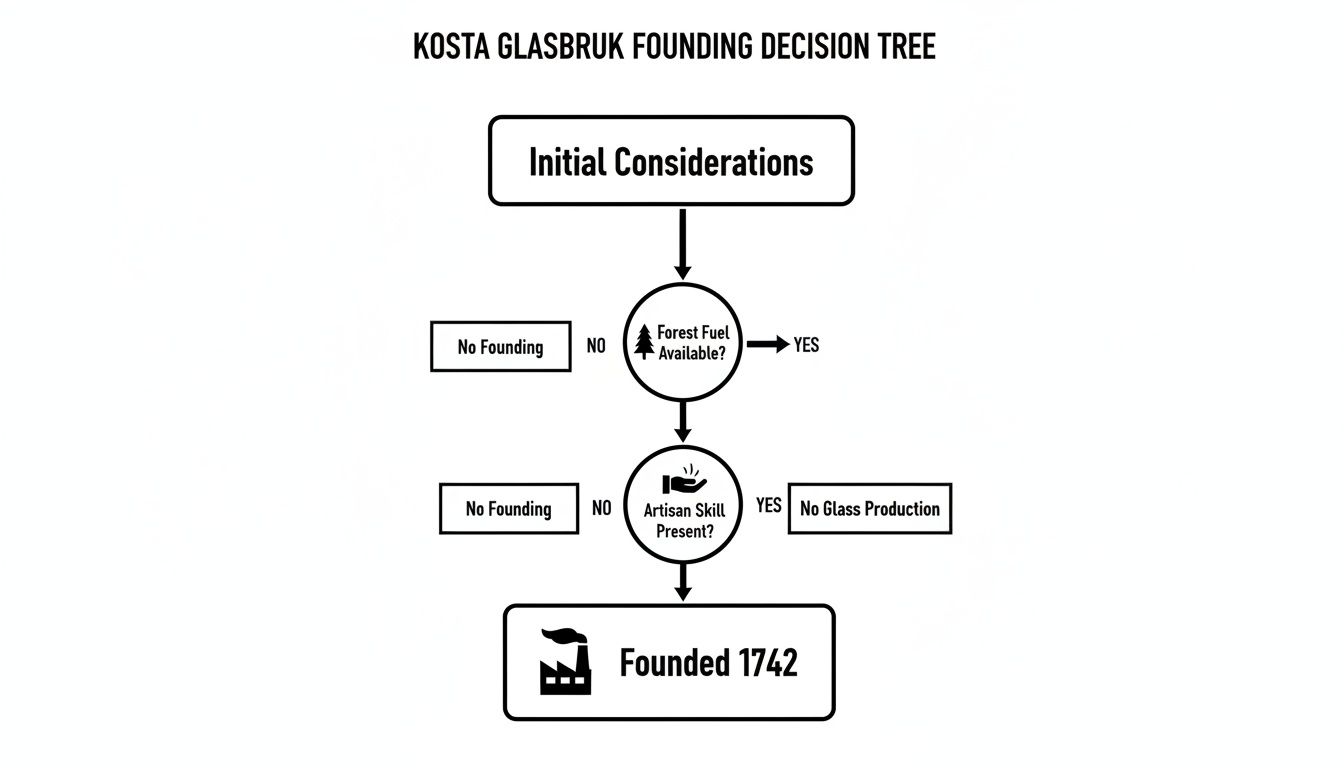
It’s clear the glassworks' establishment wasn't just a happy accident, but a strategic move based on the natural and human resources ready and waiting in the region.
The best way to identify a piece is usually through its markings. Over the decades, both Sea Glasbruk and Kosta used a whole range of identifiers, and getting to know them is key to dating your item.
Look for these key elements:
Beyond labels and signatures, the glass itself holds important clues. The techniques used in handblown glass production leave behind unique physical traits that are tough for mass-produced items to replicate. These subtle imperfections are often the very signs of authenticity you’re looking for.
One of the most important places to inspect is the base of the piece. This is where the glassblower's handiwork is most obvious.
A pontil mark—a small, often rough circular scar on the base where the glass was snapped off the pontil rod—is a classic sign of handblown glass. A ground and polished pontil means a higher-quality finish, which is typical of many Kosta and Sea Glasbruk art pieces.
You should also check the weight and clarity of the glass. Authentic Swedish glass generally has a good, substantial feel to it and excellent clarity. Look for tiny air bubbles, known as "seeds," which are common in handmade glass and are seen as part of its character, not a flaw. Mass-produced items, by contrast, are often lighter and have a flawless, uniform look that just lacks the subtle variations of a handcrafted piece. By carefully checking these details, you can build a strong case for your piece's origin and truly appreciate the artistry that went into making it.
Behind every treasured piece of Sea Glasbruk Kosta Sweden glass is an artist with a unique vision. The aesthetic that collectors adore today wasn't born from a single style, but was lovingly shaped by a long line of creative designers, each leaving their own distinct mark on the molten glass. These visionaries turned everyday functional objects into true works of art, defining the soul of Swedish glass for generations to come.
The signature styles changed and grew over the decades, often reflecting wider artistic movements happening at the time. Early Kosta pieces, for instance, frequently featured incredibly detailed engravings and classical shapes. As the mid-20th century arrived, there was a noticeable shift towards organic, nature-inspired forms and bold, fluid colours. This was the era when designers really started to play and see what glass could do. Later on, Sea Glasbruk brought a fresh, often more accessible, modernism to the table, focusing on clean lines and functional beauty.
Learning to spot these artistic shifts is like learning to read the language of the glass itself. It lets you see and appreciate the specific creative genius behind each piece you hold.
A few names are profoundly connected to the Kosta and Sea Glasbruk story. These designers weren't just employees; they were true innovators who pushed the boundaries of their craft. Their unique artistic voices came to define entire eras of production.
Two of the most celebrated figures are Vicke Lindstrand and Göran Wärff. Lindstrand, who came to Kosta in the 1950s, was a master of capturing movement within glass. He became known for his graceful forms and inventive techniques, like encasing air bubbles in beautiful, deliberate patterns. Wärff, arriving a decade later, was famous for his incredible ability to play with light and optics. He created pieces that seem to magnify and bend light in the most captivating ways, often inspired by the raw, elemental beauty of ice and water. Their designs are highly sought-after for this very reason.
The impact of these artists was immense. They didn't just design objects; they developed new techniques and philosophies that influenced the entire Glasriket, the Kingdom of Crystal, cementing its global reputation for artistic excellence.
The Glasriket region in southeastern Sweden's Småland province, which includes Kosta Glasbruk, has been a powerhouse of handblown glass since 1742. This creative hub stretches between the cities of Växjö and Kalmar. By the end of the 19th century, it was home to more than half of Sweden’s 77 glass factories. This rich heritage of unique, artisanal output is a wonderful parallel to the hand-painted Dala horses and other animals celebrated by Dalaart, each one a unique expression of authentic Swedish flair. You can find out more about this historic region on the official Visit Sweden website.
Recognising the work of a specific designer often comes down to spotting the signature elements that defined their style. This knowledge helps you not only identify a piece but also connect with the artistic moment it represents.
For more on this rich artistic tradition, you can learn about another celebrated Swedish glass designer in our article on the captivating creations of Orrefors' Anne Nilsson.
Keep an eye out for these stylistic hallmarks:
By getting familiar with these signature styles, you can start to attribute unsigned pieces and truly deepen your appreciation for the creative forces that shaped the Sea Glasbruk Kosta Sweden story.
So, what exactly turns a beautiful piece of glass into a valuable collectible? For anyone interested in Sea Glasbruk Kosta Sweden, knowing what drives market value is absolutely key. It’s the real difference between just owning a pretty decorative item and holding a piece of sought-after design history in your hands. This value isn't random; it's a careful mix of rarity, condition, the designer's name, and the unique story behind the piece.
Think of this knowledge as your most important tool for building a collection you can be proud of. When you know what to look for, you can make smarter purchases, whether you're digging through a local antique shop or browsing an online marketplace. It gives you the power to see the true worth of the Swedish art glass you already own and spot potential treasures with a much sharper eye.
Several things come together to decide what a piece is truly worth. Rarity is often the biggest driver; a limited-edition design or a funky, unusual colourway will almost always fetch a higher price than something that was mass-produced. A piece's history, or its provenance, also adds huge value—if you know an item came from a famous collection or was part of an exhibition, its desirability can shoot way up.
Beyond that, you’ll want to consider these points:
Just remember, value is a blend of things you can touch and things you can't. A piece that shows flawless technical skill combined with a compelling artistic story is what creates the most valuable and sought-after Sea Glasbruk Kosta Sweden glass.
When it comes to value, condition is non-negotiable. Even the rarest piece in the world will see its worth plummet if it's damaged. When you're inspecting an item, you have to be meticulous and check for any little flaw that could bring down its price.
Gently run your fingers along all the rims and edges. You're feeling for tiny nicks or chips, which are the most common types of damage. Next, hold the piece up to a bright light to check for scratches on the surface or, much more seriously, any internal cracks.
You also need to watch out for "sick" or "cloudy" glass—a hazy film on the inside caused by chemical reactions over many years. This condition is unfortunately irreversible and can severely slash an item’s value. A piece in pristine, original condition will always, always be worth the most.
When you bring a piece of Sea Glasbruk Kosta Sweden glass into your home, you become its custodian. These beautiful objects have often survived for decades, and with the right care, they'll keep their brilliance for generations to come. Thoughtful display can also turn them into true focal points in your home.

The golden rule for cleaning vintage glass is to be gentle. Steer clear of the dishwasher at all costs; the intense heat and harsh detergents are a recipe for disaster, potentially causing thermal shock or etching the delicate surface.
Instead, a simple bath in lukewarm water with a few drops of mild washing-up liquid is all you need. Use a soft cloth or sponge—never anything abrasive like scouring pads. For those tricky narrow vases or intricate pieces, a soft bottle brush works wonders to get into tight corners without leaving a scratch.
Always finish by rinsing with lukewarm water and drying immediately with a lint-free cloth. This little step is the secret to preventing those annoying water spots from forming.
Once your glass is sparkling clean, it’s time to show it off. The right placement can really amplify its beauty by playing with light and colour.
By thoughtfully curating how you display your collection, you’re not just storing objects; you're creating an ever-changing art installation within your own home.
For more inspiration on creating that cosy, Scandinavian feel, have a look at our article on the tradition of candles in Scandinavia. With these simple strategies, your Swedish glass collection will absolutely shine.
Discover the timeless charm of Swedish craftsmanship at Dalaart, where we curate authentic, hand-carved Dala horses and animals direct from Dalarna. Explore our collection at https://dalaart.com.


.svg)


.png)


