May 2, 2026
A beautiful handbag often hides a small daily drama. Your keys slip to the bottom. Lip balm vanishes into a dark corner. Earphones wind themselves around a pen, and the receipt you meant to keep has folded itself around your wallet. The bag may be lovely, but the inside feels less like a collection and more like a jumble drawer.
That friction adds up. You reach into your bag dozens of times a day, often in a hurry, at a till, on a train, at the door, in the rain. When the inside of the bag has no clear order, even a graceful object becomes awkward to use. Many people assume this is the nature of handbags, especially deep totes and open carryalls. It doesn't have to be.
A bag in bag organizer is a modest object with an outsized effect. It brings structure, rhythm, and a sense of placement to the things you carry every day. More than that, it changes how you relate to your belongings. Instead of tossing and searching, you begin choosing and arranging. The shift is small but meaningful.
If you appreciate hand-crafted objects, you'll recognise the appeal. A well-composed handbag has something in common with a thoughtfully displayed shelf of cherished pieces. Each item has a place. Nothing fights for attention. Utility and beauty support each other.
The most common handbag problem isn't owning too much. It's carrying without a system. A phone drops beside a glasses case, loose coins drift into the lining, and one small cosmetic pencil somehow migrates to the furthest possible seam. When you're late, that disorder feels larger than it is.
A bag in bag organizer offers a gentler way to move through the day. It doesn't ask you to become severe or minimalist. It gives your essentials a home. Your bag stops being a single empty chamber and becomes a series of useful spaces.
That change matters because daily carry is personal. The items inside your handbag are often the tools that support your day: keys, cards, medication, notebook, charger, tissues, sunglasses, perhaps a small keepsake or two. Treating those items with care isn't fussy. It's practical, calm, and respectful of your time.
Practical rule: If you have to dig, your bag isn't organised yet. Good organisation lets your hand find things almost by memory.
There's also an emotional benefit. A disordered bag can make even a calm morning feel scattered. An organised one creates a small moment of certainty. You open it and see what you have. You know what belongs there. You notice what needs replacing.
Think of it as curation rather than strict tidiness. A collector doesn't throw treasured objects into a box and hope for the best. The same instinct can shape your everyday carry. You choose what deserves space, decide where it belongs, and preserve the condition of both the bag and its contents.
A bag in bag organizer sits at the meeting point of function and care. It turns a handbag from a container into a considered arrangement.
A bag in bag organizer is a removable insert that sits inside your handbag and creates an internal structure of pockets, compartments, and dividers. The easiest way to understand it is to think of it as a portable home for your daily essentials. Instead of organising the handbag itself, you're placing a smaller organising system inside it.
That distinction clears up a common confusion. It isn't just a liner, and it isn't only padding. A liner protects the interior surface. An organiser does more. It assigns places.
When people first see one, they often notice the pockets. That's useful, but its core value is the whole arrangement. A good organiser works like a compact artist's kit. Brushes, pigments, and tools aren't left to knock against one another. Each piece has a position that makes the kit quicker to use and easier to carry.
The same idea applies here. Your wallet may sit in the central cavity. Keys may live in a narrow side pocket. Lip balm, hand cream, and a card holder can each have a separate compartment. If the organiser includes a zipped section, it becomes a secure home for small private items that shouldn't drift around.
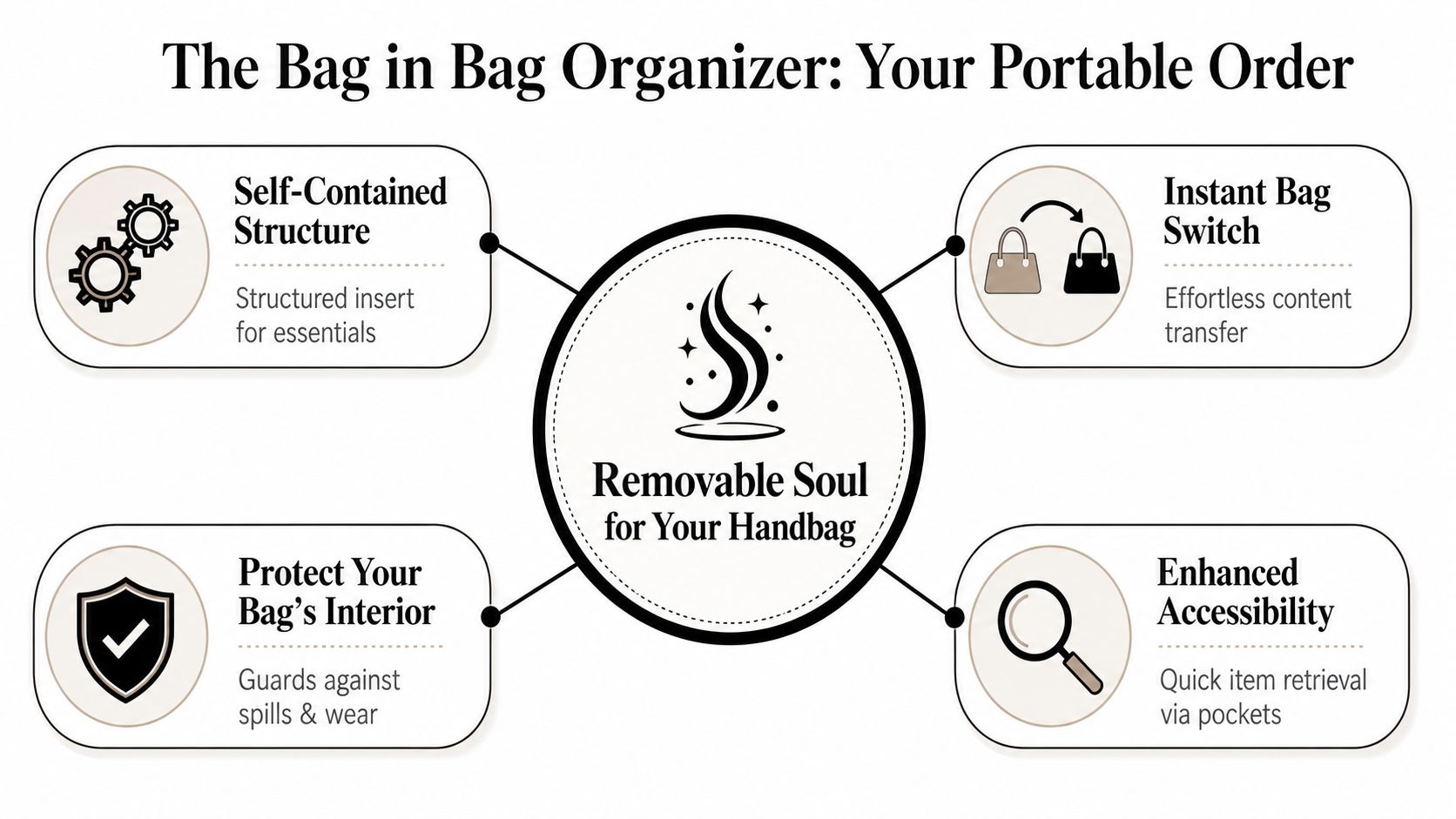
Most organisers share a familiar layout, even when materials and styling vary:
This modular design is especially helpful in soft or open-top bags. Without it, the bag's shape controls the contents. With it, the contents gain their own structure.
A well-made organiser should feel independent, not flimsy. You should be able to lift it out with your essentials still sensibly arranged.
That's why many people start with one organiser and then use it across several bags. The organiser becomes the stable core, while the handbag becomes the outer shell. If you switch bags for the day, you don't begin again from scratch. You move the system.
The first benefit is immediate. You stop searching.
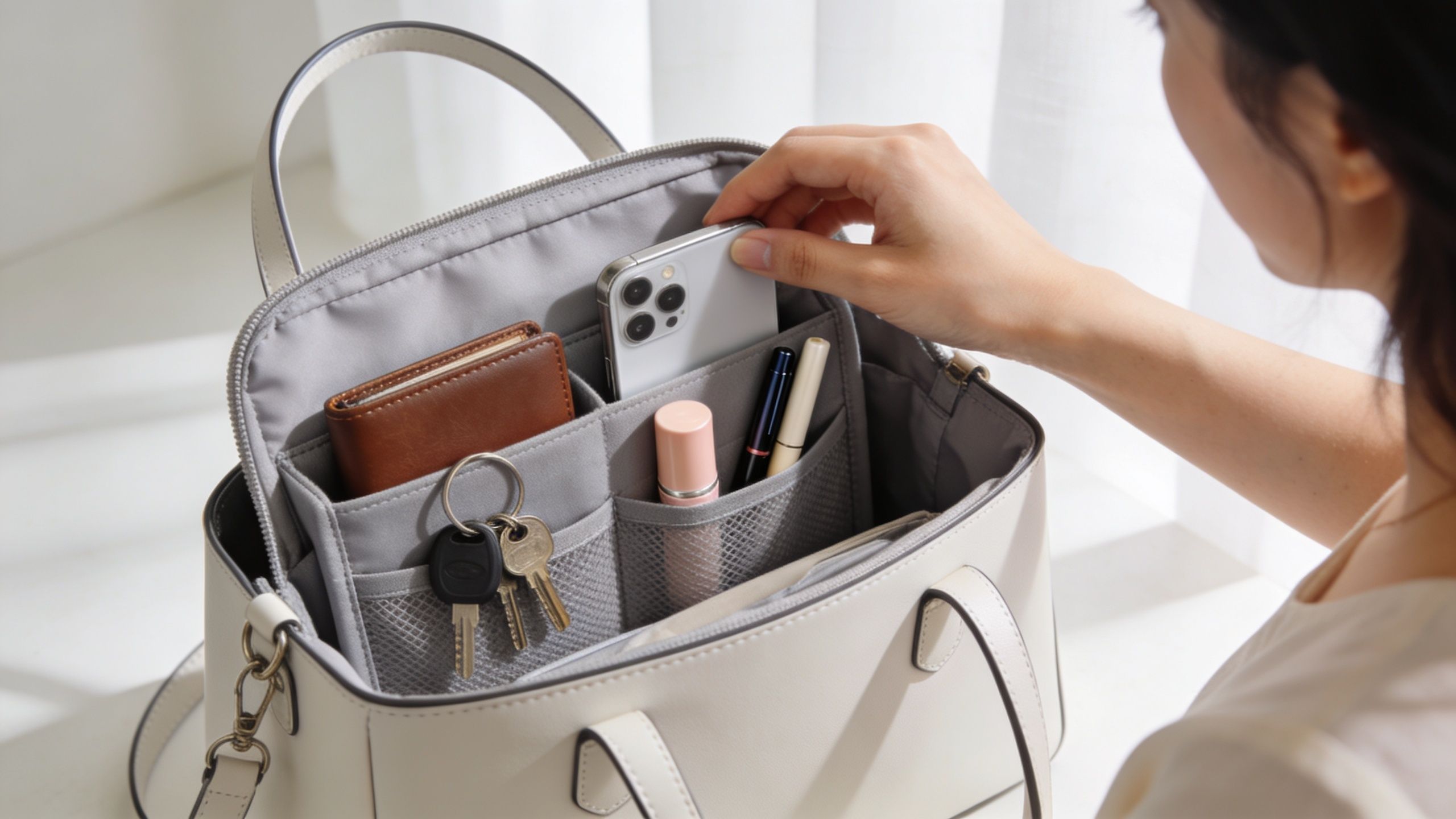
That sounds small until you notice how often you reach into your bag. At the chemist, at the station gate, outside your front door, at a café counter, in a taxi, in a meeting. A bag in bag organizer removes the low-grade irritation of repeated rummaging. The savings are measured less in grand transformations and more in a smoother day.
One of the best uses for an organiser is the bag switch. Many people keep one tote for work, another for weekends, and perhaps a smaller handbag for errands or evening plans. Without an organiser, moving between bags means handling every loose item one by one. That's how things get left behind.
With an organiser, the transfer is much simpler. You move the core set of essentials together and then add or remove only a few bag-specific items. The process feels less like repacking and more like dressing for the day.
There's also a preservation aspect that people often overlook. Pens mark linings. A metal compact scratches leather. Hand cream leaks. Loose snacks leave crumbs. An organiser creates a contained layer between your possessions and the inside of your handbag, which helps cherished bags stay cleaner and wear more gracefully.
A good organiser doesn't only sort objects. It can also improve how the bag carries. Swedish benchmarks from the SP Technical Research Institute of Sweden's 2025 report found that bag-in-bag organisers boost handbag pocket utilisation by 320% in consumer tests with 150 Dalarna-based participants, and that even load distribution reduces shoulder strain by 28% when carrying heavier totes, as noted in the reported Swedish benchmark summary.
That ergonomic point deserves attention. When weight shifts and settles unevenly, a bag can pull awkwardly at the shoulder and side. Organisers help distribute contents more deliberately, especially if you place heavier pieces low and central rather than loose at one edge.
For anyone who enjoys thoughtful gifting, that same attention to useful beauty often appears in curated seasonal objects such as well-chosen Christmas gift boxes.
A short visual demonstration can help if you're deciding whether an insert would suit your routine:
The organiser itself is simple. The effect isn't. It reduces decision fatigue, protects the things you carry, and turns one of the most-used objects in your day into something more dependable.
An organised bag doesn't just hold your day. It helps your day move cleanly from one task to the next.
The right size is the detail that makes an organiser feel natural. The wrong size makes it feel like a stubborn insert that bunches, bows, or steals useful space. If you're buying only one organiser to start with, spend most of your attention here.
People often measure the handbag from edge to edge on the exterior. That can mislead you, especially with padded bags, curved silhouettes, or thick seams. What matters is the interior space at the base and through the sides.
Try this simple method:
If your bag narrows towards the top, pay close attention to the base. That's where the organiser must sit comfortably.
Choose an organiser that is slightly smaller than the inside of the bag. That little margin matters. It allows the bag to keep its shape and lets the organiser drop in without wrestling.
Sizing rule: Leave a small amount of breathing room on each side so the organiser supports the bag instead of stretching it.
This is especially useful with softer leather bags and woven styles that should still drape or curve naturally. A too-tight insert can make a handsome bag look rigid and overfilled even when it isn't.
A structured satchel can take a firmer organiser. A slouchy tote usually prefers something lighter and more flexible. If your bag is delicate or decorative, avoid inserts with overly stiff edges that may press visibly against the material.
Use your habits as a guide too. If you carry a glasses case, notebook, and water bottle every day, you'll need a different internal layout from someone who carries only cards, keys, and lipstick. Home accessories follow the same principle. The best additions fit the object rather than forcing it, much like a well-fitted chair cushion should support without looking imposed.
A good fit should feel almost custom. The organiser settles in, your bag closes as it should, and nothing bulges or sags.
Material changes everything. Two organisers can share the same pocket layout and feel completely different in use. One may add welcome structure. Another may collapse. One may protect against damp weather. Another may suit a quieter, softer interior.
Felt is often chosen for structure. It gives a soft, cushioned shape to an unstructured bag and helps items stand upright instead of tipping into one another. It can be especially pleasant for handbags carrying sunglasses, cosmetics, or polished objects that you don't want knocking together. Felt also has a calm, matte appearance that many people find visually pleasing.
Canvas tends to feel relaxed and familiar. It suits casual bags and everyday use, especially when you want some organisation without much stiffness. Because canvas can be more pliable, it often works well in bags that don't need much reshaping.
Nylon has a different appeal. It's light, practical, and often easier to wipe clean than softer textile options. In the Swedish market, bag-in-bag organisers made from extra-thickness nylon fabric have shown superior water resistance, reducing internal moisture ingress by 87% compared with standard cotton during simulated Dalarna autumn rain, according to the verified benchmark summary provided for this topic. That benefit is tied to nylon's hydrophobic polymer structure, which helps repel water rather than absorb it.
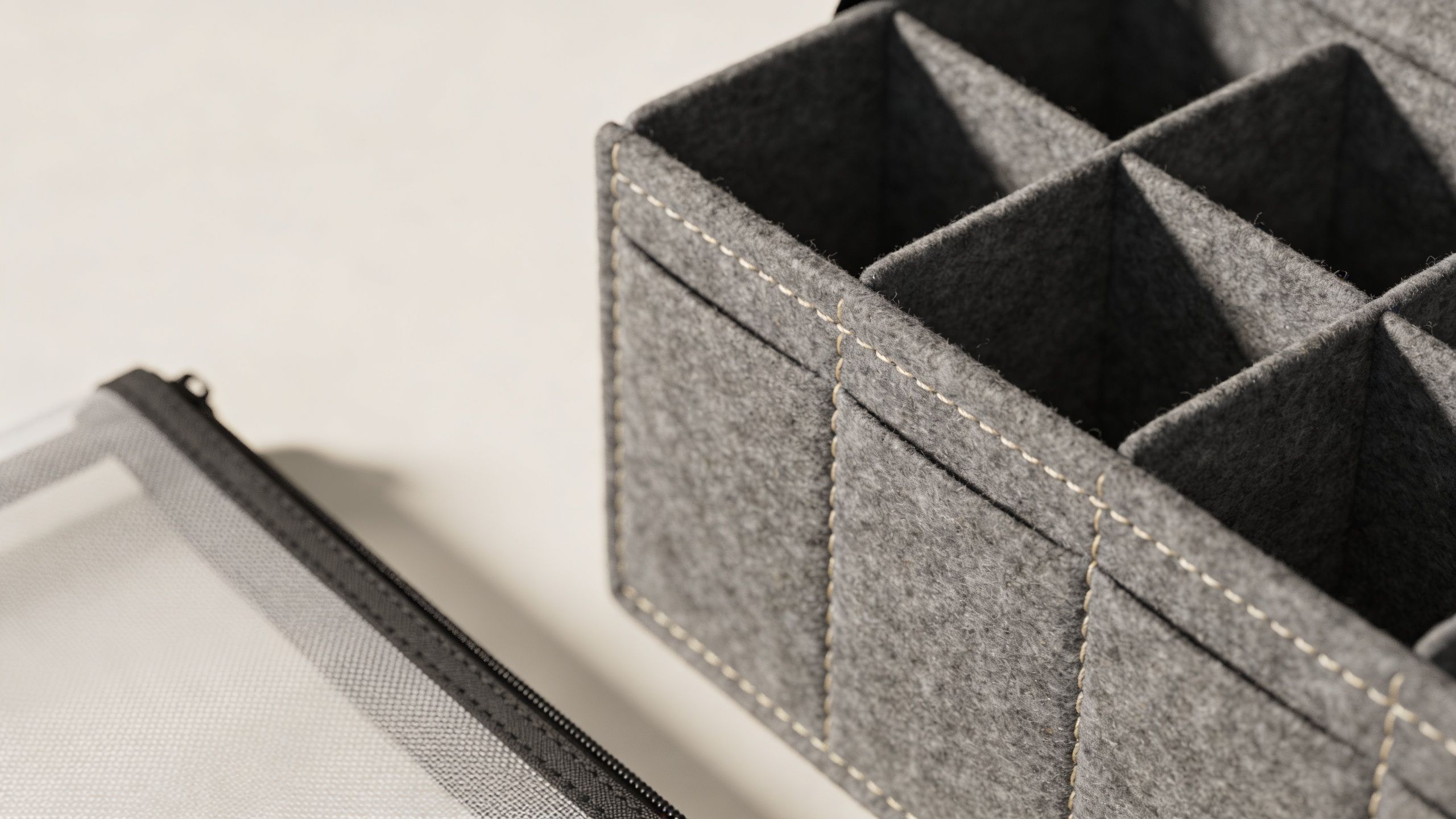
Craftsmanship shows up in humble details. Look closely at the finish, not only the shape.
A thoughtful organiser should solve problems, not create new ones. If it's too bulky, too heavy, or too stiff for your bag, even good construction won't make it pleasant to use.
Material choice can also express values. A key underserved angle in this category is the use of sustainable, regionally minded materials for Scandinavian preferences. A 2025 Swedish Consumer Insights report states that 78% of consumers in Sweden prioritise sustainability, and later market data notes a 35% year-on-year increase in searches for "hållbar väskorganisator", indicating growing interest in eco-conscious options. The verified data for this topic also notes that mainstream offerings often don't meet that demand with clearly regional, sustainable materials.
That makes material transparency worth seeking out. Recycled fibres, responsibly sourced components, and low-impact finishes may matter to you as much as pocket count. People who appreciate craft often notice these decisions instinctively. The same eye that values a handsome grain, a careful stitch, or a balanced silhouette usually values provenance too.
If you like tactile, useful accessories, the same design sensitivity appears in small everyday pieces such as a well-made leather keychain holder.
Choose the material that suits your climate, your bag, and your habits. The best organiser isn't the most rigid or the most technical. It's the one you'll enjoy using every day.
A bag in bag organizer isn't only for large totes. That's one of the biggest misconceptions around it. The better way to think about compatibility is not by bag category alone, but by what problem the bag needs solved.
A market tote often has generous space and almost no internal discipline. You drop in a purse, notebook, reusable shopping bag, perhaps a small bottle of water, and soon everything leans into everything else. An organiser gives that roomy bag a centre of gravity. The tote stays generous, but the contents stop drifting.
A structured top-handle bag has the opposite issue. It may already hold its shape beautifully, but small items jostle around inside and collect at the bottom corners. A slimmer organiser with fewer compartments can stop that movement without wasting precious room.
Then there's the soft hobo or casual backpack. These bags bend with the body and often feel wonderful to carry, yet their interiors can become a soft pile. A flexible organiser in nylon or canvas adds just enough definition to separate essentials without fighting the shape of the outer bag.
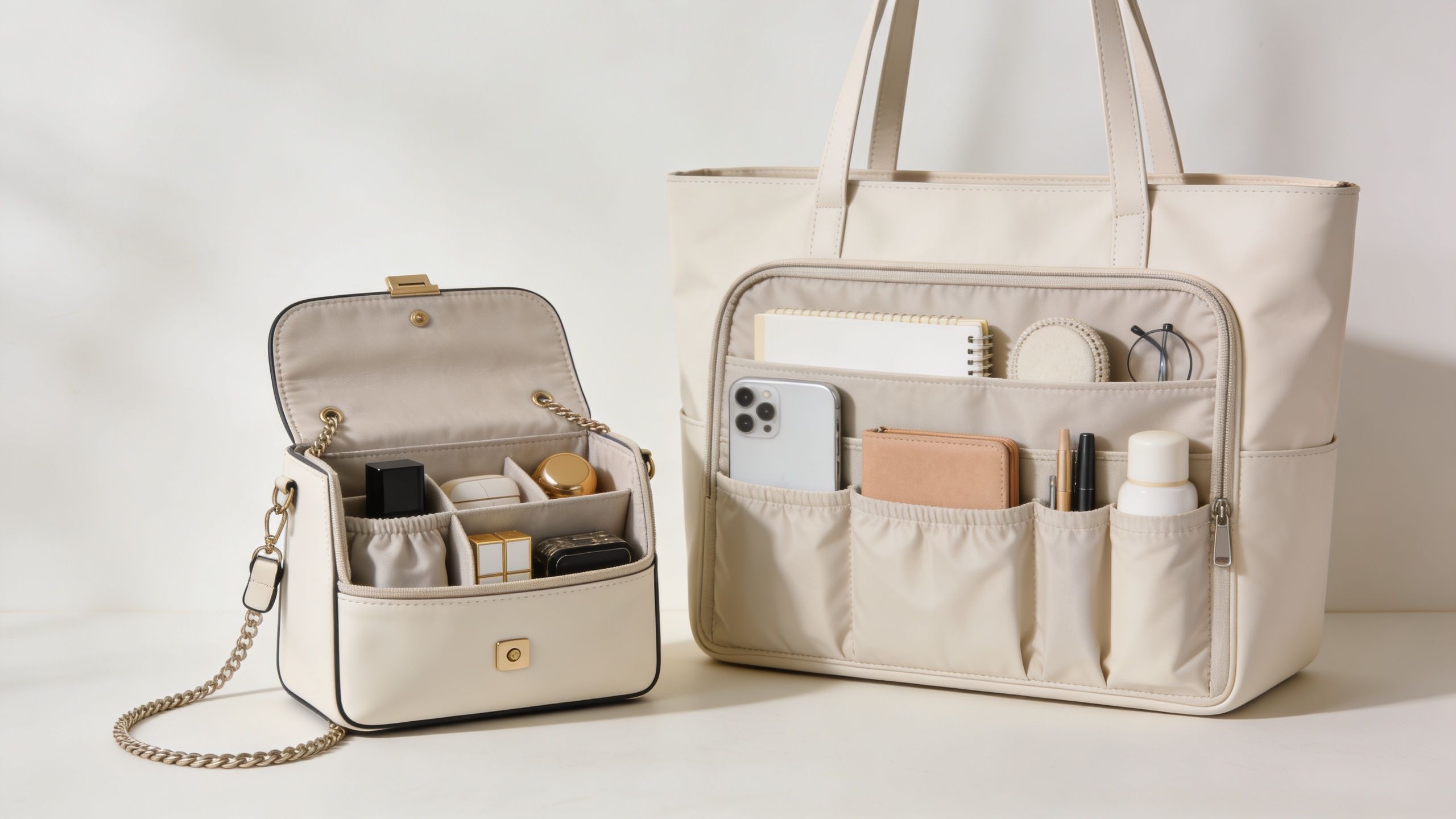
Organisers become especially charming. They travel well between uses.
The idea is always the same. One internal system, many outer containers.
That adaptability also aligns with a broader shift in taste. Verified data for this topic notes strong Swedish interest in more sustainable, regionally relevant organisers, including 78% of consumers prioritising sustainability and a 35% year-on-year rise in searches for "hållbar väskorganisator" in Swedish platforms. In plain terms, people don't only want another synthetic insert with generic branding. Many want something they'll use across settings and keep for longer.
The most satisfying organiser is rarely the one tied to a single bag. It's the one that follows your routines and still feels at home in each of them.
A bag organiser works hard. It collects lint, crumbs, traces of hand cream, old receipts, and the fine dust of daily life. A small cleaning habit keeps it pleasant to use and helps it last.
For nylon, a damp cloth and mild soap are usually enough for surface marks. Focus on corners, zip edges, and the bottoms of pockets where residue gathers. Let it dry fully before returning it to your handbag.
For felt, start gently. Shake out loose debris, then use a soft brush or lint roller to remove fibres and dust. If pilling appears, trim it carefully rather than pulling at it.
Canvas often benefits from spot cleaning rather than soaking. Blot marks instead of rubbing them deeper into the weave. In all cases, empty the organiser first and check every pocket. Small things hide well.
Emptying and resetting your organiser once a week is often enough to keep it feeling orderly rather than neglected.
An organiser doesn't have to remain anonymous. Because it lives inside your bag, it's a private place for a little character.
You might stitch a monogram onto the top edge with embroidery floss. You could sew on a vintage patch, add a ribbon tab in a colour you can spot quickly, or attach a small wooden charm to the zip pull. If you enjoy painting, a simple folk-art inspired motif on canvas can add warmth without overwhelming the piece.
Try personalising with restraint:
The best customisations don't interfere with use. They deepen your connection to the object while preserving its practical purpose.
By this point, the organiser should feel less like a trendy insert and more like a design tool. Its job isn't just to tidy. It's to help your bag carry your day with less strain, less searching, and more intention.
Choosing well comes down to self-knowledge. Before you buy, pause over a few practical questions.
A good choice should make your life simpler within seconds of use. You shouldn't need to remember a complicated system. The organiser should support your habits while gently improving them.
If you're undecided between two options, choose the one that feels easier, lighter, and more compatible with the bag you typically carry most. Perfection isn't the goal. Reliable daily order is.
An organised handbag won't change your personality. It will, however, remove one recurring source of distraction. That's no small thing. When the objects you carry are arranged with care, the day often feels more composed as well.
If you enjoy objects that combine usefulness, beauty, and Scandinavian craftsmanship, explore Dalaart. Its collection of authentic Swedish Dala horses and companion figures brings the same spirit of thoughtful design into the home, with hand-carved, hand-painted pieces made in Sweden and chosen with a collector's eye.


.svg)


.png)


