May 22, 2026
You might be standing in your bedroom right now, looking at a frame that feels too bulky, too high, or out of step with the calm home you want to create. The bedding may be lovely, the walls may be quiet in tone, yet the room still feels busy. Often, the problem isn't the styling at all. It's the bed itself.
A bed on a platform changes the whole mood of a room. It lowers the visual centre, removes unnecessary layers, and gives the bedroom that settled, uncluttered feeling that Scandinavian interiors do so well. For many homes, especially thoughtful modern homes shaped around function, it becomes the piece that lets everything else breathe.
That's also why it works so naturally with Swedish decorating traditions. A simpler bed frame leaves room for natural wood, woven textiles, and heritage accents to matter. If you love clean-lined interiors but still want warmth, memory, and craft, a platform bed gives you a strong and quiet starting point.
A bed on a platform is a bed frame with a built-in supportive base, so the mattress sits directly on the frame rather than on top of a separate box spring. In Sweden, that integrated design is the key idea. It's one structure doing one job well.
Traditional bed setups often have two layers underneath the mattress: the frame, then a box spring or foundation. A platform bed simplifies that arrangement. The support is already built in, which is one reason it feels visually lighter and mechanically cleaner.
According to Sleepopolis's guide to platform beds, this style doesn't require a box spring, and one independent U.S. guide places typical prices at about $200 to over $3,000, depending on materials and design. That wide range helps explain why platform beds appear in so many homes, from modest flats to carefully designed interiors.
The appeal isn't only practical. A platform bed reflects a design attitude many people associate with Scandinavian homes: remove what isn't needed, keep what works, and let materials speak for themselves.
You see that logic in a low oak frame, in pale linen, and in rooms where negative space is part of the design rather than an empty afterthought. If you enjoy Swedish interiors that balance colour and restraint, this reflection on colour and form in Sweden gives useful context for why simple shapes can still feel expressive.
A platform bed isn't minimal in a cold way. It's minimal in a useful way.
That difference matters. Minimalism becomes liveable when it supports daily routines, not when it strips a room of character. A bed on a platform does exactly that. It creates order first, then invites softer layers around it.
Think of three common bedroom scenes:
That's why the platform bed has become such a familiar contemporary format. It isn't a trend piece. It's a practical form that happens to look beautifully at home in modern Swedish styling.
The strongest argument for a platform bed is simple. It removes a layer you often don't need and replaces it with a more integrated design.
That gives you a cleaner look, but it also affects cost, support, airflow, and how the room feels to move around in. A platform bed can be a smart choice, but only if its lower profile suits the way you live.
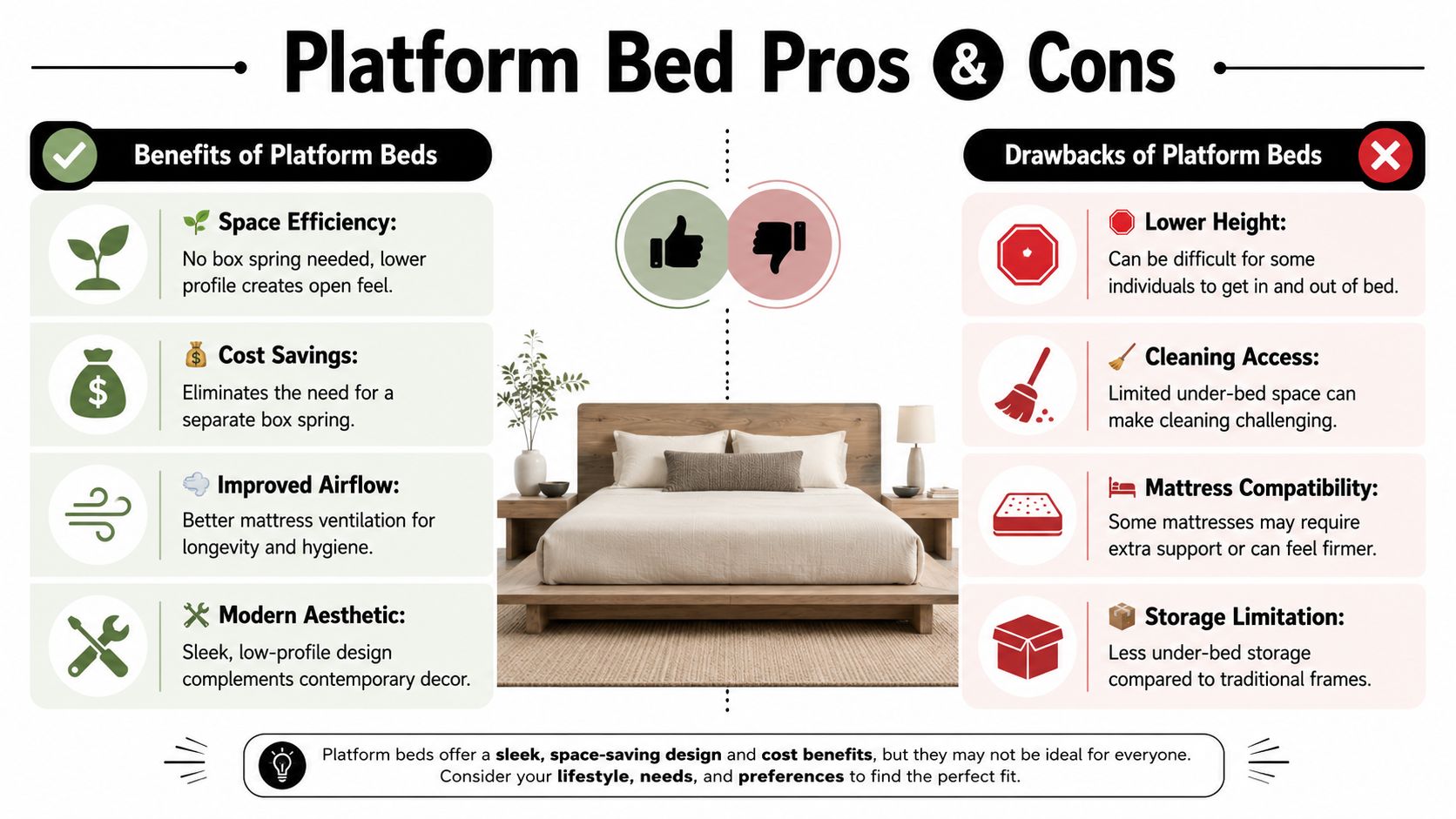
A platform bed usually looks neater because the mattress sits closer to the frame. There's less furniture mass in the room, which helps a bedroom feel more open. If you're trying to create a quiet, pared-back interior, that lower silhouette does a lot of work.
Support is another reason. NapLab's platform bed guide notes that platform beds are typically 12 to 24 inches off the ground, and that slatted versions improve air circulation, which can help reduce heat build-up in the mattress. That practical feature fits beautifully with Scandinavian design, where function and simplicity usually go together.
Many households also like the financial logic. Since the frame already includes the support structure, you don't need to buy a separate box spring. That can simplify both shopping and setup.
The same low profile that looks elegant can be awkward for some people. If you prefer a higher sitting position when getting in and out of bed, a very low platform may feel less comfortable than a traditional setup.
Cleaning can also become more specific. Some platform beds sit close enough to the floor that reaching underneath is harder. Others include useful clearance, but you have to check rather than assume.
A few mattresses can also feel firmer on a platform base, especially if the support surface is very solid. That isn't automatically a problem. It just changes the feel of the mattress, which surprises some buyers.
A platform bed often works best if these priorities sound like you:
It may be less ideal if these concerns matter most:
Practical rule: Don't judge a platform bed by style photos alone. Judge it by height, support design, and how you move through your day.
That's usually where the right answer appears.
Once you've decided that the platform format suits your room, the next question is more specific. What kind of platform bed do you want to live with?
Many shoppers encounter a common misconception. They hear “platform bed” and picture one standard shape, usually a low wooden rectangle. In reality, the support structure and the material both change the experience.
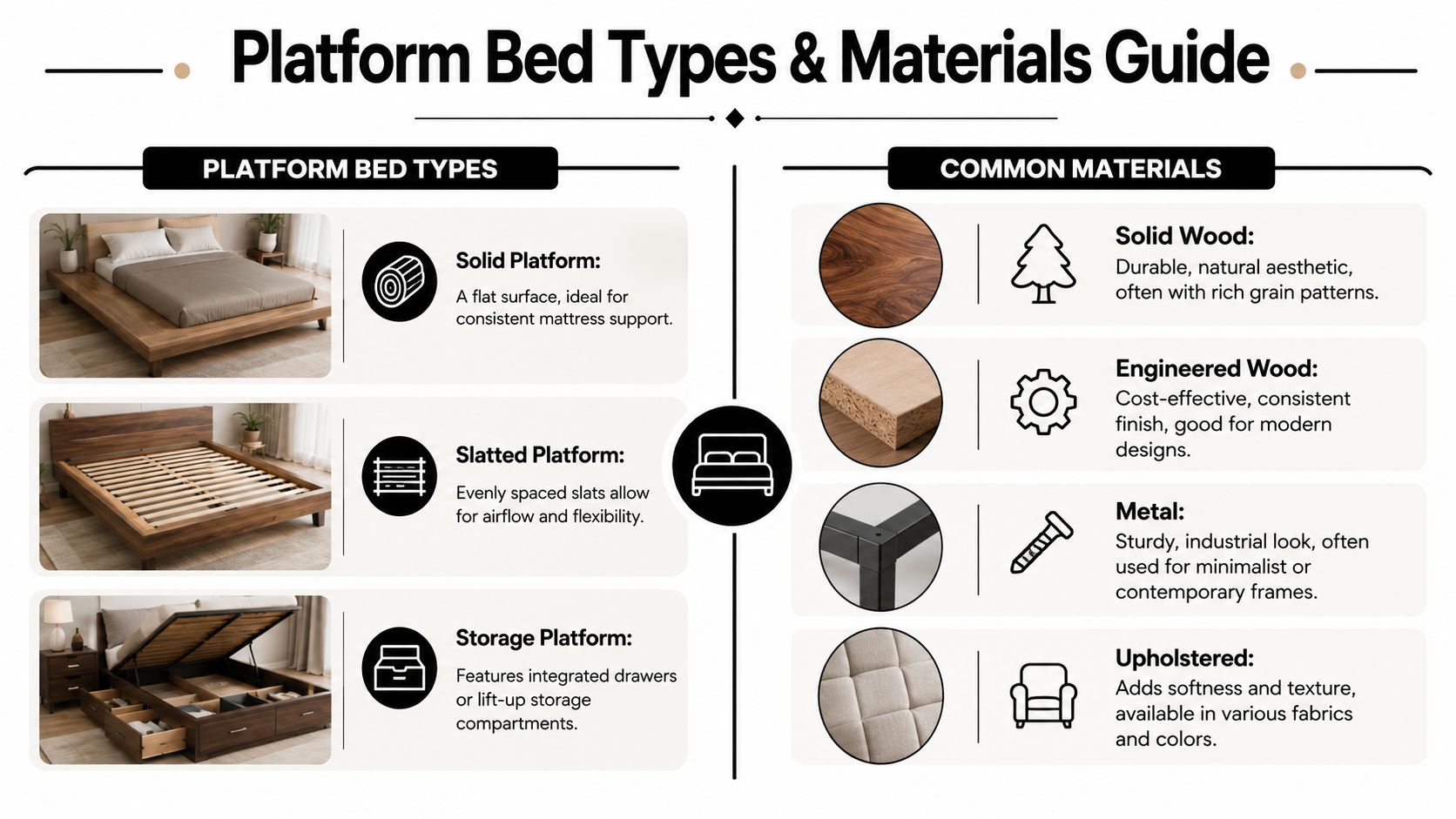
Platform beds are generally grouped into solid, slatted, and metal variants. According to eLuxury's overview of platform beds, slatted models are the most common, because they balance support and ventilation, while solid versions create a firmer, more continuous support surface.
A slatted platform uses evenly spaced boards across the frame. It's often the most versatile choice because it combines structure with airflow. This is the version many people picture in a Scandinavian bedroom.
A solid platform uses a flat deck or nearly continuous panel. It can feel more substantial under the mattress, and some sleepers prefer that stable, uniform support. The trade-off is that it offers less natural ventilation than slats.
A metal platform usually refers to a metal support system or frame rather than a warm timber look. These beds can suit stricter modern interiors, loft-style spaces, or rooms where you want the bed to almost disappear into a simpler architectural line.
Material is where function meets feeling.
Solid wood gives the most natural connection to Scandinavian interiors. Pine feels light and informal. Oak feels more grounded and architectural. Visible grain adds life without clutter, which is why wood rarely feels flat in a restrained room.
Engineered wood can be a sensible option if you want a smooth finish and a more controlled appearance. It often suits homes where the palette is crisp and the furniture lines are very clean.
Metal reads cooler and sharper. In the right room, that can be elegant. In the wrong room, it can feel a bit severe unless textiles soften it.
Upholstered frames add texture and comfort, especially if you like reading in bed or want the room to feel gentler. They're less overtly Nordic in mood, but they can work well when paired with simple bedding and natural accessories.
If your goal is authentic Scandinavian styling rather than generic modern décor, wood usually gives you the richest foundation. It has the quiet honesty that this style relies on.
A few details help:
Good Scandinavian furniture doesn't ask for attention. It earns it through proportion, texture, and use.
That's especially true of a bed on a platform. The best one won't dominate the room. It will steady it.
A good platform bed can still be the wrong bed if the mattress and base don't suit each other. Shoppers often assume too much in this situation. If the mattress fits the frame size, they think the job is done.
It isn't. Support pattern, airflow, and material all matter.
Most modern mattresses can work on a platform base, including memory foam, latex, polyfoam, hybrids, and many coil models. The important question is whether the support underneath is even and appropriate for that mattress type. Foam, in particular, needs stable support across the surface so it doesn't sag between gaps.
The detail people most often miss is slat spacing. A mattress needs support that distributes weight properly. If the slats are too far apart, parts of the mattress can dip, wear unevenly, or perform differently from what you expected.
Guidance commonly points to slats being under 3 to 4 inches apart, and DutchCrafters' discussion of platform bed questions also notes a concern many buyers overlook in cooler climates. A solid platform or poorly ventilated base may increase moisture retention risk, which matters for mattress longevity and warranty compliance where indoor humidity is a concern.
That's especially relevant in Nordic homes. Bedrooms are often kept cooler, and a cooler room doesn't eliminate moisture. It can make airflow more important.
If you're choosing a base and mattress together, use this simple filter:
People often mix up firmness with support. A solid platform may make the mattress feel firmer, but that doesn't always mean it is supporting the mattress better for your specific model. It changes how the mattress behaves.
Another confusion point is warranty language. A mattress can look fine for months and still be resting on a base that doesn't meet the maker's conditions. It's worth checking that before the bed is assembled and dressed.
The best platform bed for your mattress isn't just the one that fits. It's the one that lets the mattress perform as intended.
That's the difference between a bed that looks right on day one and one that still feels right later.
A platform bed often enters the room in one of two ways. You order a finished piece and assemble it over a weekend, or you spend several evenings measuring, sanding, and fitting boards until the bed feels your own.
Both paths can suit a Scandinavian home. The question is which one fits your life, your skills, and the kind of relationship you want with the object itself.
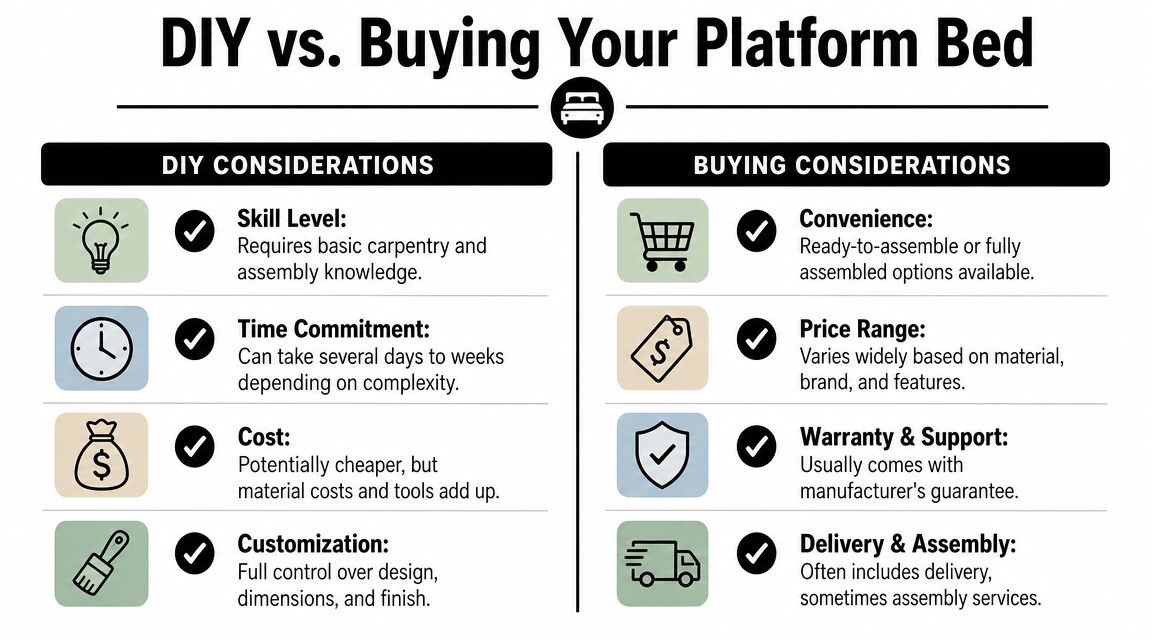
Buying is often the calmer choice if you want reliable dimensions, consistent finish quality, and a room that comes together without a long build process. A good ready-made platform bed should feel resolved before the bedding even goes on. The lines should be clean, the proportions balanced, and the construction honest.
That last point matters in Scandinavian styling. Functional minimalism only works when the piece is well made. If the frame is wobbly, the finish looks synthetic, or the storage feels tacked on, the simplicity starts to look thin instead of thoughtful.
Look closely at a few practical details:
If you are building a calm, layered bedroom, it also helps to study the room as a whole. Bedding, throws, and texture do some of the visual work that carved details might do in other traditions. Dalaart's guide to Scandinavian pillows and throws for adding warmth without clutter is a helpful example of how that balance works.
Building your own bed has a different kind of value. You control the timber, the height, the finish, and the small proportions that can make a room feel settled. In a compact bedroom, even a few centimetres in height or overhang can change how spacious the room feels.
DIY also connects naturally with Nordic ideas about craftsmanship. A bed frame is a quiet object, but it carries daily use. When you cut, oil, and assemble it yourself, you notice details that mass-market furniture often hides. Grain direction. Edge softness. How the corners meet. It works like a hand-thrown mug or a woven wool blanket. Utility becomes part of the beauty.
That mindset pairs well with authentic Scandinavian styling. A simple bed frame leaves space for meaningful pieces rather than generic decoration. A carved horse, a painted wooden accent, or other heritage details in the Dala tradition can stand out more clearly when the larger furniture stays restrained.
DIY is not automatically cheaper. Timber, hardware, tools, sanding supplies, and finishing oils can add up fast. So can mistakes.
Buying is not automatically easier, either. You still need to check dimensions, materials, delivery conditions, and whether the bed suits your mattress and room.
A simple way to decide is to ask where you want to spend your effort:
Worth considering: A handmade platform bed carries the satisfaction of craft. A carefully chosen ready-made one brings order quickly and gracefully. The better option is the one you will use well, maintain properly, and enjoy for years.
A platform bed does its best work when the rest of the room respects the same principles. Not severe minimalism. Not staged emptiness. Just a careful balance of openness, texture, and meaning.
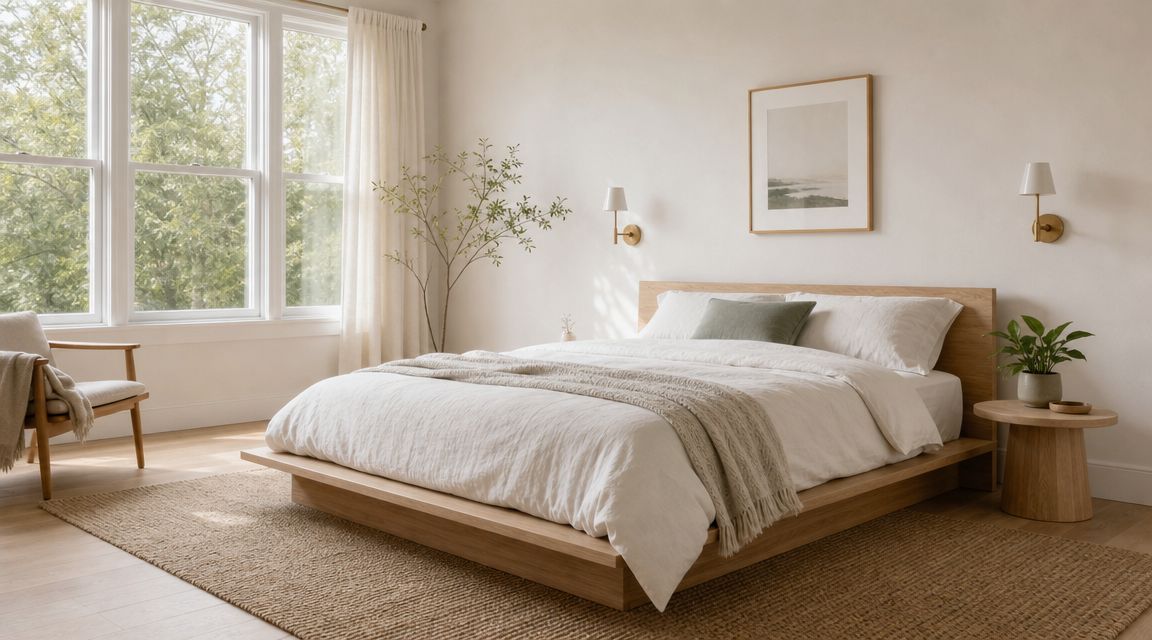
In Sweden, where average living space is about 42 square metres per person and nearly 40% of households are single-person households, the space-efficiency of a low-profile platform bed becomes especially relevant in compact interiors, as noted by Bedrooms & More's discussion of platform beds. That practical reality helps explain why the style feels so natural in Scandinavian rooms. It saves visual space as much as physical space.
A calm bedroom usually begins with a narrow palette. Soft whites, chalky greys, muted earth tones, and pale woods create the background. Then the room needs warmth layered back in.
That warmth often comes from materials rather than colour. Linen bedding with a slightly rumpled finish. A wool throw folded at the foot of the bed. A woven rug that doesn't shout for attention. Curtains that filter light instead of blocking it with heaviness.
For bedding ideas that support this softer layered look, these thoughts on pillows and throws pair well with a platform bed's lower, cleaner silhouette.
Take a simple oak platform bed against an off-white wall. Add white sheets, a natural linen duvet cover, and two sleeping pillows in a quiet stripe. Place a small birch bedside table to one side, a ceramic lamp with a matte finish on top, and a wool runner underfoot.
Then add one thing with memory.
A hand-painted Dala horse on the nightstand or bookshelf changes the room in a subtle but important way. It brings colour, but more than that, it brings story. In a restrained bedroom, one folk-art object can do what a shelf of generic décor never does. It anchors the space in heritage.
Scandinavian bedrooms look peaceful partly because they aren't overfilled. The floor remains visible. Surfaces hold a few things, not everything.
That means your styling choices should be selective:
A short visual guide can help if you're refining the look further.
The beauty of a platform bed is that it doesn't compete. It gives handcrafted objects room to matter.
That's why it pairs so well with Swedish folk pieces. A painted wooden horse, rooster, or companion animal doesn't feel random in this setting. It feels intentional, especially when the rest of the room is calm enough to support it.
The result is a bedroom that feels both modern and rooted. Clean lines on the large surfaces. Human touch in the details. That balance is very close to the heart of Scandinavian style.
If you'd like to bring that sense of Swedish craft into your bedroom, explore Dalaart for authentic hand-carved and hand-painted folk art from Dalarna. A platform bed creates the quiet foundation. A meaningful piece of heritage gives the room its soul.


.svg)


.png)


