April 20, 2026
I first saw a nixie tube clock in a dim room where everything modern had disappeared into the background. The clock didn’t just show the time. It seemed to hold it, each glowing numeral floating in glass like a tiny piece of theatre.
A good nixie tube clock has a strange effect on a room. People stop mid-sentence, lean in, and ask what it is. That reaction isn’t just nostalgia. It comes from the way the digits appear as real objects in space rather than flat symbols on a screen.
A phone display gives you information quickly. A nixie clock gives you presence. You see layered metal numerals, warm orange light, and the slight depth that makes each number feel almost hand-set, as if a craftsperson arranged it inside the tube.
Part of the charm is that nothing looks simulated. The glow isn’t printed, backlit, or rendered by pixels. It gathers around a shaped metal numeral inside glass, so the number feels sculptural.
That matters if you care about objects as much as function. A nixie tube clock sits in the same emotional category as a carved wooden figure, a well-made mechanical watch, or an old camera with honest weight in the hand. It tells time, yes, but it also rewards attention.
A nixie clock rarely disappears into décor. It becomes one of the objects that defines the mood of a space.
People sometimes assume these clocks are just novelty electronics. That misses the point. The best ones feel like small monuments to a very specific idea of progress, when engineers made technology visible rather than hiding it behind glossy panels.
That’s why collectors are drawn to them. You’re not only buying a display. You’re bringing home a piece of industrial history that still performs its original trick with elegance.
If you’ve ever loved an object because it carries both craftsmanship and story, a nixie tube clock makes immediate sense.
Long before glowing digits sat on bedside tables as conversation pieces, they lived inside test benches, counters, and serious-looking instruments. A nixie tube came out of the postwar push to make electronics more readable, more precise, and more visibly modern. Early commercial tubes appeared in the 1950s, and their look became tied to the age of laboratories, aerospace, radio shops, and control panels.
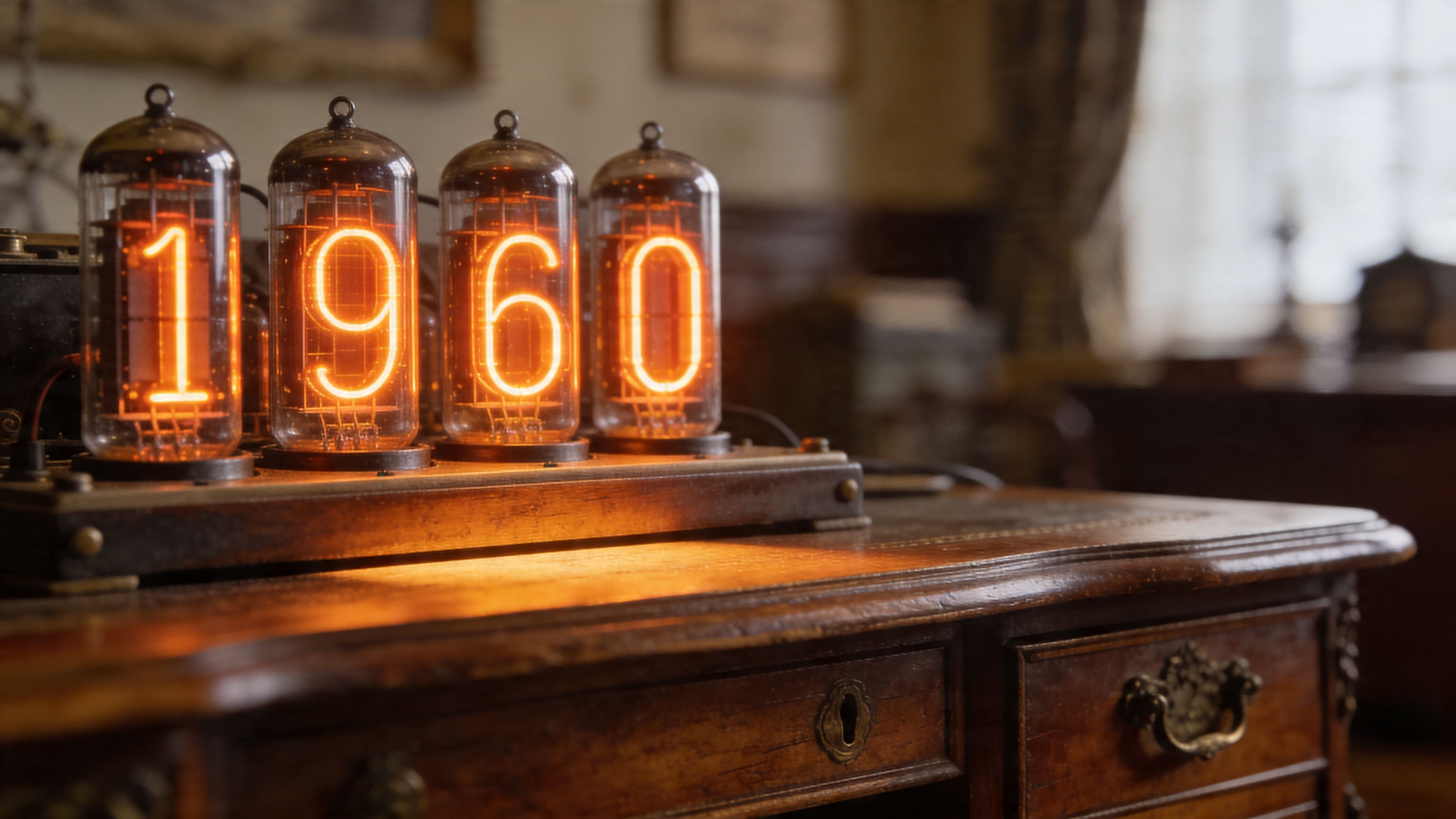
That history matters because a nixie clock carries more than a retro style. It carries the visual language of an era that treated technology almost like architecture. Parts were exposed. Materials had presence. Function and beauty often occupied the same object.
By the 1960s and 1970s, nixie tubes had spread across scientific and industrial equipment in several countries. American makers helped establish the format, but production in the Soviet Union, Germany, and Japan gave the tubes their remarkable variety. Collectors notice this immediately. One tube family has tall, elegant numerals. Another feels compact and utilitarian. Another has a softly rounded glass envelope that makes the clock feel closer to studio craft than mass electronics.
That international history gives nixie clocks the character of folk objects as much as technical artefacts. A hand-carved horse from one region does not look quite like one from another, even when both serve the same decorative role. Nixie tubes developed in a similar way. Factory, country of origin, numeral shape, and glass form all leave a visible signature.
The original purpose was practical. The afterlife is poetic.
Commercial use faded once LEDs and LCDs became cheaper, smaller, and easier to integrate into consumer products. Nixie tubes asked more from the circuit and took up more space, so mainstream manufacturing moved on. For years, that seemed to settle their fate.
Instead, the decline created scarcity, and scarcity changed how people saw them. Old stock remained in warehouses and repair inventories. Makers started building clocks around those surviving tubes, often pairing Cold War components with walnut cases, machined aluminum, or restrained modern bases. The result feels less like a gadget and more like a found object restored into relevance.
A nixie clock is compelling for the same reason a beautifully made antique tool is compelling. You can still see the work it was built to do.
Collectors tend to care about that honesty. These tubes were never designed to imitate age or manufacture nostalgia. Their beauty came as a byproduct of engineering, and that gives them unusual credibility. If you enjoy objects whose value grows when you understand their original context, you may recognize a similar appeal in how vintage digital cameras have become collectible design objects with their own layered history.
Why does that pull feel so strong now? Partly because a nixie clock satisfies several kinds of appreciation at once:
A fine nixie clock sits comfortably beside ceramics, carved wood, cameras, and other objects collected for both story and form. It still tells time. Above all, it preserves a moment when technology glowed in the open and looked worthy of admiration.
The first time you see a nixie clock change from 12:59 to 1:00, the effect feels almost theatrical. One set of glowing numerals fades, another appears, and for a moment you become aware that time is being performed by tiny sculpted pieces of metal inside glass.
That physicality is the key to understanding the whole device. A nixie clock displays time with real, shaped numerals, each sealed inside its own tube like a miniature artwork waiting for its cue.
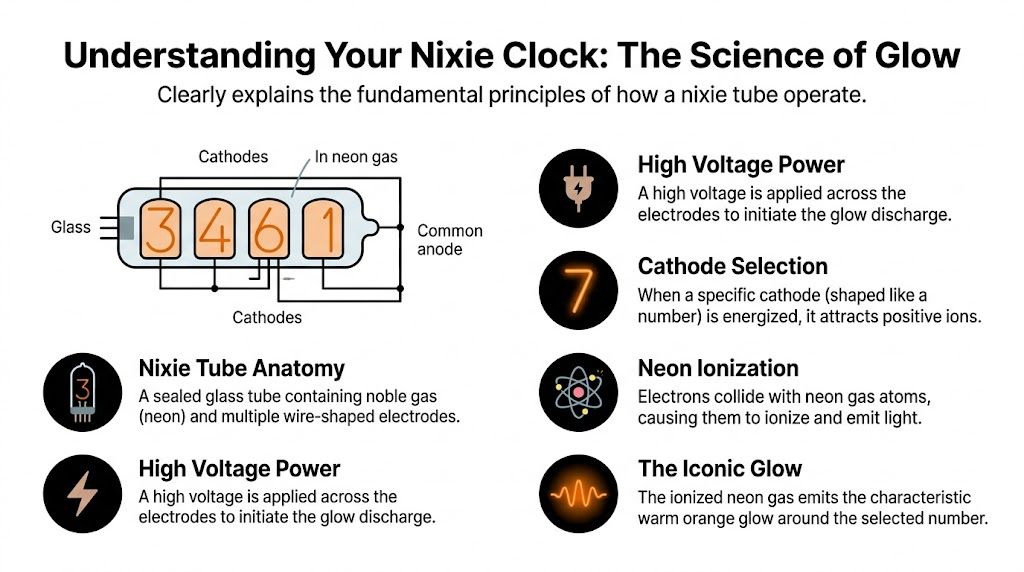
Each tube contains a stack of wire numerals from 0 to 9, a mesh anode, and a small amount of gas. The numerals sit one behind another, which is why some digits look slightly deeper in the glass than others. That layered look is part of the charm. You are seeing the tube’s construction, not a flat illusion.
New collectors often assume the clock is drawing the number electronically, like a modern LCD or OLED. A nixie tube works differently. The number already exists as a metal shape inside the tube, and the circuit chooses which one to light.
When the clock applies high voltage to the tube and selects one numeral, the gas around that numeral ionises and produces the familiar orange glow. The numeral itself does not glow like a heated filament. The light appears in the gas surrounding the chosen cathode, which gives nixies their soft halo and slightly floating look.
A good comparison is a neon sign reduced to the scale of a watchmaker’s display case. The glow feels warm and alive, but the mechanism behind it is precise.
Here is the simple version:
A multi-tube nixie clock needs two jobs done at once. It has to keep accurate time, and it has to tell each tube which numeral should glow. That work is handled by the clock’s electronics, usually through a control board with timing components and driver circuitry.
Some clocks light each tube in rapid sequence rather than feeding every digit continuously. This method is called multiplexing. Your eyes blend those quick pulses into a steady display, much like film frames become smooth motion on screen.
If multiplexing sounds abstract, focus on the result. A well-designed clock looks stable, changes digits cleanly, and avoids visible flicker.
Collectors do not need to memorise component names to benefit from good engineering. What matters is what the design achieves. A better circuit treats the tubes gently, keeps time reliably, and avoids the harsh driving methods that can shorten tube life.
That matters because nixie tubes are not just display parts. In many clocks, they are the collectible heart of the piece. The electronics are there to support the tubes in the same way a careful frame supports a valuable print.
The glow suggests heat, but a nixie clock is not a little space heater for your shelf. The tubes operate with high voltage, yet they usually produce only modest warmth in normal use. What you are seeing is mostly light from ionised gas, not a red-hot element.
That surprise adds to the magic. The clock looks fiery and dramatic, while the glass often remains far calmer than people expect.
One term appears often in collector and builder conversations: cathode poisoning. It refers to uneven wear that can happen when certain numerals are used constantly while others rarely light. Over time, neglected digits may glow less evenly or become harder to read.
Good clock makers address this with sensible current control and digit-cycling routines, sometimes called anti-poisoning features. A healthy design does more than make the clock beautiful on day one. It helps preserve the full set of numerals so the tubes continue to look balanced and vivid over years of use.
That is part of the art of a fine nixie clock. Beneath the glow, there is choreography, restraint, and respect for the material.
The choice often feels less like buying a clock and more like choosing between two kinds of collecting. One path gives you a surviving object from another era, complete with its age, quirks, and provenance. The other gives you a newly made piece that treats the nixie tube as the star, then builds a more dependable home around it.
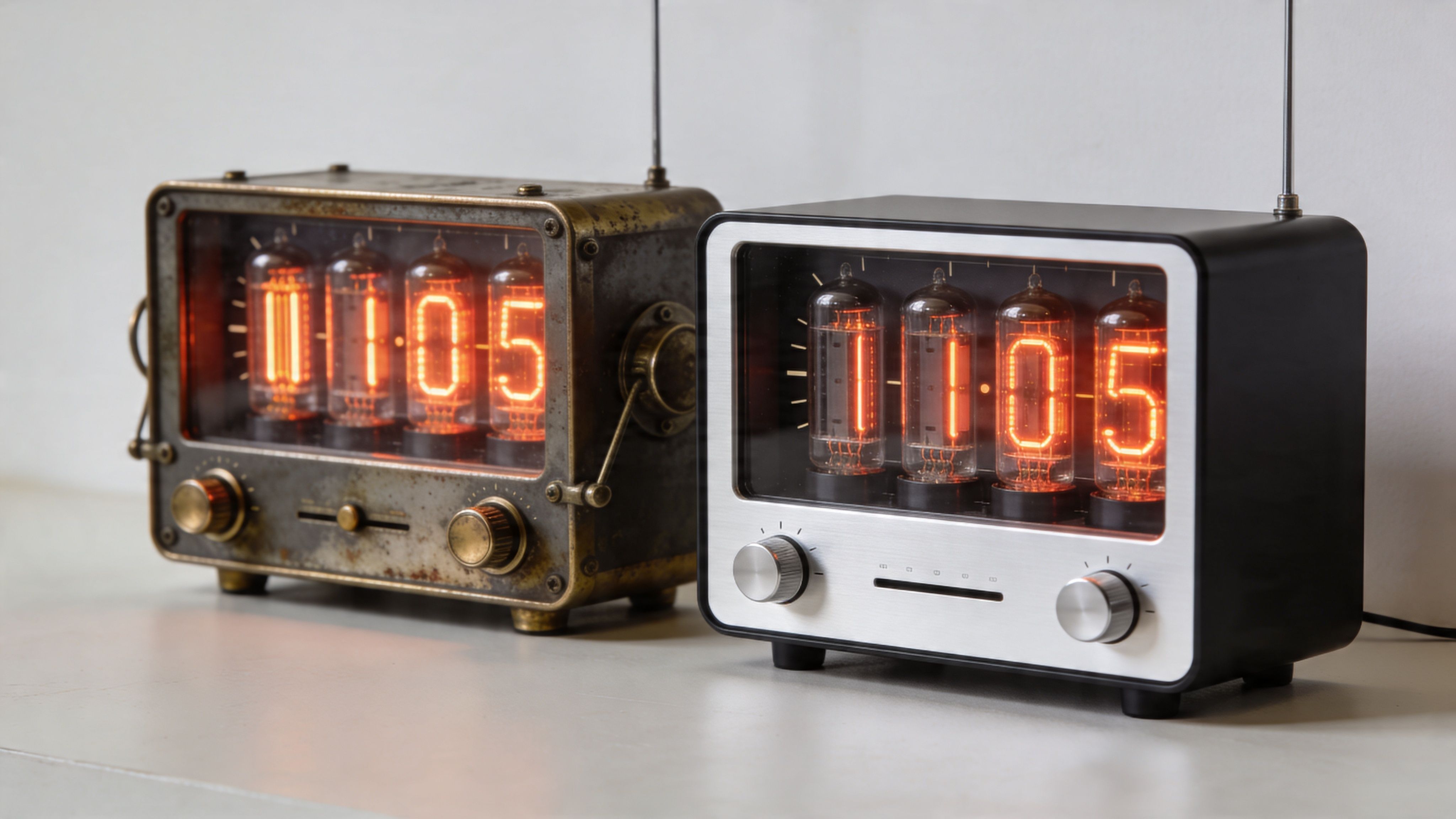
For many collectors, that distinction matters in the same way it matters with furniture, cameras, or craft objects that balance natural materials and wearable design. You are not only judging function. You are judging story, finish, authenticity, and the feeling of ownership.
A true period clock carries the design language of its own time. The proportions, switchgear, casing materials, and circuit choices all reflect what engineers and manufacturers valued when it was made. Set one on a shelf and it has the presence of a small industrial artifact.
That is why originals can feel almost ceremonial.
The scratches on the case, the softened lettering, even the slightly uneven behavior can add character. A collector may see those details the way an art lover sees tool marks in a hand-carved figure. They show that the object has lived.
Originals also ask more from you. Parts may be difficult to source. Repairs may require patience and a technician who understands older high-voltage designs. Some examples are happiest as occasional display pieces rather than everyday household clocks.
A well-made reproduction is not a lesser substitute. It is a different kind of achievement.
Many modern makers pair vintage tubes with newly designed electronics and carefully finished cases. That approach preserves the thing people love most, the floating numerals inside glass, while improving the parts that owners use day after day. Power supplies are often steadier. Controls are simpler. Setup is less fussy. Features such as automatic time synchronization, display options, or alarm functions can make regular use far more pleasant, as noted earlier.
There is artistry here too. A reproduction can frame old tubes the way a skilled gallery framer presents an antique print. The goal is not to imitate age. The goal is to honor the tubes and let them look their best in a modern setting.
The practical gap becomes clearer after a few weeks of ownership.
A vintage original may ask for occasional adjustment, careful handling, and tolerance for quirks that were normal decades ago. That can be part of the joy if you like restoration, historical accuracy, and the feeling that you are caring for a survivor.
A modern build usually suits owners who want the glow every evening without turning the clock into a project. Better service access, more consistent operation, and current production cases can make the experience calmer. If the clock will live on a desk or sideboard and run often, those differences are easy to appreciate.
Neither path is more cultured or more serious. They reward different values.
Choose a vintage original if the object’s history is the main attraction. You may forgive inconvenience because authenticity is part of the beauty.
Choose a modern reproduction if you want a dependable timepiece that still feels special to own. Many enthusiasts land here because they want a collectible work of art they can enjoy every day.
A simple way to judge the choice is to ask what would disappoint you more. Missing historical integrity, or dealing with avoidable maintenance. Your answer usually points to the right clock.
The best nixie clock usually reveals itself after you answer a simpler question. What role will it play in your life?
A bedside piece asks for quiet legibility. A desk companion should reward close viewing. A living-room clock needs enough presence to hold its own across the room, almost like a small sculpture with a pulse. That shift in perspective helps, because a nixie clock is not just a tool for reading hours. It is a collectible object, closer in spirit to a framed print, a hand-carved figure, or a well-made watch than to an ordinary appliance.
Collectors often fall in love with the glow first and the tube type second. The order should really be reversed.
Names like IN-12, IN-14, and IN-18 tell you a lot about how the clock will feel in person. Some tubes are compact and tidy, with numerals that read like fine handwriting under glass. Others are large and theatrical, with digits that seem to hover in the air. The tube determines scale, spacing, character, and often how easy the clock will be to keep running for years.
Long-term ownership matters here. As noted earlier, some tube families have a stronger reputation for longevity than others, so a clock meant for regular evening use may deserve a different choice than one bought mainly for display and collecting.
A beautiful set of tubes can still end up in a forgettable clock.
The case, the proportions, the base, the sockets, and the finishing details all affect whether the piece feels thoughtfully made. A good nixie clock should look resolved from every angle, the way a well-crafted object always does. You notice it in the corners, in the way the tubes sit above the base, and in whether the controls feel tucked in neatly or added as an afterthought.
A few details are worth inspecting closely:
These details shape the experience every time you glance at the clock.
A nixie clock changes character depending on where it lives. In a bright minimalist office, a large six-tube clock can feel like a deliberate centerpiece. On a darker bookshelf, a smaller model may feel more intimate, like a lantern made of numbers.
Material choice matters just as much. Wood softens the technical side of the clock and gives it the presence of an art object. That appeal is similar to the charm of wood wrist watches that combine material warmth with wearable design. In both cases, natural material turns precision into something more human.
Choose the clock you will enjoy seeing every day, not the one that only impresses in product photos.
First-time buyers sometimes focus so much on the glow that they forget the practical side. Tubes may need replacement one day. Some sellers offer better parts support than others. Some clocks are clearly built to be maintained, while others are harder to open, service, or understand.
That does not make nixie ownership difficult. It makes it specific, a bit like owning a mechanical watch or a vintage camera. The pleasure comes partly from appreciating how the object is made and from choosing one whose upkeep matches your patience, budget, and curiosity.
For a collector, tube pedigree and visual rarity may matter most.
For a design-minded buyer, case craftsmanship and room harmony may decide the purchase.
For a gift, ease of use and dependable construction usually matter more than tube lore.
For a hobbyist, repair access and parts availability may outweigh everything else.
The right nixie clock is the one that keeps its charm after the first week, after the novelty settles, and after it becomes part of the room. That is when you know you chose more than retro technology. You chose a small work of glowing craft.
A nixie tube clock looks best when you give it visual breathing room. These clocks already carry a lot of character, so they don’t need clutter around them to feel interesting.
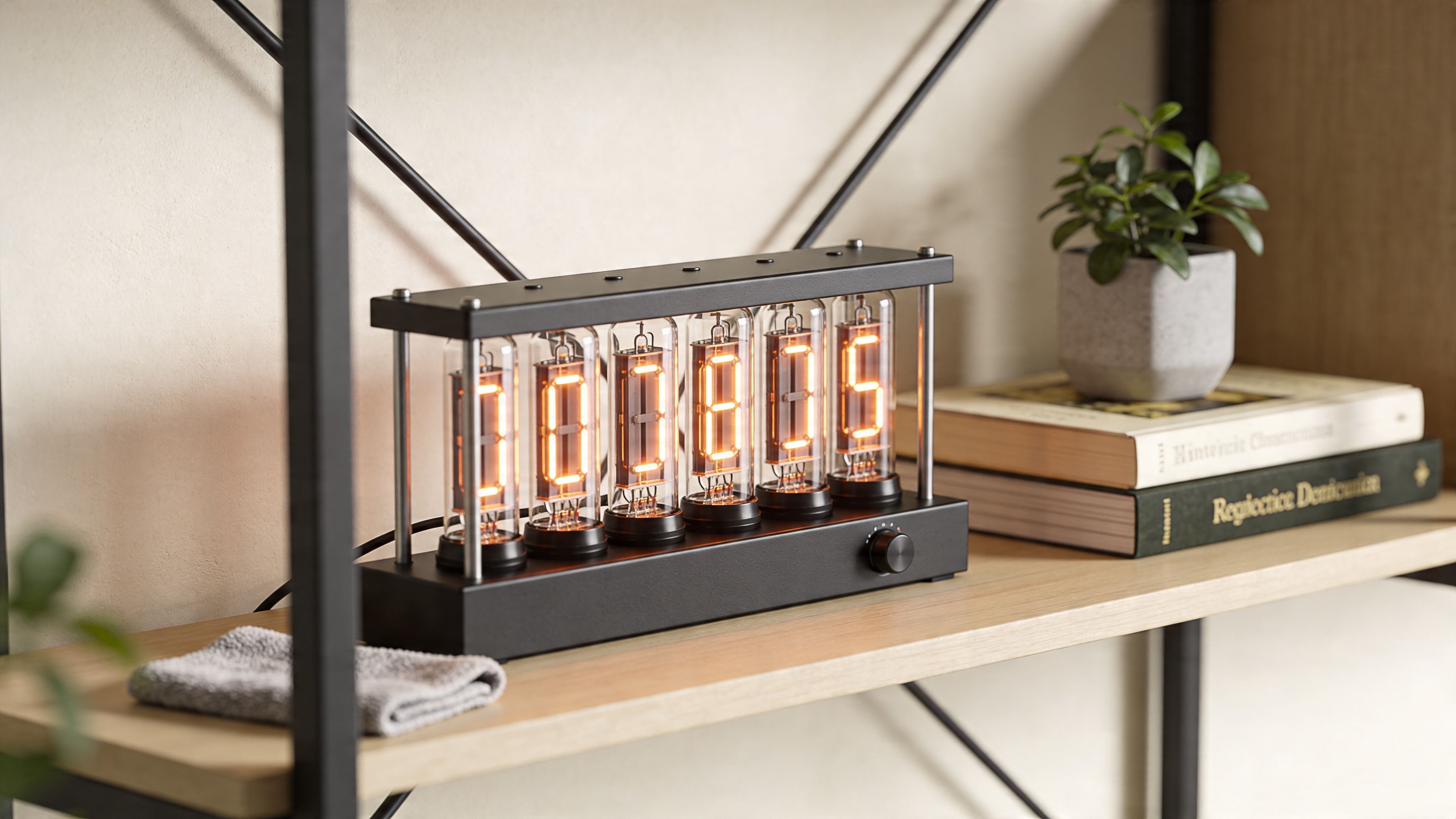
A shelf in wood tones usually works beautifully because it softens the technical feel of the glass and metal. A desk also suits a nixie clock, especially if the rest of the setup is restrained and the clock gets to act as the warm focal point.
A few styling ideas work especially well:
If you’re decorating for gatherings, the same instinct applies as with ambient lighting. A nixie clock contributes atmosphere best when the surrounding scene doesn’t compete with it. Thoughtful accent pieces and gentle illumination often do more than a crowded arrangement, much like the ideas people use when choosing lights for parties that create warmth without visual chaos.
Care is mostly about restraint. Dust the case and tubes gently with a soft dry cloth. Keep the clock out of harsh direct sunlight if possible, especially in a bright window, because long exposure isn’t kind to delicate vintage materials.
Also pay attention to how the clock is used. Many modern designs include digit-cycling routines meant to reduce uneven wear. If your clock offers such a feature, it’s wise to leave it enabled.
Keep the clock clean, stable, and sensibly placed. Most avoidable problems begin with heat, dust, knocks, or neglected maintenance.
Don’t place a nixie clock where it can be easily bumped, and don’t treat the tubes like rugged glassware. They’re display components, not general household hardware.
If the clock ever starts showing uneven brightness or an odd tint in one numeral, don’t panic. It may be a sign that the display needs attention from someone who understands tube behaviour. In collecting, calm observation beats improvisation.
A well-kept nixie tube clock doesn’t just survive. It settles into the room and becomes one of those objects guests remember.
Building your own nixie tube clock offers immense satisfaction. You handle the tubes, mount the board, fit the enclosure, and watch the first digits come alive because of work you did yourself. For many enthusiasts, that first successful glow becomes the start of a long hobby.
But this is not the place for casual shortcuts. A nixie clock contains high voltage, and that alone means a DIY build demands patience, careful reading, and respect for safety.
Most kits are conceptually simple even when the electronics look busy. You’ll usually deal with four main parts:
If you can solder neatly and follow instructions, a kit can be a realistic project. If you rush, skip checks, or power up a board without verifying assembly, it can become an expensive and potentially unsafe lesson.
Never work on a powered board unless you know exactly what you’re doing. Never assume a compact desktop clock is electrically harmless just because it looks decorative. And never treat online build videos as substitutes for proper kit documentation.
One issue hobbyists often struggle to understand is cathode poisoning prevention. A useful discussion of the topic notes that guidance is often too vague, and points out tube-specific behaviour such as a violet tinge in IN-14 as a sign of degradation, while also observing that many builders still lack clear data-driven multiplexing setups for six-tube clocks that minimise wear, as described in this discussion of cathode poisoning behaviour and prevention.
That matters because DIY isn’t only about making the clock light up. It’s about making it run well over time.
Start with a reputable kit rather than a scratch-built design. Choose one with clear instructions, labelled components, and an enclosure that doesn’t require improvisation. Build in good light, work slowly, and test in stages.
Then do what experienced hobbyists do. Read owner forums, compare tube behaviour, and pay attention when a certain digit looks odd or a tube colour shifts. Nixie clocks reward builders who observe closely.
The magic of these clocks comes from old technology, but safe success comes from modern discipline.
If you’re drawn to objects that carry history, craftsmanship, and a strong sense of place, Dalaart is worth exploring. Its collection of authentic Swedish folk art speaks to the same instinct that makes a nixie tube clock so appealing: the desire to live with things that are beautifully made, culturally rooted, and full of character.


.svg)


.png)


