May 10, 2026
You spot one in a second-hand listing and pause. The curved shell still looks expensive, the chrome trim still catches the light, and the “PlayStation 3” script still has that odd confidence of a machine built to be more than a games console.
That's the appeal of the playstation 3 fat. It isn't just old Sony hardware. It's a console from a moment when manufacturers still built big, glossy centrepiece machines and expected them to handle films, music, online gaming, and, in some versions, older PlayStation libraries too. For collectors, it feels like a trophy. For players, it can still be a superb all-in-one retro setup. For repair-minded owners, it's also a machine that asks for respect.
A lot of confusion surrounds the original PS3. People mix up the early launch models with the later cost-reduced ones. They hear “backward compatible” and assume every Fat console can run PS2 discs the same way. They hear “Yellow Light of Death” and assume every unit is doomed. The truth sits in the details, and with this console, details matter.
The original PS3 has never looked ordinary. Even today, it resembles a premium home cinema component more than a typical console. That glossy black shell, the curved top, the slot-loading disc drive, the weight of it in your hands. It feels like a product from a time when Sony wanted to win on ambition alone.
That ambition is why the playstation 3 fat still has a hold on people in 2026. Some buyers want one because it's the most dramatic-looking PS3 ever made. Others want one because certain early units can bridge PS1, PS2, and PS3 gaming in a single box. And some of us remember seeing it in a shop cabinet and thinking it looked impossibly advanced.
But nostalgia can blur judgement. A Fat PS3 can be a satisfying machine to own, yet it can also be fussy, hot-running, and sensitive to neglect. That doesn't make it a bad purchase. It means it's a collector's console with maintenance needs, not a set-and-forget appliance.
Practical rule: buy a PS3 Fat because you want its specific features or design, not because you assume every old PS3 is the same.
That distinction matters. The earliest machines chased a grander vision. Later Fat revisions pulled back, trimming features and changing hardware to reduce cost and heat. If you don't know which revision you're looking at, you can easily pay for a legend and receive a compromise.
The good news is that the original PS3 becomes much less mysterious once you know what changed, why it changed, and what owning one means. Then it stops being a rumour-filled relic and starts becoming what it really is: one of the most fascinating consoles Sony ever built.
Sony's first PS3 wasn't a modest machine. It was designed as a statement product. The original chassis was large, glossy, and packed with features that signalled luxury. Blu-ray support helped it feel like a serious media device, while the front fascia and trim gave it a premium identity that later PS3 revisions never quite matched.
The nickname “Fat” came later, after slimmer redesigns arrived. At launch, this was the PS3. Only in hindsight did it become the oversized, extravagant first draft of the platform.
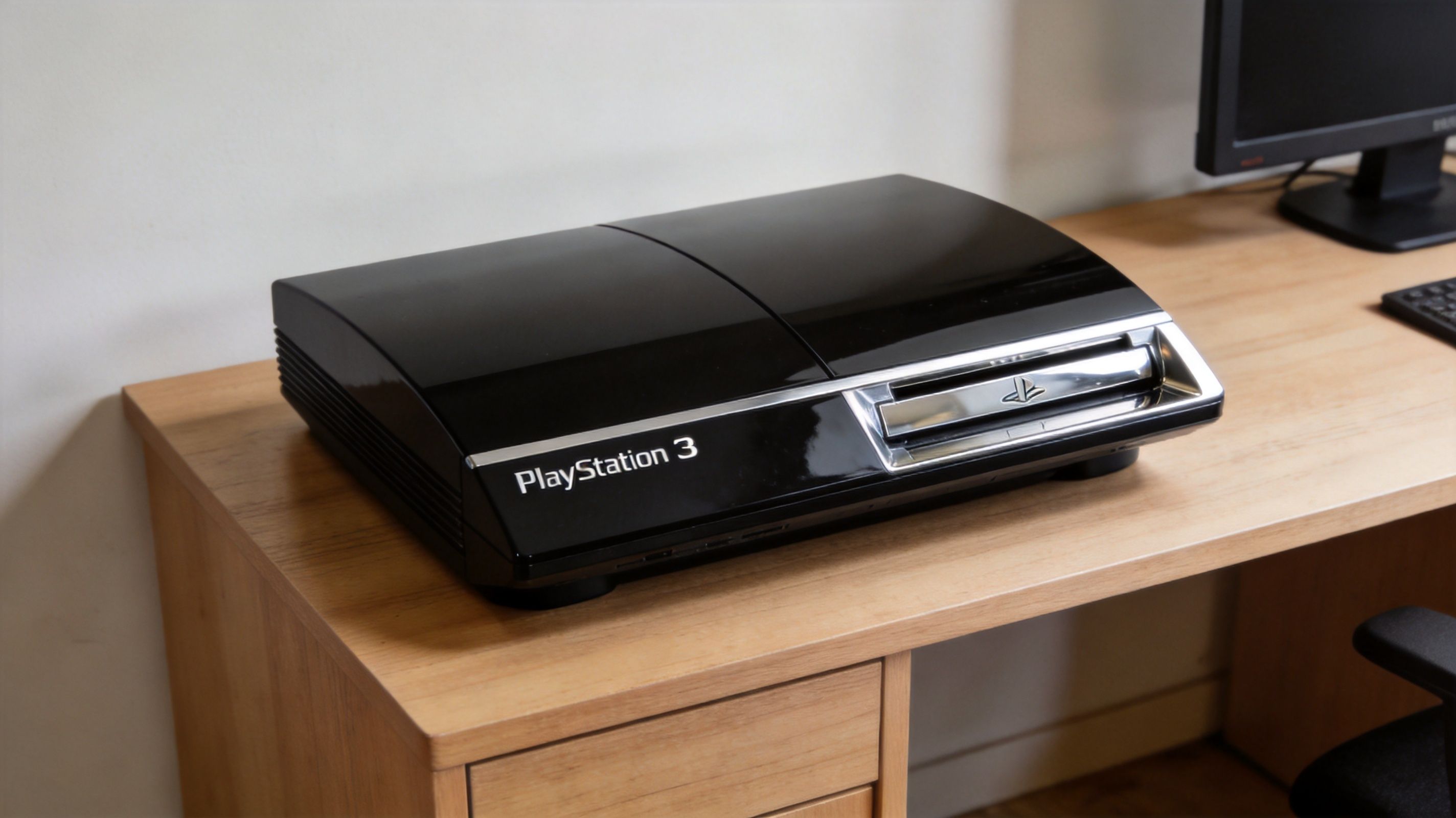
Collectors usually start with model numbers, because the shell alone can mislead you. Small external cues often hint at what's inside.
A few signs matter most:
If you're browsing online listings, ask for a clear photo of the rear sticker before you care about anything else. Sellers often focus on the top shell and front panel, but the model code is what tells you whether the console is collectible, practical, or both.
Sony didn't keep the launch configuration intact. As the generation moved on, Fat models became more cost-conscious. Features disappeared. Some internals changed. Certain versions remained desirable for modding or general PS3 use, but they weren't trying to be all-in-one legacy machines in the same way.
That's where many buyers get caught. They see a Fat shell and assume launch-era capability. In reality, the family includes machines with very different personalities. One may appeal to the collector chasing PS2 support. Another may suit someone who mainly wants the original design and broad PS3 library access without paying a premium for rare launch hardware.
The original shell tells you you're looking at a Fat PS3. The model number tells you what kind of Fat PS3 it actually is.
Once you start viewing the variants this way, the used market becomes easier to read. You stop shopping for “a PS3 Fat” and start shopping for a specific revision with a specific purpose.
Open an original PS3 Fat and you can see Sony's launch-era ambition in hardware form. This was not built like a cautious follow-up to the PS2. It was built like a statement piece, a machine meant to handle high-definition gaming, Blu-ray movies, online services, and, in some early versions, the previous generation too.
At the center sat the Cell processor alongside the RSX graphics chip. On paper, that combination looked advanced. In practice, it gave the PS3 two identities at once. It could produce remarkable results in the hands of studios that learned how to divide work across the system, but it also earned a reputation for being difficult to develop for.
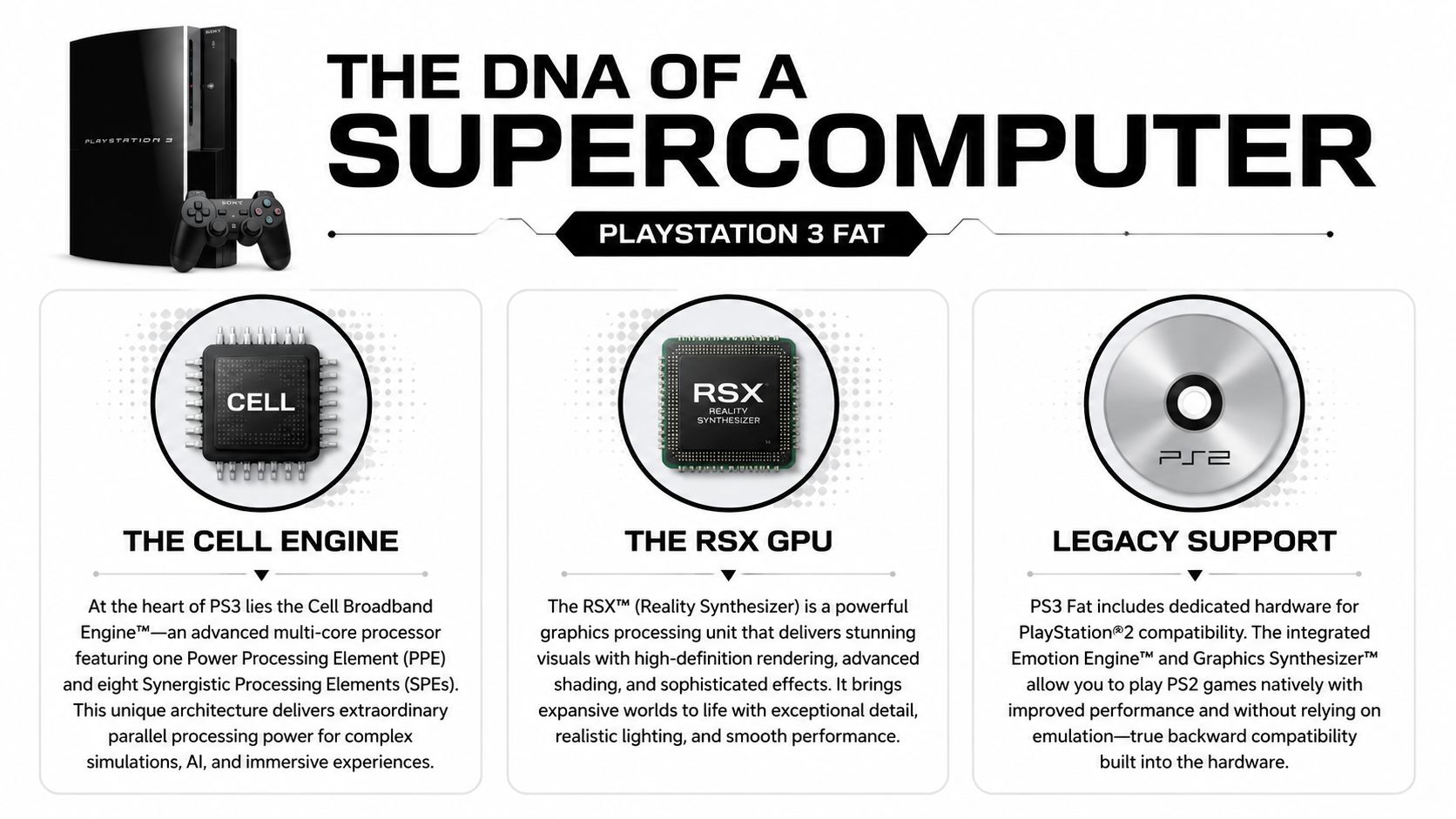
The simplest way to understand the Cell is to picture a head chef running a busy kitchen. One main processor coordinated several smaller specialist units, each suited to particular kinds of work. That setup could be powerful, especially for physics, media processing, and certain game-engine tasks, but only if developers organized jobs carefully. A studio that wrote code with the PS3 in mind could make the machine shine. A studio building the same game for several platforms often had a harder time getting equally clean results.
That helps explain why the Fat PS3 still fascinates hardware enthusiasts. It was ambitious in a very specific, mid-2000s Sony way. The machine was trying to be more than a simple game box, and that ambition shaped both its strengths and its long-term headaches.
For an owner in 2026, the important takeaway is practical. The Cell is part of the PS3 Fat's mystique, but it is also part of why the system feels so tied to its era. You are buying into a bold design philosophy, not just a spec sheet.
Backward compatibility is the feature that turned some Fat models from interesting old consoles into collector targets.
Sony knew the PS2 library was a major selling point, so the earliest PS3 revisions were designed to preserve that link. Some launch-era systems included real PS2 hardware inside the console. That is the cleanest form of compatibility you can ask for. The PS3 is not imitating a PS2 in those models. Part of the machine is, in effect, still a PS2.
That design choice explains the price gap you see in the used market. Buyers are not only paying for a glossy shell or launch nostalgia. They are paying for a version of the PS3 that carries forward a piece of Sony's earlier console in a tangible way.
This is the part that trips people up.
Early NTSC launch models such as CECHAxx and CECHBxx are the famous fully backward compatible units. They include the key PS2 hardware needed for near-native PS2 game support, which is why collectors chase them so aggressively.
The PAL CECHCxx model and some other early revisions took a cheaper path. Sony removed part of the PS2 hardware and relied on a mixed approach that used software to fill in the gaps. Those systems can still play many PS2 titles, but the experience is not identical across the board. Some games work well. Some show quirks. Some do not behave the way they do on an original PS2.
A useful way to frame it is this. “Backward compatible” on a Fat PS3 is a category, not a guarantee of equal performance across every early model.
If PS2 support is the reason you want a Fat PS3, the exact model matters more than the fact that it says PlayStation 3 on the lid.
That difference matters to two kinds of buyers. Collectors care because originality and capability affect value. Everyday users care because expectations determine whether the console feels charming or disappointing once it is under the TV.
The backward compatibility promise was brilliant from a customer point of view. One machine could potentially cover PS1, PS2, and PS3 software while also serving as a Blu-ray player. In 2006, that was an exciting idea. In 2026, it is still attractive for anyone who wants fewer boxes and a stronger connection to the PlayStation lineage.
The catch is that this promise came with cost, heat, and complexity. Packing advanced components and, in some versions, extra legacy hardware into one chassis made the earliest Fat models more demanding to own. That is the heart of the PS3 Fat story. The same features that made it legendary also made it harder to manufacture, harder to support, and harder to preserve well years later.
For many enthusiasts, that trade-off is still worth it. The original PS3 was Sony at its most ambitious, and the backward compatibility story is the clearest example of that ambition.
A Fat PS3 has presence. A Slim feels sensible. A Super Slim feels practical to the point of austerity. That's the shortest honest summary I can give.
For many buyers, the mistake is assuming the original model is automatically the best because it's the most iconic. It isn't. It's the most charismatic. That's different.
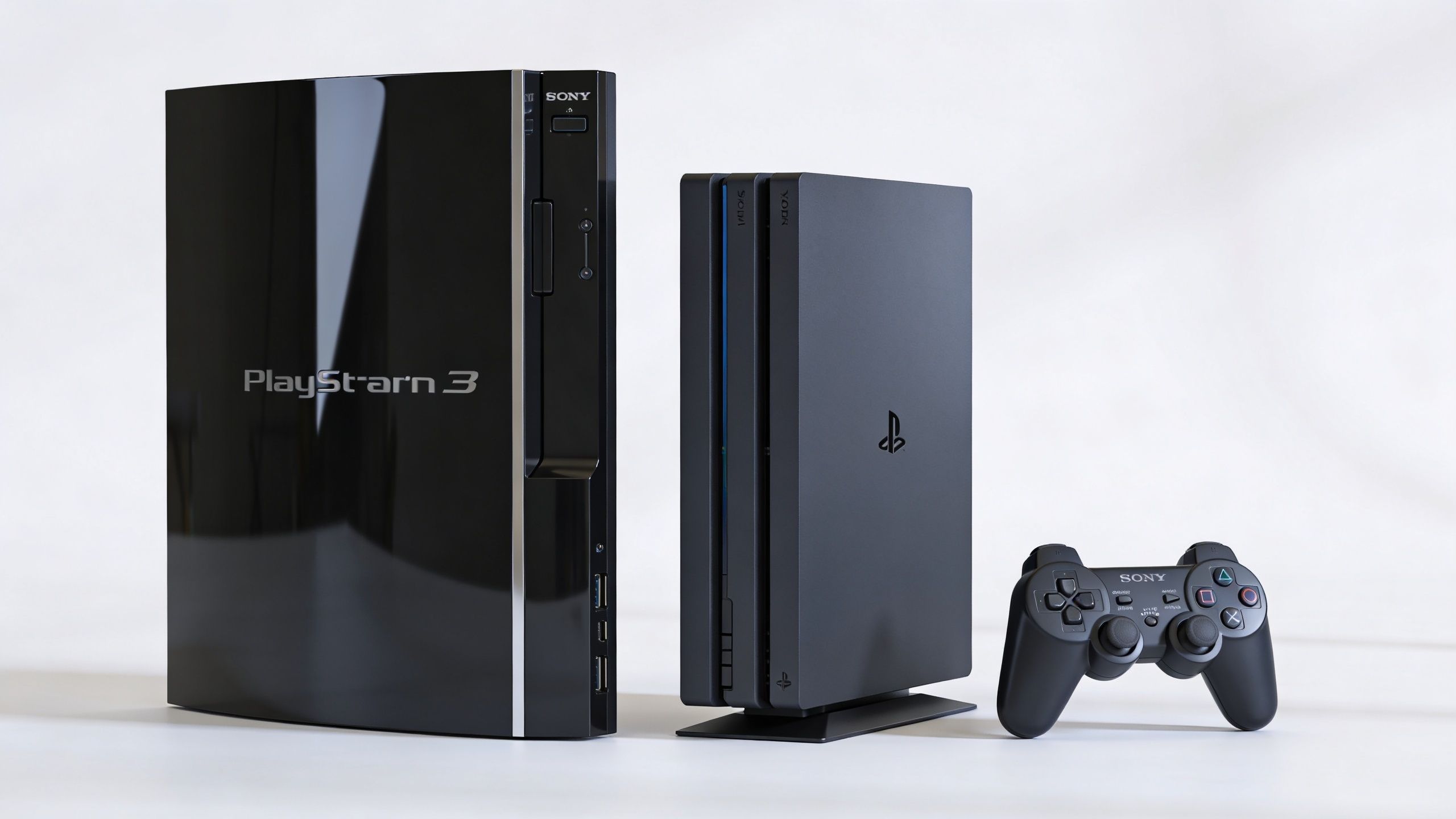
The Fat model wins on identity. It looks and feels like a premium launch-era console. Some revisions also offer the features that later versions gave up, especially if you care about early hardware design and collector appeal.
You buy a Fat if these points matter to you:
For enthusiasts, that's enough. They want the machine with the story.
As everyday consoles, the later revisions are easier to recommend. They're smaller, simpler, and much less intimidating to live with. If your goal is just to play PS3 games reliably, a Slim or Super Slim is usually the calmer choice.
The later machines also avoid much of the psychological baggage that follows the Fat. Owners don't stare at them wondering whether heat is slowly cooking a rare motherboard. They just turn them on and play.
That doesn't make them more exciting. It makes them more relaxed.
A Slim is often the sensible player's PS3. A Fat is often the enthusiast's PS3.
Choose the Fat if you want the original industrial design, the history, or a specific early feature set that later models dropped.
Choose a Slim if you want a balanced middle ground. It still feels like a proper PS3, but with fewer ownership anxieties.
Choose a Super Slim if your priorities are convenience and practicality over romance.
This isn't a contest with one winner. It's a question of temperament. Some people want the PS3 that makes the strongest first impression. Others want the one that asks the least from them. Knowing which type of owner you are will save you money and frustration.
Owning a PlayStation 3 Fat is a bit like owning a classic sports car. The shape is iconic, the engineering is fascinating, and the driving experience still has charm years later. It also asks more from its owner than a newer, simpler machine.
That is the heart of the Fat PS3 story in 2026. You are not just buying a console. You are taking responsibility for an ageing piece of hardware that runs hot, packs a lot into one shell, and often arrives with an unknown service history.
The failure people know best is the Yellow Light of Death, or YLOD. New owners often assume it refers to one specific broken part. It does not. It is a general failure state. The console powers on, briefly shows a warning light sequence, then shuts itself back down. On Fat models, long-term heat stress is often part of the chain of events that leads there.
Not every Fat PS3 ages the same way. That point matters because buyers often talk about "the Fat" as if every model shares the same strengths and weaknesses. They do not.
Some early units are prized because they sit closest to Sony's original all-in-one vision. Those same machines are also older, denser inside, and more demanding from a cooling and reliability standpoint. Certain backward compatible models have a special place in PS3 history, but they also tend to make experienced owners more cautious. Age, heat cycles, dust buildup, old thermal compound, and years of cramped storage all work against them.
This is why a console that "still works" is not automatically a healthy one. A Fat PS3 can boot normally and still be carrying the slow wear that later turns into fan surging, graphical instability, disc read trouble, or a hard shutdown.
The ownership mindset is similar to caring for other older tech with delicate internals. The patience used in preserving a vintage digital camera with ageing electronics and plastics applies here too. Clean storage, gentle use, and realistic expectations matter more than a glossy shell.
Good maintenance is plain, methodical work. That is good news, because the internet has spent years dressing up risky shortcuts as expert repairs.
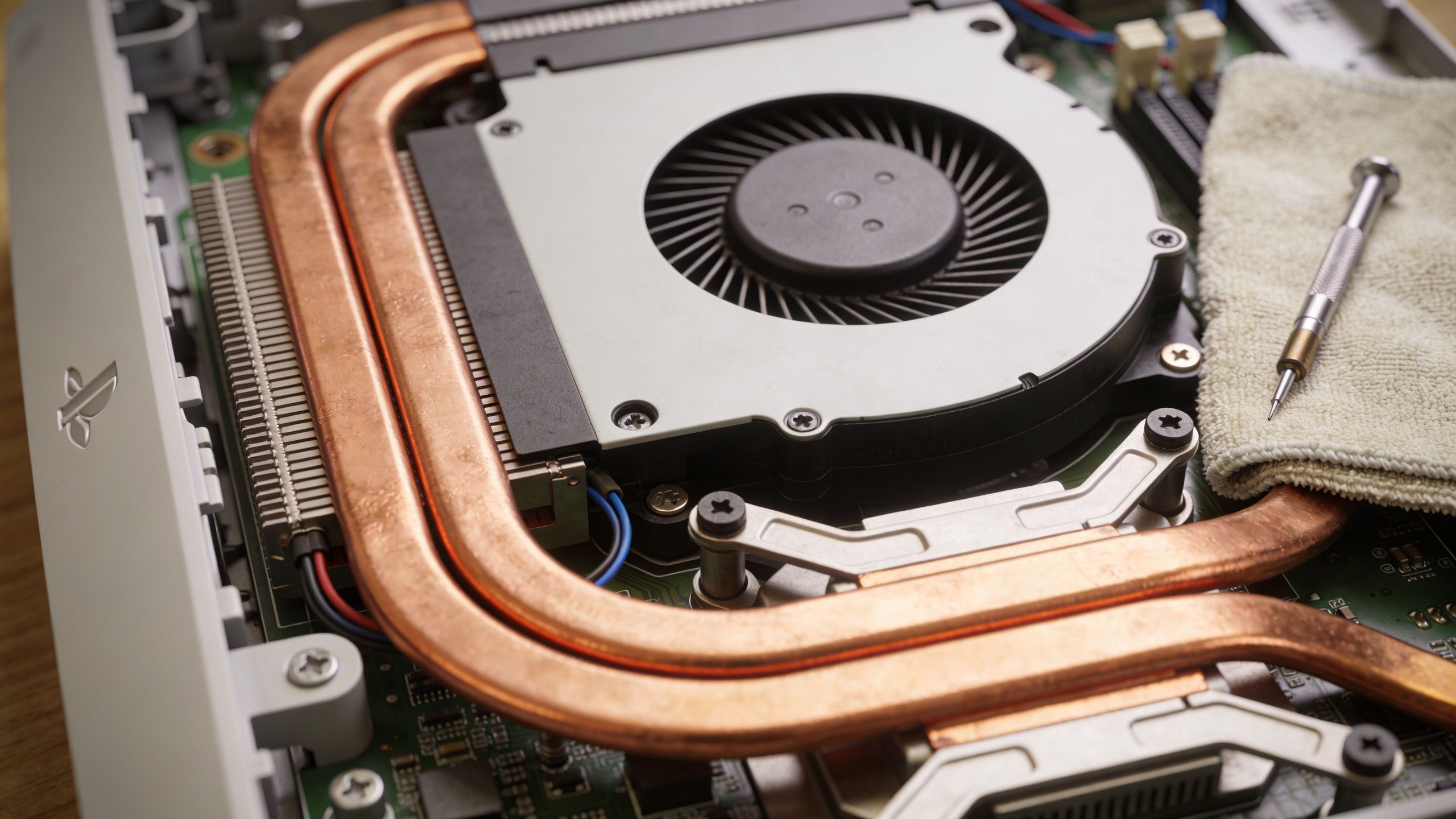
Start with airflow. The Fat PS3 needs open space around it, especially at the rear and sides where heat has to leave the chassis. A closed TV cabinet turns an already warm-running console into an oven. Dust makes that worse, so careful cleaning of vents and internal cooling paths is one of the most useful things an owner can do.
Thermal paste also matters, but this point needs context. Replacing dried-out thermal compound can help restore proper heat transfer between the chips and heatsinks. It is not magic, and it is not a cure for every unstable console. Still, on an untouched system that has been running for many years, fresh thermal material is often part of responsible preventative maintenance.
Pay attention to fan behaviour as well. A Fat PS3 that climbs to high fan speed quickly during ordinary play is telling you something. It may be dusty, it may need servicing, or it may be struggling under the heat profile that comes with this design. Either way, that noise is useful information.
A practical checklist looks like this:
One warning matters more than any other. Be skeptical of reflow stories. Heat-gun repairs and other quick fixes often make a dead console appear healthy for a short time, much like forcing a sticky lock to turn without fixing the worn mechanism inside. For a buyer or collector, a machine that has been cleaned, repasted, and thoroughly tested is far more reassuring than one described as "revived."
Here's a repair-focused look at the internals and workflow many owners find useful before opening one up:
Good PS3 Fat ownership is not dramatic. It is routine.
Use the console in a well-ventilated space. Do not stack hot equipment on top of it. If you buy one with no clear maintenance record, assume inspection and cleaning are part of the actual purchase price. That approach bridges nostalgia and practicality, which is the only sensible way to enjoy one of these machines now.
The goal is not to make a Fat PS3 last forever. The goal is to give a historically important console the conditions it needs to keep working, so it can still be played, collected, and appreciated without unnecessary risk.
The worst time to learn your PS3 Fat needs maintenance is after you've filled it with games and started trusting it.
Buying a Fat PS3 in 2026 is less about luck than discipline. The best purchases usually come from buyers who ask slightly annoying questions before they hand over money.
Start with the rear label. Without the model number, you're guessing. Once you have that, the whole machine becomes easier to judge. A sought-after early revision and a later cost-reduced Fat can look similar in listing photos, but they're not the same purchase.
You don't need to interrogate people, but you do need clear answers. Ask short, specific questions.
If you're buying online, ask for photos taken during operation. Front light status, menu output, and the system information screen are all more useful than glamour shots of a polished shell.
A general marketplace mindset helps too. If you're weighing seller trust, return terms, and listing quality, the practical habits people use when buying on eBay in Sweden transfer well to retro console hunting: verify details, prefer clear communication, and treat missing information as a risk, not a bargain.
When you can see the console physically, focus on signs of care rather than signs of age alone. Hairline scratches are normal. Heavy grime around vents, stripped screws, and damaged warranty seals suggest a rougher story.
Pay attention to behaviour:
Buy the seller's honesty as much as the console itself.
Value in this market comes from desirability, rarity, condition, and honesty of history. Early launch-style machines command stronger interest because of their place in the PS3 story and, for certain models, their stronger backward compatibility appeal. Later Fat units can still be worthwhile, but they're usually bought for different reasons.
Don't pay top-end collector money for a machine with unknown repair history, missing labels, or suspiciously polished wording in the listing. A clean, correctly identified console with documented maintenance is often a better buy than a supposedly “mint” example that nobody has tested properly.
The smartest purchase is rarely the cheapest listing. It's the unit whose story makes sense.
You bring home a PS3 Fat, set it under the TV, hear that startup chime, and then the practical questions begin. Should you leave it completely original. Should you mod it. Which upgrades help the machine, and which ones only add risk to already ageing hardware.
A good 2026 approach starts with a simple rule. Preserve first, experiment second.
The safest upgrades are the ones that reduce strain and improve day to day use. A storage replacement sits at the top of that list. Swapping an old hard drive for a dependable 2.5-inch SATA drive or SSD will not turn the PS3 into a modern speed machine, but it can make installs, menu navigation, and game loading feel more consistent. More importantly, it removes one elderly mechanical part that may be closer to failure than it looks.
Cooling matters even more.
Dust cleanup, fresh thermal paste, and a careful check of airflow do far more for a Fat PS3 than flashy mod screenshots ever will. This is old high performance console hardware packed into a shell that was designed with ambition first and long term heat management second. If you treat maintenance as the foundation, every other upgrade becomes easier to judge.
A sensible upgrade path usually looks like this:
Custom firmware enters the conversation at that last step. On compatible Fat models, many experienced owners use CFW to monitor temperatures, adjust fan behaviour, back up data, and access maintenance features that Sony never exposed to ordinary users. Used that way, modding is less about novelty and more about giving yourself a better dashboard for an ageing machine.
That distinction matters because the PS3 Fat attracts two very different kinds of modding. One approach is preservation. The other is performance chasing.
Preservation modding makes sense for many owners. Temperature monitoring, fan control within reason, storage upgrades, and backup tools all fit the idea of respectful ownership. Performance tuning is trickier, especially on a console already known for heat related failures. The RSX and Cell are not forgiving parts when cooling is marginal, and many Fat units are running with years of dust exposure, dried paste, or prior repair work of unknown quality.
So if you are tempted by overclocking talk, slow down. A few extra frames in selected games are not worth much if they push a fragile board closer to failure. The better question is not “Can this PS3 Fat run faster?” It is “Can this specific unit stay healthy under more stress?” For many consoles, the honest answer is no.
That mindset is common in other corners of retro hardware too. Restoring a handheld or tuning a classic system works best when you respect the original design, much like collectors do with the Game and Watch Donkey Kong Jr restoration scene. The fun comes from understanding the machine's limits, not pretending those limits do not exist.
For many users, the sweet spot is clear. Replace failing storage. Clean the machine thoroughly. Service the thermals if needed. Install custom firmware only if you understand compatibility, recovery options, and the trade-offs for online use and long term stability.
A PS3 Fat does not need every mod on a forum checklist. It needs the small number of upgrades that make ownership easier, safer, and more enjoyable. That is a genuine collector's view in 2026. Respect the hardware, improve the weak points, and keep Sony's most ambitious console usable for as long as possible.


.svg)


.png)


