April 14, 2026
Morning light hit a small stained glass roundel on my windowsill, and the whole white room changed. The wall stayed still, but the colour moved across it like a living thing.
Churches frequently come to mind when people hear stained glass windows. That’s understandable, but it’s also too narrow. Stained glass belongs just as naturally in a hallway, kitchen window, stairwell, reading corner, or above a simple Scandinavian bench of pale wood.
At its heart, stained glass is glass shaped to work with light. The colour isn’t only something you look at. It’s something sunlight carries into the room.
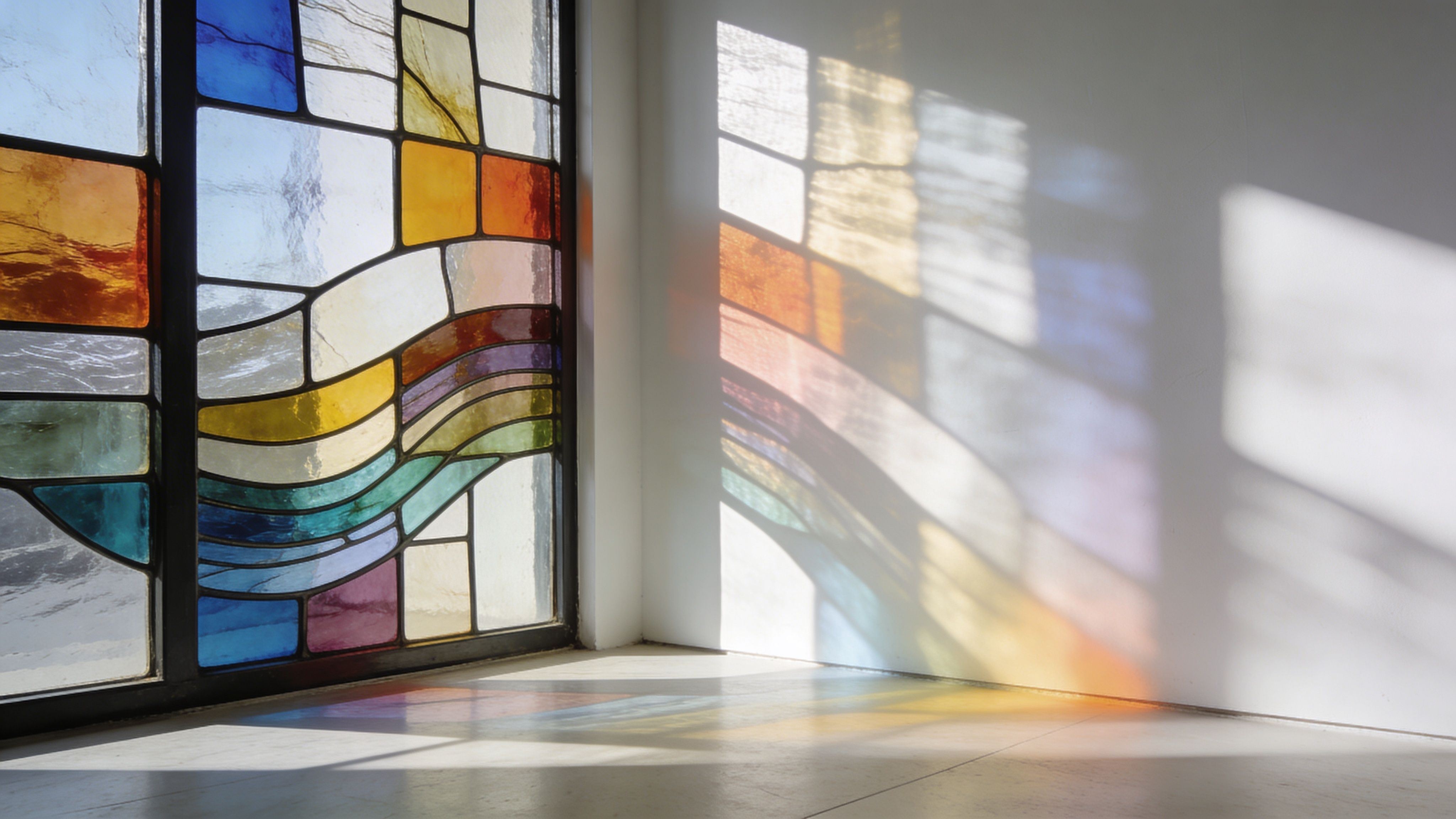
A plain pane of clear glass lets light pass through. A stained glass panel filters, softens, deepens, or scatters that light. That’s why a piece can feel different in the morning than it does in late afternoon.
Think of sunlight as a painter’s brush. The glass chooses the pigment, but the day decides how the colours are laid across the floor, wall, or table.
That’s also why stained glass never feels entirely static. A framed panel hanging in front of a window may look calm at noon and dramatic at sunset. A bathroom pane with frosted texture can feel private and soft, while a jewel-toned border around a doorway can make an otherwise restrained interior feel warm and personal.
Historically, stained glass often showed saints, vines, stars, shields, flowers, and scenes from scripture. In a home, the storytelling can be quieter.
A panel might tell a story through:
You don’t need a grand interior for stained glass to make sense. In fact, minimal rooms often show it best because there’s less visual competition.
Stained glass works best when it isn’t asked to fill every inch. Give it light, a little breathing room, and something simple nearby.
People sometimes confuse stained glass with any coloured glass object. But a true stained glass piece is usually constructed from separate pieces of glass joined into a designed whole. The structure matters as much as the colour.
That structure gives stained glass windows their character. You’re not only seeing red, blue, or gold. You’re seeing line, rhythm, division, and balance.
Here’s where readers often get stuck. They ask, “Isn’t it just old-fashioned?” Not at all. Traditional technique can hold a modern design beautifully. A simple grid of pale grey and honey glass can look perfectly at home in a clean Nordic interior. A circular hanging panel can act almost like a sun-catcher, but with more presence and craftsmanship.
Stained glass changes ordinary light into atmosphere. Few materials do that so gently.
It can be dramatic, yes. But it can also be intimate. In a modest room, one small panel can do what a large artwork sometimes can’t. It can alter the mood of the space itself.
That’s the magic. You aren’t only adding an object. You’re shaping how the room feels when the light arrives.
A winter church in Sweden can feel almost monastic before sunrise. Pale stone, quiet wood, a breath of cold air at the door. Then the light shifts, and a small patch of coloured glass begins to glow. The room changes first, then the mood. That is how stained glass has worked for centuries. It turns light into presence.
Long before stained glass windows became linked so strongly with cathedrals, artisans had learned to make glass hold colour. What grew from that discovery was more than decoration. It became a meeting point of architecture, belief, memory, and craft.
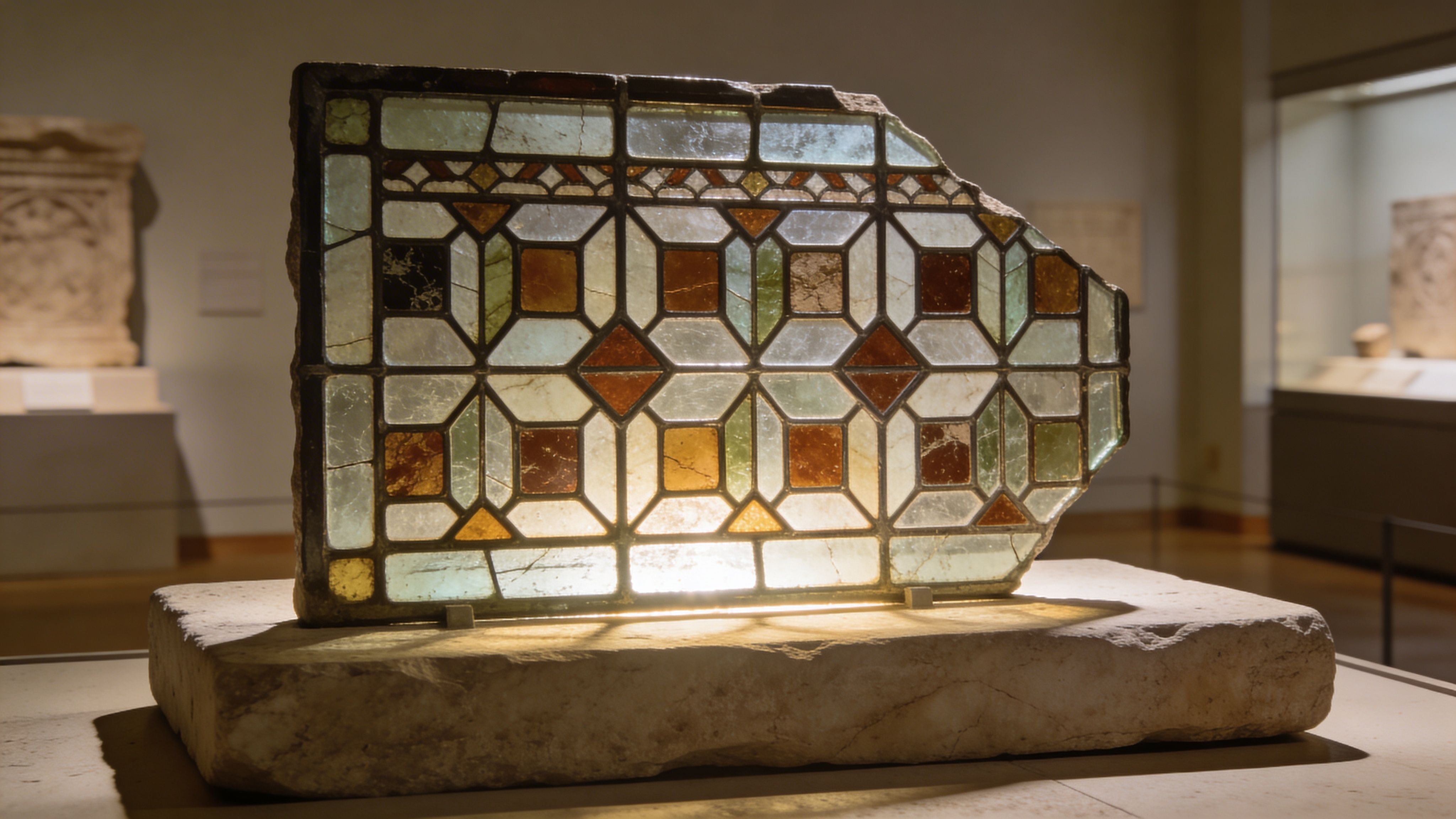
In the ancient world, coloured glass appeared in vessels, mosaics, and decorative fragments. Its role changed once builders placed coloured pieces into windows. The wall itself began to participate in the life of a room. Instead of blocking weather, it could filter daylight, soften it, and give it symbolic force.
By the medieval period, churches across Europe used stained glass to shape spiritual experience. Colour did part of the teaching. So did line, gesture, and repeated symbols. In an age when many worshippers learned visually, a window worked almost like a painted manuscript opened to the sun.
Northern Europe belongs in this story too. Sweden preserves important evidence of early stained glass, including medieval material connected with Skara Cathedral and other historic churches. The Swedish National Heritage Board’s survey of stained glass in Sweden records the breadth of this legacy and its continuing presence in buildings still in use today (Swedish National Heritage Board survey on stained glass in Sweden).
That northern setting matters. In Sweden, light has a different temperament than it does in southern Europe. It arrives low, lingers differently across the year, and becomes precious in winter. Coloured glass in that climate can feel especially intimate. Even a modest panel can warm a spare interior in the same way a red Dala horse or a handblown bowl can animate a white room. You can see a similar Nordic love of luminous colour in Kosta Boda Polar glass design.
Some of the most moving stained glass survives in fragments. A broken panel can still carry centuries of weather, repair, faith, and human touch.
The Gothic period gave stained glass its grand public stage. Builders raised vaults higher and opened larger areas of wall for windows, which let light and image work together on a scale earlier periods rarely matched.
Several features became especially prominent:
A Gothic window was more than a coloured surface. It was a visual system. Each section played a role, much like pieces in a woven textile or carved motifs in a church portal. The lead lines held the story together while the glass gave it emotion.
Later periods did not leave stained glass behind. They reinterpreted it according to new ideals.
The Gothic Revival returned to medieval forms with admiration, especially in churches and civic buildings. The Arts and Crafts movement shifted attention toward handwork and the dignity of the maker, producing windows that often feel more personal and humane. Art Nouveau brought flowing lines, flowers, and organic curves, helping stained glass settle naturally into domestic interiors such as entrance halls, staircases, and parlours.
By then, stained glass had clearly moved beyond the cathedral. It could live in a townhouse, a school, or a quiet family home.
That long history helps explain why stained glass still works in minimalist interiors today. Many people associate it only with grand religious spaces, but the underlying idea is simple. Shape the light, and you shape the room.
In a Scandinavian home, that might mean a narrow panel of soft amber and clear textured glass near an entry, or a geometric piece whose colours echo folk objects on a shelf. The mood is different from a Gothic chapel, yet the artistic impulse is the same. Stained glass still gives ordinary daylight form, feeling, and memory.
If history gives stained glass windows their aura, craft gives them their authority. A well-made panel doesn’t feel accidental. You can sense the planning in the lines, the care in the joins, and the maker’s judgement in every choice of colour and texture.
Many beginners think the magic lies only in the glass itself. It doesn’t. The magic comes from how each piece is selected, cut, supported, and joined.
Here’s a clear visual overview of the traditional workflow.
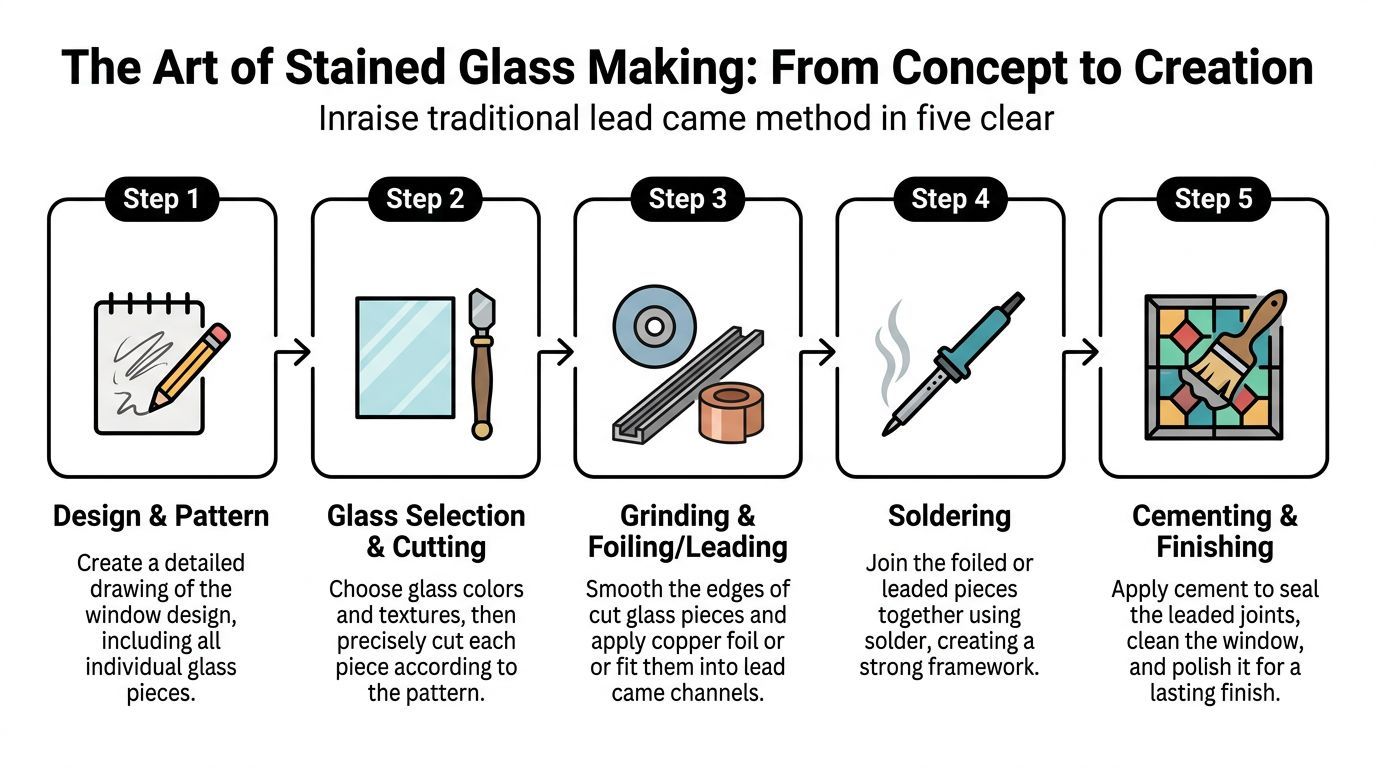
A stained glass panel usually combines several elements, each with a distinct role.
Readers often get confused by the names of glass types, so it helps to think visually instead of technically.
Cathedral glass is generally more transparent and lets light pass through clearly.
Opalescent glass looks milkier or clouded, often with richer visual body.
Textured glass softens direct views and adds sparkle or distortion.
The older and more architectural method is lead came construction. Each cut piece of glass fits into channels of lead, rather like bones fitted into a flexible framework.
This method suits panels with strong line work and broader structural clarity. It’s often what people associate with traditional stained glass windows in churches and period houses.
The usual sequence goes like this:
Lead came gives a piece a certain visual authority. The lines are usually more pronounced, and the panel often feels architectural, balanced, and rooted.
Here’s one useful comparison from the wider world of Scandinavian glass appreciation. If you enjoy how sculptural glass can shape atmosphere, the Kosta Boda Polar collection offers another lens on how Nordic interiors use light, translucency, and form with restraint.
The second major method is copper foil, often linked with Tiffany-style work. Instead of slotting glass into lead channels, the maker wraps the edge of every piece in thin foil and then solders those foiled edges together.
That creates a finer, more detailed seam. It allows for more delicate curves and smaller pieces.
Copper foil often suits:
If lead came feels like constructing a framework, copper foil feels closer to joining fragments with a metal skin. The finished lines are usually slimmer, and the result can feel lighter or more decorative.
Practical rule: If a design has many tiny pieces, tight curves, or delicate detail, copper foil often makes more sense. If it needs architectural strength and a classic look, lead came usually serves better.
A short film can make the handwork easier to understand.
You don’t need to make stained glass yourself to appreciate quality. You just need to know what to look for.
Notice these features when you examine a piece:
Good stained glass rewards both close inspection and long viewing. Up close, you see tool marks, textures, and joins. From across the room, you see composition and light.
Machine-made imitation panels exist, but they rarely carry the same presence. Handcrafted stained glass has small decisions built into it. One blue is chosen over another. One ripple is preferred because it catches the afternoon sun better. One lead line is shifted to strengthen the rhythm of the design.
That’s why stained glass windows still feel personal. They are made piece by piece, and you can sense that in the finished work. Even the imperfections often add character, provided they come from judgement rather than carelessness.
A good panel doesn’t only show colour. It shows thought.
Walk through enough old buildings, studios, and galleries, and you’ll start to recognise that stained glass windows speak in different visual dialects. Some are solemn and narrative. Some curve like vines. Some reduce everything to geometry.
Knowing the major styles helps you read a window quickly. It also helps you decide what belongs in your own space.
Gothic stained glass is often the most recognisable. It favours strong vertical movement, rich colour, and image-driven storytelling.
You’ll often see saints, canopies, medallions, and architectural framing. The lead lines play a major role, almost like ink drawing. The mood is usually grand and formal.
If you stand before a Gothic window, ask yourself two questions. Is the image meant to instruct? Does the composition pull your eye upward? If the answer to both is yes, you’re likely in Gothic territory.
Arts and Crafts stained glass usually feels more domestic and grounded. It values the hand of the maker and often avoids excessive theatricality.
Instead of overwhelming spectacle, it tends to offer warmth, craftsmanship, and harmony with the surrounding interior. A garden flower, a bird, a cottage scene, or a modest shield can all appear in this tradition.
What makes it distinctive isn’t only subject matter. It’s temperament. These windows often feel as if they were made for lived rooms, not only monumental buildings.
Good Arts and Crafts glass sits comfortably with wood, linen, plaster, and everyday life.
Art Nouveau brought movement into stained glass. Lines bend, stems curl, hair flows, and the whole panel often feels as though it has grown rather than been engineered.
This style tends to favour:
In a house, Art Nouveau glass often appears in doors, stair landings, and decorative interior panels. It can be lush, but if used carefully, it also pairs well with simple furniture because the glass itself provides the ornament.
A very different language appears in Prairie-style and other geometric modernist stained glass. Here, the design is disciplined. Rectangles, lines, borders, and repeated forms take precedence over figures and flowers.
The effect is calm, ordered, and architectural. Colour is often more restrained. A few accents of amber, olive, or muted red may sit within large areas of clear or lightly tinted glass.
This is the style many contemporary homeowners find easiest to live with because it doesn’t demand a historical interior. It often works beautifully with white walls, oak, birch, stone, and other quiet materials.
Current stained glass makers often borrow from older traditions without belonging fully to any one of them. A panel may use medieval-style lead lines but abstract colour fields. Another may use folk motifs in a modern composition. Another may become almost sculptural, designed to hang freely rather than fill a fixed window opening.
A useful way to identify contemporary abstract stained glass is to look for intent rather than category. Ask:
That’s where modern stained glass becomes especially exciting. It can borrow the discipline of old craft while speaking in a voice that suits present-day interiors.
People often choose stained glass by colour alone and regret it later. Style matters more than many realise.
Choose Gothic if you love history, symbolism, and drama. Choose Arts and Crafts if you want warmth and handmade character. Choose Art Nouveau if you’re drawn to graceful ornament. Choose geometric modernism if your home is pared back and architectural.
The best stained glass windows don’t merely match a room. They complete its emotional tone.
A stained glass panel enters a home in two ways at once. It arrives as an artwork, with colour, line, and feeling. It also arrives as a built object, made of glass, lead, solder, and support. A wise purchase respects both.
That is why the first question should be practical as well as emotional. Ask whether the piece suits your opening, your light, your budget for care, and the way you live. A jewel-like panel that needs constant protection may be perfect in a quiet reading corner and completely wrong for a busy exterior door.
New work offers precision. You can commission the exact size, choose how much privacy you need, and shape the palette around your home rather than forcing your home to serve the panel. For a pared-back Scandinavian interior, that control matters. A softly geometric design in smoky greens, amber, or clear textured glass can sit beautifully with white walls, pale timber, and even painted folk objects such as Dala horses without making the room feel heavy.
Older stained glass offers a different pleasure. Age leaves traces. The lead may have softened in profile, the glass may hold tiny ripples, and the design may carry a hand that is hard to imitate. That character is real, but so is wear.
When you inspect an older panel, look closely at five things:
Good restoration works like careful mending in textile conservation. The aim is not to make an old object look newly made. The aim is to help it live on with its character intact.
That may mean releading a weakened panel, repairing broken pieces, stabilising paint, or removing grime that has dulled the surface for decades. An experienced restorer knows how much to intervene and when restraint is the higher skill.
Questions about cost and practicality often stop homeowners before they begin. That hesitation is understandable. Stained glass sits between art collecting, building repair, and specialist craft. Concerns about the future of those skills are also real. The Contemporary Glass Society’s report on stained glass window making joining the Red List of Endangered Crafts notes pressures on the trade while also showing that the craft continues through teaching, experimentation, and small-scale making.
Use this filter before you buy or restore.
If the panel is small and mainly decorative, modest flaws may be acceptable.
If it will serve as part of an exterior window or door, structural condition matters much more.
If the design is rare, beautifully drawn, or tied to a known maker, restoration may be worth the cost.
If the panel is badly damaged and visually ordinary, a new commission may serve you better.
Scandinavian collectors already make similar judgments in studio glass. The balance between artistic identity and material quality is clear in this look at Björn Ramel glass.
Buy reliability for hard-working spaces. Buy character for places where history can breathe.
Many beginners are drawn to stained glass for the same reason they love folk art or hand-painted wood. The craft feels intimate. It asks the hand to slow down.
Start small. A sun-catcher, a hanging panel, or a simple geometric composition teaches more than an ambitious window ever will. Clean shapes and a limited palette usually produce the strongest results, especially in minimalist interiors where every line is visible.
A sensible beginner’s path looks like this:
A good stained glass purchase keeps giving long after the first excitement passes. It still looks convincing on a grey afternoon. It still belongs in the room when sunlight is weak. It adds presence, not noise.
That quality matters in calm homes. In a Scandinavian setting, stained glass should feel like a note of music in a quiet room, not a shout across it. The best pieces hold their own beside oak, linen, and cherished folk objects because they bring light into the composition, not clutter.
On a winter afternoon in a pale Nordic room, a small stained glass panel can do what a bright cushion or painted wall never quite does. It catches the low sun, warms the white surfaces, and turns restraint into atmosphere. That is why stained glass belongs so naturally in Scandinavian interiors. It gives colour to the light itself.
White walls, pale timber, wool, linen, and simple furniture sharpen stained glass rather than competing with it. The room acts like a quiet gallery. Every line in the glass reads more clearly, and every colour feels deliberate.
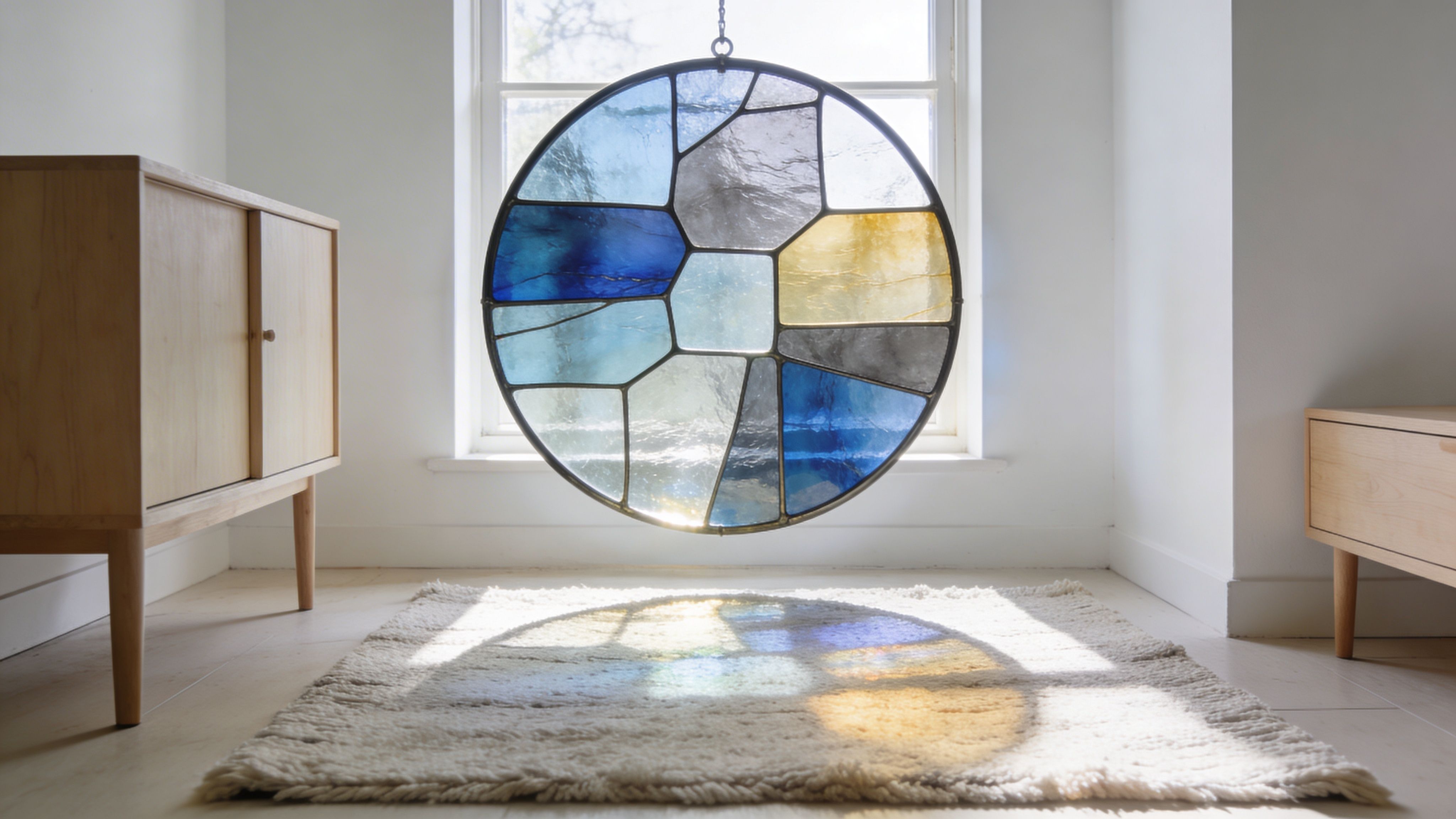
Scandinavian design often depends on calm structure, natural materials, and careful accents. Stained glass fits that grammar beautifully because it adds richness without adding bulk. A cabinet takes up space. A patterned rug claims the floor. A glass panel changes with the hour and leaves the room airy.
It also shares an ethic with Nordic craft traditions. Both value honest materials, visible workmanship, and objects that improve daily life. In that sense, a stained glass roundel beside a painted Dala horse is not an unlikely pairing. It is a conversation between two handmade traditions, one shaped by light and one shaped by the hand.
That conversation becomes especially moving when stained glass borrows from Scandinavian folk imagery. A rooster, horse, tulip, fir tree, or curling painted vine can be translated into lead lines and translucent colour with surprising grace. Folk painting and stained glass both depend on strong silhouette. Both need disciplined pattern. Both become memorable when the maker knows what to leave out.
The connection matters for craft history too. Traditional stained glass is one of the heritage skills under pressure in Britain, as noted by the British Society of Master Glass Painters on stained glass joining endangered crafts concerns. That concern opens a useful design question for the home: how do older crafts stay alive? One answer is simple. Let them enter ordinary rooms in forms that suit present life, including quiet Scandinavian homes where a small panel can sit comfortably beside carved and painted folk objects.
A geometric hanging panel near a window can act like a small fire in a cool room. Keep the shapes clean. Let oak, ash, or birch furniture carry the structure around it.
A few folk objects on a shelf nearby, perhaps a Dala horse or carved animal form, help the glass feel rooted rather than isolated. The result is collected, not crowded.
Kitchens welcome stained glass better than people often expect. A modest panel with a rooster, flower, berry motif, or a simple band of amber and green can bring warmth to cabinetry and tile without making the room busy.
This works well above a sink, beside a breakfast nook, or in a cabinet door where daylight can pass through the glass and soften the hard surfaces around it.
Passing spaces benefit from changing light. A narrow vertical panel can draw the eye upward in a stairwell. A roundel in an entry window can make the first few minutes at home feel ceremonial in the gentlest way.
For related ideas on balancing handmade statement pieces with Nordic restraint, this guide to metal artwork for wall in Scandinavian-style interiors offers a useful comparison.
A restrained room needs art with presence, clarity, and good manners.
A few habits make stained glass easier to place well, especially in minimalist homes where every object is asked to justify itself.
Scandinavian interiors are often misunderstood as empty or severe. The best ones are neither. They are selective. They make room for objects that carry memory, labour, and feeling.
Stained glass suits that spirit. So does folk carving. One gives a room coloured light. The other gives it rhythm, pattern, and touch. Together they create warmth that does not depend on visual noise, and they show that historic crafts can live comfortably in modern homes.
Stained glass windows have always done more than fill openings. They shape atmosphere, hold memory, and turn light into something you can almost feel on your skin.
That’s why they remain so compelling. A medieval cathedral used them to inspire wonder. A modern home can use them to soften a room, add privacy, or bring a little ritual to ordinary daylight. The scale changes. The emotional power doesn’t.
The craft also rewards slow looking. Once you understand how stained glass is made, how styles differ, and how condition affects value, you stop seeing only coloured panes. You begin seeing structure, judgement, and design. You start noticing the lead lines, the cut of the glass, the mood created by one small shift in tone.
In Scandinavian interiors, stained glass can be especially moving because it brings richness without heaviness. Paired thoughtfully with folk art, pale wood, and simple forms, it feels both old and current.
A good piece doesn’t merely decorate a room. It gives the room a different kind of daylight. And that light, in turn, becomes part of your own story.
If you’re drawn to Swedish folk craftsmanship that brings colour, character, and heritage into the home, explore Dalaart. Their collection of hand-carved and hand-painted Dala horses and companion animals offers another beautiful way to live with Scandinavian artistry every day.


.svg)


.png)


