April 25, 2026
The first thing I noticed was the scent of pine. Then my eye caught a row of red Dala horses, each one similar enough to feel part of a family, yet different enough to reveal the hand that carved and painted it.
A good swedish gift shop doesn’t feel like a warehouse of souvenirs. It feels like a small cultural archive. Shelves hold painted horses, roosters with proud tails, enamel mugs, woven textiles, and small objects that seem ready to tell you where they came from if you only stand still long enough.
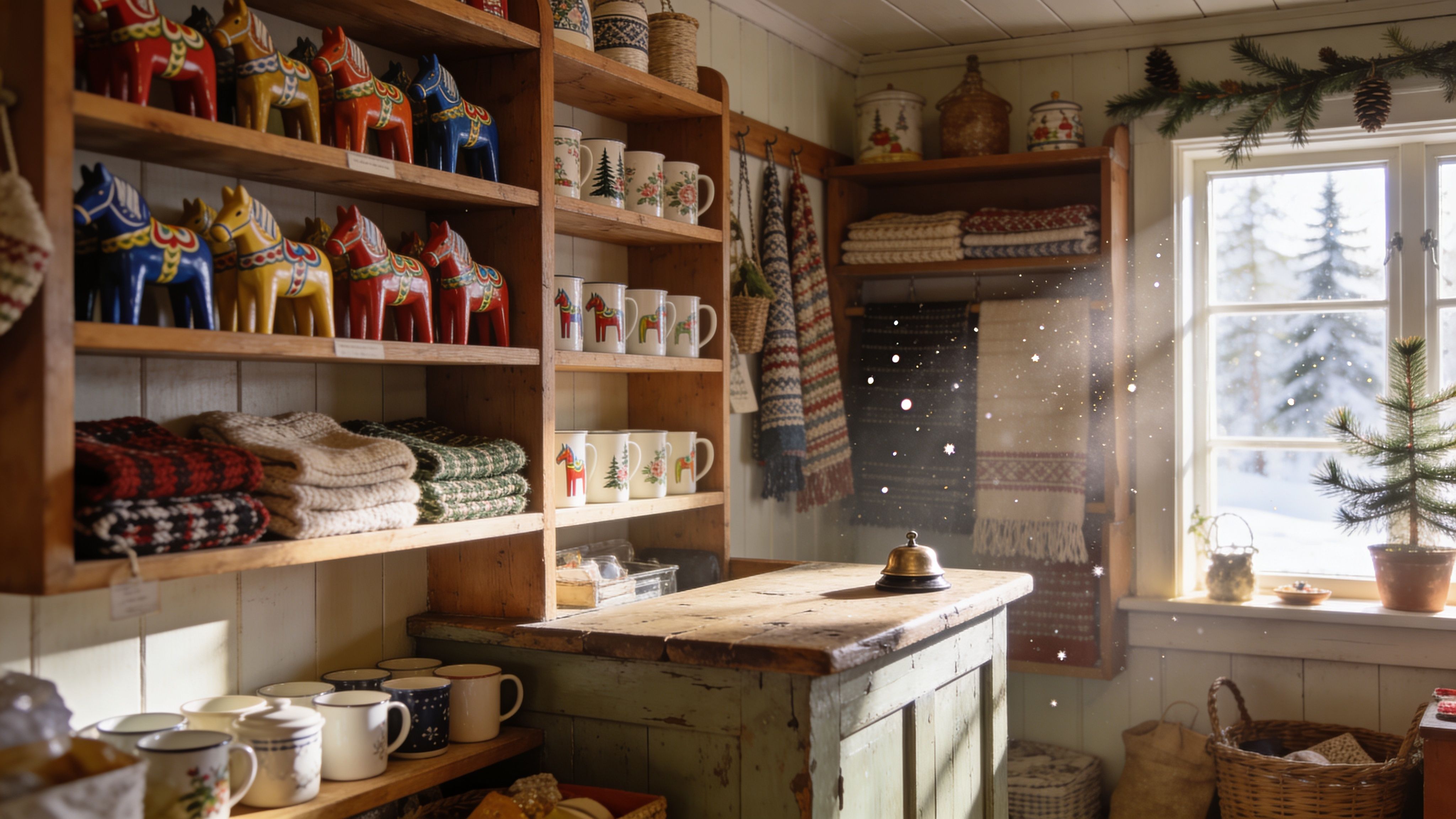
That atmosphere matters because Swedish gifting isn’t a minor seasonal footnote. Swedish households are forecasted to spend approximately 24.5 billion SEK on Christmas gifts in 2025, a projection that shows how intrinsically gift-giving remains woven into everyday culture and seasonal shopping, including specialty craft retailers offering heritage items such as Dala horses, according to this 2025 Swedish Christmas spending projection.
A visitor can easily get confused at first. Is this shop about decoration, collecting, national history, or practical gift-buying? The answer is yes to all four.
Swedish folk art has a rare quality. It’s decorative without being shallow, traditional without feeling frozen, and useful even when it sits on a shelf. A painted horse can be a childhood memory, a Christmas gift, a design accent, and a piece of regional heritage at once.
What draws many people in is the Dala horse, but it’s never alone for long. Once you begin looking carefully, you notice companion animals, vintage pieces with quieter colours, and unpainted models that invite you to take part in the craft yourself.
A swedish gift shop is often less about buying an object and more about choosing which story you want to bring home.
If you’ve ever wondered how to tell a handmade piece from a factory imitation, how to style folk art in a modern room, or how to buy responsibly without losing the joy of discovery, you’re in the right place.
To understand a swedish gift shop, start with hemslöjd. The word is often translated as handicraft, but that can sound smaller than it is. In practice, hemslöjd points to skill, place, memory, and the idea that ordinary objects can carry a community’s identity.
In Sweden, a hand-carved animal isn’t only an ornament. It can act as a cultural ambassador. A painted horse from Dalarna carries traces of regional style, workshop habits, and the maker’s hand in a way a generic souvenir never can.
This becomes clearer when you look at how Swedes treat holiday giving. Christmas gifting accounts for 8.57% of December disposable income in Sweden, placing the country second in the Nordic region and showing how firmly these traditions remain part of family and social life, as shown in Nordregio’s visualisation of Christmas gift spending.
That figure helps explain why heritage objects still matter. People aren’t only buying things. They’re choosing symbols, rituals, and shared references. A Dala horse works because it means something before the wrapping paper even comes off.
Dalarna sits at the centre of this story. For many admirers of Swedish folk art, it’s the emotional homeland of the painted wooden animal. The region’s craft traditions shaped the look people around the world now recognise as distinctly Swedish.
A thoughtful shop does more than display those objects. It interprets them. It places a carved horse beside a rooster or pig and lets you see a living tradition rather than a single famous icon.
Look closely and you’ll start to notice what these shops preserve:
Museum habit: If you want to understand a folk object, ask two questions first. Who made it, and what local tradition taught them how?
That’s the heart of it. A swedish gift shop isn’t interesting because it sells “traditional things”. It’s interesting because it keeps tradition in circulation. The craft stays alive when someone carves, paints, gifts, displays, repairs, and treasures the object in turn.
When people first shop for Swedish folk art, they often ask the wrong question. They ask, “Is this pretty?” A better question is, “Does this show the marks of real making?”
That shift changes everything. Authentic Swedish craft, especially a Dala horse, usually rewards patient looking.
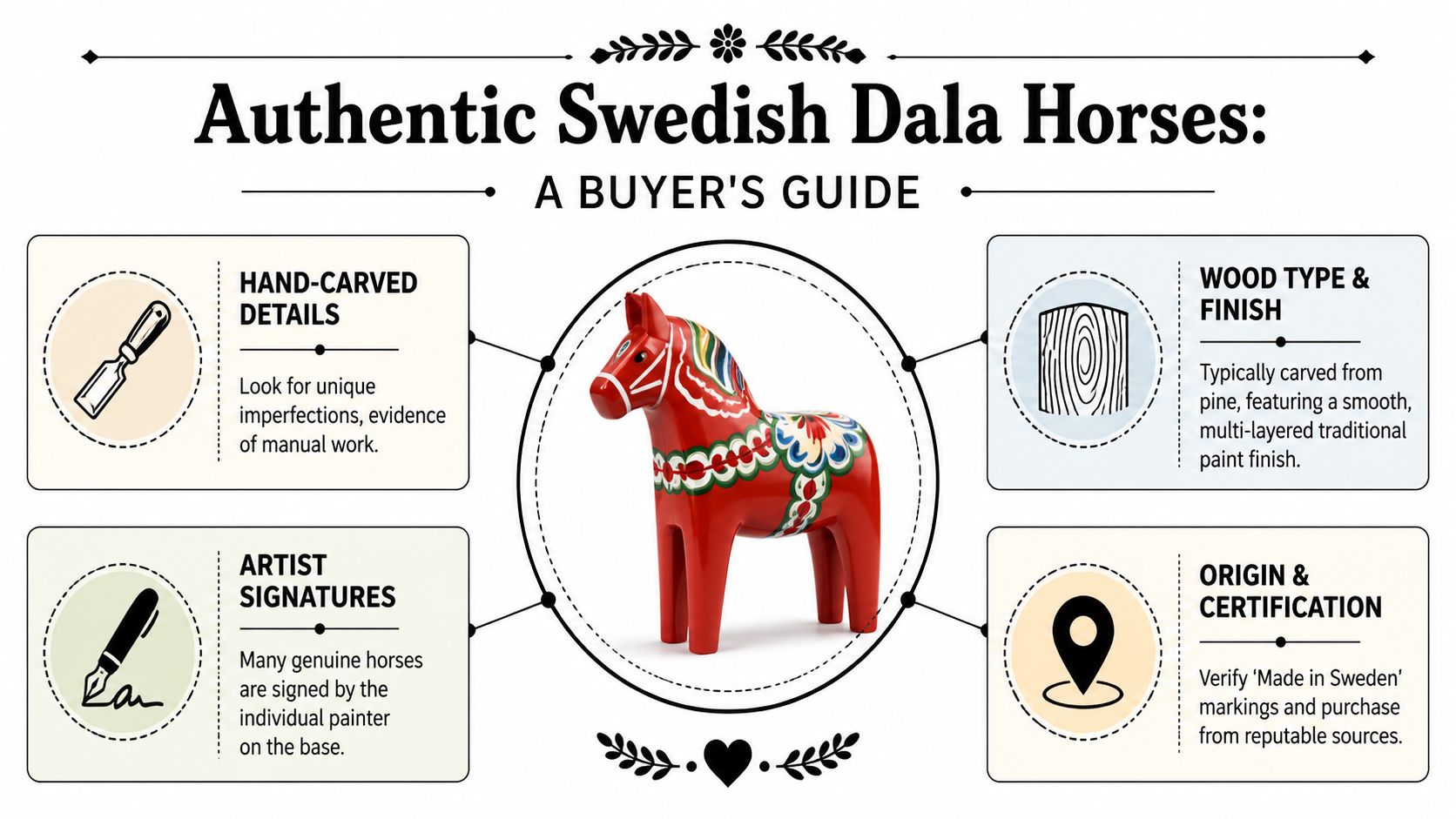
A genuine handcrafted horse often has presence before you analyse it. The shape feels balanced, but not sterile. The neck may lean with a bit more personality. The legs may show tiny differences in contour. The silhouette looks intentional, not mechanically perfect.
If you can hold the piece, notice how the surface feels. Hand-finished wood tends to feel lively rather than dead smooth. That doesn’t mean rough. It means the object still carries subtle evidence of carving and sanding by hand.
Look for these clues:
Mass-produced copies often fail here first. They may appear oddly uniform, as if every edge has been rounded by the same machine setting. Their perfection can make them less persuasive.
Traditional painted folk art asks you to slow down. On an authentic piece, decoration usually follows the body’s shape. The painted pattern doesn’t fight the carving. It works with it.
The familiar ornamental style often associated with Swedish folk painting includes flowing floral and leaf-like forms. You may see careful brushwork around the saddle area, chest, or flanks. On handmade pieces, these motifs tend to have rhythm. They don’t look stamped on.
A useful way to inspect paint is to ask whether it reveals a person’s sequence of actions. Can you imagine someone turning the horse, pausing, adding one curve, then another, then a fine contrasting line? If you can, that’s a good sign.
Practical rule: Tiny differences in brushstroke and pattern placement are often proof of authenticity, not flaws.
Collectors sometimes spend all their time on the front of an object. Turn it over. The base can tell you a great deal.
Many genuine pieces include some trace of origin, whether that’s a signature, workshop mark, or country-of-origin indication. Even when the markings are modest, they help connect the object to a real maker or studio practice.
Ask a seller sensible questions such as:
Who made it
A trustworthy seller should be able to say whether the piece comes from an individual artisan, a workshop, or a traditional carving environment in Sweden.
Where was it made
“Inspired by Sweden” is not the same as made in Sweden.
Is the exact item photographed
For handmade work, this matters. If each piece varies, you want to know whether you’re seeing your actual horse or a representative example.
A swedish gift shop often includes more than horses, and the same principles carry across the collection. Roosters, pigs, bears, and moose each have their own charm, but they should still feel rooted in craft rather than novelty.
Roosters often show off the painter’s confidence. Their tails provide room for flourish and colour. Pigs can look playful, but an authentic one still has a sense of carved volume. Moose often reveal whether the maker understands proportion, because their antlers and long legs can easily become awkward in poor-quality copies.
Old doesn’t always mean good, and worn doesn’t always mean valuable. A vintage horse may have softened paint, small chips, or a slightly muted palette. Those signs can be appealing if they fit the piece’s age and use.
What matters is whether the wear feels honest. Natural ageing often appears on edges, bases, and raised painted areas. Artificial distressing tends to look theatrical, as if the object has been “aged” for effect rather than lived with.
A careful buyer usually weighs four things at once:
If one is weak, the others need to be strong.
Buy the piece that still feels alive when you stop looking at the label.
That’s often the surest test. Authentic craftsmanship leaves a trace of the maker’s judgement in the object. You don’t just see a horse. You see a series of human decisions preserved in wood and paint.
Swedish folk art works best in a home when it’s treated as design with memory, not as clutter with a passport. A single piece can sharpen a room. A small group can soften a modern interior and make it feel inhabited.
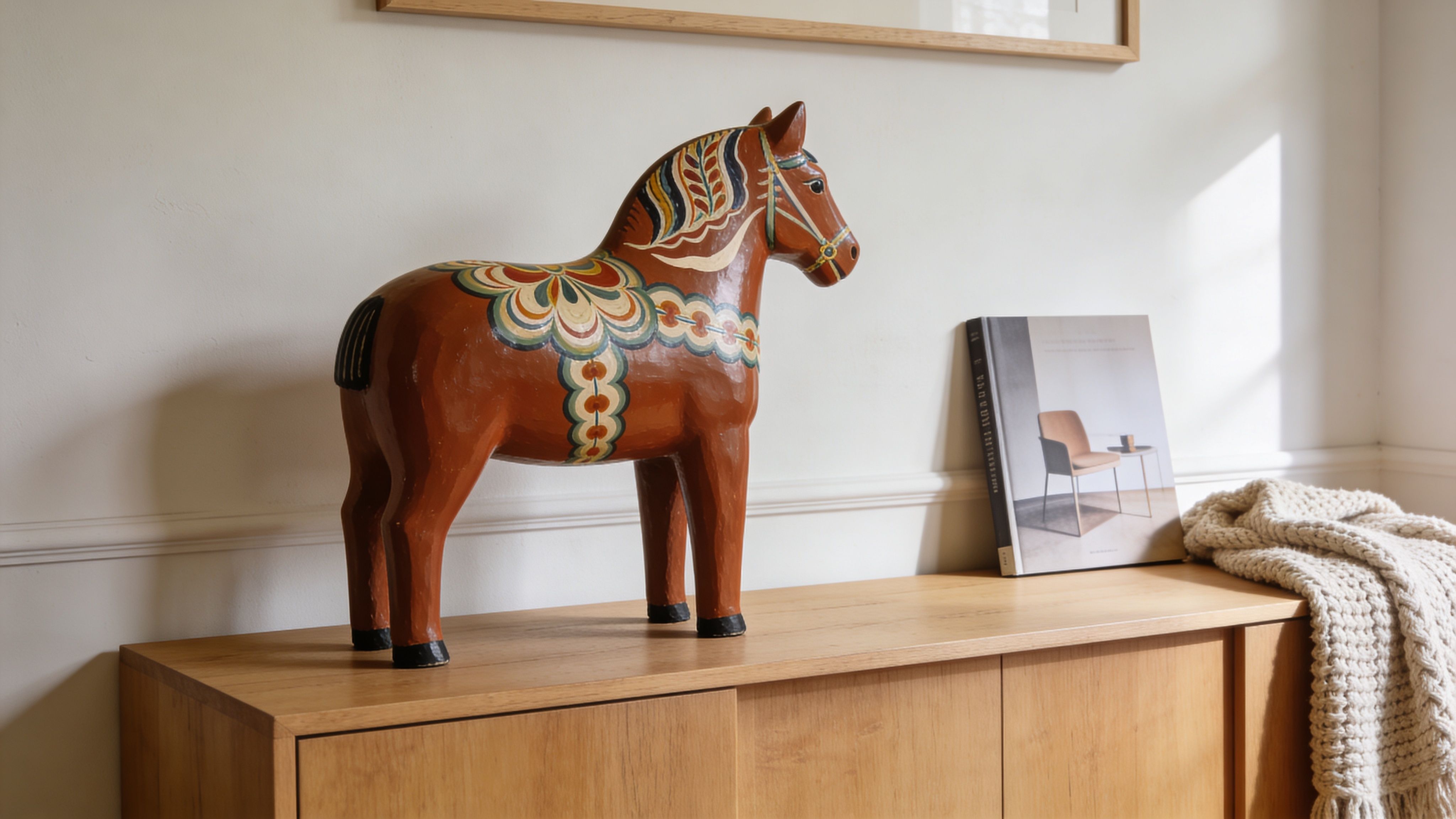
A classic mistake is to hide these objects among too many unrelated decorations. A Dala horse has strong shape and colour. It needs visual breathing room.
In a pared-back room, place one larger horse on a light oak sideboard, a narrow console, or a mantel. Let it sit near a stack of books, a ceramic vessel, or a framed print. The contrast is what makes it sing. Folk art becomes more striking when modern surroundings give it space.
If your room already has strong colour, choose a piece that echoes one existing shade rather than competing with all of them. Red is traditional and bold, but darker blues, greens, or black-ground pieces can also sit beautifully in contemporary interiors.
Grouping works when the objects speak to one another. You might arrange a horse, a rooster, and a pig in graduated sizes so the display feels like a little procession. The charm comes from variation within a shared tradition.
Useful pairings include:
Video can help you notice how these objects hold space in real interiors and gift settings:
Traditional Swedish folk colours aren’t timid. That’s part of their value. They can wake up neutral rooms filled with pale woods, wool throws, linen upholstery, and white walls.
If you’re nervous about colour, start with repetition. Echo the horse’s red in a book spine, a cushion detail, or a small textile. Suddenly the object stops feeling isolated and starts feeling integrated.
Folk art doesn’t need a rustic room. It needs a room willing to let craft be visible.
Collectors often discover that these pieces also move well through the home. A horse that begins on a winter mantel may later belong on a spring dining shelf or an autumn hallway table. Because the forms are simple and the painting is rich, they adapt more easily than many trend-driven accessories.
The most satisfying purchase usually happens when beauty and information meet. A swedish gift shop should help you understand not only what an object looks like, but how it was made, what materials were used, and how it will travel from workshop to your home.
For Swedish folk art, sustainability isn’t a vague green halo. It can show up in very specific material choices. Authentic products from Dalarna artisans often use recycled wood from local forestry waste and environmentally safe, water-based acrylics with less than 5% VOCs. This can lower embodied carbon by 25% to 35% compared with virgin timber and complies with EU REACH safety standards, as described by Hemslojd’s information on Swedish handicraft materials and sustainability.
That matters because a painted wooden animal is, at heart, a material story. Reclaimed wood carries a different ethical weight from freshly cut timber used without much thought. Safe paints matter too, especially if the object may be handled often, displayed in family spaces, or given as a gift.
When reading a product description, look for substance rather than mood. Good listings usually tell you:
Online buying can feel risky because you can’t touch the piece. That’s why the seller’s language matters. Strong product pages tend to be concrete. They note whether an item is handmade, vintage, made to order, or one of a kind.
Look closely at photographs as well. A useful listing usually shows more than one angle, including side views or the base. If a shop also explains delivery expectations, customs issues, or packing methods, that’s a good sign that the seller understands the practicalities of international orders. For readers comparing practical options, this guide to Etsy shipping from Sweden is a helpful example of the shipping questions buyers often need answered.
Vintage Swedish folk art can be rewarding because it brings age, patina, and historical texture into a collection. But vintage buying asks for slower judgement.
Check whether wear looks consistent with use. Small paint loss at edges may be perfectly acceptable. A cracked body, unstable base, or suspiciously vague history deserves more caution.
A sensible vintage checklist includes the following:
Condition first
Honest wear can be charming. Structural damage is another matter.
Ask about provenance
Even a brief account of where the piece came from can add trust.
Study repainting carefully
Restoration isn’t always bad, but you want to know whether it preserves the object or disguises it.
Buy with your eyes open, not only with your heart. Folk art should delight you, but it should also withstand scrutiny.
Shipping is part of the purchase, not an afterthought. The best buying experience comes from treating provenance, materials, condition, and delivery as one connected decision.
The pleasure of a swedish gift shop lies in matching object to person. The same shelf can hold something right for a new parent, a seasoned collector, a homesick Swede abroad, and a friend who always wants a project for rainy weekends.
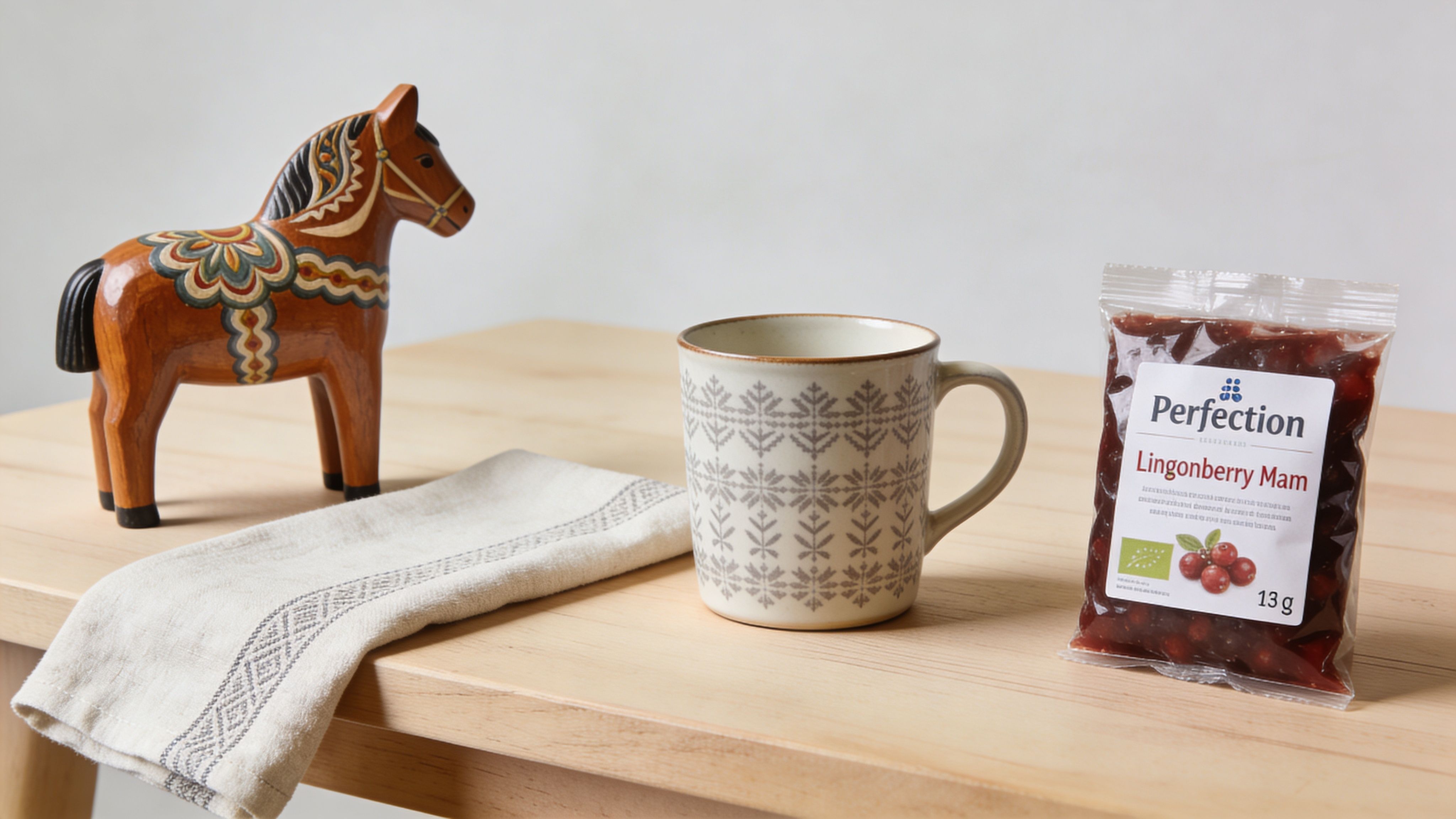
One reason handmade Swedish gifts remain appealing is that they don’t feel anonymous. They carry a distinct place and craft tradition with them, so even a small present can feel considered.
For a child or first-time collector, a small painted animal often works beautifully. It feels special without being overwhelming. A horse, pig, or rooster can become the first object in a lifelong shelf of keepsakes.
For a new homeowner, a classic Dala horse makes sense because it sits at the meeting point of decoration and symbolism. It says welcome, but in a way that feels rooted rather than generic.
For the design-minded friend, choose something with a clear silhouette and controlled palette. Black, white, blue, or deeper green variants can suit more pared-back interiors while still keeping their folk character.
Here are a few easy matches:
A handmade object becomes even more personal when the recipient can finish part of the story. That helps explain why craft-based gifts have such appeal right now. In Sweden, the 2025 Gift of the Year was adult toys, meaning advanced craft kits, and this trend saw a 32% year-on-year revenue increase for interactive Swedish folk craft sets, including unpainted Dala horse DIY models that invite personalisation, according to Hej Sweden’s 2025 guide to Swedish gift ideas.
That trend makes intuitive sense. A DIY horse isn’t only an object. It’s an evening’s activity, a memory in progress, and often a more intimate gift because the recipient leaves their own mark on it. If you want more inspiration for matching Scandinavian presents to different people and occasions, this guide to gifts from Sweden is a useful place to browse ideas.
Some gifts are finished when they’re wrapped. A craft-based Swedish gift keeps unfolding after it’s opened.
That’s why these objects endure. They can comfort, decorate, amuse, and connect. A good gift doesn’t just fill space. It creates attachment.
A swedish gift shop earns trust when it makes the line between maker and buyer easier to see. That’s where the conversation shifts from object alone to ecosystem. Who carves the piece? Who paints it? Who explains its materials clearly? Who preserves the context that keeps the craft from becoming a costume version of itself?
Modern buyers often care about sustainability, but many shops still speak in broad strokes. Analysis shows that 68% of Swedes prioritise eco-labeled products, yet many major Swedish gift retailers emphasise authenticity and design without detailing sourcing or environmental impact, creating a gap that brands focused on recycled materials and safe paints are well placed to address, as noted in this discussion of eco-conscious Swedish gift retail gaps.
When a shop tells you a piece is handmade, that’s a start. When it also tells you how the wood was sourced, what kind of paint was used, and how the artisan community is supported, the object gains depth. Transparency turns admiration into informed appreciation.
That’s one reason some buyers look closely at specialist boutiques rather than general Scandinavian décor shops. They want a stronger chain of evidence between the tradition, the workshop, and the finished object.
Dalaart is one example of that more specific model. It operates as an online boutique centred on authentic Swedish Dala horses and companion animals made in Dalarna, with classic, vintage, exclusive, and DIY pieces, alongside background material that shows how the objects connect to working artisans and local craft practice. Readers who want a closer look at that maker-focused approach can explore Dalaart’s behind-the-scenes view of its process.
What matters here isn’t promotional language. It’s the structure of the relationship. A shop like this can help a buyer understand that purchasing folk art isn’t a neutral retail act. It can support continued carving, painting, curation, and storytelling around a regional tradition.
Support for artisans often becomes visible through choices such as:
The strongest craft shops don’t flatten handmade work into stock. They preserve the sense that each piece comes from a real place and a real pair of hands.
That’s the kind of shop worth returning to. It doesn’t just sell Swedish objects. It helps keep Swedish craft legible.
The joy of a swedish gift shop lies in how much it can hold at once. A carved horse can be a design object, a memory of travel, a thoughtful gift, a collectible, and a small lesson in regional history.
Once you know what to look for, the whole experience changes. You start noticing the difference between handmade variation and factory sameness. You begin reading paint, wood, wear, and provenance almost the way a curator reads labels and brushwork in a gallery.
That doesn’t make the experience colder. It makes it richer.
If you bring one of these pieces home, you’re not only decorating a shelf. You’re extending a chain of making and meaning. The artisan shaped it, the painter gave it character, the shop placed it in context, and now you decide how it lives on.
A good collection doesn’t have to be large. It only needs attention. One well-chosen horse on a sideboard, one vintage rooster with a story, one unpainted model completed at your own kitchen table, that can be enough to begin.
Let your first question be practical. Is it authentic, well made, and clearly described? Then let your second question be personal. Does it move you?
That combination of judgement and affection is what makes collecting satisfying. Swedish folk art rewards both. It welcomes the careful buyer and the sentimental one, because at its best it speaks to the head, the hand, and the home all at once.
If you’d like to explore authentic Swedish Dala horses and companion animals from Dalarna, Dalaart offers a focused place to browse handcrafted, vintage, and DIY pieces while learning more about the tradition behind them.


.svg)


.png)


