April 23, 2026
A room can be beautifully furnished and still feel slightly unfinished. The linen curtains hang well, the timber has warmth, the ceramics catch the light, and a painted wooden horse on the shelf adds that unmistakable Scandinavian note of cheer and craft. Yet something remains flat.
Often, it’s not a missing object. It’s a missing atmosphere.
That’s where fragrance and art meet in a way many people sense instinctively but rarely name. Visual art gives shape, colour, line, and symbol. Scent gives mood, memory, and presence. When the two work together, a home stops feeling like a display and starts feeling lived, remembered, and personal.
You might know the feeling already. You’ve styled a corner of your sitting room with care. A Dala horse stands against a pale wall. A wool throw softens the chair nearby. There’s a stack of art books, a candle holder in brushed metal, and maybe a bowl of pinecones in winter. It looks right, but it doesn’t yet feel complete.
That missing layer is often invisible. Scent changes how a room is received before anyone has consciously judged it. A faint note of pine, birch, clean linen, or soft resin can make carved wood feel more rooted, colours feel warmer, and folk art feel more tied to its place.
This matters especially with heritage pieces. Handmade objects carry more than form. They carry place, labour, memory, and rhythm. A hand-painted horse from Dalarna isn’t only decoration. It suggests forests, workshops, family traditions, festive colour, and the patience of the artisan’s hand. Fragrance can lend subtle support to that story.
A well-chosen scent doesn’t compete with visual art. It gives the eye a companion.
In a Scandinavian home, that idea feels especially natural. The design language is already restrained. Materials are honest. Surfaces breathe. Rooms tend to favour clarity over clutter. Because of that, scent doesn’t need to be dramatic to matter. It only needs to be intentional.
That’s why scent belongs in the conversation about interiors, collecting, and display. It isn’t an afterthought. It’s part of curation.
Olfactory art is art that uses scent as a deliberate medium of expression. That can mean fragrance standing alone as the artwork, or scent working alongside objects, sound, light, or space to shape how a person feels and interprets what they encounter.
A useful way to understand it is to think like a painter. A painter uses pigment, contrast, scale, and composition. A perfumer uses aromatic materials, intensity, timing, and diffusion. Both make choices about what should appear first, what should linger, and what emotional tone should remain after the first impression fades.
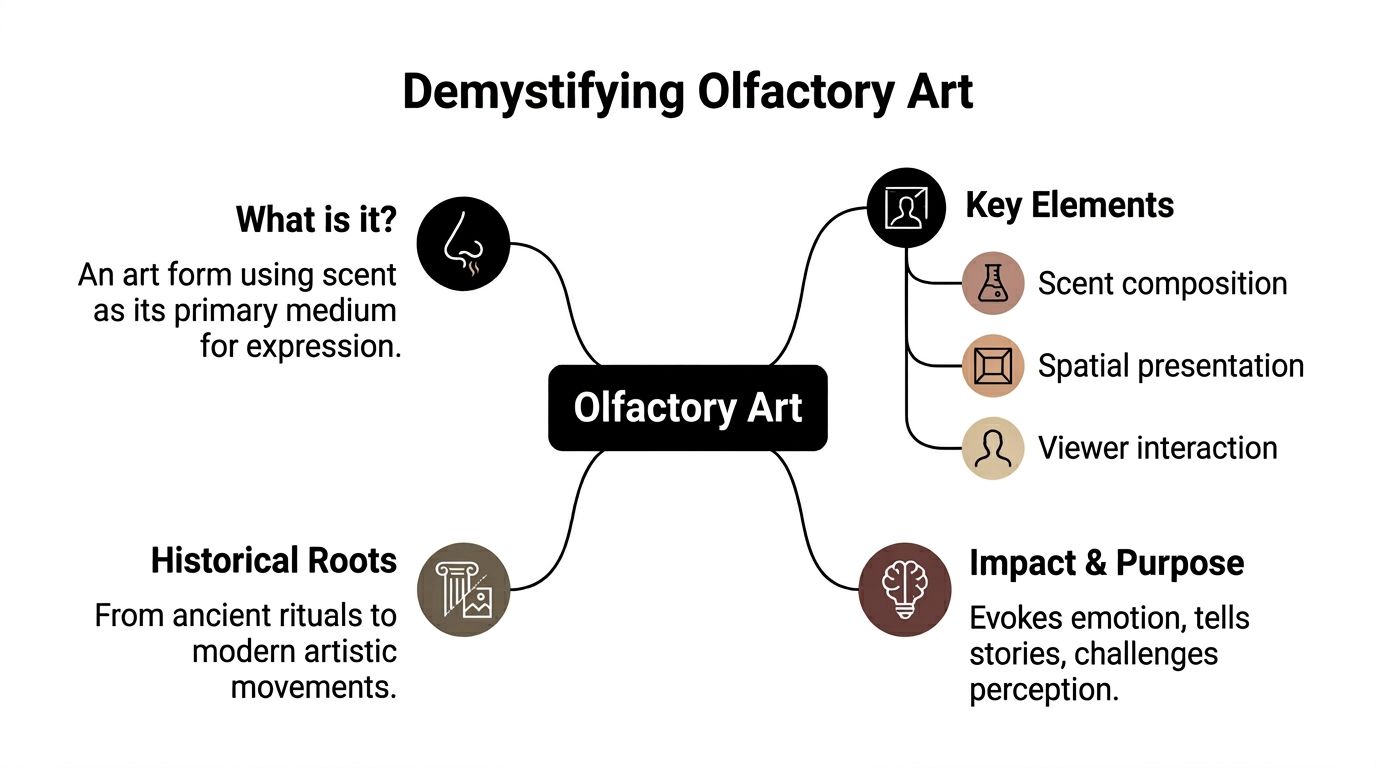
Unlike paint or clay, scent is invisible and unstable. It moves. It changes over time. It can be subtle in one corner of a room and stronger near a doorway or fabric surface. That shifting quality is part of its artistic power.
Core idea: Olfactory art uses scent not as decoration, but as meaning.
A fragrance can suggest season, memory, distance, ritual, freshness, age, or intimacy. It can soften a stark interior, sharpen a minimal one, or give emotional depth to an object that might otherwise be admired only for craftsmanship.
Often, readers misunderstand. They assume scent in a room is either functional or cosmetic. Either it masks odours or it smells pleasant. Olfactory art asks more of fragrance. It treats scent as something composed with intention.
One of the clearest tools for understanding scent is the fragrance pyramid. It describes how a fragrance unfolds over time.
If that sounds abstract, connect it to a styled room. A fresh citrus opening might mirror the brightness of painted florals. A floral or herbal middle can support the decorative language of folk motifs. A woody or amber base can echo carved timber, waxed surfaces, and the grounded calm of Scandinavian interiors.
You don’t need a gallery installation to use olfactory thinking. You only need to ask three curator-style questions:
Those questions move scent from impulse purchase to design decision. That’s the shift that makes fragrance and art such a useful pairing in the home.
A painted Dala horse on a shelf can change the mood of a room before anyone touches it. Scent has done similar work for thousands of years. It has long been used to mark a place as sacred, ceremonial, welcoming, or refined, which is why fragrance belongs in the history of art as much as in the history of grooming.
Early perfume traditions were closely tied to ritual life in ancient Mesopotamia and Egypt, where aromatic materials were burned, blended, and offered in religious and ceremonial settings, as noted in this history of perfume. That context matters. It shows that scent first functioned less like a personal accessory and more like lighting, music, or decoration in a space. It shaped how people experienced what they saw.
Over time, perfumery became more refined, but its role stayed surprisingly familiar. Fragrance continued to define settings, signal status, and support shared ideas of beauty. Temples, courts, bathhouses, dressing rooms, and reception spaces all used scent to influence feeling before a single word was spoken.
A useful historical overview from The Perfume Society traces several turning points in that shift. It notes the artistic use of fragrance in ancient Egypt, Catherine de Medici’s role in bringing perfumery prestige to France, the arrival of Eau de Cologne, and later the blend of synthetic and natural materials in modern perfume. Read together, those moments show a craft becoming more precise, more expressive, and more closely linked to taste.
By the French court, scent had become part of visual culture itself. Rooms, fabrics, bodies, and ceremonies were composed as a total aesthetic experience. In practical terms, fragrance was working like another design material. Colour shaped the eye. Texture shaped the hand. Scent shaped the atmosphere around both.
This helps explain why pairing fragrance with heritage objects feels natural rather than contrived. A room holding authentic Scandinavian craft already carries visual memory through painted ornament, carved wood, and repeated motif. Scent can support that memory in the same way a well-chosen textile or wall colour can. It adds context.
That is especially relevant with Dalaart. Traditional painted pieces are rich in pattern and symbolism, yet they usually live within calm interiors where every detail must earn its place. If you understand how colour and form work in Swedish folk tradition, it becomes easier to see fragrance as part of the same curatorial decision. The scent should not compete with the object. It should frame it, much as a quiet mount helps a print read more clearly.
Contemporary museums sometimes use fragrance in installations to deepen memory and mood, but the principle is older than any modern gallery technique. People have long used aromatic materials to give objects and rooms a stronger emotional setting.
That continuity is reassuring. Fragrance may be invisible, yet its cultural role has been remarkably steady. It helps turn space into experience, and experience into memory. In a Scandinavian home, that can mean using scent with restraint so a piece of folk art feels more rooted in place, season, and heritage.
Scandinavian interiors rarely ask for excess. They ask for clarity, texture, balance, and materials that feel honest in the hand. Wood should look like wood. Linen should crease naturally. Light should move across a room without obstruction. In that setting, fragrance works best when it behaves the same way. Clean, quiet, and grounded.
That’s why fragrance and art sit so comfortably together in a Nordic-inspired home. Scandinavian design already invites sensory restraint. A heavy or overly sweet perfume can feel out of step, but a scent built around woods, herbs, airiness, or soft florals can make the room feel more coherent.
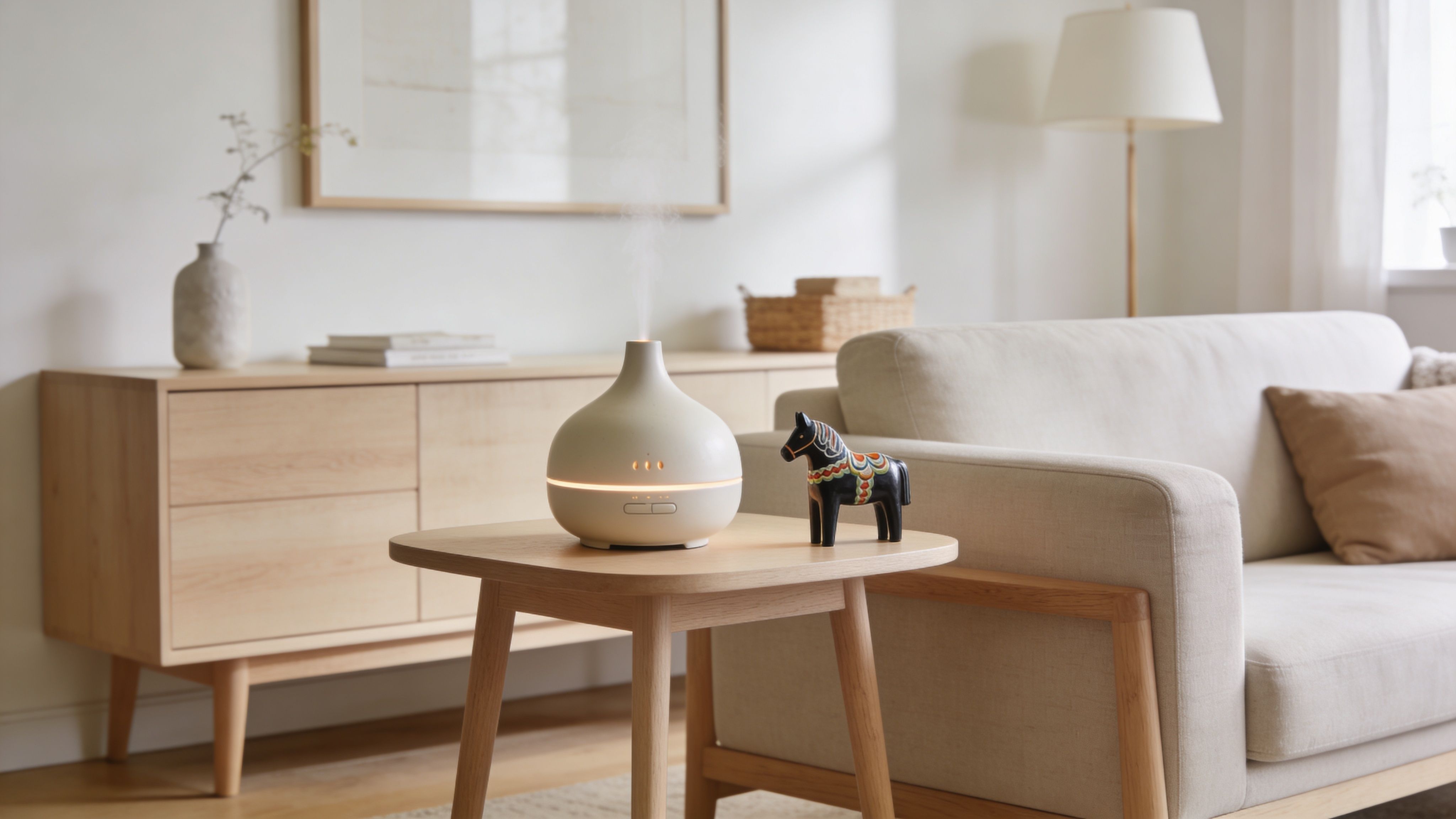
Scandinavian folk art has strong colour, but it usually sits within a larger setting of pale timber, simple forms, and practical beauty. That contrast is part of its charm. The room stays calm, and the crafted piece becomes the voice.
The fragrance pyramid is especially useful here. In guidance on scent structure and display, this explanation of the art and science of fragrance notes that top notes such as citrus can echo bright hand-painted florals, heart notes such as jasmine can deepen the narrative feel of decorative motifs, and base notes like woods and amber can mirror the wooden body of a carving. The same source also states that wood-derived bases can reduce potential discoloration by up to 60% compared with some synthetic alternatives, which is relevant when displaying painted wooden art in variable humidity.
That practical detail matters more than many collectors expect. Scent choice isn’t only aesthetic. It can also affect how suitable a fragranced environment is around sensitive surfaces.
Scandinavian style values atmosphere, but not theatrical atmosphere. It tends to favour lived comfort over display for display’s sake. Concepts such as lagom and cosiness depend on balance. The room should feel complete, not overstated.
A scent profile that suits this approach often includes:
If you enjoy the relationship between Swedish colour and form, the article on colour and shape in Swedish design offers a helpful visual companion to this idea.
In a Scandinavian room, the best fragrance often feels as though it belongs to the materials already present.
When in doubt, choose a fragrance that sounds like the room’s textures. Timber, wool, dried herbs, wax, clean air, berries, moss, or soft blossom. That keeps scent aligned with the visual language instead of pulling it away.
A carved folk object doesn’t need perfume that announces itself. It needs a scented setting that lets its heritage breathe.
Pairing fragrance with folk art works best when you stop thinking in product categories and start thinking in character. Don’t begin with “Which candle should I buy?” Begin with “What feeling does this object already carry?”
A carved horse, rooster, pig, bear, or moose each suggests a different rhythm. Some feel celebratory. Some feel rustic. Some feel playful. Others feel grounded and almost architectural in a room. Your fragrance choice should support that personality.
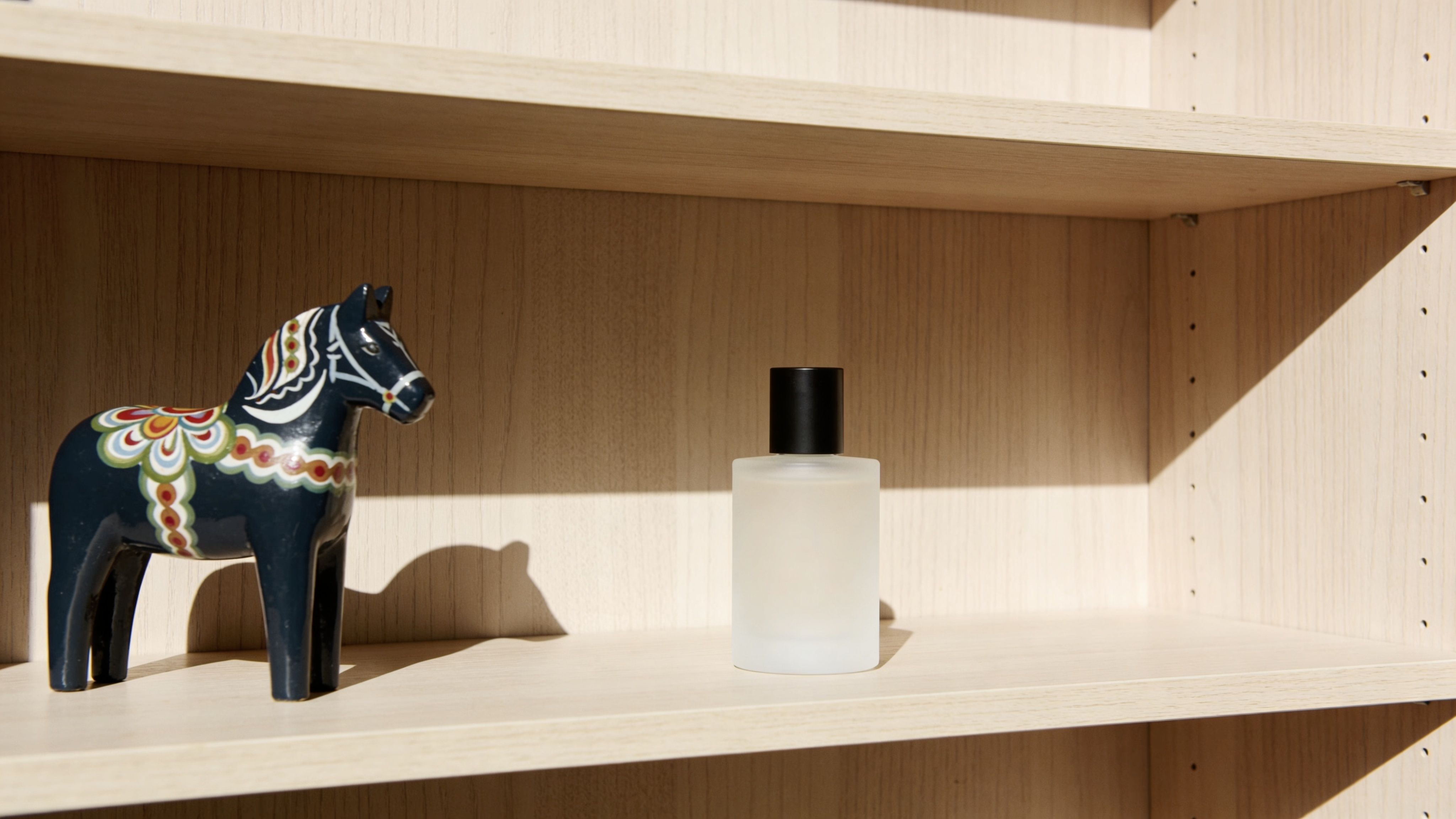
A classic red horse often carries warmth and tradition. It suits scents with a gentle winter feeling. Pine, clove-like spice, soft resin, or orange peel can all work if used with restraint. The reason is simple. The red reads as festive and historic, so the fragrance can lean cosy without becoming heavy.
A blue horse feels cooler and more reflective. Try airy woods, juniper-like freshness, or linen-style scents. Blue often calms the visual field, so a cleaner fragrance profile supports that effect.
A rooster usually has more movement in its shape and decoration. It can take something brighter. Herbal greens, citrus-led openings, or meadow-like florals can bring out that lively energy.
Some pieces call attention to carving more than colour. In those cases, the wood itself should lead the fragrance choice.
Practical rule: The more visually detailed the object, the simpler the fragrance should be.
That rule helps avoid sensory crowding. A highly patterned folk object already gives the eye a lot to enjoy. The fragrance should steady the experience, not compete with it.
The same object can wear different scents depending on where it lives.
In an entrance hall, a Dala horse may benefit from something fresh and welcoming because the scent forms part of the first impression. In a sitting room, woods and soft spice can support longer, slower appreciation. In a bedroom, a gentler floral or clean textile note may be more appropriate.
Try this method:
Different delivery methods create different relationships with the object.
For those who enjoy process and making, the workshop-style perspective in this behind-the-scenes look at traditional craft pairs beautifully with the idea of scent as something considered, layered, and slowly refined.
One especially interesting development comes from this article on the technical nature of creative perfumery, which reports that interactive fragrance trails at Nordic art fairs increased interest in personalising unpainted Dala horses by 42%. The idea is revealing even if you never build an installation at home. When scent changes as people move through a space, it can guide mood and colour perception in a surprisingly direct way.
That suggests a simple domestic lesson. You can place a brighter scent near the approach to an artwork and a warmer one deeper in the room, creating a small sensory journey rather than one flat scent cloud.
You don’t need specialist equipment to make scent part of your home in a thoughtful way. A few natural materials, a light hand, and some patience are enough. The aim isn’t to produce a commercial perfume. It’s to make a small atmospheric companion for the objects you love.
The best home projects also suit Scandinavian values well. They use simple ingredients, avoid waste where possible, and leave room for personal variation.
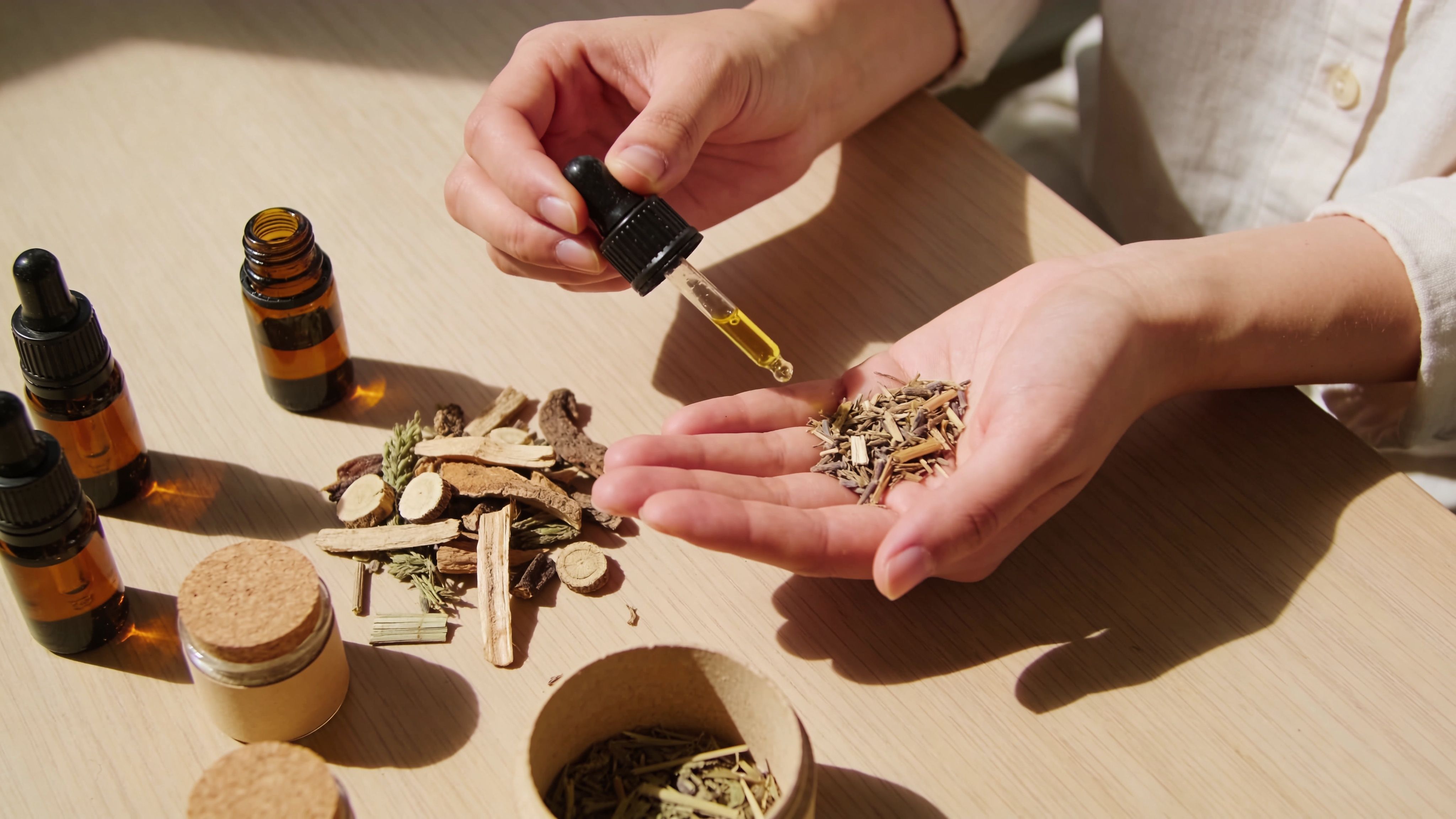
Start with a small bowl or shallow ceramic dish. Add dried pinecones, a little birch bark if you have it, dried herbs such as rosemary or thyme, and a few dried berries for colour. Then add a very small amount of essential oil blend to the dry materials and let it settle before placing it near, but not on, display pieces.
This works well in living rooms and entrance areas because it looks decorative even before the scent is noticed.
Melt plain unscented wax gently, add a restrained amount of fragrance, and pour into a mould with dried botanicals pressed lightly into the surface. Once set, the tablet can be hung in a wardrobe, placed in a drawer, or displayed near textiles.
Choose fragrance according to function. Linen-like scents suit clothing storage. Herb and wood combinations tend to work well near natural fibre throws, baskets, or spare room shelving.
A room spray gives the most control. You can use it only when guests arrive, before quiet evening reading, or when resetting a room after cooking or cleaning.
Try this simple approach:
Keep home blends lighter than you think you need. Scent expands in enclosed rooms.
Many people often hesitate. They worry about getting the formula right. But the point of home olfactory art isn’t technical perfection. It’s resonance. If a blend makes your shelf of folk objects feel more alive, more seasonal, or more rooted in place, it’s doing its job.
A useful habit is to keep a small notebook. Write down what you combined, where you placed it, and how the room felt after a day or two. Over time, you’ll notice preferences. Maybe you prefer dry woods to florals. Maybe citrus works only in daylight. Maybe soft herb blends make painted objects feel calmer.
That process is very close to curating. You observe, adjust, remove, and refine.
A memorable home speaks in more than one language. Colour speaks. Texture speaks. Light speaks. Scent does too.
When fragrance and art are considered together, rooms gain another layer of meaning. A carved and painted object no longer sits in isolation. It belongs to an atmosphere. That atmosphere can feel fresh, wooded, festive, calm, or gently nostalgic, depending on the choices you make.
The goal isn’t to make every room fragrant. It’s to let scent support what the room is already trying to say.
That final point deserves more attention than it usually gets. As this discussion of fragrance in modern art installations notes, there’s still a market gap in understanding how individual sensory preferences and regional Scandinavian tastes for natural, sustainable scents shape the success of fragrance-art collaborations. For anyone styling a home, that’s a useful reminder. Taste in scent is personal, cultural, and situational.
If you enjoy extending that sensory thinking into seasonal ritual, the reflections in this piece on Scandinavian candles offer another way to connect light, atmosphere, and heritage at home.
A multi-sensory home doesn’t need to be elaborate. It needs to be attentive. When visual beauty and fragrance support one another, the result feels less staged and more lived. That’s often the difference between a room people admire and a room they remember.
If you'd like to bring authentic Swedish craftsmanship into that kind of thoughtfully layered home, explore Dalaart. Their collection of hand-carved, hand-painted Dala horses and companion animals offers a beautiful foundation for creating interiors that honour Scandinavian heritage with warmth, character, and lasting artistry.


.svg)


.png)


