May 23, 2026
You come home after a cold, grey day, drop your keys on the console, and wish the room felt softer somehow. Not cleaner exactly. Not brighter. Just more settled, more welcoming, more like a place that helps you exhale.
That's often the moment people start looking for an essential oils diffuser. They aren't only shopping for scent. They're trying to shape atmosphere. A faint cedar note in the hallway, a quiet curl of mist beside a reading chair, a bedroom that feels restful before the lamp even goes on. In a Scandinavian-inspired home, that small ritual fits naturally. The best interiors don't stop at what you see. They also consider what you sense.
A diffuser used to be the sort of object you'd spot in a yoga studio or a niche wellness shop. That changed. The wider category has become much more mainstream, with the aromatherapy diffuser market growing from a historic 5% CAGR to a projected 9% CAGR post-2020, and projected to rise from US$1.6 billion in 2021 to US$3.8 billion by 2031, largely driven by residential use, according to Fact.MR's aromatherapy diffuser market analysis.
That shift says something simple about how people live now. Many of us want our homes to do more than function well. We want them to restore us a little.
In practice, an essential oils diffuser often becomes part of a daily rhythm. Someone runs it for a short spell while reading in the evening. Another person places one near the entrance so the home feels calm the moment they step inside. In homes shaped by Nordic design values, this makes sense. Clean lines, natural materials, useful objects, and quiet comfort all leave room for scent as part of the overall composition.
A chair changes how a corner looks. A lamp changes how it glows. Scent changes how the room is experienced.
That's why a diffuser can feel more personal than many small appliances. It doesn't just sit there. It participates in the mood of the home.
A good home fragrance setup shouldn't dominate the room. It should feel woven into it.
If you enjoy spaces where art, craft, and atmosphere work together, fragrance and art in the home is a useful idea to sit with. The room feels complete when the sensory details support the visual ones.
Many first-time buyers expect dramatic spa-like transformation. Usually, the experience is gentler. The best results are often subtle. You notice them when the room feels less flat, less stale, and more intentionally lived in.
That subtlety is part of the appeal. Used well, an essential oils diffuser helps build a sanctuary without making the space feel staged.
At heart, an essential oils diffuser is a device that breaks scent into tiny airborne particles so the aroma can spread through a room. The key idea is atomization. Instead of pouring oil into a room or heating it until the fragrance becomes strong, the diffuser turns oil, or oil mixed with water, into a fine mist or vapour-like output.
A useful way to think about it is this. It's a bit like a miniature cloud-maker for fragrance. The machine takes a small amount of aromatic material and disperses it in a way your nose can detect gradually rather than all at once.
This process is often encountered initially through an ultrasonic diffuser. In that design, water goes into a reservoir, a few drops of oil are added, and a vibrating component does the rest.
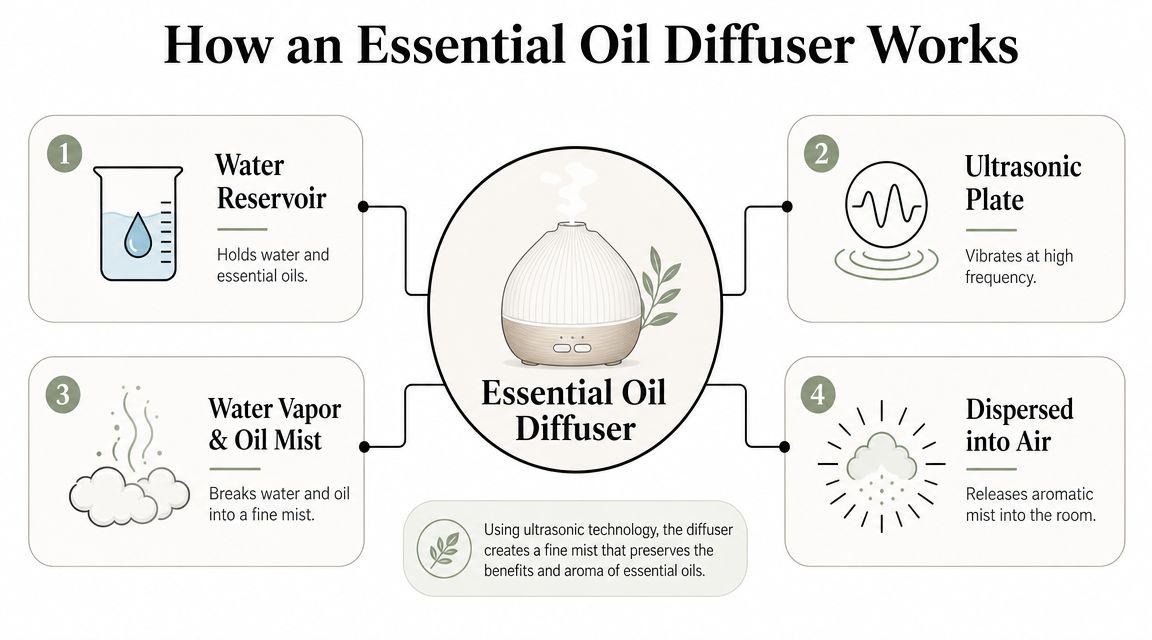
The mechanism matters because it explains why some diffusers feel soft and barely-there, while others fill a room quickly. As described by Vitruvi's guide to diffuser types and benefits, ultrasonic diffusers use a piezoelectric disc vibrating at high frequencies to mechanically break an oil-water mixture into a fine aerosol. It's a low-temperature atomization method, which means the oil isn't being heated as the main method of dispersion.
People often ask why one diffuser seems gentler than another even when the same oil is used. The answer usually isn't the oil alone. It's the delivery method.
With an ultrasonic unit, fragrance output depends on things like:
That's why manufacturers often ask you to use room-temperature water and stay within the fill line. Too much water, too little water, or mineral-heavy water can affect how steadily the mist forms.
Practical rule: A diffuser doesn't “burn” fragrance into the room. It disperses it. That's why setup and maintenance matter so much.
Once you understand that point, choosing between diffuser types becomes far easier.
The four most common diffuser styles are ultrasonic, nebulizing, evaporative, and heat-based. They all aim to do the same job, but they create very different experiences at home.
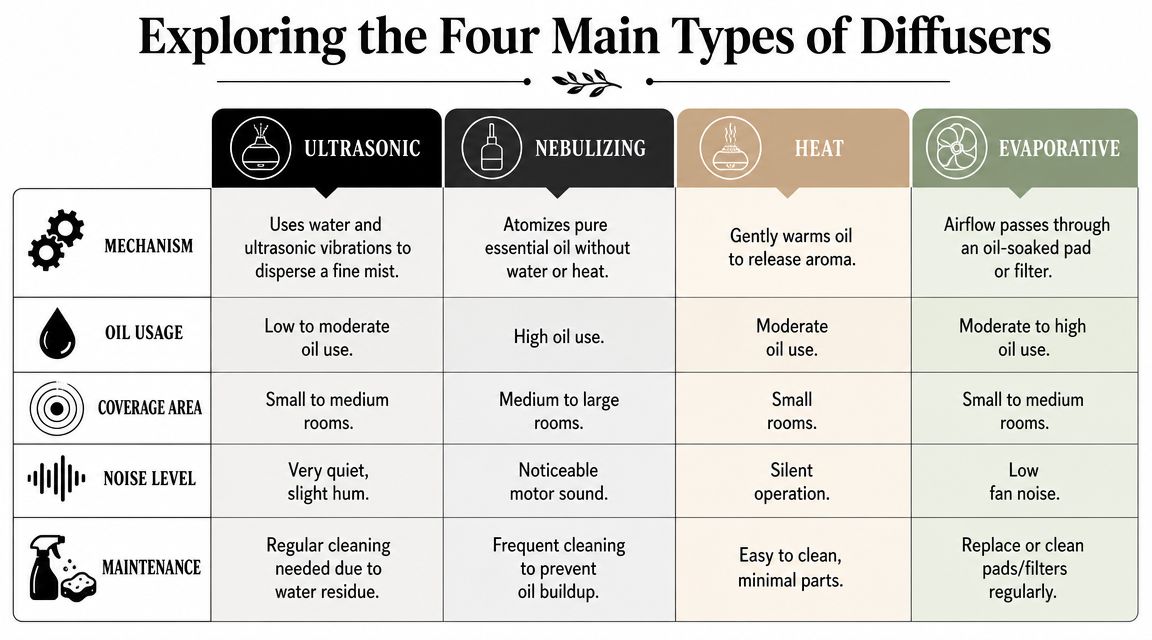
This is the style many people start with. You add water, add oil, and the unit produces a cool mist.
Ultrasonic models tend to suit people who want a balanced experience rather than maximum intensity. The aroma usually feels more diluted and easier to live with over a short session. In a bedroom, reading nook, or smaller living area, that softer output can be a real advantage.
Common reasons people like them:
The trade-off is upkeep. Because water is involved, you need to keep the reservoir and plate clean.
If ultrasonic models are the soft speakers of the diffuser world, nebulizers are the studio monitors. They're direct, fast, and much more forceful.
According to Aroma Designers' explanation of how aroma diffusers work, nebulizing diffusers atomize pure essential oil without water using compressed air, which creates a dense, dry mist and saturates a room quickly. That differs from evaporative diffusers, which use a fan to blow air over a scented pad, producing a less intense and more uneven scent output as the pad dries.
That makes nebulizers useful in:
But they're not always the best choice for a compact flat or a small bedroom. Because they use pure oil, the effect can feel concentrated very quickly.
A short visual demo can help make the differences more concrete:
These are often overlooked because they seem less dramatic, but they can be useful. A fan pushes air over a pad, wick, or absorbent surface that holds the oil.
Their strength is simplicity. They're often straightforward to use, and some people like that they don't create visible mist. Their weakness is consistency. The scent profile can change as the oil on the pad diminishes, so the room may smell stronger at first and weaker later.
Heat-based models rely on warmth to help fragrance disperse. They can be silent and visually minimal, which is attractive in calm, pared-back interiors.
Still, they tend to be chosen more for ambience and ease than for precise performance. If your priority is controlled output, a different mechanism usually gives you more predictability.
The choice isn't really about which diffuser is “best”. It's about how you want scent to behave in your room.
If you want softness, choose ultrasonic. If you want impact, look at nebulizing. If you want a low-fuss setup, evaporative may appeal. If silence and simplicity matter most, heat can be worth considering.
Choosing an essential oils diffuser gets easier when you stop thinking about the machine first and think about the room instead. A diffuser that feels perfect in a spacious sitting room can feel overwhelming in a sealed bedroom. A model that works beautifully for evening wind-down might be too faint for a busy kitchen-living area.
Some people want scent to remain in the background. Others want to notice it as soon as they enter the room. That preference matters more than trend.
If you like subtle ambience, ultrasonic or gentler passive styles usually make sense. If you want quick fragrance in a broad area, nebulizing models are often more suitable. If the room is used for work, reading, or sleep, lower intensity is usually easier to live with.
Choose for behaviour, not hype. Ask how you want the scent to arrive, linger, and fade.
A few practical pairings tend to work well:
The room's styling matters too. If your space includes ceramics, pale woods, linen, and greenery, choose a diffuser that feels at home among those textures. A bulky glossy device can interrupt an otherwise calm scheme.
Natural decor can also help frame the diffuser visually. If you're building a softer interior with clay vessels, stoneware, or indoor foliage, pots and planters in Scandinavian styling offer the same grounding effect that a well-chosen diffuser does.
For many homes, the best setup isn't stronger fragrance. It's better timing. Guidance commonly recommends intermittent use for 30 to 60 minutes at a time, followed by a break, especially in smaller or tightly sealed Nordic homes, as described in Nikura's diffuser guidance.
That advice is helpful because many buyers focus on drop counts and forget exposure. A room that smells lovely for half an hour may feel heavy if the diffuser runs continuously.
A good buying checklist looks like this:
The right diffuser should feel easy to use, easy to place, and easy to switch off before the scent takes over.
A diffuser can be pleasant and practical, but it isn't the same thing as improving air quality. That distinction matters. Essential oils diffusers add aromatic compounds to the air. They don't replace fresh air, and they aren't a substitute for ventilation.
Independent health guidance also points to a second reason to use them thoughtfully. As discussed by Smart Air's review of diffuser safety and VOC exposure, diffusers release volatile organic compounds (VOCs). That review notes recommendations to limit exposure to about 15 minutes to 1 hour at a time and highlights a 2022 study of 200 people in which inhaling essential oils for one hour or more per day was associated with increased heart rate and blood pressure.
This doesn't mean diffusers are automatically unsafe. It means they're best treated like any other indoor fragrance source. Use them in moderation, and give the room fresh air.
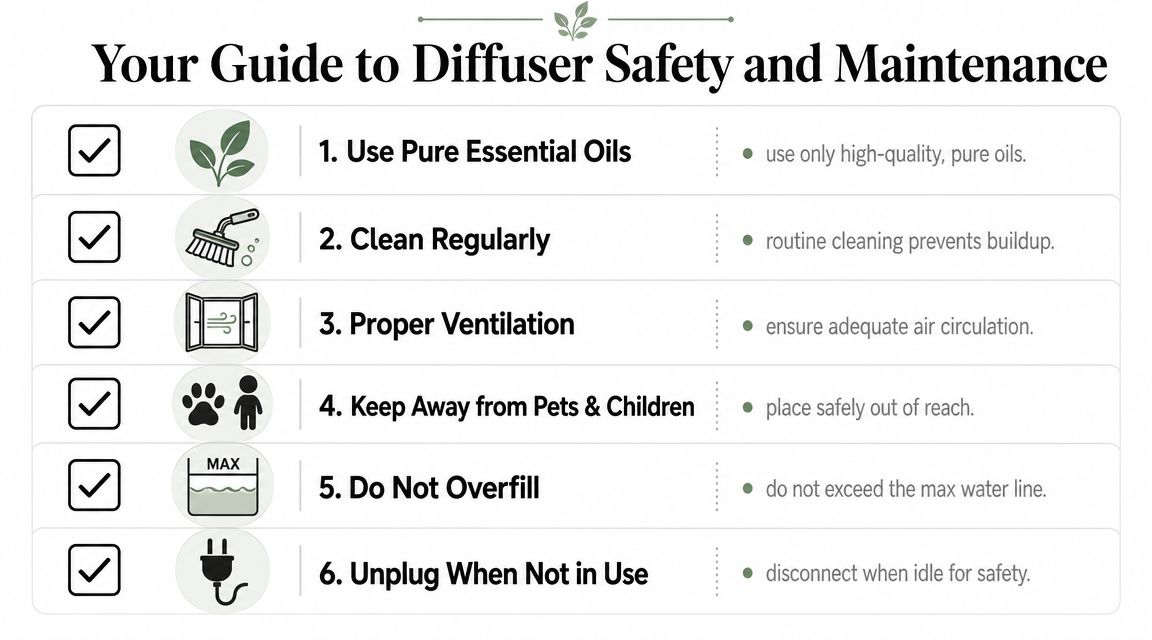
A sensible home routine includes:
Ventilation comes first. Scent should be an optional layer in the room, not the foundation of indoor air care.
A surprising number of “broken” diffusers are just dirty diffusers. Mineral residue, leftover oil, and stagnant water can all interfere with mist output. In ultrasonic units, buildup on the plate can reduce performance. In water tanks, residue can also leave the next blend smelling muddled rather than clean.
Keep the cleaning routine simple:
If the room starts to smell heavy, if the mist seems weak, or if the diffuser leaves noticeable residue nearby, take that as feedback.
Usually the fix is one of three things:
That safety-first mindset makes the diffuser more enjoyable, not less. You get a clearer scent, a cleaner machine, and a room that still feels fresh.
A diffuser works best visually when it doesn't look like an afterthought. In a Scandinavian home, that usually means choosing a design with clean lines, calm colour, and natural-looking materials. Matte ceramic, soft stone tones, pale wood accents, and rounded forms tend to sit comfortably beside Nordic furnishings.
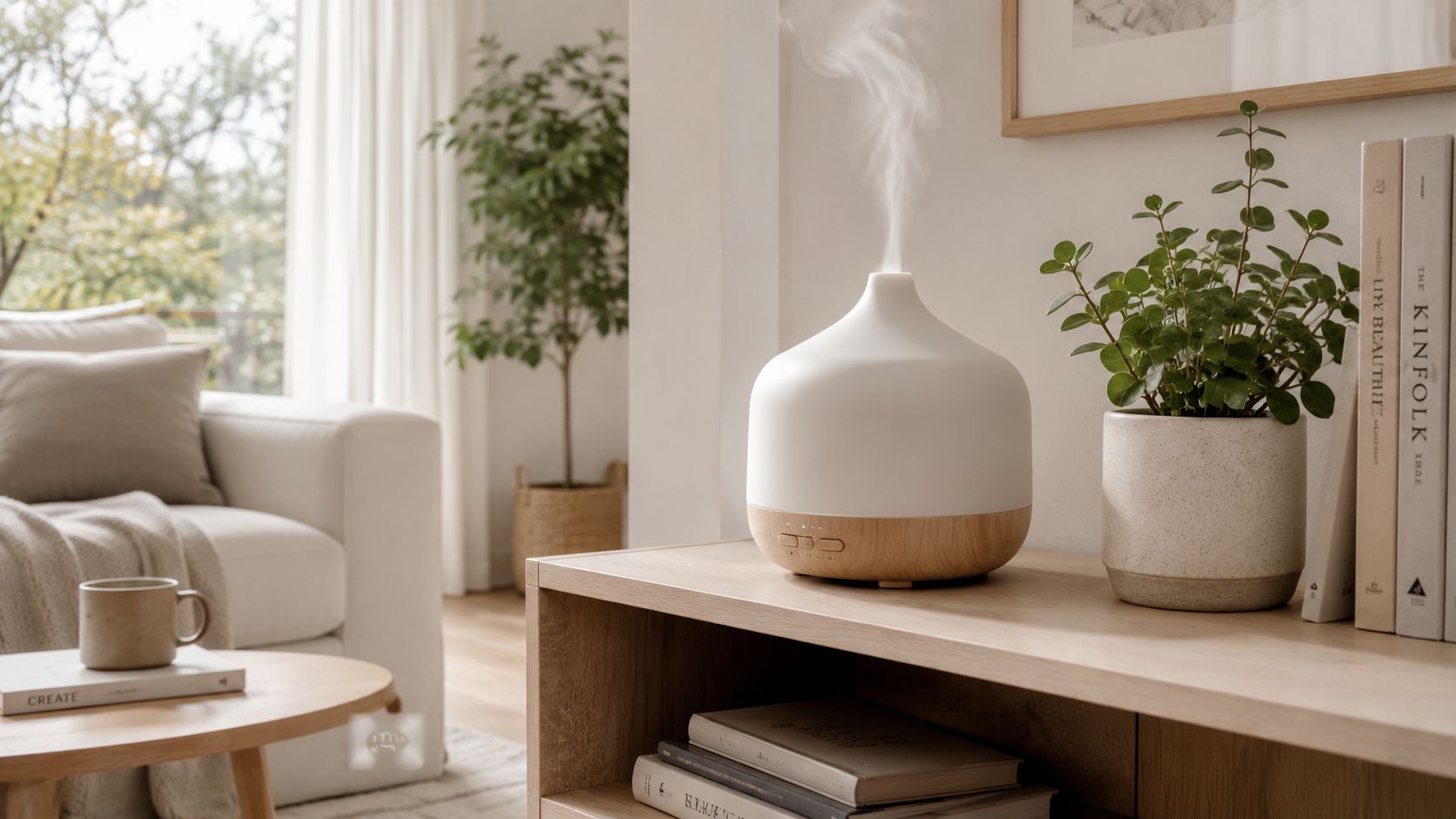
The most successful arrangement often looks almost effortless. A diffuser on a wooden shelf. A linen runner beneath it. A glazed pot nearby. A carved object that gives the scene history and warmth. The result isn't “spa décor”. It's a lived-in composition where modern wellness and traditional craft sit side by side.
Think in clusters of texture rather than matching sets. A diffuser can anchor a small still life on a console, sideboard, or mantel.
You might combine:
That arrangement works because Scandinavian interiors often rely on contrast. Smooth against textured. Plain against patterned. Quiet against expressive.
A useful styling trick is to match fragrance character to what's already in the room. If the space leans woody, handcrafted, and grounded, forest-inspired oils can feel coherent with the setting. If the room is lighter and airier, cleaner citrus or herb-led scents may fit better.
Embracing seasonal styling can be a delightful experience. In colder months, wood, wool, and candlelight naturally invite deeper, earthier aromas. If you like that Nordic sense of warmth and ritual, Scandinavian candle traditions offer a related way of thinking about atmosphere.
A beautiful diffuser setup should feel integrated. If you remove the scent, the corner should still look complete.
Avoid hiding the diffuser completely, but don't place it where the mist dominates eye level or lands on delicate surfaces. A sideboard, low shelf, or stable table usually works better than a crowded windowsill.
The goal is quiet presence. In the best Scandinavian rooms, the diffuser becomes one more thoughtful object among others, doing its job without shouting for attention.
Most diffuser problems are ordinary. Weak scent, no mist, odd blinking lights, or residue near the unit usually point to setup, cleaning, or placement rather than total failure.
If your ultrasonic diffuser powers on but produces little or no visible mist, check the basics first.
If you've cleaned it and filled it correctly, let it rest dry for a while, then try again.
This is one of the most common frustrations, especially with a new essential oils diffuser. Usually, the issue isn't that the machine is poor. It's that the match between diffuser type, room size, and expectations is off.
Try these adjustments:
If you're using an evaporative model, remember that output often drops as the pad dries out.
This tends to happen in small rooms, especially if the home is tightly sealed during colder months.
A quick reset helps:
If a nebulizer feels intense in your space, it may be the wrong tool for that room rather than user error.
A sour, stale, or muddy smell often means old water or oil residue has been left inside. Empty it, clean it thoroughly, and let every part dry before the next use.
That one habit solves a surprising number of issues. A clean diffuser gives clearer scent, steadier mist, and fewer headaches.
If you love the calm, crafted feeling of Scandinavian interiors, Dalaart offers authentic Swedish wooden folk art that pairs beautifully with natural, sensory home styling. Explore hand-carved Dala horses and companion animals to add warmth, colour, and heritage to the corners of your home that already invite light, texture, and scent.


.svg)


.png)


