April 22, 2026
The first time many collectors see the Imperial Star Destroyer properly, it isn’t on a shelf. It’s in the opening chase of A New Hope, where a wedge of steel seems to keep arriving long after the smaller ship beneath it has already crossed the screen. That sensation, scale revealed through duration, is exactly what the best LEGO version tries to preserve.
The lego star wars imperial star destroyer holds a rare place in popular design. It isn’t merely recognisable. It communicates power through shape alone. Even in silhouette, the long triangular hull, stepped bridge tower, and clustered engines tell you what kind of object this is before a logo or name enters the frame.
That matters to collectors because some film vehicles age as effects. The Imperial Star Destroyer has aged as architecture. It looks less like a gadget and more like a floating monument, severe and ordered, a machine designed to dominate both space and attention.
Cinema taught viewers to read the Star Destroyer as an event. In the opening of A New Hope, the ship doesn’t just appear. It overtakes. Adults who return to that image often find that their admiration has shifted. As children, they responded to its menace. As collectors, they respond to its composition.
The wedge form is deceptively simple. A child might say, “It’s a triangle with engines.” A builder sees the harder truth. It’s a controlled balance of flat planes, recessed details, and surface texture. Too smooth, and it loses character. Too busy, and it loses authority.
The Imperial Star Destroyer works because it combines strict geometry with dense mechanical detail. It feels disciplined at a distance and intricate up close.
LEGO has always been well suited to this kind of subject. Bricks excel at structure, rhythm, and repetition. Yet the Star Destroyer asks for more than blocky resemblance. It asks a designer to suggest metal plating, command decks, weapons, vents, and the visual language fans call greebling, those clustered surface details that imply internal complexity.
Serious collectors rarely discuss this model in the language of ordinary playthings. They talk about proportion, stability, display footprint, and finish. They consider whether the stand presents the ship with enough lift, whether the underside has been treated with the same care as the top, and whether the model can hold attention from several angles in a room.
That shift in language is important. It places the set closer to sculpture than novelty. A well-displayed Star Destroyer behaves like a design object. It controls sightlines. It invites approach. It rewards slow looking.
Three forms of value usually come together in this model:
People often get confused here and assume reverence makes the set fragile or inaccessible. It doesn’t. The best way to understand it is to treat it as you would a finely made cabinet or a carved folk object. You can enjoy it emotionally, admire it formally, and evaluate it practically at the same time.
A collector standing in front of two LEGO Star Destroyers is not choosing between bigger and smaller. The choice is between two curatorial ideas. One model treats the ship as an accessible object to handle and enjoy. Another treats it as a study in proportion, surface control, and presence.
That distinction explains why the line’s history matters. Each major release answers the same design brief in a different way. How do you turn one of cinema’s most severe and recognisable shapes into brick form without losing its authority?
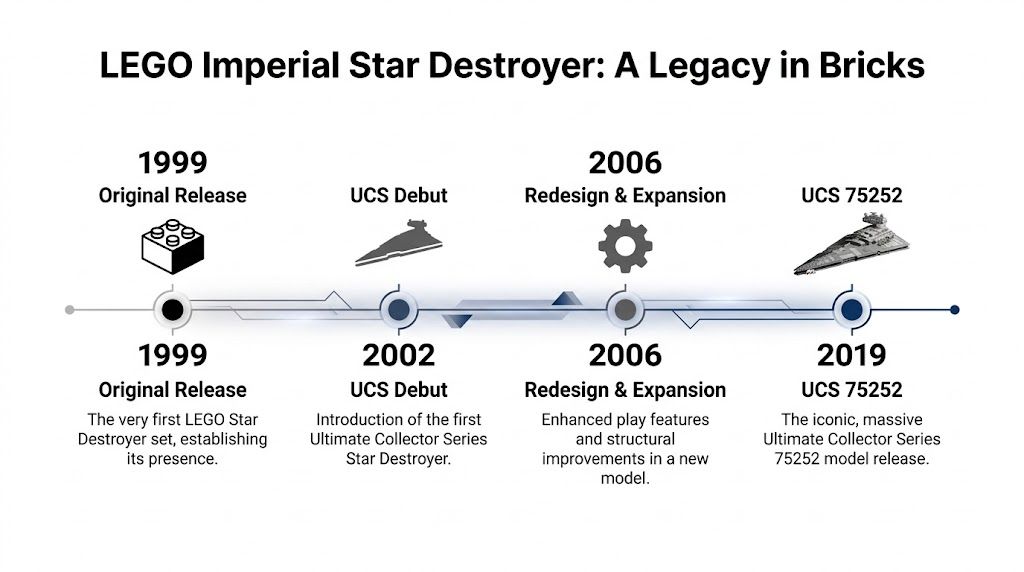
The first generations of LEGO Star Destroyers focused on translation. Designers had to prove that the ship’s broad wedge, raised command structure, and stern engine array could read clearly in a medium made of small rectangular parts. Early sets succeeded by emphasising silhouette and recognisability. They gave fans the icon first, then worried about refinement.
The 2002 UCS debut, shown in the timeline above, changed the conversation. At that point, LEGO was no longer presenting the Star Destroyer chiefly as a vessel for action scenes. It was presenting it as a subject worthy of formal interpretation, closer to a scale model or display sculpture than a conventional playset.
For collectors, that shift is profound.
A display-led Star Destroyer has to solve a different class of problems. The hull planes need discipline so the triangle feels sharp rather than soft. Surface detailing has to suggest armour and machinery without dissolving into visual noise. The stand must frame the ship as an exhibit, not hold it off a shelf. Even the command tower has to sit in proportion, because a small error there changes the whole silhouette.
Collectors often wonder why one Star Destroyer becomes revered while another remains merely well liked. Nostalgia plays a part, but craftsmanship usually decides the matter. The best versions capture the ship’s unusual duality. From across a room, it appears almost stark. Up close, it becomes dense with layered detail.
That balance is hard to achieve in LEGO. Too little surface articulation, and the model looks plain. Too much, and the clean military geometry begins to break apart. The strongest entries in the line preserve both readings at once, which is why they feel closer to designed objects than merchandise.
By the time LEGO reached the 2019 UCS set 75252, the series had matured into a form of collectible engineering. LEGO’s product page for the set lists 4,784 pieces and a length of over 43 in. (110 cm) for 75252 Imperial Star Destroyer. Those figures matter because scale gives the designers enough room to pursue fidelity, layering, and visual rhythm, not because large numbers are impressive on their own.
Historical lens: The Star Destroyer gained lasting collector prestige in LEGO form once the design priority shifted from play access to observation, proportion, and display presence.
A useful historical comparison sits between 75252 and the 2024 set 75394. The difference is not merely old versus new. It is monument versus reinterpretation.
Recent commentary around 75394 has focused on practical refinements such as easier handling and a structure that feels more accommodating in everyday display life. Those improvements matter, especially to buyers who plan to move the model, dust it regularly, or place it in homes where climate and shelf stability are real concerns. A large LEGO sculpture lives in the physical world. It is affected by weight, grip points, and environmental stress in the same way a framed print or scale maquette would be.
Still, 75252 holds a particular place in the lineage. Its appeal comes from ambition. It asks for more space, more patience, and more commitment from the owner. In return, it offers the kind of long, commanding profile that makes the Star Destroyer feel less like a franchise object and more like an exhibit piece.
That is the deeper pattern across this history. New releases do not merely replace older ones. They reinterpret what kind of artifact the Star Destroyer should be. Some versions prioritise access and practicality. Others pursue awe, scale, and ceremonial display.
For a serious collector, that variety is not a complication. It is the reason the lineage remains worth studying.
A collector approaching UCS 75252 often has the same first reaction people have in front of a large scale model in a museum. The eye goes to the silhouette first. Then the questions begin. How does something this long stay precise? How does a wedge-shaped form avoid looking heavy, or worse, collapsing under its own ambition?
That is the quiet triumph of this set. Its beauty depends on hidden discipline.

The set comprises 4,784 pieces, measures 110 cm long, and weighs 12.48 kg, according to BricksDirect’s product details for LEGO 75252. Those figures place it closer to a display object than a casual weekend build.
Scale changes your relationship with the model. A small set can be picked up and turned in the hand. UCS 75252 asks for preparation. You clear a surface, plan where the finished ship will live, and learn where it can be handled safely. In collecting terms, that shift matters. The model begins to behave less like a toy and more like an assembled artifact with presence, weight, and a clear claim on the room around it.
That sense of presence is part of its value. Size alone does not create prestige, but size paired with control often does.
Inside the ship is an internal Technic frame. It works like the steel structure inside a modern cantilevered building. You rarely see it, yet every visible surface depends on it.
For newer builders, that internal frame explains why the model feels coherent rather than fragile. The outer hull is not carrying the burden by itself. The load is distributed through a central spine and supporting geometry, so the visible panels can do what they are meant to do. Define the form.
The engineering logic is easier to follow when broken into parts:
That last point deserves attention. The stand is part of the composition. It does more than hold the ship above a table. It establishes the line of sight that makes the bow feel aggressive, the upper planes feel disciplined, and the whole form feel in motion. In design terms, support and presentation are working together.
The hull relies on SNOT, short for Studs Not On Top. This building method turns elements sideways or into other orientations so the outer surface appears smoother and more controlled.
The term can sound technical, but the visual effect is simple. Traditional brick stacking produces a field of studs. SNOT lets designers treat LEGO elements more like cladding panels on architecture or plates on a scale maquette. That approach matters here because the Imperial Star Destroyer is defined by sharp planes, long surfaces, and deliberate seams. If the hull were built in a more conventional upright grid, the ship would lose much of its severity.
Once you know that, several details become easier to read:
This is one reason collectors speak about certain UCS sets with the language usually reserved for design objects. The pleasure is not only in recognition. It is in technique.
A model at this scale could easily become monotonous. UCS 75252 avoids that by organizing the process into systems and subassemblies. You are not wrestling with one enormous mass from the first hour to the last. You build a framework, then surfaces, then distinct architectural features, and each stage explains the next.
That progression gives the build a satisfying rhythm. It asks for patience, but it also rewards attention. As sections come together, the logic of the ship becomes legible. You begin to see why the underside needs support in one area, why the top plane must stay taut in another, and why small geometric choices affect the authority of the full silhouette.
For collectors who value craftsmanship, this is the heart of 75252. The finished model is impressive on a shelf, but its deeper appeal lies in how clearly it reveals the designer’s priorities. Strength first. Proportion second. Surface refinement third. The result is a LEGO set that can be appreciated as engineering, as sculpture, and as a cultural object built to command space.
The moment of purchase has its own drama. A collector sees the vast black box, the severe wedge of the ship across the front, and the pulse quickens. Yet a set like the Imperial Star Destroyer asks for the opposite of impulse. It asks for the calm judgement you would bring to a print, a watch, or a piece of studio furniture.
A model of this scale carries two values at once. One is obvious: bricks, instructions, stand, plaque, minifigures, box. The other is quieter: provenance, condition, completeness, and the confidence that what you are buying will present well, build well, and hold its dignity in a serious collection.

A sealed copy offers the cleanest provenance. You are buying the set in its most intact state, with the full ritual of opening, sorting, and building preserved. For collectors who see 75252 as an engineered art object, that untouched status can matter as much as the model itself.
Pre-owned copies deserve respect too. In many cases, they are entering their second life as collectible objects. A careful owner can leave behind a set that is fully inventoried, well stored, and easier to trust than a vague sealed listing with poor photos.
The difference lies in documentation.
When you assess a used listing, focus on evidence:
A seller who understands these points usually understands the set.
The resale market for UCS 75252 changes with timing, geography, box condition, and shipping costs. Those shifts are real, but they are often discussed with more certainty than the evidence supports. A wiser approach is to watch completed listings across established resale platforms, compare local availability, and treat sudden price spikes with caution rather than excitement.
For this reason, I’d treat the Star Destroyer as a collectible with investment potential, not as a guaranteed return. Heritage objects work the same way. Craftsmanship, cultural recognition, rarity after retirement, and presentation quality can all support value, but none of them remove risk.
That perspective keeps your standards clear. If the market rises, you benefit. If it softens, you still own one of the most commanding pieces LEGO has produced.
Buy the example you would be proud to keep on display for years.
Collectors who enjoy the wider display world often apply the same logic to adjacent hobbies such as 3D printable miniatures for custom display and collecting. The principle is identical. Provenance, finish, and presentation shape long-term satisfaction as much as purchase price.
Counterfeits and part-swapped copies usually reveal themselves through inconsistency. The goal is not suspicion for its own sake. The goal is to notice whether the set behaves like an authentic, well-kept object.
Start with the physical signals:
Then study the listing itself. Strong listings show the set from several angles, including the underside, stand, plaque, and any wear to the box. Weak listings hide behind distance. They rely on broad claims and low-detail photos because detail invites scrutiny.
Seller behaviour matters just as much. If you ask whether the ship was inventoried before listing, a reliable seller will answer directly. If you ask whether the instruction books are included, they will not dodge the question with “see photos.” Specific questions deserve specific replies.
Platforms such as BrickLink remain useful because the culture there tends to reward accurate inventories and clear descriptions. Even so, the burden of judgement still belongs to the buyer.
Good acquisitions rarely come from urgency. They come from comparison.
Watch the set for a few weeks. Save strong listings. Note what complete examples include, how sellers photograph them, and where condition problems tend to appear. Once you have seen five or ten listings closely, weak ones become easy to spot.
A simple routine helps:
That patience suits the object. The Imperial Star Destroyer was designed with discipline, precision, and structural logic. It deserves to be acquired the same way.
A finished Imperial Star Destroyer changes a room the moment it arrives. On the floor it is a large LEGO set. On a well-chosen surface it becomes something closer to a scale maquette from a film archive, an object that asks for distance, light, and a clear line of sight.
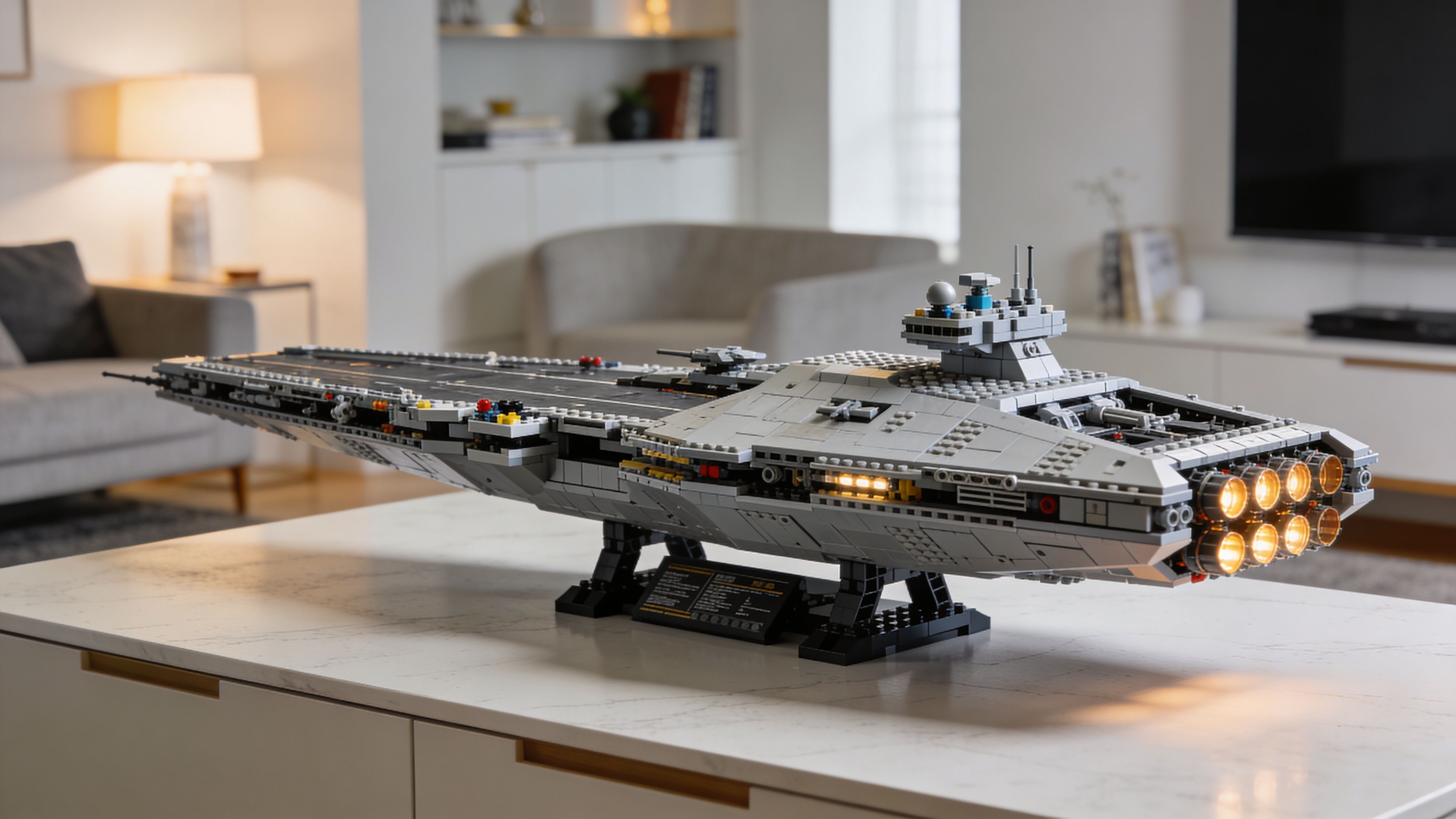
This model is long, low, and visually dense. Those qualities make it impressive, but they also make it easy to mute if the setting is crowded. A dark shelf, nearby clutter, or decorative objects with competing shapes can break up the hull line and reduce the ship’s authority.
Display works best when the eye can read the whole wedge in one sweep.
A credenza, console, or broad shelf usually suits the set better than a packed bookcase. The Star Destroyer needs lateral space for the silhouette to register properly, much as a long abstract sculpture needs wall clearance before its proportions make sense. If the bow nearly touches one side and the engines crowd the other, the model looks compressed instead of deliberate.
Three choices matter most:
Grey LEGO can look flat under general room lighting. Directed light changes that completely. A lamp placed low to one side catches the stepped plating, trench details, and clustered greebling, so the surface reads less like a single colour field and more like layered industrial design.
Under-lighting can work too, especially if it is subtle. Many collectors add soft LED illumination beneath or around the stand to outline the ship’s mass without turning the display into a stage set. The goal is not spectacle. The goal is legibility.
Protection deserves the same level of thought. An acrylic case is not mandatory, but it solves two persistent problems with one decision: dust settling into hundreds of recesses, and accidental brushes against fragile surface sections. For a display piece of this scale, prevention often preserves the model more gracefully than frequent cleaning.
Display insight: The strongest setups give the ship one clear visual field to command.
A minimalist interior suits the Star Destroyer well. Place it on a simple cabinet, keep nearby objects sparse, and let the ship’s own lines carry the drama. The wedge, tower structure, and engine bank already provide enough visual rhythm.
A collector’s study allows a denser composition, though it still benefits from restraint. A few related books, framed production art, or carefully chosen sci-fi objects can create context without stealing attention. Collectors who enjoy building a broader display environment sometimes add small scene elements or companion pieces, much as model makers use 3D printable miniatures for display scenes and diorama accents.
An eclectic room asks for confidence. Here the Star Destroyer works best as a contrast object, set among wood, stone, ceramics, or heritage materials that give the plastic hull a sharper identity. The conversation becomes interesting because the materials differ, while the craftsmanship holds them together.
Placement decides whether this set feels stored or exhibited. Treated with care, it stops being something you happened to build and becomes the piece visitors cross the room to study.
Owning a Star Destroyer doesn’t end with the final page of the instructions. For many collectors, that’s where the more personal relationship begins. They start noticing what they’d like to strengthen, refine, preserve, or reinterpret.
Customisation doesn’t have to mean radical alteration. Often the best modifications are the ones that respect the original design while making the model more secure or more suited to your space.
The safest changes are non-destructive. They don’t ask you to reinvent the set. They ask you to tune it.
A common approach is to improve handling confidence. If a panel connection feels less secure than you’d like during dusting or moving, collectors often look for reinforcement methods that can be reversed later. Others focus on presentation, adding subtle lighting or refining the way the model sits in a cabinet.
Some enthusiasts go further and imagine the set as a base for a more expansive build. They may experiment with interior suggestions, docking-bay emphasis, or display companions that deepen the story. The same makerly instinct that draws people to crafted décor can lead them from one iconic object to another, whether that’s a capital ship or a more meditative project such as a LEGO bonsai tree build with decorative appeal.
The Imperial Star Destroyer’s surface rewards close detail, but that same detail traps dust. Cleaning it carelessly can loosen small assemblies or grind dirt into crevices.
A sensible care routine usually includes:
If you display the model openly, brief and frequent dusting is better than infrequent heavy cleaning. Dust is easier to remove when it hasn’t settled thoroughly into corners.
Care is part of collecting. A model this intricate asks for stewardship, not just admiration.
People often realise too late that a very large LEGO model shouldn’t be moved like a boxed appliance. If a house move or room redesign is coming, plan the process before you touch the ship.
The least stressful approach is usually partial disassembly into logical sections, with careful bagging and notes. Randomly separating pieces to “sort it out later” turns a dignified model into an avoidable puzzle. If you have the original instructions, keep them close during the process.
Storage asks for the same calm logic. Choose a clean, dry environment and avoid crushing pressure from stacked items. If the model will remain disassembled for a while, preserve order. Future-you will be grateful.
Customising a famous set can tempt collectors into endless revision. There’s always another idea, another reinforcement, another lighting tweak. That energy can be productive, but it can also obscure what made the set worth owning in the first place.
The best personalised Star Destroyers still feel like Star Destroyers. They carry the original discipline of the design, with the owner’s judgement layered on top.
The Imperial Star Destroyer has endured because it satisfies more than one kind of admiration. It reaches the film lover through memory, the builder through engineering, and the collector through permanence. Few LEGO subjects carry that many forms of appeal at once.
Seen from afar, it’s an icon. Seen up close, it’s a negotiation between structure and illusion. Bricks must become armour. Supports must disappear into form. Weight must feel effortless. That transformation is where much of the set’s dignity lies.
For collectors, the journey matters almost as much as the object. You learn the lineage of the model. You decide which version aligns with your taste. You evaluate the market with care. You prepare a place for it at home. Then, once it’s built, you become its curator.
That may sound lofty for a LEGO set. Yet the best collecting often involves exactly this kind of shift in perception. A thing once known through play becomes newly legible through design, craftsmanship, and stewardship.
If the lego star wars imperial star destroyer earns a place in your home, it won’t only enlarge your shelf. It will sharpen your eye. It will ask you to notice structure, proportion, finish, and presence in a way that lesser objects never do. That’s why it so often becomes the admiral of a collection rather than one ship among many.
For collectors who appreciate objects with provenance, handcraft, and strong visual identity, related display worlds can be just as rewarding. If you enjoy iconic forms rendered as collectible art, you may also appreciate LEGO Star Wars helmet designs and their sculptural display appeal.
If your taste runs toward collectible objects that balance craftsmanship, heritage, and display presence, explore Dalaart. Its curated collection of authentic Swedish Dala horses and companion animals offers another way to live with artful, hand-finished pieces that reward close looking and thoughtful collecting.


.svg)


.png)


